

Zhenzhi Medicine Files for IPO: Pioneering Solid Tumor-Specific T Cell Therapies and Building China's Universal Neoantigen Database
With the continuous advancement of technology, humanity has gained control over many diseases that once caused immense suffering. Nevertheless, cancer remains a source of profound fear. Although the emergence of novel therapies and technologies has extended survival for some patients, certain “high-difficulty” cancer types still leave medicine with limited options.
Liver cancer and pancreatic cancer rank as the fourth and tenth most common cancers, respectively, in China by incidence rate, while their mortality rates rank second and sixth among all cancer types. With very limited existing clinical therapies, there remains a substantial unmet medical need for these two malignancies. Pancreatic cancer, often referred to as the "king of cancers," accounts for approximately 100,000 new cases annually in China. The majority of patients experience rapid recurrence and short survival times, with a five-year survival rate of only about 5%. Currently, research into new drugs for this disease has yet to achieve any breakthroughs.
"Knowing there are tigers in the mountains, yet heading toward the tiger-infested peaks." Beijing Zhenzhi Medical Technology Co., Ltd. (hereinafter referred to as "Zhenzhi Medical") has made cellular immunotherapy for various solid tumors, including liver cancer and pancreatic cancer, its primary focus. Zhang Henghui, co-founder of the company, stated, "Liver cancer and pancreatic cancer share certain commonalities in their immunological mechanisms, which makes it highly likely that breakthroughs can be achieved in cellular immunotherapy for these two types of tumors."

Zhang Henghui, Co-founder of Zhenzhi Medical
Zhang Henghui began his exploration in the field of therapeutic cancer vaccines as early as 2005, accumulating 15 years of experience in the development of therapeutic cancer vaccines and cellular immunotherapy drugs. He has led the development of multiple cancer immunodiagnostic products, spanning from the early discovery and validation of cellular immunotherapy targets to the development and commercialization of adoptive cell therapy drugs. Currently, he has advanced multiple candidate drug and immunodiagnostic R&D pipelines into preclinical or clinical registration stages.
The cell therapy targeting the commonalities of liver cancer and pancreatic cancer, as mentioned by Zhang Henghui, is a specific antigen-sensitized immune cell therapy developed by the company. Leveraging immune multi-omics technology, the company has established three core business segments: development of cellular immunotherapy drugs, monitoring of immunotherapy efficacy, and development of companion diagnostics, thereby building an integrated platform for tumor treatment.
Tumorigenesis is driven by two key factors: immune evasion by tumor cells and insufficient positive cytotoxic activity of the immune system. “Anti-cancer therapies represented by PD-1 inhibitors work by relieving negative immune suppression exerted by tumor cells. However, merely alleviating negative immune suppression is inadequate; a robust immune system with strong positive cytotoxic capability is also required. Therefore, it is necessary to deploy an ‘elite force’ into the tumor microenvironment to achieve specific tumor cell killing,” explained Zhang Henghui.
This cytotoxic effect is based on the specific recognition of tumor neoantigens. By conducting multi-omics research on all biological processes involved in the generation of tumor neoantigens (NeoAg) and abnormally expressed tumor-specific antigens (aeTSA), Beijing Zhenzhi Medical Technology Co., Ltd. has constructed a comprehensive bioinformatics analysis matrix. Furthermore, by analyzing the NeoAg/aeTSA data characteristics from over 1,000 Chinese patients with liver cancer and pancreatic cancer, the company has established a universal database of tumor neoantigens and related antigens for solid tumors in the Chinese population, aiming to identify high-quality NeoAg/aeTSA candidates.
Currently, Zhenzhi Medical has established a proprietary platform for the discovery of tumor neoantigen and tumor-associated antigen targets. This platform covers neoantigens associated with hepatitis B virus-related hepatocellular carcinoma in China, including mutation-derived neoantigens and tumor-associated antigens with strong immunogenicity. From these, the company has screened and identified a universal core peptide library comprising dozens of tumor-specific antigens with high prevalence in the Chinese population. This library serves as the foundation for the development of multi-target specific T-cell therapies and is expected to cover over 25% of newly diagnosed liver cancer patients and more than 50% of newly diagnosed pancreatic cancer patients.
During treatment, Zhenzhi Medical first conducts immune multi-omics data assessment and validation on the patient’s own tumor tissue. Subsequently, multiple antigenic peptides from a core peptide library are selected to sensitize the patient’s autologous dendritic cells (DCs), which are then co-cultured with T cells to expand cytotoxic T lymphocytes (CTLs) targeting multiple antigenic peptides, thereby producing NeoAg/TSA CTL therapeutics. Compared with cell therapy products targeting a single antigen, this therapeutic approach can more effectively address tumor escape mechanisms and maintain prolonged persistence in the patient’s bloodstream.
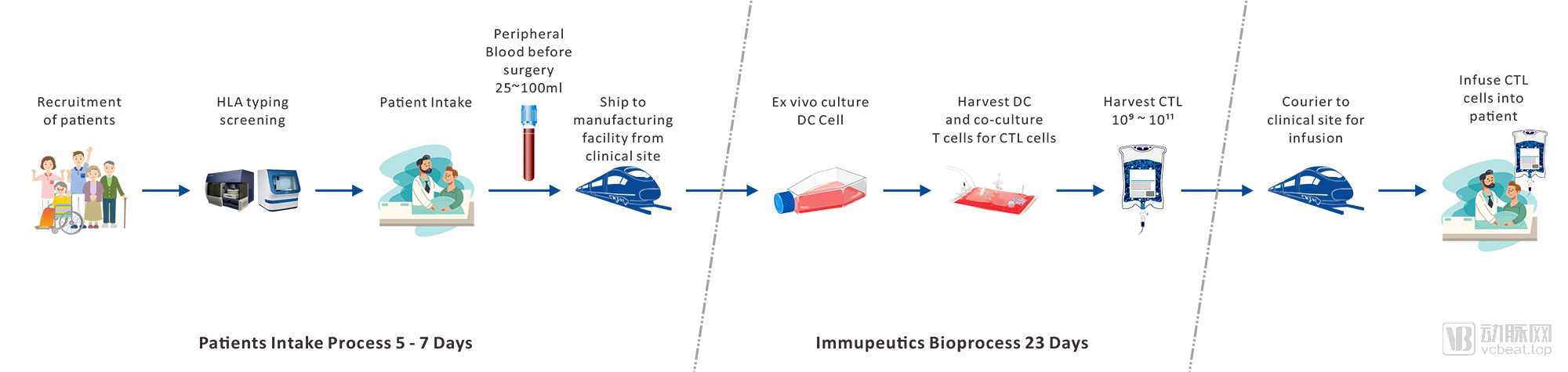
IPM001 Treatment Flowchart
Currently, Zhenzhi Medical has partnered with Huashan Hospital of Fudan University in Shanghai to conduct a study on the efficacy and safety of IPM001, an autologous immune cell therapy sensitized with neoantigens for hepatocellular carcinoma. To date, enrollment of five patients has been completed. Existing data demonstrate favorable safety profiles and definitive therapeutic efficacy. Zhenzhi Medical will continue its collaboration with the research team at Huashan Hospital, aiming to complete the enrollment and treatment follow-up of 20 patients within this year. This effort seeks to further validate the efficacy of IPM001 and prepare for formal Investigational New Drug (IND) application.
Pancreatic tumors consist of multiple coordinated cellular and non-cellular components, forming a tumor microenvironment that is highly drug-resistant and immunosuppressive. Conventional drugs targeting a single known cancer target often struggle to combat such synergistically acting adversaries. Zhang Henghui explained, “Over 80% of pancreatic cancer cases in China harbor oncogenic KRAS mutations. Zhenzhi Medical’s core strategy for addressing pancreatic cancer involves molecular drug design combined with drug delivery strategies, simultaneously targeting multiple distinct biological pathways in pancreatic cancer, with the aim of significantly enhancing therapeutic efficacy.”
The drug delivery strategy, proposed by Dr. Zhang Jundong, Chief Scientist at Zhenzhi Medical, leverages a unique KRAS-targeted drug delivery technology to transport active molecules that are inherently undruggable to pancreatic tumors, thereby enhancing antigen presentation while significantly reducing systemic toxicity.
Currently, the company’s pancreatic cancer project, IPM002, is still in the early preclinical research stage, with plans to advance it into clinical trials in 2021. In the immediate term, the focus will be on advancing IPM001 for Investigational New Drug (IND) application. It is reported that Zhenzhi Medical has established collaborations for clinical trials with leading hospitals such as Peking University People’s Hospital and Shanghai Huashan Hospital.
In addition to its robust data and accelerated progress in anti-cancer drug development, Zhenzhi Medical has also made strategic moves in the field of diagnostic reagents. The company’s products, including a monitoring kit for cytokine release syndrome and an MPML immune scoring system for assessing the risk of hepatocellular carcinoma recurrence, have all entered the clinical validation phase. Zhang Henghui candidly attributes these rapid achievements to the strong support from its strategic shareholders.
Zhenzhi Medical is strategically backed by Zhenhe Technology, Junshi Biosciences, and Loyal Valley Capital. These three strategic shareholders have made significant achievements in the fields of precision oncology diagnostics and immunotherapy, playing a crucial role in driving the development of Zhenzhi Medical.
It is reported that Beijing Zhenzhi Medical Technology Co., Ltd. has launched its pre-A round of financing, aiming to raise tens of millions of RMB. The funds will be primarily used to advance IPM001 into registrational clinical trials and to construct the company’s pilot-scale production facility.