

Xiang'an District in Xiamen Explores New Models for Health Digital Applications as Medical Big Data Enters Its 'Second Half'

LinkDoc
Provider of Artificial Intelligence and Medical Big Data Solutions
Xiamen, known as Egret Island, is located in the core area of China’s open southeastern coast and hosts numerous major industry conferences in the life sciences each year. At the Xiamen Biopharmaceutical Innovation and Development Conference held on June 7, 2020, Xiamen City for the first time proposed to “go all out to build a world-class Chinese city of life science and technology,” expressing its hope that more enterprises and investment institutions would join in the innovative exploration to achieve this goal.
During the Biopharmaceutical Innovation and Development Conference, the People's Government of Xiang'an District, Xiamen City, signed a strategic cooperation agreement with LinkDoc. Leveraging the government's open data ecosystem and the company's big data technological advantages, both parties will jointly create the "Xiang'an-LinkDoc" 3.0 model for the development of the medical big data industry. Additionally, LinkDoc's South China headquarters will be established in Xiang'an District.
In the post-pandemic era, China has launched “new infrastructure” initiatives represented by big data and artificial intelligence. In early April, the State Council issued the *Opinions on Building a More Complete System and Mechanism for Market-Based Allocation of Production Factors*, explicitly recognizing data as a new type of production factor. Consequently, the development of health and medical data has officially entered its “second half,” with the urgent challenge being how to integrate widely distributed data resources to achieve full value realization.
Cheng Ming, Deputy District Mayor of Xiang’an District, stated in an interview with VCBeat that Xiang’an District had actually begun exploring the construction of a medical and health big data platform as early as around 2006, accumulating nearly 15 years of continuous, standardized population-level medical data. “The next step will focus on data governance, collaborating with high-quality enterprises and institutions within the industry to jointly develop applications tailored to real-world clinical scenarios.”
As the first step in implementing their partnership, LinkDoc, under the guidance of the Xiang’an District Government, is facilitating the deployment of projects such as an AI-integrated platform for lung cancer diagnosis and treatment and a clinical research database for specific diseases at local hospitals in Xiang’an District. Additionally, in collaboration with Quantum Insurance, an internet insurance technology company, they are piloting inclusive commercial supplemental insurance in Xiang’an District.
Since its establishment in 2014, LinkDoc has been exploring the development of a more efficient pre-processing model for medical big data. Ms. Yang Wenlin, Partner and Chief Government Affairs Officer at LinkDoc, told VCBeat that the company’s development of commercial application scenarios for medical big data began in 2018. Since then, it has continuously fostered integration and transformative change within the industry through medical big data, serving diverse healthcare needs centered on “accurate diagnosis, appropriate medication, and affordable care.”
It is understood that the newly implemented “Integrated AI-Assisted Diagnosis and Treatment Platform for Lung Cancer” will cover the entire patient journey, including diagnosis, treatment, and research management. Independently developed by LinkDoc, the platform has been successfully deployed in medical institutions across multiple regions. By leveraging advanced technologies such as AI algorithms, deep learning, data processing, and disease-specific knowledge bases, this assisted diagnosis and treatment platform truly achieves integration of diagnostic and therapeutic services. Ms. Yang Wenlin stated that LinkDoc’s decision to introduce the platform to hospitals in Xiang’an District will help channel high-quality medical resources to the grassroots level, enhance the quality and efficiency of diagnostic and treatment services, and realize the public benefits of AI technology.
Meanwhile, leveraging its years of accumulated expertise, LinkDoc has built a specialized clinical research database for specific diseases in Xiang’an District. Relying on the nephrology department of local hospitals in Xiang’an, the company has established a data processing center, a data management center, a research data application center, a research project management center, a patient management center, and a data security system. This infrastructure provides support for hospitals to conduct high-quality and efficient clinical research, patient management, and operational decision-making.
Furthermore, as a major highlight of this collaboration, LinkDoc, under the guidance of the Xiang’an District Government and in partnership with institutions such as the internet insurance technology company Quantum Bao, is leveraging its medical big data platform as a driving engine to facilitate the implementation of inclusive commercial supplemental insurance in Xiang’an District. This inclusive commercial supplemental insurance will rely on an online platform to provide target populations with end-to-end personal management services, including online consultation, early screening, specialty drug delivery, and follow-up management, thereby delivering “one-stop insurance coverage + healthcare services” to the public.
Inclusive Commercial Supplementary Insurance is an innovative insurance product that has gradually gained popularity against the backdrop of domestic consumption upgrades. According to Mr. Tang Peng, Founder and CEO of Quantum Insurance, Inclusive Commercial Supplementary Insurance adopts a commercial insurance model while featuring the low-cost and broad-coverage characteristics of basic medical insurance. It incorporates new and specialized drugs, represented by targeted cancer therapies and cancer immunotherapies, into its coverage scope. As an effective supplement to basic medical insurance, it brings new hope for addressing the issue of some families falling back into poverty due to illness.
It is worth noting that the coverage of such innovative insurance products encompasses nearly the entire population, with a particular focus on previously “non-standard” groups—such as the elderly and individuals with pre-existing conditions—who were traditionally excluded due to uncontrollable claims risks. This places exceptionally high demands on insurers’ data governance and actuarial capabilities. “Product refinement driven by user needs is crucial,” pointed out Mr. Tang Peng. “This pilot project represents an integration of Xiang’an District’s open access to its comprehensive medical big data, LinkDoc’s medical big data platform, and Quantum Insure’s big data actuarial modeling technologies. We aim to gradually establish a closed-loop ecosystem linking healthcare, pharmaceuticals, and insurance.”
Over the past few years, medical institutions at all levels have implemented highly effective information technology initiatives driven by policy mandates. These IT systems span multiple aspects of hospital diagnosis, treatment, and management, generating vast amounts of healthcare data.
In June 2016, the General Office of the State Council issued the Guiding Opinions on Promoting and Standardizing the Application and Development of Medical Big Data, requiring that by the end of 2017, cloud interconnectivity be achieved among national and provincial population health information platforms and the national drug centralized procurement and bidding application platform, basically forming a pattern of cross-departmental sharing and utilization of health and medical data resources; and that by 2020, a national hierarchical open-application platform for healthcare information be established, basically ensuring that urban and rural residents have standardized electronic health records and fully functional health cards. Consequently, China’s health and medical data industry has emerged.
In October of the same year, the former National Health and Family Planning Commission designated five provinces and municipalities, including Xiamen City, as the first batch of national pilot regions to centrally launch the construction of health and medical big data centers and industrial parks. As one of its six administrative districts, Xiang’an District actively seized the opportunities presented by the pilot program for health and medical big data, optimizing the business environment to facilitate the establishment of relevant enterprises. Currently, Xiang’an District has preliminarily integrated healthcare information resources across the district and established regional health and medical big data platforms, including the “Medical Service Cloud,” “Government Supervision Cloud,” and “Scientific Research and Industry Cloud.”
In the report “Entering the Era of Value Output: 2018 Medical Big Data Industry Report,” VCBeat Eggshell Research Institute developed a medical big data hourglass model. This model describes the developmental flow of medical big data from three perspectives—data collection, data governance, and data application—reflecting the process by which data is transformed into knowledge and knowledge guides action. Based on this, the institute delineated three stages in the development of the medical big data industry: the Data Aggregation Era, the Information Mining Era, and the Value Output Era.
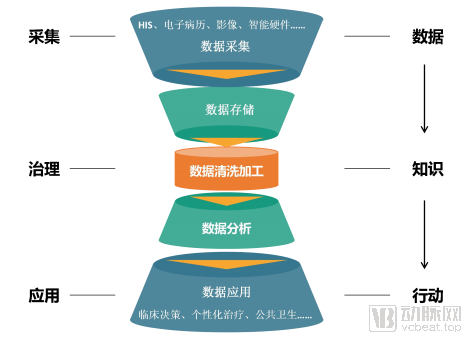
Hourglass Model of the Medical Big Data Industry
Ms. Yang Wenlin’s views align closely with those of VCBeat. Ms. Yang believes that the development of China’s medical big data industry has undergone three phases of model iteration: the Data Infrastructure 1.0 model, the Data Aggregation 2.0 model, and the currently emerging Data Application 3.0 model.
With the advancement of technologies such as informatization, the Internet of Things (IoT), cloud computing, and artificial intelligence, the utilization value of big data is increasing. The medical big data industry is gradually transitioning from the era of data acquisition to the eras of information mining and value output. Meanwhile, the value of data is evolving from summarizing medical practices to supporting medical decision-making and providing comprehensive clinical decision support, with value output becoming a key characteristic of the “second half” of the medical big data landscape.
Ms. Yang Wenlin explained that the primary participants in the Data Infrastructure 1.0 model were well-resourced “national teams,” which focused on providing data storage services by building large-capacity, secure, and reliable regional data center facilities. At that time, due to the lack of effective planning for the data industry, accumulated data was aggregated but not utilized, leading to the transition into the Data Aggregation 2.0 model. During this period, policy support for the data industry began to take effect. Industrial groups such as Huawei and China Electronics Corporation (CEC) built data infrastructure service platforms with preliminary capabilities for data exchange and utilization, based on government-authorized data resources.
“In the Data Application 3.0 phase, LinkDoc has sought to build a comprehensive industry ecosystem centered on structured healthcare big data, enabling integrated applications of medical big data across various domains,” pointed out Ms. Yang Wenlin. The primary participants in this phase were healthcare big-data startups founded around 2014, which, leveraging their team DNA and understanding of data value, have explored diverse models for integrating healthcare big data with the medical industry.
Taking LinkDoc as an example, the company fully launched its commercial application development in 2018. On one hand, it has developed AI products based on its accumulation of medical big data, providing an integrated solution to meet physicians’ needs for patient screening, clinical diagnosis, and follow-up consultations. These solutions have already been deployed in clinical settings at healthcare institutions in Shanghai, Tianjin, and other regions.
On the other hand, capabilities in real-world data collection and governance support pharmaceutical companies in conducting drug consistency evaluations. Over the past two years, real-world data has garnered increasing attention in pharmaceutical regulation both domestically and internationally, leading to significant changes in the review processes for post-marketing drug consistency evaluations and applications for new indications. In January 2020, the National Medical Products Administration issued the "Guiding Principles for Real-World Evidence Supporting Drug Development and Review (Trial)," which stipulates requirements for the sources and applicability of real-world data, the use of real-world evidence to support regulatory decision-making, and the basic design of real-world studies. LinkDoc participated in the discussion and design regarding the use of real-world data for approval purposes.
Furthermore, as China’s per capita income continues to rise and government governance capabilities are steadily optimized, the need for financial products to play a significant leveraging role in covering medical expenses has become evident. Since 2019, LinkDoc has been exploring and establishing inclusive health insurance initiatives. By integrating commercial insurance, LinkDoc has further enhanced its comprehensive out-of-hospital diagnosis and treatment service system.
Under the Data Application 3.0 model, LinkDoc seeks to integrate the healthcare ecosystem—including genetic testing companies, pharmaceutical manufacturers, medical institutions, health management firms, and pharmacies—through a comprehensive diagnosis and treatment service system, thereby optimizing the healthcare experience with big data empowerment. Ms. Yang Wenlin stated that LinkDoc aims to rapidly implement the Data Application 3.0 model in Xiang’an District and replicate it across China, striving to make precise medical services accessible to all.