

Thinking Big, Acting Small: Ping An HealthKonnect Drives Precision in Poverty Alleviation Through Health Tech

PINGAN GOOD DOCTOR
Internet Medical Health Platform
Chang’an Township, Weixin County, Zhaotong City, Yunnan Province, is commonly known as “Little Kunming.” However, compared with Kunming, which boasts abundant resources and extensive connectivity, this remote village lags significantly behind in both economic development and health management.
Pan Xiancui is a representative of the village’s “impoverished and ill” households. She suffers from hypertension and rheumatoid arthritis, her eldest son has a disability, her younger son is still in school, and her father-in-law has long been plagued by chronic conditions such as gastric ulcers and arthritis. The family’s financial situation can well be imagined. Fortunately, harmony prevails in the community; whenever any household faces difficulties, neighbors pitch in together to help tide them over. When good news arises, it spreads quickly by word of mouth, allowing everyone to share in the joy: “In a couple of days, free medical check-ups will be available in the village, with doctors and nurses coming from major cities!” “It’s not just blood pressure measurements; I heard they’ve brought large-scale medical equipment. Tests that previously required a trip to the county hospital can now be done right here!”
These “doctors and nurses from major cities,” part of Ping An Group’s “Ping An Health Guardian Initiative,” will bring comprehensive medical checkups and various health management services to rural residents like Pan Xiancui who are eager for better health. As one of the “key participants” in this initiative, Ping An Medical Insurance Technology has previously collaborated with its subsidiary, Ping An Health (Testing) Center, to carry out nearly 600 public welfare campaigns under the “Medical Care Across Thousands of Miles” program, demonstrating profound expertise in precisely supporting poverty alleviation efforts.
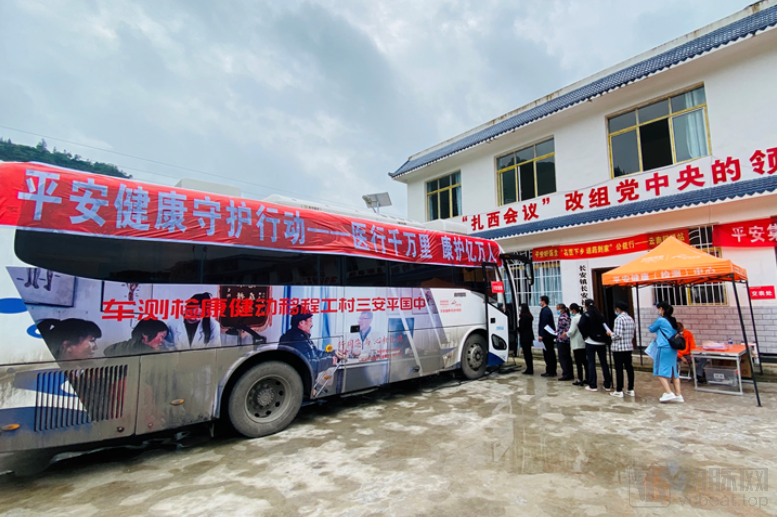
Figure: Ping An Mobile Health Screening Vehicle Enters Chang’an Township, Weixin County, Yunnan Province
On June 10, a Ping An Mobile Health Screening Vehicle, carrying the “Medical Care Across Thousands of Miles” volunteer medical team, entered Chang’an Township. The team is committed to actively engaging in the decisive battle against poverty through health initiatives in the post-pandemic era, precisely advancing healthcare security system reforms and enhancing primary healthcare services, thereby fully improving the sense of gain, happiness, and security among impoverished villagers across various regions.
2020 was a year of challenges in safeguarding the health of the entire population, as well as the decisive final year for achieving comprehensive poverty alleviation. At the opening ceremony of the Third Session of the 13th National People's Congress, Premier Li Keqiang delivered the "Government Work Report," solemnly listing the improvement of basic medical service levels as one of the eight major tasks in the health sector for the year.
To strengthen the foundation of health and well-being for all, it is essential not only for governments at all levels and administrative departments to work together, but also to recognize the significant role played by “third-party forces.” Helping lift people out of poverty through better health and safeguarding the nation’s health is precisely the goal that Ping An Health Insurance Technology, as a core member of Ping An Group’s “Big Healthcare” sector, has been continuously exploring and striving to achieve since launching its “Medical Care Across Thousands of Miles” public welfare initiative.
Poverty Alleviation through Healthcare: Starting with Details and Persisting in PracticeThe "Medical Services Across Thousands of Miles" special initiative, responding to Ping An Group’s "Three Villages Project," has penetrated deep into the grassroots of impoverished rural areas. By adopting a dual approach of "prioritizing diagnosis and screening while emphasizing health awareness," the initiative helps shift disease prevention upstream, safeguarding health hopes in remote mountainous regions. At the individual health level, Ping An’s mobile health screening vehicles, integrated with digital tools such as the AI-powered imaging cloud platform, provide villagers in impoverished areas with comprehensive "one-stop" health check-ups. These include routine tests like fully digital DR (Digital Radiography), color Doppler ultrasound, electrocardiograms (ECG), and urinalysis, as well as advanced examinations typically available only at secondary hospitals, such as tumor marker testing (AFP, CEA), gynecological ultrasounds (uterus and adnexa), and posteroanterior chest X-rays. This enables villagers to monitor their health status right at their doorstep. In terms of health awareness, compassionate medical staff and Ping An volunteers conduct systematic education on daily healthcare practices tailored to local prevalent diseases. This approach integrates health deeply into villagers’ daily lives, preventing poverty caused or exacerbated by illness before diseases occur, thereby achieving an effective closed-loop system for poverty alleviation through healthcare.
Hebei, Shanxi, Shaanxi, Shandong, Henan, Anhui, Sichuan, Hubei, Chongqing, Jiangxi, Guizhou, Yunnan, Guangxi, Guangdong... Upholding the pragmatic spirit of “leaving a mark every kilometer and bringing benefits wherever we go,” by the end of 2019, the public welfare initiative “Medical Care Across Thousands of Miles” had covered more than 600,000 kilometers, reached 558 mountain villages, conducted 573 health check-ups and free clinic campaigns, and served nearly 100,000 people. A total of 1,114 visits by renowned medical experts, 4,585 visits by medical staff, and 10,555 visits by municipal- and county-level hospitals and volunteers participated in the initiative, making unremitting efforts to safeguard rural health.
In 2020, “Medical Care Across Thousands of Miles” took Libei Village in Bixi Town, Jinggangshan as its new starting point for the year, and took a steady second step in Chang’an Township, Weixin County, Yunnan Province, continuing to pave a broad path to health for impoverished mountain villages and bringing hope for better health to more villagers in poverty.
Safeguarding the health of all citizens and ensuring peace for every family is a beneficial initiative that brings well-being to the entire nation. On a micro level, through loving free clinics and health education delivered by the “Medical Care Across Thousands of Miles” program, it nurtures villagers’ health in a subtle and silent way; on a macro level, it helps advance the national process of health-focused poverty alleviation. Ping An Medical Insurance Technology has fully leveraged its technological advantages, courageously shouldering its responsibilities and mission. By focusing on the fundamental roles of medical insurance—providing a safety net and ensuring basic coverage—it has facilitated the implementation of national policies and delivered its own satisfactory answer.
Poverty alleviation through healthcare also requires a broad perspective and robust top-level design. In October 2018, the National Healthcare Security Administration, the Ministry of Finance, and the State Council Leading Group Office of Poverty Alleviation and Development jointly issued the Three-Year Action Plan for Healthcare Security in Poverty Alleviation (2018–2020). The plan explicitly incorporated “adhering to targeted poverty alleviation and ensuring tangible results” as a fundamental principle of healthcare security initiatives for poverty alleviation. It mandated the precise identification of beneficiaries, the accurate use of poverty alleviation funds, and the targeted implementation of poverty alleviation policies. Furthermore, it called for refined management of impoverished populations, a clear understanding of the baseline poverty data, detailed poverty alleviation measures, well-defined objectives, the fulfillment of responsibilities at all levels, and the consolidation of poverty alleviation outcomes.
In line with these work requirements, Ping An Medical Insurance Technology has actively supported the National Healthcare Security Administration in implementing the State Council Leading Group Office of Poverty Alleviation and Development’s “Guiding Opinions on Addressing Prominent Issues Related to ‘Two Assurances and Three Guarantees’,” fully completing the tasks outlined in the “2020 Key Work Points of the State Council Leading Group Office of Poverty Alleviation and Development,” and establishing the “Medical Insurance Poverty Alleviation Management Platform” to ensure the orderly advancement of poverty alleviation efforts through medical security and the comprehensive implementation of relevant policies.
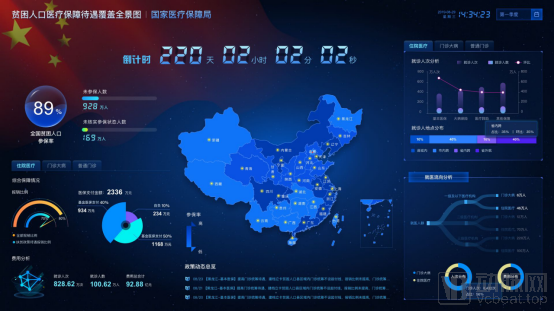
Figure: Medical Insurance Poverty Alleviation Management Platform
It is reported that the “Medical Insurance Poverty Alleviation Management Platform” has officially launched its “Poverty Alleviation Supervision Module,” which was made available to provincial medical insurance bureaus across China in 2020. Based on scheduling data for medical insurance-driven poverty alleviation, the module provides county-level precision and comprehensively displays 108 data indicators across 12 categories, including insurance coverage among the impoverished population, level of coverage, consumption of medical resources, and patient referral patterns. The module focuses primarily on the 52 poverty-stricken counties that had not yet been removed from the poverty list by the end of 2019, as well as the counties containing 88 villages with more than 1,000 impoverished residents and 1,025 villages with a poverty incidence rate exceeding 10%. By leveraging information technology, it enables decision-makers in medical insurance poverty alleviation to monitor the overall status of such efforts nationwide.
Through the poverty alleviation supervision and command module, the National Healthcare Security Administration can monitor in real time the progress of healthcare security-based poverty alleviation efforts, strengthen assessment and analysis, and promptly adjust and refine policies to ensure the safe and stable operation of the healthcare security fund and the long-term sustainability of poverty alleviation policies under the healthcare security framework. After local healthcare security departments are integrated into the system, they can also deeply mine big data on healthcare security-based poverty alleviation, comprehensively monitor policy implementation, conduct in-depth analyses of medical service utilization among the impoverished population, and accurately track the operational status of healthcare security funds.
Meanwhile, the reporter learned that to address the issues of asymmetric and opaque policy information, the platform has added a “Policy Coordination and Monitoring Module” this year. To date, more than 1,000 pooling areas have used this module to submit data on poverty alleviation policies, providing strong support for the National Healthcare Security Administration in understanding the details of local poverty alleviation policies, gaining a comprehensive overview of healthcare security-related poverty alleviation efforts, and establishing a long-term mechanism for healthcare security-based poverty alleviation.
Recently, the General Office of the National Healthcare Security Administration, the General Office of the Ministry of Finance, the General Office of the National Health Commission, the General Office of the State Taxation Administration, and the Comprehensive Department of the State Council Leading Group Office of Poverty Alleviation and Development jointly issued the "Notice on Winning the Battle Against Poverty in Medical Security with High Quality." The notice explicitly requires that provincial-level medical security departments, leveraging functional modules for supervision, scheduling, and policy monitoring in poverty alleviation through medical security, dynamically monitor the progress of key cities and counties. This aims to promptly identify, verify, and rectify shortcomings in areas such as insurance enrollment for the impoverished population, implementation of various benefits, and "one-stop" settlement services.
Powered by technological innovation, the “Medical Insurance Poverty Alleviation Management Platform” has become an effective tool for medical insurance departments at all levels to accurately monitor the progress of poverty alleviation through medical insurance, and has emerged as a major highlight in the health poverty alleviation sector at the State Council Leading Group Office of Poverty Alleviation and Development’s online exhibition on poverty eradication.
Public data shows that in 2019, China achieved a decisive victory in its poverty alleviation campaign. More than 10 million people were lifted out of poverty, approximately 340 impoverished counties were removed from the poverty list, and the poverty incidence rate in the deeply impoverished “Three Regions and Three Prefectures” dropped to 2%, laying a solid foundation for comprehensively winning the battle against poverty in 2020. As a “third-party force” supporting this decisive battle, Ping An Healthcare Technology will continue to adhere to Ping An’s strategic plans of “Finance + Technology” and “Finance + Ecosystem.” By taking a broad view while attending to details, it will consistently contribute to targeted poverty alleviation through its steadfast implementation of health-focused poverty relief initiatives.
It is understood that in the future, the “Ping An Health Guardian Initiative” will actively leverage the unique advantages of Ping An’s grand medical and health ecosystem strategy to continue its in-depth efforts in remote and impoverished areas across multiple provinces, including Tibet, Yunnan, Hainan, Guangxi, and Xinjiang, carrying out comprehensive, multi-level health poverty alleviation work.
Ping An Health Insurance Technology also stated that it would continue to advance its “digitalization + precision + one-stop” tripartite health poverty alleviation model in 2020. At the micro level, guided by compassion and a commitment to social responsibility, the company will steadily carry out the public welfare initiative “Ping An Health Guardian Action: Medical Services Across Thousands of Miles,” strengthen the digital infrastructure for mobile testing, and provide comprehensive one-stop poverty alleviation services spanning disease prevention, screening, diagnosis, and treatment, thereby precisely benefiting tens of thousands of impoverished villagers. At the macro level, Ping An Health Insurance Technology will continue to leverage its technological capabilities to deepen the development of the “Health Insurance Poverty Alleviation Management Platform,” assist provinces and regions across China in addressing gaps in health-related poverty alleviation efforts, and work firmly in concert with all sectors of society to illuminate every corner of the nation with the light of health, ensuring peace and well-being for every household.