

Northern Light Venture Capital's Pioneering Investment Logic in Gene Sequencing: Early Bets, Strategic Patience, and Clinical Application Focus
On the evening of June 12, 2020, after six months of preparation, Burning Rock Biotech listed on the NASDAQ stock exchange in the United States under the ticker symbol “BNR.” The company issued American Depositary Shares (ADS) equivalent to 13.5 million ordinary shares, raising over USD 250 million. Following its receipt of the first approval for a tumor genetic testing product in China, Burning Rock Biotech became the first domestic cancer gene sequencing service provider to go public on the capital market.
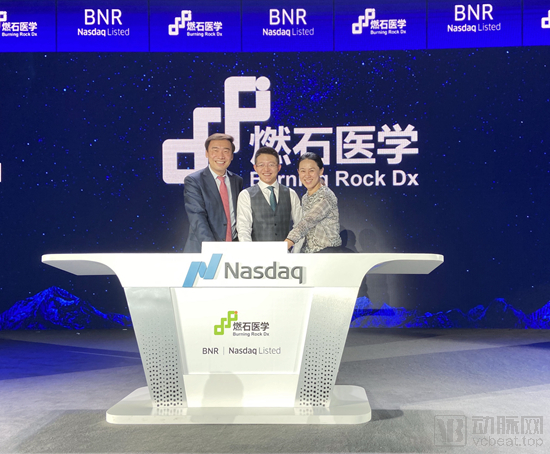
Burning Rock Biotech IPO Bell-Ringing Ceremony. From left to right: Deng Feng, Han Yusheng, Yu Fang
Burning Rock Biotech was founded in 2014 by Han Yusheng, a former investment manager at Northern Light Venture Capital. Prior to its initial public offering, Burning Rock had already emerged as a investor favorite in the highly competitive (“red ocean”) market for oncology gene sequencing services. During the three-day share subscription period, cornerstone investors comprising top-tier global healthcare investment institutions—including OrbiMed and Lilly Asia Ventures—subscribed for 50% of the shares issued in the offering. Previously, leading firms such as Northern Light Venture Capital, Legend Star, Sequoia Capital China, Jefferies Financial Group (JF Capital), GIC, and Lilly Asia Ventures had all participated in Burning Rock’s four rounds of primary market financing.
In the second decade of the 21st century, the American genetics company Illumina developed high-throughput gene sequencing platforms, bringing about a disruptive, order-of-magnitude transformation in the cost and efficiency of gene sequencing. This shift rapidly triggered a chain reaction across the industry. As the application of gene sequencing in China gradually expanded from research services to clinical testing, Non-Invasive Prenatal Testing (NIPT), as the first clinically validated product, drove substantial commercial success for BGI and Berry Genomics. Consequently, a surge of capital and technical teams flooded into the genetic testing sector, kicking off a race to identify the next blockbuster NGS-based clinical application. Among these, the application of NGS in tumor companion diagnostics emerged as the primary focus.
At that time, Han Yusheng was following up on gene sequencing-related projects at Aurora Venture Capital. With a background in molecular biology and years of experience in sales management, Han possessed unique insights into the industry’s development trajectory. However, after several months, he failed to identify any satisfactory investment opportunities. Concerned about missing the window of opportunity for tumor next-generation sequencing (NGS), Han left his venture capital firm to found Burning Rock Biotech. His former employer, Aurora Venture Capital, naturally became his first investor.
On the night of Burning Rock Dx’s IPO, when discussing the investment decision made in those early days, Deng Feng, Founder and Managing Director of Northern Light Venture Capital, told VCBeat: “Based on our judgment of the development trajectory of next-generation sequencing (NGS) applications across the broader industry, and with a thorough understanding of and confidence in the founders’ capabilities, Northern Light became Burning Rock’s angel investor. Many venture capitalists harbor entrepreneurial dreams, but prime opportunities are rare and serendipitous. Early-stage technology investing requires foresight; this enabled Han Yusheng to identify the opportunity earlier than others. His willingness to take risks empowered him to embark on his entrepreneurial journey and achieve outstanding results.”
Following its public listing, Burning Rock Biotech’s market capitalization exceeded $2 billion. Northern Light Venture Capital (NLVC), holding an 11.6% stake in Burning Rock, has consistently remained the company’s largest institutional shareholder. Meanwhile, NLVC Founder Deng Feng, Legend Stars Partner Lu Gang, Sequoia China Managing Director Yang Yunxia, and CMB International Managing Director Rong Jing joined Burning Rock’s board of directors as investor representatives. NLVC’s initial $3 million investment ultimately generated returns exceeding 100-fold.
By investing in tumor NGS and backing Burning Rock Biotech, Northern Light Venture Capital has made its third strategic move in the field of genetic testing. Since 2012, they have successively co-invested in BGI Genomics and led the investment in Annoroad Gene Technology, diligently studying the potential medical industry transformation brought about by next-generation sequencing (NGS) technology platforms. The development patterns of the NGS testing industry differ entirely from the domestic substitution model seen in other traditional medical device and diagnostic sectors. The commercial explosion potentially driven by new technological advancements requires forward-looking technical insight and foresight. True early-stage technology investment lies in strategically positioning oneself ahead of the surge in industry trends.
On this topic, we had a discussion with Yu Fang, Executive Director at Northern Light Venture Capital. “The so-called ‘early’ is actually a relative concept. It means closely following technological trends, having the courage to make judgments before the major market wave arrives, and taking action.” In Yu Fang’s view, investing in Burning Rock Biotech was a very “comfortable” investment. The term “comfortable” refers to investors having ample room for due diligence and decision-making before the market becomes complex and crowded, thereby allowing them to complete investments at a lower cost and enter the market. Conversely, if investors only pay attention after industry hype has heated up, they will inevitably face dilemmas such as “having to pick the right trend,” “being forced to establish a presence,” and “having no choice but to invest,” along with the associated risks of high valuations.
Following its investment in Burning Rock Biotech, Northern Light Venture Capital promptly became the Series A investor in Geneseeq Technology, thereby rounding out its portfolio in tumor next-generation sequencing (NGS). From 2016 to 2018, however, Northern Light did not make any further investments in tumor NGS projects. During this period, a large number of startup teams were drawn into the tumor NGS sector by capital and market forces. Tumor NGS products with diverse categories but convergent functionalities emerged from laboratories, vying for limited clinical application scenarios in medical inspection laboratories and healthcare institutions. Consequently, a fiercely competitive red-ocean market had already taken shape.
Despite the fact that many investment institutions made moves during this period, with financing and investment in tumor NGS projects being exceptionally active, Northern Light Venture Capital decided not to invest further in this field. In the view of Northern Light Venture Capital, the logic of the gene testing market should be that entrepreneurs and investors keep moving forward to seek the next application scenario with a sufficiently large scale.
The next investment move came in 2018, when Aurora Venture Capital invested in Bohao Yuntian, a startup applying NGS to early screening for monogenic diseases in obstetrics and gynecology. Aurora remained its Series A investor.
To identify a promising application for gene sequencing, it must be commercially and technically viable. Prior to engaging with the founding team of Bohao Yuntian, Northern Light Venture Capital’s investment team conducted in-depth technical due diligence. They found that the feasibility of using next-generation sequencing (NGS) to detect fetal DNA fragments in maternal peripheral blood during early pregnancy for screening certain monogenic disorders with high mortality rates had been repeatedly validated through technical verification. Baylor College of Medicine in the United States has already developed related NGS products and achieved commercialization. The underlying technological logic is sound.
On the other hand, the team was the right fit. The two founders of BoHao YunTian bring complementary expertise: one has end-to-end experience in product sales and management for non-invasive prenatal testing (NIPT) across a full market cycle, while the other has comprehensive experience in developing single-gene disorder diagnostic tests at Baylor Laboratory. Aurora Venture Capital decided to become the angel-round investor in BoHao YunTian, joined in the same round by Lilly Asia Ventures, which is also an investor in Burning Rock Dx. Summarizing Aurora’s investment thesis for BoHao YunTian, Yu Fang, Executive Director at Aurora Venture Capital, put it succinctly: “When the industry’s overarching direction is right and the team is right, we move forward.”
By 2019, metagenomic next-generation sequencing (mNGS) of pathogenic microorganisms had emerged as a new hotspot in the field of NGS applications. For ICU patients with sepsis or severe infections, existing PCR and mass spectrometry techniques are unable to identify unknown infectious sources. In contrast, NGS technology can sequence nearly all genetic material present in a sample. With the continuous improvement of bioinformatics databases, microbial infection diagnosis is becoming an ideal new application scenario for NGS.
Following the explosive growth of NIPT and the fierce competition in tumor NGS, Aurora Venture Capital incorporated commercialization capabilities and sustained fundraising potential into its evaluation criteria for mNGS projects, in addition to technical strength and team background. Ultimately, Aurora selected Yuguobio, largely due to the founding team’s strong sales management expertise. The rapid adoption of Yuguobio’s mNGS testing products in hospitals also aligned with Aurora’s initial vision. Notably, the Aurora colleague who led the successful investment in Yuguobio eventually decided to join the company, embarking on an entrepreneurial journey alongside the founding team.
At this point, Aurora Venture Capital’s footprint in genetic testing covers every promising application scenario that has emerged as NGS technology moved beyond the confines of research services. Each investment was made at an early stage, allowing ample time for deliberate and well-considered decision-making.
When VCBeat asked how final project selection is made in early-stage investment decisions, Yu Fang admitted that there are no absolute standards to follow. “Once it reaches the final decision-making stage, investing becomes a highly subjective matter, influenced by the investor’s experience and preferences. Whether an investment ultimately goes through may even involve an element of luck.”
Although it is nearly impossible to find a standard formula for investment, investors should strive to accumulate rational analysis and minimize subjective judgment. In this process, industry understanding and due diligence remain the most critical tools. Acquiring project-related information through various methods—including industry research, team communications, competitor interviews, and every conversation with industry practitioners—constitutes an input phase. During this phase, supporting information for investment decisions accumulates iteratively, ultimately leading to outputs and final conclusions.
Subjectivity and luck in investment are more concentrated on individuals, making human judgment the most complex and variable aspect. Yu Fang provided us with an example: assessing the learning ability of founding teams. “The person you meet today will inevitably be different from the person they become years later, when the company either goes public or fails.” Yu Fang emphasized that successful entrepreneurs adjust themselves to adapt to changing environments at different stages of project and industry development. Investors can infer an entrepreneur’s learning ability through their comprehension, imitation skills, and response speed. However, even for entrepreneurs with strong learning capabilities, whether they can ultimately grow into qualified corporate leaders remains the most challenging part of investment decision-making.
“Making early-stage investments demands a higher level of professional acumen from investors.” The team at Northern Light Venture Capital possesses extensive professional education and industry experience, enabling them to accurately identify the innovative application potential of cutting-edge technologies. Taking Yu Fang as an example, prior to joining Northern Light Venture Capital in 2014, nearly all of her professional experience was concentrated in Johnson & Johnson’s medical device division, giving her profound insights into industry development. Several other colleagues have also undergone many years of specialized technical training in their respective fields.
Summary of Aurora Venture Capital’s Investment Experience in Gene Sequencing: Three Key Takeaways
First, enter the market and establish a strategic presence before the explosive growth of products and capital;
Second, the industry has entered a red ocean phase; calmly await new opportunities;
Third, exhaust all possibilities to conduct thorough due diligence, avoiding subjective judgments from interfering with rational analysis.
In a previous interview with VCBeat, Deng Feng stated that Northern Light Venture Capital would consistently focus on both application-driven innovations of technology platforms and innovations within the technology platforms themselves. This approach serves as the foundation for the team’s pioneering market strategy and represents their most profound analytical insight.