

Standardization, Platformization, and Productization: How Pathology AI Crosses the Last Mile
After 107 days, the "Digital Human" Vision Challenge, hosted by Alibaba Cloud Tianchi, has come to a close. Focusing on cervical cancer, the competition aimed to provide contestants with large-scale, professionally annotated liquid-based thin-layer cytology data for cervical cancer. Participants were tasked with proposing and integrating methods such as object detection and deep learning to localize abnormal cells and classify cervical cancer cytology images, thereby improving the speed and accuracy of model detection to assist physicians in diagnosis.
As a co-organizer of the competition, Intel significantly enhanced inference efficiency through its pioneering Intel Deep Learning Boost technology. During the event, nearly 3,000 participants from 12 countries and regions presented over 2,000 innovative achievements in pathology AI, injecting new vitality into the transformation of digital pathology for clinical applications.
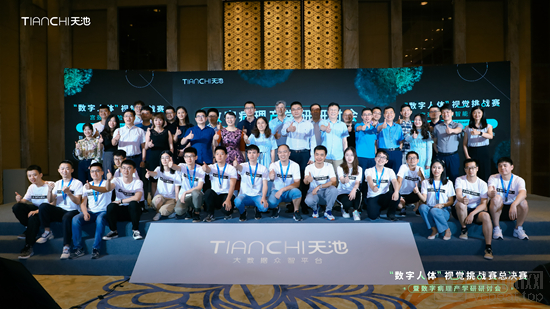
Award-Winning Contestants and Guests Group Photo
On the afternoon of June 13, 2020, the Digital Pathology Industry-Academia-Research Symposium, co-hosted by Alibaba Cloud Tianchi and Intel, was held in Hangzhou. More than twenty guests from medical institutions and the industry engaged in in-depth discussions on the clinical needs and future development trends of pathology AI. The symposium was moderated by Bi Yuanfeng, Co-founder and COO of VCBeat.
In the “Digital Human” Vision Challenge, some algorithmic models are ready for direct integration into digital equipment at major hospitals. Chi Ying, Director of Medical AI at Alibaba DAMO Academy, considers this a positive trend.
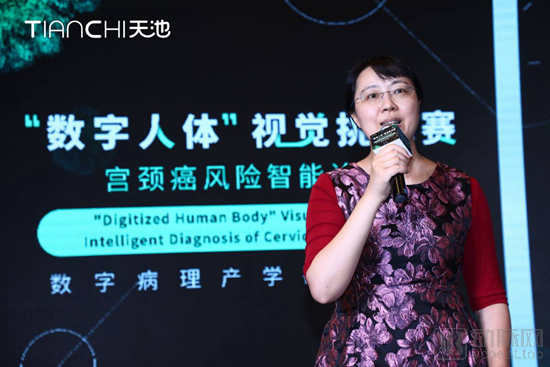
Chi Ying, Director of Medical AI at Alibaba DAMO Academy
In her opening remarks, Chi Ying likened artificial intelligence (AI) technology to a navigator for healthcare, enabling the goal of preventive care by shifting technological interventions upstream. Currently, the primary research directions in medical AI involve leveraging technologies such as visual engines, knowledge engines, and search engines to assist clinical practices, thereby making medical analysis, health management, and public health more efficient, inclusive, and cost-effective. Chi Ying believes that scenarios for the practical application of medical AI span across medical institutions, primary public health care, health insurance, and medical devices and consumables. “As traditional machine learning continues to evolve into deep learning, the mainstream value of AI in healthcare is becoming increasingly evident, serving as an indispensable driving force for progress.”
Hu Xiao, Chief Engineer of Cloud Computing and Artificial Intelligence at Intel, also emphasized that the key to medical AI technology lies in practical implementation, rather than pursuing ivory-tower academic achievements detached from real-world needs; it must better serve the general public. Encouragingly, current AI technological innovations are not only focused on algorithmic advancements but are also striving for practical applications that reduce the disease burden for every patient.
In recent years, many AI-based pathology products have been applied in clinical innovation practices. However, as the underlying core technology, AI still has a long way to go before it can truly mature and form a systematic framework in this field.

On-site of the Digital Pathology Industry-Academia-Research Seminar
Bu Hong, Professor in the Department of Pathology at West China Hospital, Sichuan University, and Immediate Past Chair of the Chinese Society of Pathology, Chinese Medical Association, delivered a remote presentation titled “Rethinking Telepathology and Artificial Intelligence,” sharing three perspectives on telepathology and three reflections on artificial intelligence.
Professor Bu Hong believes that, first, the intelligence level and user-friendliness of remote platforms are insufficient, with many digital elements underutilized; remote pathology platforms should not be developed using traditional pathology mindsets. Second, when conducting remote pathology diagnoses, attention should be paid to differentiating the difficulty of operations to motivate physicians’ participation. Third, remote pathology platforms should leverage AI technology to innovate the content and format of pathology diagnostic reports.
The joint application of algorithms, computing power, and medical big data constitutes the three fundamental conditions for AI advancement, with the full utilization of medical big data being the most critical element. Pathological diagnosis requires the integration of multi-dimensional medical information, and the goal of pathology AI should be to provide a support system based on diverse quantitative indicators.
Professor Bu Hong pointed out that, first, pathological AI must be refined and matured through practical application; second, application scenarios, as the “last mile” of pathological AI, represent a weak link and should receive particular attention; third, an information-sharing platform should be established to break down the silos in the research and development of artificial intelligence in pathology through flexible mechanisms and operations.
"In China, the shortage of licensed physicians is the most pressing issue facing pathology departments," stated Wu Jian, Deputy Director of the National Institute of Health and Medical Big Data at Zhejiang University. The deeper underlying challenges include the complexity of pathological diagnosis and the substantial workload involved. As a department that does not have direct contact with patients, pathology has seen lagging technological iteration. Labor costs in pathology departments still account for nearly 40% of total expenditures, making it difficult to expand the workforce of pathologists under current conditions.
Jiang Yi, Deputy Director of the Department of Pathology at the Second Xiangya Hospital of Central South University, stated that emphasizing artificial intelligence alone is insufficient for pathological AI; without the involvement of pathologists, such AI solutions are unlikely to achieve commercial success. Pathology is a highly complex discipline that should not be confined to techniques such as slide scanning, annotation, and deep learning. Instead, it requires integrating the expertise of diagnostic specialists with digital scan analysis. Pathological AI products should enhance the workflow comfort of pathologists rather than replace them.
Sun Wenyong, Director of the Department of Pathology at Zhejiang Cancer Hospital, stated that cytopathology and molecular pathology are relatively new technologies in clinical practice, with physicians having limited experience in data integration and result analysis. Histopathological analysis and diagnosis constitute the largest portion of the workload in pathology departments. If sufficiently effective AI products for histopathology could be developed, physicians’ workload would be significantly reduced.
Xie Jing, Deputy Director of the Department of Pathology at Ruijin Hospital, pointed out that pathology is a highly specialized field with significant differences among its various subspecialties. Compared with lung cancer and gastrointestinal cancers, endocrine tumor samples exhibit less heterogeneity, making them potentially suitable as an application direction for AI.
A mechanism of mutual tolerance must be established between the pathology community and the corporate sector, emphasized Guo Yongjun, Vice President of Henan Academy of Medical Sciences and Director of the Department of Pathology at Henan Cancer Hospital. He noted that integrating all medical information for pathological diagnosis is a gradual process, and expectations from both sides should not be overly high. Director Guo suggested that innovative enterprises align with policy requirements and leverage strategic efforts to facilitate the clinical implementation of AI in pathology and drive industry development.
In addition, guests from third-party pathology diagnostic centers also shared their insights. Wen Yunjie, Deputy General Manager of Huayin Health Group, stated that Huayin Health has accumulated a large volume of digital slide data necessary for developing AI products during its daily service operations. Pathologists and AI teams should foster mutual understanding, and when selecting applications, they should prioritize directions that are relatively straightforward yet most needed by physicians.
Regarding the mismatch between the demand for AI in histopathology and the supply of AI solutions in cytopathology raised by Director Sun Wenyong, Dr. Liu Jingxin, Technical Director and Chief Scientist at Hengdao Pathology, stated that cytopathology involves quantitative analytical metrics, and machines perform these tasks more efficiently than humans, thereby facilitating easier implementation.
Medical imaging is characterized by high dimensionality and high density. In a remote lecture titled “Characteristics, Technologies, and Trends of Medical Imaging + Artificial Intelligence,” Zhou Shaohua, a researcher at the Institute of Computing Technology, Chinese Academy of Sciences, pointed out current challenges such as significant data heterogeneity, decentralized storage, scarcity of large-scale annotated datasets, multimodal samples, and a wide variety of associated disease types. Nevertheless, Dr. Zhou noted that emerging trend-setting technologies are addressing these challenges, and called for strengthened collaboration among academia, healthcare institutions, and industry.
Jiangfeng Bio has been cultivating the domestic market for nearly nine years and is one of the largest suppliers of digital pathology scanning equipment in China. In May 2019, Jiangfeng Bio’s independently developed cervical cancer screening product, based on its accumulated data, obtained a Class II medical device registration certificate. However, Liu Bingxian, Chairman of Jiangfeng Bio, believes that pathological AI is still in its early stages and emphasizes the importance of multi-point collaborations.
Due to the lack of unified annotation standards, pathology AI models built based on different doctors, medical institutions, or even reagents and consumables are not reusable. Yang Lin, Chairman of Deyingjia Technology, stated that during an attempt to bring a high-specificity product with 99.5% sensitivity in model training to market, they even received negative feedback where the accuracy was completely inconsistent with the product parameters. “Discussions and exchanges with pathology experts are more complex than imagined. The implementation of AI faces many issues, including model analytical capabilities, non-standardized data, and medical service charging standards. It requires joint efforts from experts and enterprises.”
Artificial intelligence has not only recently begun to integrate with various industries. Yang Zhiming, CEO of DeepThinking, pointed out that what may seem like a simple task—such as cytological screening for cervical cancer—becomes increasingly difficult as one delves deeper. A common dilemma is that AI lacks understanding of pathology, while cytopathologists lack understanding of AI, hindering industrialization; thus, their integration is crucial. Nevertheless, Yang Zhiming believes that pathological AI is currently at the “5 or 6 o’clock hour before dawn,” with a breakthrough imminent.
According to surveys, the adoption rate of AI in imaging among physicians is already very high, with a click-through rate exceeding 80%. Chen Hao, CEO of Shijian Technology, used data to validate Yang Zhiming’s viewpoint: “AI has proven its value in certain niche fields.”
Doctors’ needs vary, and so do their requirements for AI models. Liu Mingqian, AI Director at Winning Health, pointed out that bridging gaps and building bridges are also crucial in the process of paving the way for the application of new products and technologies. In this context, algorithms may represent only a minor issue within the entire pathology AI workflow. She believes that many other challenges require collaborative efforts across the industry to address.
As Professor Bu Hong stated, pathological AI must be refined through practical application. Liu Xiangwen, General Manager of Marketing and Public Affairs at Alibaba Cloud, pointed out that while pathological AI is a highly specialized and vertical field, it involves an extensive industry chain spanning from technology development to clinical adoption by physicians. AI developers must identify their strategic position to generate business value. Specifically, in the context of pathological AI, the goal is to reduce physicians’ time burden and lower healthcare costs.
So, what would an ideal pathway look like? Attendees offered their respective proposals.
The implementation of AI applications in pathology should proceed from the easier to the more difficult tasks. Qi Hua, founder of Sinotest, suggests starting with biomarkers that are easy to identify and quantify. Typically, reagent manufacturers already have mature business models. Qi Hua recommends directly bundling AI products with reagents, thereby creating a monetization channel for AI while enhancing the competitiveness of the reagents.
In light of the potential impact of the external environment, Zhou Xu, Chief Algorithm Scientist at Epsen, has called on domestic hardware manufacturers to increase R&D efforts in foundational components for pathology AI, so as to rapidly strengthen and expand Chinese-made equipment. Han Fangjian, head of Lanxi Biotechnology, stated that the most pragmatic priority is to serve pathologists well and gain their recognition.
Huang Xiaodi, Head of Smart Health Pathology Products at SenseTime, pointed out that a more platform-oriented approach can be adopted to address the implementation challenges of pathology AI. By integrating data from radiology and pathology departments across regions, hospitals, and individual units, the fusion of different data modalities can truly drive the evolution of digital pathology.
As the concluding segment of the symposium, VCBeat Eggshell Research Institute released the “Digital Pathology Diagnosis Ranking,” jointly produced with Alibaba Cloud Tianchi and Intel. VCBeat believes that collaboration within the pathology AI industrial ecosystem is essential; various specialties should integrate to address the practical concerns of physicians in real-world clinical scenarios. It also hopes that more stakeholders, including government agencies, will pay attention to the growth and application of pathology AI.