

60% of Hospitals Lack Appointment-Based Services: Navigating the Path Forward Under New NHC Policy
On May 22, the National Health Commission issued the “Notice on Further Improving the Appointment-based Diagnosis and Treatment System and Strengthening the Development of Smart Hospitals,” which primarily outlined three steps for improvement and once again highlighted three major industry buzzwords: appointment-based diagnosis and treatment, smart hospitals, and internet hospitals.
In the area of appointment-based diagnosis and treatment, policies require that hospitals at Level II and above generally establish an appointment system, providing time-slot-specific outpatient appointments, inpatient admission appointments, and elective surgery appointments, with time-slot precision down to 30 minutes. Hospitals offering day-case surgeries shall provide appointment services for such procedures. Tertiary hospitals shall also offer centralized appointment services for examinations and tests, as well as for outpatient treatments. These measures aim to eliminate issues such as duplicate bookings and online scalping through process optimization and technological upgrades.
Policies related to smart hospitals have remained largely unchanged, continuing to focus on “Smart Hospital Service Rating,” “Electronic Medical Records,” and “Smart Management.” Notably, these policies encourage hospitals at Level II and above to participate in smart hospital management, using a rating system to standardize their intelligent development.
Finally, in the area of internet-based healthcare, policies require hospitals to summarize their telemedicine experiences during the pandemic and further develop and refine their online platforms. This aims to leverage the advantages of internet diagnosis and treatment—such as efficiency, convenience, and personalization—to integrate online and offline services. Hospitals are encouraged to conduct online follow-up consultations for common and chronic diseases and actively collaborate with third-party providers to offer services such as medication delivery.
Overall, in addition to requiring hospitals to develop smart hospitals and internet-based healthcare along their existing trajectories, the policy has also placed the smart transformation of secondary hospitals on the agenda, indicating that hospital digitalization is extending downward.
Compared with the past, secondary hospitals are a key focus of this policy and an important entity that urgently needs reform and development. To determine the development direction of secondary hospitals, it is first necessary to understand their current status.
Unlike the generally well-developed tertiary hospitals, secondary hospitals vary significantly across regions in terms of informatization levels. Some Class II Grade A hospitals already possess certain medical resources and stable patient flows comparable to those of tertiary hospitals, qualifying them as quasi-tertiary institutions. However, other secondary hospitals, particularly Class II Grade B facilities, often see scant foot traffic in their lobbies, failing to fulfill their intended roles; nevertheless, their geographic locations underscore the necessity of their continued operation.
From the perspective of Liu Xiaoguang, CEO of Ruikang Yongchuang, a healthcare informatics enterprise, the first category of secondary hospitals (primarily Class II Grade A) already possess a solid foundation in informatization. They have established reasonable and effective diagnostic, therapeutic, and clinical pathways, and have made certain progress in appointment-based diagnosis and treatment. These hospitals are poised to evolve into tertiary-level institutions. Therefore, for such hospitals, the current priorities are to enhance their electronic medical record (EMR) systems, improve interoperability ratings, and advance the development of smart hospital services and internet hospital platforms.
For the latter category of secondary hospitals (primarily Class II, Grade B), the challenges they face are more complex. If upgrading through their own resources is not feasible, their only option is to await the development of medical consortia and become part of a higher-level hospital, thereby escaping the predicament of low patient volume, insufficient funding, and weak infrastructure.
Liu Xiaoguang told VCBeat, “Due to the low patient volume, patients can see doctors at certain secondary hospitals with almost no wait time, so there is naturally no need for time-slot appointment registration. On the other hand, many hospitals still lack a mature basic electronic medical record (EMR) infrastructure, meaning the conditions for establishing internet hospitals are not yet in place.”
“In other words, based on the policy’s requirements for secondary hospitals, the National Health Commission aims to encourage those secondary hospitals that lean toward tertiary-level standards to accelerate their informatization development and rapidly become a core force in medical service delivery. For secondary hospitals at the lower end of the spectrum, this policy may drive them to establish basic informatization infrastructure, ensuring they can at least interface patient information with upper-tier hospitals within medical consortiums. Only with such foundational capabilities can the tiered diagnosis and treatment system be effectively advanced.”
Therefore, regardless of the future trajectory of secondary hospitals, the advancement of foundational medical informatics infrastructure must proceed; this is also a key driver for the expansion of smart hospital initiatives into secondary hospitals.
On June 6, the National Health Commission released the Statistical Bulletin on the Development of China’s Health and Health Services in 2019. The Bulletin showed that by the end of 2019, among public hospitals at Level II and above, 46.1% had implemented appointment-based diagnosis and treatment, 91.6% had adopted clinical pathway management, 59.1% had provided telemedicine services, 86.1% had participated in mutual recognition of test results among hospitals at the same level, and 93.9% had delivered high-quality nursing services.
The figure of 46.1% indicates that nearly half of hospitals have implemented appointment-based consultation services; however, the bulletin does not provide details on the composition of these hospitals.
Therefore, to gain insight into the actual status of hospitals across different regions, VCBeat conducted a sampling survey on online appointment scheduling. Starting from the online registration component of the appointment and diagnosis process, we randomly selected a total of 72 hospitals of varying tiers from Chongqing Municipality, Beijing Municipality, Zhejiang Province, and Fujian Province. Six service access channels were evaluated: WeChat, Alipay, iOS apps, and third-party registration platforms. The specific details are presented in the table below.
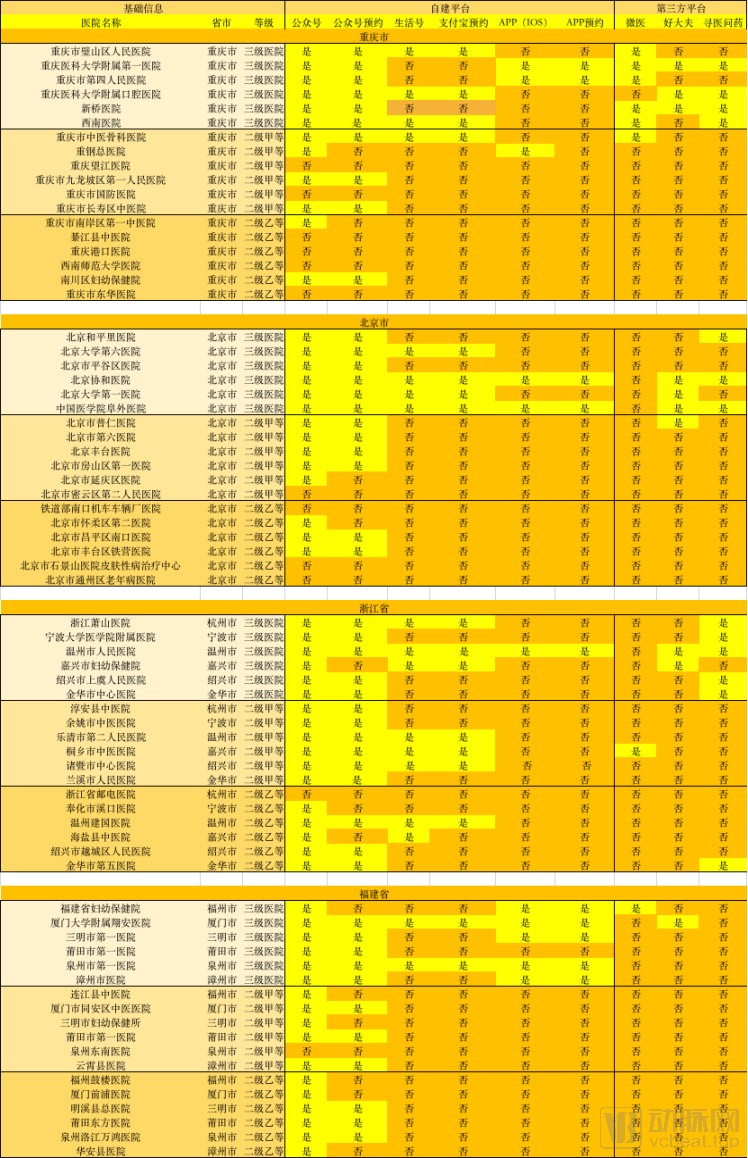
Statistics on Appointment Registration at Various Hospitals
Due to the small sample size and limited statistical dimensions, this table cannot fully reflect the detailed development of medical capabilities in hospitals within individual regions. However, based on the overall data, certain trends can still be identified.
Among the 72 hospitals surveyed, 47 have enabled appointment registration services through various channels. Of these, all 24 tertiary hospitals provide such services to patients. Secondary Class A hospitals follow in number, while few Secondary Class B hospitals have established appointment-based diagnosis and treatment systems. Therefore, it is evident that the majority of hospitals with appointment-based care capabilities are tertiary Class A hospitals, accounting for more than half of the total.
The situation at secondary hospitals is entirely different. During its statistical analysis, VCBeat found that many secondary hospitals in non-provincial capital cities do not even have official websites, lacking basic IT infrastructure and the information transparency expected of healthcare institutions. These hospitals still have a long way to go to meet policy requirements.
Fujian and Zhejiang, two regions with relatively rapid advancement in smart healthcare policies, have placed significantly greater emphasis on the development of appointment-based diagnosis and treatment. Local health commissions have even incorporated patient service ratings into hospital performance evaluation systems. Consequently, the number of hospitals meeting policy requirements in these two provinces is markedly higher than that in Beijing and Chongqing. All six sampled secondary Grade A hospitals in Zhejiang Province have implemented online appointment registration services via WeChat platforms. Similarly, all six sampled secondary Grade B hospitals in Fujian Province have launched official WeChat accounts, establishing a certain level of interaction with patients through internet-based channels; among these, five hospitals have enabled appointment registration functionality within their WeChat official accounts.
What sets Fujian Province apart is the local preference for mobile apps among its tertiary (Grade 3A) hospitals. Among the six hospitals surveyed, five have developed their own proprietary apps, indicating that they are ahead of the curve in building smart hospital services. This is particularly notable given the high costs associated with the development, promotion, and maintenance of mobile applications today.
From a longitudinal data perspective, the WeChat Official Account channel demonstrates a dominant position among various channels, followed by Alipay’s Lifestyle Accounts. Specifically, among the 47 hospitals that offer online appointment registration services, 44 allow patients to book appointments via WeChat Official Accounts, and 22 hospitals have enabled multiple appointment booking channels. This indicates that WeChat is becoming the primary entry point for patients to access medical services in the era of smart hospitals. Generally, hospital appointment booking platforms on Official Accounts are supported by healthcare IT vendors.
Third-party appointment booking platforms such as WeDoctor, Haodf, and Xunyi Wenyao have integrated with a relatively limited number of hospitals. Their business models are more oriented toward online consultations, facilitating direct communication between patients and physicians. These third-party platforms exhibit significant regional disparities, with listed hospitals predominantly concentrated in first- and second-tier cities and mainly comprising Grade 3A general hospitals and specialized hospitals.
Most hospitals appear more inclined to collaborate with traditional healthcare IT companies to build appointment scheduling platforms. Commenting on this trend, the CEO of Ningfan Technology, a healthcare IT firm based in Ningbo, stated, “For hospitals, appointment registration constitutes only a small fraction of the overall clinical workflow. They prefer vendors that can provide customized solutions covering the entire patient care journey. This includes integrating official WeChat accounts with electronic medical insurance cards and electronic health records for process management and insurance payment, while continuing to deliver relevant information to patients during their wait times after arriving at the hospital.”
Overall, as the construction of online appointment registration systems in tertiary hospitals is nearly complete, the focus of the first provision of the aforementioned policy will shift more toward secondary hospitals. Nevertheless, there is still a long road ahead for secondary hospitals to strengthen their health information technology infrastructure under the policy framework and fully reap the benefits of digitalization.
The policy also states that tertiary hospitals shall provide centralized appointment services for examinations and tests, as well as appointment services for outpatient treatments. While secondary hospitals focus on appointment-based registration, tertiary hospitals prioritize centralized appointments for examinations and tests and outpatient treatment appointments.
Completing appointment registration is the first step in connecting patients from offline channels to hospitals. However, numerous steps requiring careful planning lie between establishing this connection and the final consultation. A “centralized appointment platform” that covers all aspects of diagnostic and treatment scheduling represents the next phase in hospitals’ journey toward smart healthcare. Many publicly listed health IT companies have targeted this gap in the market.

Pain Points for Hospitals and Patients
Taking Yilianzhong as an example, the company has established an appointment system for hospitals that covers the entire diagnosis and treatment process, including intelligent medical technology examinations and day surgery services. This system encompasses numerous examination departments such as ultrasound, radiology, endoscopy, and pathology.
YiLianZhong stated: “Taking medical technology departments as an example, relevant examination items are typically embedded within the consultation and treatment processes, making them difficult to manage. Scheduling often relies on front-desk nurses who arrange appointments based on equipment availability and physicians’ schedules. To address this issue, we analyzed the existing appointment rules for each department, codified these operational experiences into programming logic, and developed a rule engine powered by deep learning to centrally coordinate and allocate patient examinations. Leveraging AI, the system can automatically recognize electronic examination requisitions and recommend the most appropriate appointment times by integrating environmental, medical, temporal, and dynamic factors associated with the examinations.”
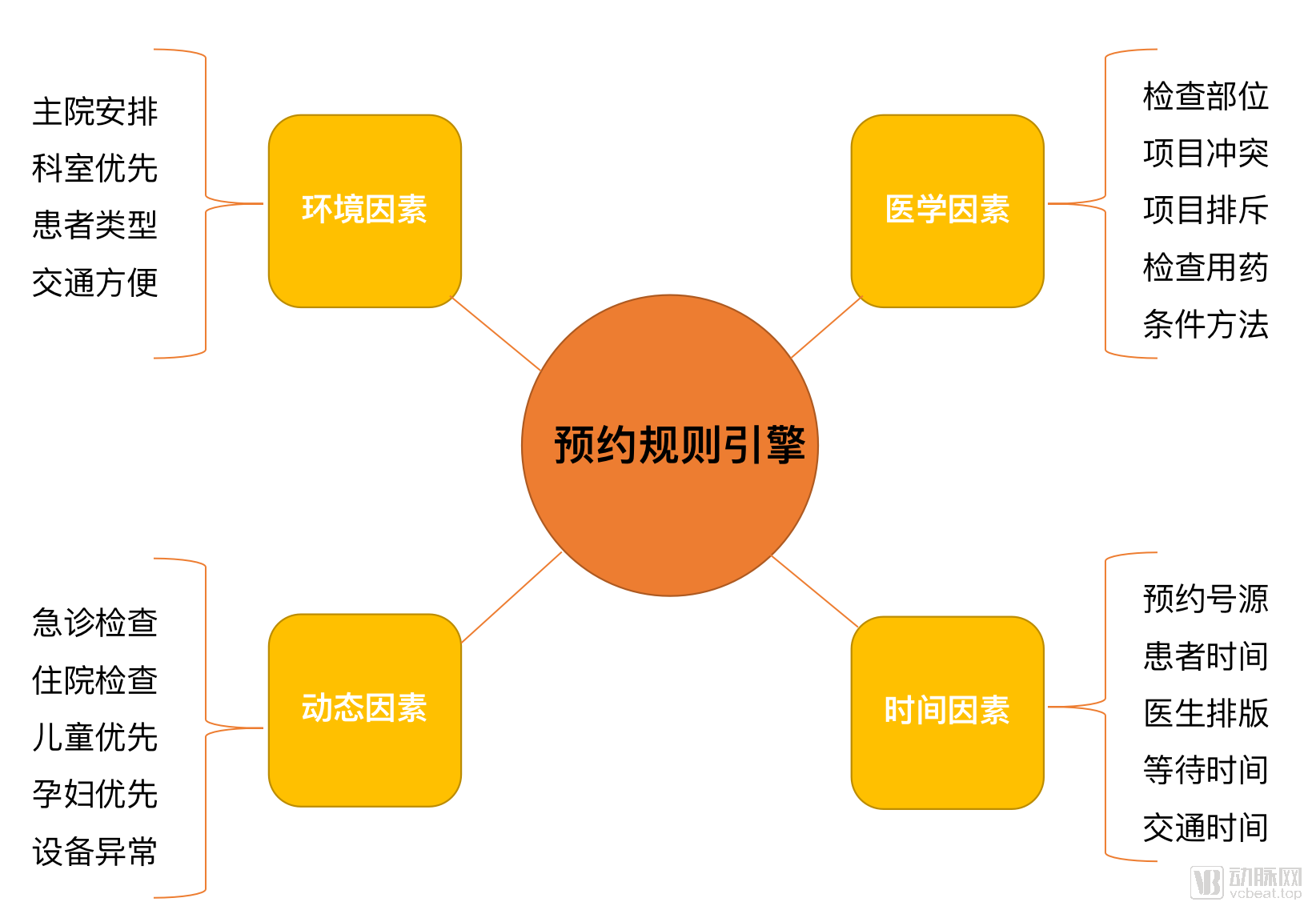
Intelligent Engine
Process upgrades primarily enhance the patient experience. Although many hospitals currently have digital displays related to clinical workflows, patients can only monitor these screens and rely on manual calls from physicians to track departmental progress. This approach is prone to missed appointments and queue-jumping. Health IT vendors are striving to achieve interoperability for this information, enabling patients to access real-time updates on their consultation status via mobile devices and other terminals.
Based on current implementation, the development of AI-powered centralized appointment platforms has been largely confined to coastal provinces with progressive policies, such as Zhejiang, Jiangsu, and Fujian, while progress in inland regions has been relatively slow. Recently, Yilianzhong completed the information technology infrastructure project for West China Second University Hospital, marking the establishment of the first “Intelligent Centralized Appointment Platform” in Southwest China.
The average transaction value for such projects is significantly higher than that of the online appointment registration market. Yilianzhong told VCBeat, “This is a highly customized software solution. Currently, many secondary and tertiary hospitals have demands for its implementation. The construction period for secondary hospitals is approximately 1–2 months, with costs around RMB 1 million; for tertiary hospitals, the timeline ranges from 3 to 6 months, depending on hospital size, and prices typically fluctuate between RMB 5 million and RMB 10 million.”
This business segment is closely aligned with the “Smart Hospital Rating,” “Electronic Medical Records (EMR),” and “Smart Hospital Management” outlined in Article 2 of the policy. With the EMR rating assessments launched in 2020, “appointment-based diagnosis and treatment” will emerge as a new, vast market.
The National Health Commission’s emphasis on the development of internet healthcare is not new. According to statistics from the VCBeat Orange Database, a total of 88 policies related to internet hospitals were issued at both national and local levels between 2015 and March 2020 (as of March 2020). The distinguishing feature of the current policy is that it affirms the role played by internet hospitals during the pandemic and underscores the necessity of “summarizing experience.”
Regardless of the format, the development of internet hospitals has always been “on the way,” with various new concepts and promotion methods emerging one after another. Companies such as Weimai, Zhuojian Technology, Nali Health, Kingdee Medical, and Yuntai Network have all entered this field.
In the development of smart internet hospitals, Zhuojian Technology has been continuously promoting the rapid and healthy growth of appointment-based diagnosis and treatment, smart hospitals, online medical consultations, and internet hospitals. The integrated appointment service platform built by Zhuojian Technology consolidates various patient service functions, providing patients with one-stop services for appointments, triage, payment, and follow-up care. Currently, this platform has been implemented in multiple hospitals, including the Internet Hospital of Heilongjiang Provincial Hospital and Xiangya Hospital of Central South University, reducing patients' time spent seeking medical care. The integrated appointment service platform is based on further improving and establishing a comprehensive appointment-based diagnosis and treatment system, strengthening the construction of smart hospitals, and accelerating the establishment of a new model of integrated online and offline medical services. It integrates all medical technical resources to achieve "one-stop appointments, intelligent scheduling, and precise booking."
By achieving comprehensive integration with hospital information systems, we enable data to move instead of patients, thereby improving the patient care experience and enhancing patient satisfaction. Through an integrated appointment platform, we reduce waiting times for medical technology examinations and bed reservations, facilitating convenient and efficient access to healthcare. This approach elevates the level of hospital informatization management, reduces labor costs associated with appointment registration, improves the utilization efficiency of medical resources, alleviates operational pressures on hospitals, and advances the tier of smart hospital services, ultimately building smart hospitals and establishing a new model for healthcare delivery.
Supported by national policies, Zhuojian Technology is delivering superior products through in-depth model development and scenario exploration for patient services. By establishing provincial-level flagship models and regional healthcare service benchmarks across China, the company provides valuable references for the internet healthcare industry, truly enabling the public to enjoy high-quality, efficient medical experiences through its products and services.
In the process of exploring the development of internet hospitals, Zhuojian Technology has undergone three evolutionary stages. The Internet Hospital 1.0 stage focused on the full online consultation process, providing common functions such as appointment registration, payment, and report retrieval (“registration, payment, and inquiry”), as well as text-and-image consultations, video consultations, and medication delivery. To reduce the frequency of patient visits to physical hospitals and achieve integrated scheduling for examinations and laboratory tests, the Internet Hospital 2.0 stage was developed upon the 1.0 foundation by adding a unified resource pool and integrated appointment scheduling, thereby connecting online services with offline care. To help hospitals establish intelligent, automated, and professional full-process health management services spanning both online and offline channels, the Internet Hospital 3.0 stage was built upon the 2.0 framework by incorporating an intelligent engine and automated execution capabilities. This stage delivers professional, intelligent, end-to-end patient management through the integration of online and offline services.
Zhuojian Technology stated, “The professional, intelligent, end-to-end internet medical services of Internet Hospital 3.0 encompass a wide range of health services across the pre-hospital, in-hospital, and post-hospital stages. This approach can genuinely help hospitals reduce healthcare management costs and improve diagnostic and treatment efficiency, aligning with the overarching policy direction of China’s healthcare reform. Meanwhile, from an intra-hospital perspective, this model is poised to deliver greater value in chronic disease management, scientific research, and clinical pharmacotherapy studies in the future.”
Weimai’s model is different; itBased on a localized operational model, we are committed to building a one-stop service that integrates online consultations with offline medical resources, ensuring that patients can find their doctors at local hospitals after online consultations or maintain continuous online communication with the same doctor following offline visits.
Meanwhile, on the Weimai platform, patients can complete the process fromFrom Online Consultations to Specialty Disease Management Services: Amid the Pandemic, This Approach to Follow-Up and Disease Management Can Significantly Reduce Risks.
Although the policy mentions appointment-based diagnosis and treatment, smart hospitals, and internet hospitals, VCBeat believes that its core lies in promoting the development of IT infrastructure through practical applications. As Liu Xiaoguang stated, “Without a solid IT foundation, enterprises may possess cutting-edge IT service capabilities but remain powerless, unable to integrate with these hospitals’ systems.”
Therefore, the foundational IT infrastructure construction in hospitals remains a significant market opportunity. Driven by policy support, these previously hard-to-penetrate markets may be revitalized through internet-based healthcare and the development of medical consortia. Meanwhile, for hospitals that have already completed their foundational IT infrastructure, the smart hospital initiative will become the next competitive frontier for health IT enterprises.
It is foreseeable that the notice issued by the National Health Commission is merely the beginning. In the near future, various regions will sequentially introduce policies tailored to their local conditions, helping secondary hospitals achieve standardization and driving tertiary hospitals toward intelligent transformation. Those who can leverage these policy opportunities will be poised to capture the future market.