Shengen Bio Files for IPO Following Landmark RNAi Deals with Roche and Lilly
SANEGENEBIO
Small Nucleic Acid Drug Developer

Innovent
High-end Biologics Developer
Recently, SANEGENEBIO announced its collaboration withGenentech, a member of the Roche GroupSANEGENEBIO Reaches Global R&D Collaboration and Licensing Agreement, Granting Exclusive Worldwide Development and Commercialization Rights for an RNAi Drug. Under the agreement, SANEGENEBIO will receive an upfront payment of $200 million and up to $1.5 billion in development and sales milestone payments.
And just three months ago, SANEGENEBIO had justLillyAchieved a total of over 1.2 billion US dollars in RNAi drug research and development cooperation.
In the short term, two major deals were reached consecutively with two multinational pharmaceutical giants, whichThis has confirmed the strength of SANEGENEBIO's LEAD technology platform and also highlighted that the small nucleic acid field has become a key competitive track for global new drug research and development.
01
Platform Advantages

SANEGENEBIO was founded in 2021 by a pioneering team in the RNAi field and is led by them.
ItsThe core advantage lies in the unique LEAD™ (Ligand and Enhancer Assisted Delivery) technology platform.. The platform achieves targeting by designing ligands for specific receptors, enablingPrecise Delivery to Extrahepatic Tissues; and synergize with exclusively innovative efficacy-enhancing groups, thereby efficiently modulating the tissue selectivity and pharmaceutical properties of drugs, successfully achieving high-efficiency delivery to core cells such as adipocytes, muscle cells, and immune cells.
Another major advantage of this platform is thatSupports subcutaneous administration once every six months or even once a year., and has safety comparable to GalNAc technology.
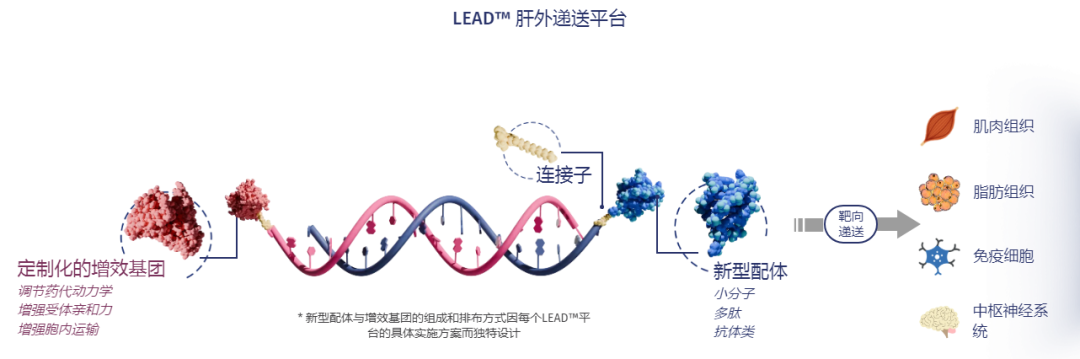
Image Source: SANEGENEBIO Official Website
Based on this platform, SANEGENEBIO has developed multiple RNAi drug candidates, five of which have entered clinical stages, covering various fields such as immune-mediated diseases, obesity, and cardiometabolic disorders.
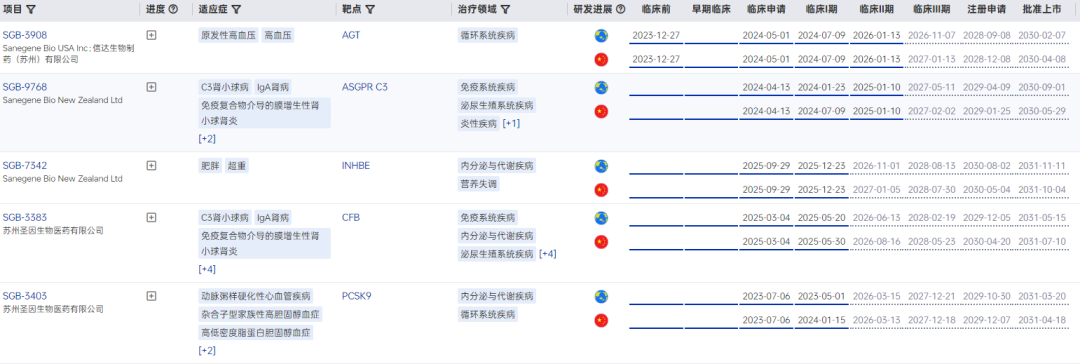
SANEGENEBIO Clinical-Stage Candidate Drug
Source of the image: PharmCube Data - Global Drug Analysis System
Delivery technology has always been a major challenge in the development of RNAi drugs, especially for extrahepatic delivery. The fact that Eli Lilly and Roche have successively shown interest in SANEGENEBIO indirectly confirms the value of the LEAD platform.
According to the agreement between SANEGENEBIO and Roche, SANEGENEBIO will be responsible for the early research and development of the collaborative drug, while Genentech will handle all subsequent clinical development and commercialization activities for the drug.
Through the collaboration with Eli Lilly, SANEGENEBIO will be responsible for screening and identifying the optimal RNAi active molecules for the joint projects, while Eli Lilly will handle the subsequent IND application research, clinical development, and commercialization of the drug.
This collaborative model precisely aligns with the current innovation ecosystem in the biotechnology field, characterized by an efficient division of labor where "small Biotech companies focus on cutting-edge exploration, and large Pharma companies lead clinical development and market transformation."
Earlier, SANEGENEBIO reached a strategic cooperation agreement with Innovent Bio, a pharmaceutical company in China, to jointly develop the siRNA candidate drug SGB-3908 targeting angiotensinogen (AGT) for the treatment of hypertension.
According to the cooperation agreement, the two parties will jointly advance the development of SGB-3908 to a certain stage. Meanwhile, Innovent Bio will obtain an exclusive option and can pay the exercise fee in the future to acquire the exclusive rights for the development, production, and commercialization of SGB-3908 within different global scopes. After Innovent Bio exercises the option, SANEGENEBIO will also be entitled to subsequent R&D milestone payments and sales milestone payments, as well as tiered royalties based on net sales post-commercialization.
Currently, this drug has initiated Phase 2 clinical trials. According to the Phase 1 clinical results previously disclosed at the 2025 AHA conference,SGB-3908 Single Dose Achieves Long-Lasting and Potent Reduction in AGT Levels and Preliminary Blood Pressure Decrease. After a single dose, serum AGT levels were significantly and persistently reduced, with a maximum reduction of over 95%, which remained stable for six months.At the same time, the safety and tolerability were good, with no severe adverse events or serious adverse events observed.
SANEGENEBIO's another candidate drug SGB-9768 (targeting C3 siRNA) that has entered Phase 2 clinical trials also shows outstanding performance.
According to the Phase 1 clinical data presented by SANEGENEBIO at the ASN 2025 conference,After a single dose of SGB-9768, serum C3 levels were significantly and persistently reduced in a dose-dependent manner, while alternative complement pathway activity was almost completely inhibited.; and has good safety and tolerability, supporting further clinical development.
02
Continuous Transactions

Breakthroughs in extrahepatic delivery technology over the past decade have removed the final obstacles for small nucleic acid drugs to enter the mainstream field of chronic disease treatment.
According to Frost & Sullivan statistics, the global small nucleic acid drug market has shown strong and continuous growth, increasing from US$2.7 billion in 2019 to US$5.7 billion in 2024, with a compound annual growth rate of 16.2%. With continuous breakthroughs in extrahepatic targeted delivery technology, its market size is expected to reachIt will reach 54.9 billion US dollars in 2034。
Leading overseas pharmaceutical companies frequently release positive news.
Alnylam, represented by siRNA technology, expects its four self-commercialized siRNA drugs to generate nearly $3 billion in revenue by 2025, an 81% year-over-year increase, driving the company to achieve non-GAAP profitability.
Ionis, represented by ASO technology, expects the peak sales of its first self-commercialized product Tryngolza (olezarsen) to exceed $2 billion.
Meanwhile, the transaction activities in the global small nucleic acid field have significantly heated up in recent years. In 2025, the potential total transaction volume in this field soared to 365 billion US dollars. multinational pharmaceutical giants such as Novartis, Eli Lilly, Roche, GSK, and BI have increased their investment in the small nucleic acid track through various methods including pipeline cooperation, technology platform licensing, and mergers and acquisitions.
Chinese pharmaceutical companies have become a core force in the nucleic acid drug trading market, thanks to the two major advantages of efficient R&D productivity and engineering innovation.
September 2025,Bowang PharmaceuticalEntered into collaborations with Novartis for multiple cardiovascular products, receiving a $160 million upfront payment and up to $5.2 billion in potential total milestone value.
Notably, this is not Novartis' first asset acquisition from Bowang Pharmaceutical. Previously, in January 2024, Novartis and Bowang Pharmaceutical entered into their first collaboration to co-develop multiple innovative siRNA drugs targeting cardiovascular diseases, with a total value of up to $4.165 billion.
September 2025,Mabwell BioAditum Bio Reaches NewCo Deal to Establish Kalexo Bio. Mabwell Licenses Global Rights of 2MW7141, a Preclinical Cardiovascular Dual-Target siRNA Innovative Drug, to Kalexo Bio. In return, Mabwell will receive up to $1 billion in upfront and milestone payments from Kalexo, along with low single-digit royalties. Additionally, under agreed conditions, Mabwell will also obtain a total of double-digit Series A preferred shares in Kalexo.
August 2025,VIAGENESANEGENEBIO reached an agreement with Sanofi, granting the latter the development and commercialization rights for the RNAi drug VSA001 (Plozasiran) targeting apolipoprotein C-III (APOC3) in the Greater China region. SANEGENEBIO received a $130 million upfront payment and is eligible to receive up to $265 million in milestone payments upon NMPA approval of related indications.
May 2025,Jingyin PharmaSANEGENEBIO Reaches Co-Development Agreement with CRISPR Therapeutics for Next-Generation Long-Acting Factor XI (FXI) Targeted siRNA Therapy SRSD107, Secures Initial Payment of $95 Million and is Eligible for Over $800 Million in Advance and Milestone Payments.
Earlier, in 2024RiboBioCollaborated with Boehringer Ingelheim to co-develop innovative small nucleic acid therapies for the treatment of non-alcoholic or metabolic dysfunction-associated steatohepatitis, with a total transaction value exceeding 2 billion US dollars.
03
Conclusion

In recent years, small nucleic acid drugs have frequently made breakthroughs in almost all popular chronic disease fields such as cardio-metabolic diseases, "functional cure" of hepatitis B, and weight loss, and are expected to become another mainstream drug category following small molecules and antibody drugs.
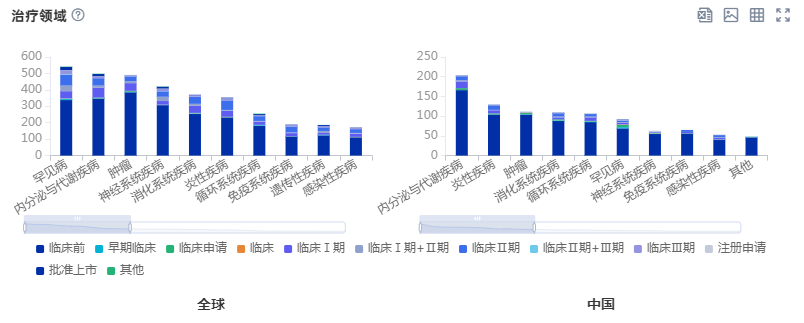
Distribution of Treatment Areas for Small Nucleic Acid Candidate Drugs
Source of the image: PharmCube Data - Global Drug Analysis System
In this competition, China's innovative forces are no longer merely technology followers but have become key participants in global RNAi drug research and development through self-developed platform technologies.
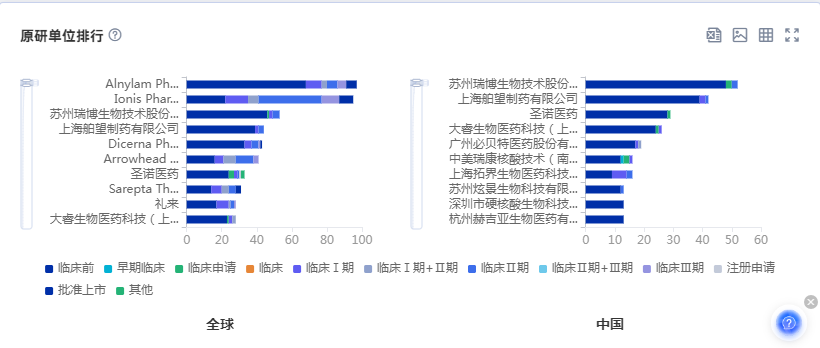
Ranking of Original Research Units by Number of Small Nucleic Acid Candidate Drugs
Source of the image: PharmaGo - Global Drug Analysis System
Editor-in-Chief| Little Moon Stone
Cooperation, Contribution, and Reprint Authorization | HorseTeacher18323856316 (Same as WeChat)

 Read the original text, it isPopular Articles