

How Aushada Serves Over 3,000 Global Fortune 500 and Listed Companies: A Leading MedTech CRO’s IPO Prospectus

OSMUNDA
Comprehensive Medical Device Service Provider
Why Do We Focus on OSMUNDA Medical Device Services Group (hereinafter referred to as “OSMUNDA”)?
From an industry perspective, the rapid expansion of the global medical device market is continuously raising the growth ceiling for players entering this sector. According to the "Report on the Competitive Landscape and Investment Risk Forecast of China's Medical Device Market (2019–2025)" released by Zhiyan Consulting, the global medical device market was valued at approximately USD 405 billion in 2017, representing a year-on-year growth of about 4%. It is projected to reach around USD 595 billion by 2024, with a compound annual growth rate (CAGR) of approximately 5.6%.
From a corporate perspective, OSMUNDA has secured a first-mover advantage in the industry as the sole provider of industrial solutions that owns both the big data platform for the medical device industry (“Medical Device Cloud”) and an industrial implementation platform (“3C Industrial Platform”). To date, OSMUNDA has delivered comprehensive, one-stop medical device industry solutions to more than 3,000 medical device companies, medical R&D professionals, and government entities worldwide. The company has established 12 branch offices in Beijing, Shanghai, Guangzhou, Shenzhen, Suzhou, Chengdu, and overseas locations including the United States and Germany. As a representative exporter of high-end services from China, OSMUNDA has been received twice by national leaders.
How has OSMUNDA achieved such outstanding performance in the medical device services sector? How does it manage the full lifecycle of medical device products? Can a company with an innovative DNA bring breakthrough changes to the industry? What opportunities and challenges remain in the field of medical device services? To address these questions, VCBeat (WeChat ID: vcbeat) conducted an exclusive interview with Zhang Feng, Founder and Chairman of OSMUNDA.
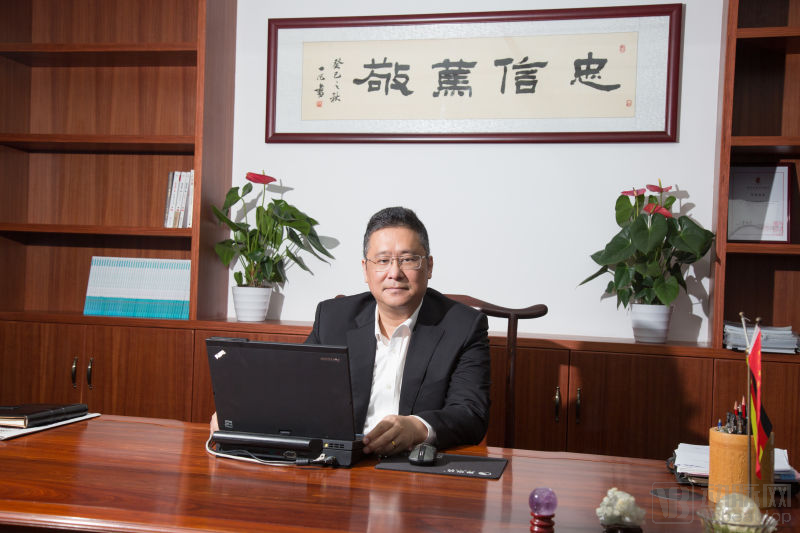
Zhang Feng, Founder and Chairman of OSMUNDA
In recent years, with the implementation of a series of policies such as the Special Approval Procedure for Innovative Medical Devices and the Priority Approval Procedure for Medical Devices, the medical device industry has become a major policy beneficiary. Many individuals or teams specializing in medical device R&D have established enterprises by leveraging the advantages of the Medical Device Registrant System.
However, following the implementation of the new Good Clinical Practice for Medical Device Clinical Trials, clinical trials have become increasingly standardized and stringent. Many medical device entrepreneurs continue to face numerous challenges.
First, obtaining a medical device product registration certificate is a time-consuming process that involves multiple stages, including facility setup, quality system implementation, production standards compliance, testing, animal studies, clinical trials, regulatory submission, and corrective actions, making the overall workflow and details highly complex.
Second, routine administrative tasks such as site selection, team management, and policy analysis consume substantial time, which can easily lead to delays in obtaining certification.
Third, the prolonged waiting period for registration applications results in significant idle waste of resources, including facilities, quality systems, equipment, personnel, and capital.
Fourth, there are numerous medical device regulations, and company founders lack in-depth interpretation and understanding of them.
5. The medical device industry is developing rapidly, with an accelerating pace of technological updates.
6. Enterprises face difficulties in building talent teams, suffer from a shortage of senior technical personnel, and contend with persistently high management costs.
Seventh, there is a lack of R&D translation capability, making it impossible to achieve design transfer.
Eighth, R&D activities are fragmented, and there is insufficient funding for both research and development expenses and the construction of self-owned manufacturing facilities.
9. Inadequate supply chain management prevents effective risk control.
In response to these challenges, OSMUNDA has creatively proposed the establishment of a 3C industrial platform in accordance with China’s Medical Device Registrant System. This platform provides targeted, one-stop solutions for medical device startups, with services covering sample production, contract manufacturing, and customized production for active devices, passive devices, and IVD products; facility leasing; production line transfer; concept incubation; patent technology acquisition; R&D design and commercialization; industry resource matchmaking; regulatory policy interpretation and guidance; as well as GMP, ISO 13485, and YY/T 0287 compliance solutions. By integrating “medical devices + internet + high-end services + advanced intelligent manufacturing,” OSMUNDA has pioneered an innovative model for the global medical device industry.
“Specifically, OSMUNDA’s 3C industry platform comprises a CDMO (high-end contract manufacturing and R&D design platform), a CRO (global regulatory registration and clinical trial platform), and MD Cloud (a big data platform for medical devices). It further integrates an investment and financing service platform (featuring patent evaluation and inclusive finance) and an industrial service platform (covering industrial planning, professional education, and industry think tanks), along with a robust professional medical device database, a project management platform, and R&D and production bases (CDMO facilities in Shanghai, Shenzhen, Xinxiang, and Shangrao). This innovative platform service model serves two primary purposes. On one hand, it attracts outstanding global talent in medical device technology, innovative projects, and industrial fund capital to settle on the platform and in local regions. It particularly addresses the practical commercialization needs of research institutes, medical institutions, and domestic and international startups, accelerating the product launch cycle and industrialization from conceptual ideation to finished product, thereby facilitating rapid industrial investment promotion and acting as a supportive partner for enterprise growth and a capable facilitator of service integration. On the other hand, the platform integrates professional services such as CROs with enterprises, universities, research institutions, investment firms, hospitals, and service agencies, converging industry resources, capital, technology, and regulations to form a vertical incubation platform for medical device innovation projects. This accelerates the growth of innovative enterprises, leads the development and clustering of regional medical device industries, and rapidly establishes a high-value-added, low-energy-consumption industrial structure, achieving simultaneous increases in output value and tax revenue. Furthermore, the platform empowers products, enterprises, and the industry at three levels, enhancing the efficiency of the entire industrial chain and corporate products, and building a regional medical device industry ecosystem characterized by innovative incubation, industrial clustering, and capital support.”
How Does OSMUNDA Deliver Full-Lifecycle Services for Medical Devices? Zhang Feng stated that, taking CRO services as an example, OSMUNDA supports medical device companies throughout their development journey. In the early stages, it provides industrial planning, technical feasibility studies, regulatory due diligence, and global medical device quality system certifications, such as China’s GMP YY/T 0287, the U.S. QSR 820, and the EU’s ISO 13485. At later stages, it offers clinical trials for active medical devices, passive medical devices, and in vitro diagnostics (IVD), along with animal studies, medical writing, biostatistics, and data management, culminating in global regulatory registration.
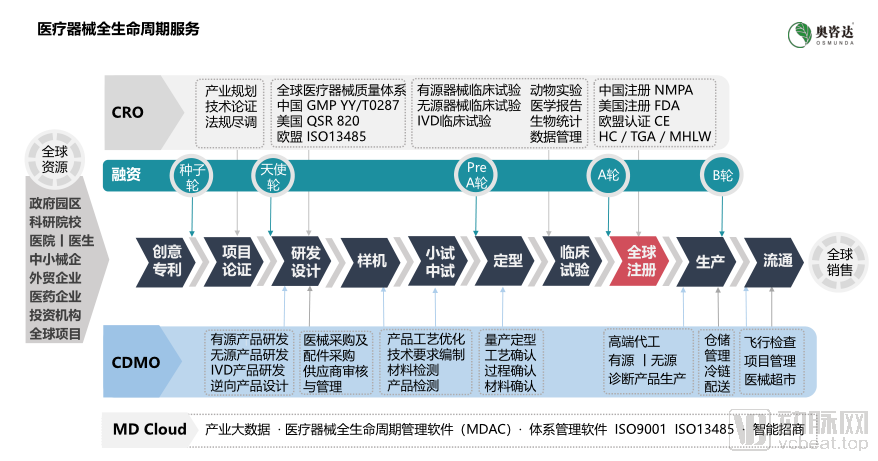
“We also provide industrial big data to governments, investment institutions, industrial parks, corporate research institutes, and overseas organizations,” said Zhang Feng. OSMUNDA’s RIMS (Medical Device Lifecycle Management Software) and MDAC (3C Industry Platform Management Software) enable precise resource matching and intelligent investment promotion for clients.
A mature service system and comprehensive process design form the closed loop of OSMUNDA’s business model. To date, OSMUNDA operates over 10,000 specialized production workshops, more than 200 high-end imported inspection, testing, and production equipment units, over 200 production and inspection devices, and 20+ production lines for active medical devices, passive medical devices, and in vitro diagnostics (IVD). It has served more than 3,000 clients from the Fortune Global 500 and publicly listed companies, helping them secure over 1,000 global medical device product registration certificates.
“OSMUNDA is a researcher, promoter, and practitioner of the methodology for transforming medical device patent technologies into productive forces.” When asked how to define what kind of company OSMUNDA is, Zhang Feng told VCBeat. Accelerating the translation of medical engineering, boosting the development of high-end healthcare, and building an industrial ecosystem and innovation chain are OSMUNDA’s service objectives. The remarkable achievements stem from OSMUNDA’s team, which boasts extensive experience and strong capabilities: currently comprising over 200 members, the team is led by Founder and Chairman Zhang Feng, an international expert in medical device regulations and strategy, a leading talent in innovation and entrepreneurship in Guangzhou City and the Guangzhou Development District, and Vice President of the Medical Device Business Branch of the China Health Industry Enterprise Management Association. He has authored multiple monographs on medical devices and previously served as Vice President of a listed medical device group and Regional Head for a European Union Notified Body.
Managing Director Jona Zhong is a strategic expert in China’s medical device industry. He currently serves as Chief Medical Device Regulatory Expert at OSMUNDA, bringing 20 years of experience in the medical device sector. He previously held the position of Deputy Plant Manager at a major domestic enterprise specializing in interventional and implantable medical devices.Managing Director Mike Gu is a strategic expert in the medical device industry. He currently serves as Chief Overseas Medical Device Regulatory Expert at OSMUNDA, with over 20 years of experience in the field. He has previously worked at several renowned multinational corporations, including GE and Medline.Managing Director Vivian Pan is an expert in resource integration within the medical device industry and a senior advisor on medical device investment and financing. With over 20 years of work experience, including overseas assignments, she formerly served as Human Resources Manager for the Southern Region at AC Nielsen, a U.S.-based market research firm.
Regarding future development, Zhang Feng stated that OSMUNDA is driven by a steadfast mission: to help establish China as the global hub for the medical device industry, make innovation and entrepreneurship in the medical device sector more accessible, and provide patients with newer medical device options, thereby safeguarding public health. “We have been diligently strengthening our core competencies and have achieved notable results in global regulatory registration and certification, global contract manufacturing capabilities, and global quality management systems. We hope to contribute further by helping innovative enterprises integrate global R&D technologies in the medical device field during China’s industrial upgrading process.”
Another concrete manifestation of this sense of mission was demonstrated during the COVID-19 pandemic this year, when OSMUNDA actively responded to the call from the government and relevant authorities. In collaboration with the Greater Bay Area Science and Technology Innovation Service Center, OSMUNDA donated epidemic prevention supplies to the Zhong Nanshan Medical Foundation, which were then delivered to the front lines of the outbreak in Hubei Province. In Zhang Feng’s view, enterprises should not only meticulously refine their products and provide high-quality services, but also actively engage in public welfare initiatives and give back to society.