

Zhu Ibis Awards Announced: Hangzhou Medicine Port Builds a Global Ecosystem for Scientific and Technological Achievement Transformation
In June 2020, the global call for innovative healthcare startups and projects drew to a close, and the winners of the Zhu Huan Award were announced. The event was hosted by the Administrative Committee of Hangzhou Qiantang New Area, the Hangzhou Municipal Talent Office, the Hangzhou Municipal Investment Promotion Bureau, and the First Affiliated Hospital of Zhejiang University School of Medicine. It was organized by China Hangzhou Medical Port, China Hangzhou Dachuang Town, the Innovation and Translation Center of the First Affiliated Hospital of Zhejiang University, and VCBeat. The initiative aimed to implement the “Healthy China 2030” strategy, promote the translation and commercialization of scientific and technological achievements in health and medicine, and foster innovative development in the healthcare industry.
Over the past two months, the event has sequentially completed stages including project solicitation, shortlisting review, and expert evaluation, attracting nearly 100 project submissions from around the world, with 47 projects advancing to the award selection phase.
Following evaluation by a panel of expert judges, the project “Clinical Application Development of a Deubiquitinating Enzyme Inhibitor” from The First Affiliated Hospital, Zhejiang University School of Medicine was awarded as a Category I project. Four projects were awarded as Category II projects: “Clinical Development and Commercialization of a First-in-Class Novel Drug Targeting EP4 and STAT3” from Yuyao Biopharma; “Innovative Antibody-Drug Conjugation Technology and Product Development” from Nuoling Biopharma; “Source Innovation Solutions for Biopharmaceuticals” from Xiangyao Biopharma; and “R&D of an Automated Point-of-Care Nucleic Acid Diagnostic System for SARS-CoV-2” from the Institute of Translational Medicine, Zhejiang University. In addition, 17 projects were selected as Category III, 16 as Category IV, and 7 as Category V. All awarded projects will receive not only the participation benefits associated with the Shortlist Award but also project startup funding ranging from RMB 200,000 to RMB 1 million, along with a rental subsidy of RMB 200,000.
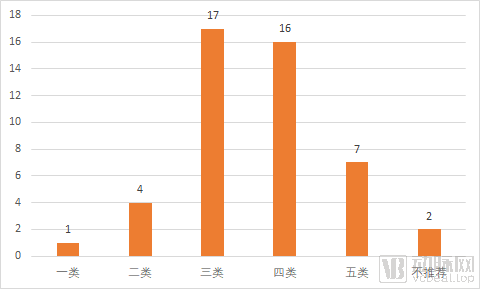
Distribution of Shortlisted Project CategoriesData Source: Event Organizing Committee
Judges of the call for entries told VCBeat that the overall quality of the projects submitted for evaluation was high, with thorough preparation. These projects integrate scientific research with the incubation of new technologies, covering innovative drugs, novel vaccines, advanced medical equipment, digital health, telemedicine technologies, and biotherapies. “We have observed that the innovative startup projects registered for evaluation demonstrate innovations at various levels, including the translation of new technologies in key disciplinary fields, clinical diagnosis and treatment capabilities, and translational research capacity.”
In this project solicitation campaign, more than one-third of the shortlisted projects focused on biomedicine. VCBeat has learned that the shortlisted biomedical innovation and entrepreneurship projects encompass both exploratory efforts in translating cutting-edge technologies—such as tumor neoantigens, synthetic biology, 3D printing, and artificial intelligence—into practical applications, and the clinical and commercial development of relatively mature technologies, including enzyme inhibitors, targeted drugs, and antibody-drug conjugates.
For example, the Class I Zhu Huan Award-winning project, “Development of Clinical Applications for a Deubiquitinase Inhibitor,” has designed and developed a series of targeted small-molecule drugs based on previously undruggable targets and a novel molecular mechanism of deubiquitinase inhibition, with the first molecule currently undergoing clinical studies.
According to the event judges, Dr. Zhang, the founder and chief scientist of this project, has long been engaged in basic cancer biology and molecular genetics research and holds technical patents in both China and the United States. “Although there is still some way to go before the project achieves final industrial commercialization, the team’s inhibitor development technology is at the global forefront, holding significant commercial and social value.”
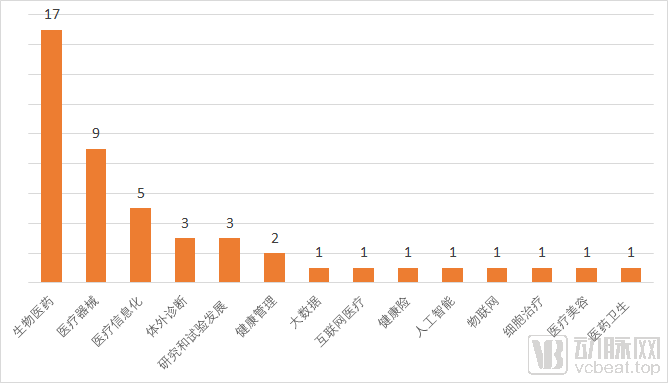
Distribution of Shortlisted Projects by Sub-sector | Data Source: Event Organizing Committee
In addition, medical device-related innovation and entrepreneurship projects also performed well in this selection. For instance, two Class III award-winning projects—the “CDMO + CRO Innovative Service Model” by Medisino and the “Magnetic Navigation AI Cardiac Intervention Robot” by MayoCoreMag—have already achieved considerable scale. Another Class III project, “Development and Market Promotion of Chemiluminescence and Dry Biochemistry POCT Testing Systems (for Critical Care),” from Xiangya School of Medicine, Central South University, was highlighted by VCBeat judges for its complete team structure and established company dedicated to product development. “Their relatively mature industrialization capabilities stand out among projects originating from healthcare institutions.”
Notably, three products from the Mayo Core Magnetic project have entered the early-stage prototype development phase. VCBeat has learned that the cardiac automatic navigation and interventional cardiology surgical equipment developed by Mayo Core Magnetic are classified as high-end medical devices, featuring extremely high entry barriers and significant product development challenges. The company is jointly developing these technologies with the Chinese PLA General Hospital (301 Hospital) and Zhejiang University, and plans to establish a research and development center in Hangzhou.
A highlight of this project solicitation campaign is that innovation and entrepreneurship projects from medical institutions and universities accounted for more than 40% of the total, with the only project awarded the Class I Crested Ibis Award coming from The First Affiliated Hospital, Zhejiang University School of Medicine.
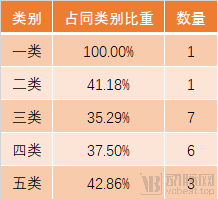
Projects from Medical Institutions and Universities by Category Data Source: Event Organizing Committee
In recent years, clinicians have increasingly become key drivers of innovation and entrepreneurship in healthcare. Positioned at the forefront of patient care, they possess a natural advantage in identifying genuine clinical needs. Furthermore, as clinicians serve as the primary point of access for patients, they facilitate later-stage project activities such as patient recruitment for clinical trials and product iteration and upgrades. Judges of the event noted that projects from medical institutions demonstrated greater universality than in previous years, reflecting a growing product-oriented mindset among clinicians.
As is common with early-stage innovation and entrepreneurship ventures, the shortlisted projects also frequently exhibit typical deficiencies such as a lack of industrialization resources, product development still in its nascent stages, and products or services not yet validated in other regions. According to incomplete statistics from VCBeat, nearly one-third of the shortlisted projects demonstrate weak industrialization capabilities, including “Surgical Training Based on 3D-Printed Models” from Zhejiang Provincial People’s Hospital and “Living Biobank of Organoids and Its Industrialization” from The First Affiliated Hospital, Zhejiang University School of Medicine. More than half of the shortlisted projects are at a very early stage, such as “Research on New Drugs for Affective Disorders Based on the Gut-Brain Axis” and “Development of Gene Chip Nucleic Acid Detection Kits for Nine Respiratory Viruses Including Novel Coronavirus and Mycobacterium Tuberculosis Complex” from The First Affiliated Hospital, Zhejiang University School of Medicine; some projects have only just completed proof of concept. In addition, a small number of projects have already launched their products or services in other cities but have not yet established a presence in Hangzhou, such as Quanyu Medical.
VCBeat has learned that the outstanding projects shortlisted this time will also be recommended for further award evaluation. For innovation and entrepreneurship projects established in Hangzhou Medicine Port, the park will regularly conduct policy interpretations and provide all-weather project matchmaking. “The park will fully leverage government and platform resources to actively support biomedical innovation projects at different stages, providing multi-dimensional innovation empowerment across policy, technology, ecosystem, capital, operations, physical space, and branding,” a relevant official from Hangzhou Medicine Port told VCBeat.
Since the state launched the Torch Program in August 1988 and explicitly proposed the establishment of high-tech industrial development zones and high-tech business incubators, the first batch of biomedical industrial parks in China has rapidly emerged. Four major industrial clusters have gradually taken shape in the Bohai Rim, the Yangtze River Delta, the Pearl River Delta, and the central and western regions, with leading parks serving as cores to radiate production capacity and innovation capabilities to surrounding areas.
In recent years, with the formation and improvement of the innovation ecosystem in China’s life sciences sector, startups with unique technologies have continued to emerge, and an increasing number of regions have placed greater emphasis on vigorously developing the biopharmaceutical industry. In May 2018, nearly three years after Hangzhou Medicine Port was designated as one of the first batch of municipal-level characteristic towns in Hangzhou, the Hangzhou Economic and Technological Development Zone, where it is located, was officially granted the title “Hangzhou Medicine Port” by the municipal government. Since then, as the core area for the development of Hangzhou’s biopharmaceutical industry, Hangzhou Medicine Port has gradually established a full-chain innovation and entrepreneurship ecosystem characterized by the “six chains,” with its output value accounting for nearly 50% of Hangzhou’s total.
For biomedical industrial parks, aligning with local supportive policies to drive industry development; attracting capital to support startups; collaborating with nearby universities to build talent pipelines; establishing an incubation system to provide comprehensive assistance for the growth of park enterprises; constructing industrial chains to promote upstream and downstream collaboration; and staying attuned to entrepreneurs’ needs by delivering high-quality services to alleviate their concerns are essential factors for standing out among numerous similar parks. To this end, Hangzhou Medical Port has built six key chains: the industrial chain, innovation chain, ecosystem chain, talent chain, financial chain, and service chain.
VCBeat has noted that the industrial chain at Hangzhou Medicine Port aggregates more than 1,000 biotechnology enterprises, covering core sectors such as biopharmaceuticals, medical devices, biomedical engineering, and healthcare big data. Seven of the global top 10 pharmaceutical companies, including Pfizer and Merck & Co., have established operations there. Through a review of the development trajectory of China’s biopharmaceutical industry clusters, VCBeat found that a comprehensive upstream and downstream supply chain enables synergistic relationships among enterprises within and around industrial parks, fosters industry collaboration, facilitates smoother inter-company communication, and more effectively accelerates the validation and commercialization of core products.
Secondly, in terms of the innovation translation and development ecosystem—addressing the most urgent needs of the shortlisted projects—Hangzhou Medicine Port has successively co-established 11 innovation service platforms with prestigious universities worldwide. Public service platforms such as the Innovation Translation Center of The First Affiliated Hospital, Zhejiang University School of Medicine, its Clinical Trial Center at Hangzhou Medicine Port, the Hangzhou Medicine Port Public Service Platform for Biopharmaceutical R&D, and the Zhejiang Provincial Institute for Medical Device Testing, along with renowned domestic and international third-party biopharmaceutical technology service providers, have been sequentially established. This has created a comprehensive support chain spanning laboratory research, preclinical studies, clinical trials, regulatory approval, drug manufacturing, and commercialization, thereby enabling targeted reinforcement of weaknesses in early-stage innovative startups.
Furthermore, Hangzhou Medicine Port has assembled a “pyramid”-shaped talent system, featuring “top-tier” leading talents and “widespread” R&D and applied professionals, providing robust intellectual support for the translation and growth of innovation and entrepreneurship projects. Meanwhile, by leveraging the efficacy of its RMB 5 billion industrial fund-of-funds and collaborating with top domestic and international pharmaceutical funds to form a financial chain, the park continues to inject vitality into these innovative ventures. According to VCBeat, the park’s financial chain has already invested in 22 projects, with actual investment exceeding RMB 700 million.
A representative from Hangzhou Medical Port stated, “We are delighted to see the strong enthusiasm for translating scientific and technological achievements into practical applications demonstrated by various innovation and entrepreneurship teams in this project solicitation campaign. High-level talents have participated actively, fostering an innovative community of shared interests among universities, research institutes, and enterprises. Hangzhou Medical Port will continue to leverage the advantages of its full-chain ecosystem, vigorously introduce prestigious institutions and leading medical resources, and jointly build innovation platforms.”