

EnViveus Intelligence Files IPO Prospectus: 15 Years of Innovation with 9 AI Technologies and a 1-Billion-Node Medical Knowledge Graph Empowering Precision Diagnosis Across Specialties
In recent years, the application of AI technology in healthcare has become increasingly widespread. Beyond the treatment phase, AI also supports a broad spectrum of health-related activities, including pre-consultation triage, intra-consultation management, and post-consultation monitoring.
The COVID-19 pandemic in 2020 fundamentally transformed the healthcare-seeking mindset of both the public and government agencies, allowing “AI + Internet” non-contact medical services to demonstrate their significant value. In early February, online consultations were incorporated into the national medical insurance system. On April 10, the National Development and Reform Commission and the Cyberspace Administration of China issued the Action Plan for Promoting “Cloud Adoption, Data Utilization, and Intelligence Empowerment” to Foster the New Economy, which advanced the implementation of first-diagnosis and appointment-based triage systems for internet-based healthcare under medical insurance, marking the first inclusion of initial online diagnoses within the scope of medical insurance reimbursement.
However, online consultations are subject to numerous limitations, such as the inability to perform physical examinations or conduct various laboratory and diagnostic tests, as well as limited diagnostic capabilities during virtual visits. As a result, online communication between doctors and patients often takes longer than face-to-face consultations. While contactless online consultations offer convenience for patients, they increase the time burden on physicians.
In the field of AI-assisted diagnosis and treatment, a large number of enterprises have invested in the research and development of single-disease imaging recognition applications for auxiliary diagnosis in recent years. However, due to limitations in technical capabilities, the volume of medical records, and other factors, it is difficult to achieve the high precision required for auxiliary diagnosis and treatment in the short term. Furthermore, variations in equipment across different regions and hospitals hinder the scalability and replicability of these solutions. Meanwhile, specialists possess extensive experience in diagnosing conditions within their own fields, resulting in limited demand for single-disease imaging recognition tools.Therefore, in medical AI products, what truly benefits physicians is an AI-assisted diagnostic system that spans multiple specialties.
ENVIVE Medical Consulting Co., Ltd. (hereinafter referred to as “ENVIVE Intelligence”) has dedicated 15 years to refining its expertise. Its knowledge graph encompasses 12 major specialties, including cardiology, respiratory medicine, gastroenterology, neurology, nephrology, endocrinology, infectious diseases, oncology, immunology, general surgery, gynecology, and pediatrics, covering over 4,000 diseases. The system provides comprehensive coverage from typical to atypical symptoms and from common to rare diseases, enabling precise multi-specialty diagnostic assistance. It also offers physicians guidance on potential differential diagnoses, physical examinations, and laboratory or imaging tests, along with accurate symptom-based prescription recommendations.
Gao Jialin, Founder and CEO of ENVIVE, holds three doctorates from Stanford University in Artificial Intelligence, Engineering Economics, and Planning Management. With broad application scenarios for AI, Gao has founded eight technology companies, four of which are related to artificial intelligence technology.
Dr. Ge Jialin told VCBeat that the concept of “AI + Healthcare” had long been on his mind. The United States imposes extremely stringent requirements on the granularity of electronic health records (EHRs). When Dr. Ge led his team into the EHR sector in 1999, he aimed to harness the power of AI. However, the technological capabilities and hardware infrastructure at the time were insufficient to support such an initiative, prompting the team to first lay the groundwork by focusing on knowledge structuring.
Dr. Ge Jialin’s team developed the world’s first structured electronic medical record (EMR) system, which has been adopted by more than 100 hospitals and healthcare institutions. After over a decade of accumulation, the system has gathered more than 450 million complete medical records. Leveraging this vast data repository, Dr. Ge Jialin has begun to build a true artificial intelligence physician based on electronic medical records.
“Generalist diagnosis is the Himalayas of the AI field, and climbing to the summit of Mount Everest is no easy feat,” said Dr. Ge Jialin in an interview. “We recognize that China faces a severe shortage of high-caliber general practitioners, which drives patients to seek care at large hospitals for even minor illnesses, resulting in an imbalance in medical resource allocation. Therefore, we have made it the mission of ENVIVE Intelligence to address this issue.”
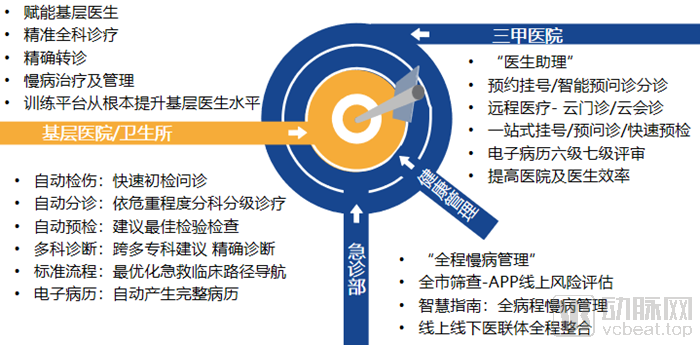
In 2015, ENVIVE was officially established in Shanghai, launching its multi-specialty AI consultation, triage, and clinical decision support system, which had been under research and development for many years. The offering includes both software and hardware products, with a product line spanning pre-consultation, intra-consultation, and post-consultation phases, as well as online-to-offline services. Commercially, it provides comprehensive solutions tailored to diverse medical institutions.
(Image provided by ENVIVE)
The core of the ENVIVE AI-Assisted Diagnosis System is a vast medical knowledge graph with one billion associated neurons, coupled with a precise AI physician reasoning engine. The platform’s underlying module, “ENVIVE AI Deep Diagnosis,” calculates the most likely primary and differential diagnoses in real time based on patient consultation data, following evidence-based medical logic. To date, the ENVIVE AI-Assisted Diagnosis System has covered 12 major internal medicine specialties and over 4,000 disease types.
To become an auxiliary diagnostic system endorsed by physicians, it must pass rigorous tests for accuracy and comprehensiveness. Since 2005, the ENVIVE team has employed machine learning to conduct supervised learning on de-identified medical records from over 100 large hospitals and more than 10 million medical journal articles and reports. A knowledge graph comprising one billion neurons was constructed through expert annotation jointly performed by 18 medical specialists from Stanford University and nearly one hundred senior physicians across different countries.
To search for the optimal path across a massive knowledge graph, identify potential diagnoses, and rank them, the ENVIVE team pioneered the “Deep Medical Reasoning Engine.” They developed a multi-dimensional reasoning engine that leverages nine AI technologies—including Bayesian networks, higher-order abstract search, and reinforcement learning—to perform real-time diagnostic reasoning and computation.
“ENVIVE’s multi-specialty AI physician functions like a multidisciplinary consultation involving more than ten specialists, delivering professional expertise across diverse medical institutions and health sectors. Therefore, we have deployed the ENVIVE AI Clinical Decision Support System across various scenarios to provide comprehensive services—ranging from tertiary hospitals to primary care facilities, from pre-consultation to post-consultation care, and from in-person to online services,” introduced Dr. Ge.
Three-Hour Wait, Three-Minute Consultation. Built upon the core of ENVIVE’s “AI In-Depth Diagnosis,” the ENVIVE AI Full-Specialty Consultation, Triage, and Diagnostic Assistance Platform enables intelligent pre-consultation within medical consortiums and hospitals, implements multi-level, end-to-end triage, and assists physicians in achieving precise diagnosis and treatment, thereby comprehensively enhancing diagnostic accuracy and consultation efficiency.
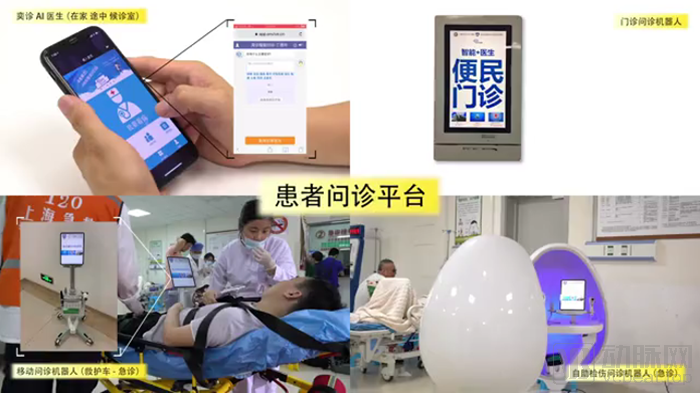
ENVIVE Intelligent divides the pre-consultation phase into three components: AI-powered preliminary consultation, AI-based automated triage, and injury severity grading. Correspondingly, it has developed three products: a mobile app, a consultation robot, and a vital signs consultation kiosk.
In recent years, with the integration of intelligent robotics and healthcare, intelligent triage robots have gradually become a new highlight in hospitals. ENVIVE’s triage robots have been deployed and put into use at Xuhui Hospital of Zhongshan Hospital Affiliated to Fudan University and Shanghai Tenth People’s Hospital.
(Image provided by ENVIVE Intelligent)
Before visiting the hospital, patients can complete a pre-consultation at home via the ENVIVE APP. Upon arrival, they can also undergo an initial pre-consultation with a robot. The vital signs consultation pods installed within the hospital can real-time collect patients’ vital sign data, including blood pressure, pulse, temperature, blood oxygen saturation, and respiratory rate, enabling precise triage classification. After completing the pre-consultation, the robot will automatically recommend a triage level, match the patient with the appropriate department, and directly register the appointment. Guided by the intelligent system, patients can undergo basic examinations before seeing the doctor.
Furthermore, this system plays a significant role in the emergency department. As 95% of emergency patients are conscious and able to communicate, the ENVIVE robotic assistant completes comprehensive vital signs monitoring within 40 seconds, provides nurses or patients with dynamic, targeted prompts for history taking, and finalizes triage classification and assignment within 90 seconds, thereby enabling rational and efficient allocation of emergency resources. Hospital feedback data provided to ENVIVE indicates that this model has substantially improved the efficiency and accuracy of diagnosis and triage.
Unlike many AI-assisted diagnostic products on the market, the ENVIVE AI Pre-Consultation System not only allows patients to input their chief complaints but also dynamically prompts them regarding other associated symptoms, enabling a step-by-step, reasoned clinical inquiry.Dr. Ge told VCBeat that this consultation format enables patients to describe their symptoms more accurately, ensuring that no critical information is omitted. Meanwhile, by leveraging structured data to assist AI algorithms in making more precise diagnoses, it can effectively reduce the risks of missed and misdiagnoses. This has been the key challenge that ENVIVE has dedicated 15 years to overcoming.
On the physician-side interface of the ENVIVE system, doctors can view the patient’s complete clinical profile and the system’s preliminary diagnosis, thereby gaining a comprehensive understanding of potential high-risk and rare diseases.Dr. Go explained, “Specialists with typical experience are generally familiar with dozens of diseases. The ENVIVE diagnostic system comprehensively provides differential diagnosis alerts for high-risk and rare diseases, along with corresponding testing recommendations for physicians’ reference, functioning as a real-time navigation tool for doctors.”
Upon completion of the physician’s diagnosis, the system simultaneously generates a structured electronic medical record to better support big data analytics and intelligent management.
Since its inception in 2015, the ENVIVE AI System has been successfully deployed at Xuhui Hospital Affiliated to Zhongshan Hospital, Fudan University, and Shanghai Tenth People’s Hospital. It has also established an online consultation and triage system for the medical consortium, covering the Xuhui District Health Commission, Zhongshan Hospital, Xuhui District Central Hospital, and primary healthcare institutions within the district. Furthermore, through strategic internet partnerships, it provides intelligent pre-consultation and triage services to hundreds of hospitals across China.
“A child around two years old can easily distinguish between cats and dogs, but for a machine to learn this distinction, it requires training on tens of thousands of manually annotated image datasets to barely achieve the same capability,” Dr. Ge remarked humorously in an interview. He noted that current AI machine learning possesses only the intellectual capacity of a two-year-old, and it is no easy feat for artificial intelligence centered on machine learning to reach medical-grade proficiency.
Dr. Ge stated, “The foundation of artificial intelligence lies in vast amounts of knowledge, and constructing a medical knowledge structure requires substantial time and corresponding technical expertise. The structured knowledge graph we have refined over 15 years constitutes the greatest technological barrier for ENVIVE.”
Regarding future development, Dr. Ge stated that ENVIVE currently has two complementary segments: online and offline. Its AI system already possesses precise diagnostic capabilities to assist in clinical diagnosis and treatment. In the future, the company will continue to expand the scope and depth of its knowledge base, creating a more efficient medical consultation process for both patients and physicians.