

Shandong Proposes Stricter Internet Hospital Regulations: Key Changes in Entity Requirements, One-to-One Affiliation, and Clinical Practice Standards
Recently, a document titled “Detailed Implementation Rules for the Administration of Internet Hospitals in Shandong Province (Draft for Comments)” (hereinafter referred to as the “Rules”), issued by the Health Commission of Shandong Province, has been circulating within the industry. Building upon the National Health Commission’s “Administrative Measures for Internet Hospitals (Trial)” and “Administrative Measures for Internet Diagnosis and Treatment (Trial),” the Rules propose more detailed requirements in three major areas, including restrictions on the categories of physical hospitals that may serve as the foundation for internet hospitals and the required levels of electronic medical records.
Although this is not an officially issued document, it has still sparked intense discussion within the industry in a short period. Some viewpoints suggest that the "Detailed Rules" exclude primary healthcare institutions from participating in internet hospitals and even restrict family doctor contract services. To provide a more comprehensive perspective, we have collected multi-source data and conducted numerous interviews in this article to analyze the potential industry impact of the "Detailed Rules."
Since the General Office of the State Council issued the “Opinions on Promoting the Development of ‘Internet + Healthcare’” in 2018, setting the policy tone for the internet healthcare industry, and the National Health Commission formulated three normative documents, including the “Administrative Measures for Internet Hospitals (Trial),” 13 provinces and municipalities, such as Ningxia, Gansu, and Shanghai, have promulgated administrative measures or detailed implementation rules related to internet hospitals.
In key areas such as the accreditation, practice, and supervision of internet hospitals, most provinces have adopted the regulations issued by the National Health Commission, with some introducing more specific requirements. Shandong’s recently formulated “Detailed Rules” fall into the latter category, primarily covering three major aspects:
First, there are requirements regarding the grade or category of the physical hospitals involved in internet hospitals. Eligible medical institutions are restricted to those categorized as “Hospitals,” “Maternal and Child Health Hospitals,” or “Specialized Disease Prevention and Treatment Hospitals” (excluding community hospitals). Independently established internet hospitals must rely on physical medical institutions that meet the aforementioned category requirements and have achieved Level 3 or above in electronic medical record systems.
Second, online services relying on offline entities are subject to a “one-to-one” requirement. A medical institution may add only one internet hospital as its secondary name. An independently established internet hospital shall rely on no more than one physical medical institution. It is prohibited to apply for an independently established internet hospital by relying on a physical medical institution that has already designated an internet hospital as its secondary name, and it is also prohibited to apply for multiple independently established internet hospitals by relying on the same physical medical institution.
In other words, regardless of the application model adopted, each physical hospital corresponds to one internet hospital.
Third, the practice requirements are more specific. Physicians must have at least five years of independent clinical experience, and medical services must be provided in an environment where both the physician and the patient can see each other in real time. This requirement for the physician-patient interaction environment means that medical services can only be delivered through video consultations, while text-and-image consultations may only offer advisory services.
Regarding follow-up visits, the Detailed Rules specify as follows: For patients who have not visited a physical medical institution, they are required to provide medical records from a physical medical institution confirming a diagnosis of one or more common or chronic diseases. Provided that the physician has a comprehensive understanding of the patient’s medical history, prior diagnoses, and previous prescription medications, and under conditions of real-time, seamless doctor-patient communication, follow-up services may be delivered via an internet hospital within the prescribed scope of services.
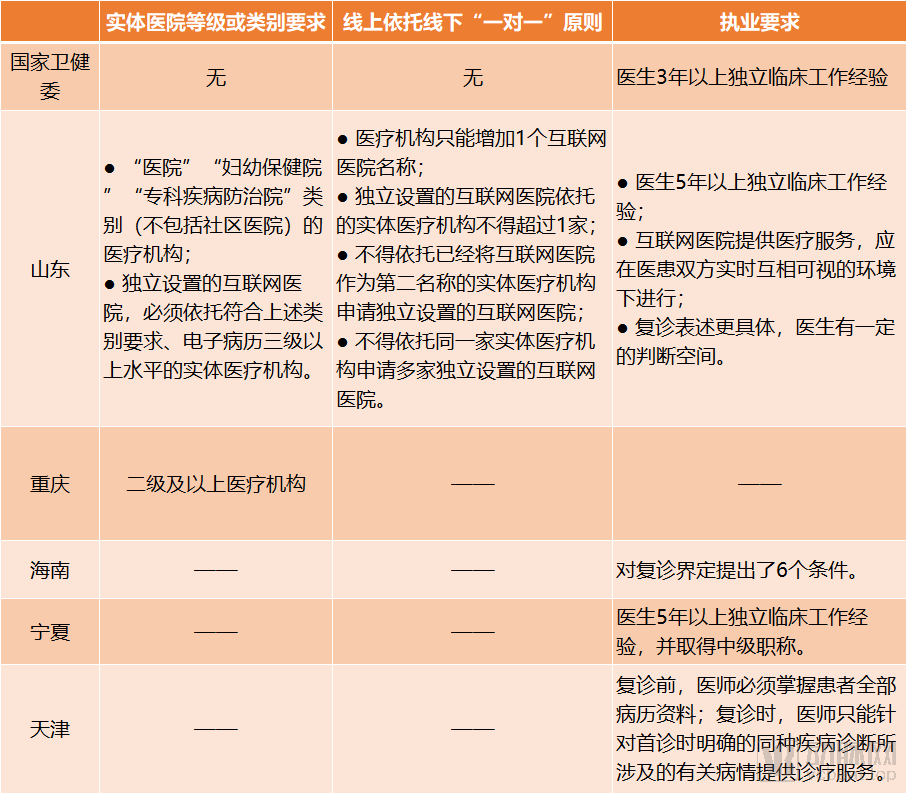
Regulations on Key Links of Internet Hospitals by the National Health Commission and Some Provinces and Cities, Source: Official Websites of the National Health Commission and Provincial/Municipal Health Commissions, Chart by VCBeat
We have reviewed the regulations issued by the National Health Commission and certain provinces and municipalities regarding key aspects of internet hospitals. It is evident that, in addition to Shandong, other regions have also established more stringent requirements. For instance, Chongqing mandates that physical hospitals be classified at Level II or above, while Ningxia requires physicians to have at least five years of independent clinical practice experience. In comparison, Shandong’s detailed implementation rules are indeed more comprehensive and tailored.
Chen Qiulin, Director of the Health Economics Research Office at the Institute of Population and Labor Economics, Chinese Academy of Social Sciences, believes that the overarching approach of the Detailed Rules is to enforce strict regulation and ensure safety.
For example, requirements have been imposed on the electronic medical record (EMR) systems of brick-and-mortar hospitals, which is beneficial for the long-term development of internet healthcare. Currently, many internet healthcare platforms primarily offer lightweight consultations and lack standardized EMRs.
Meanwhile, in accordance with the provisions of the Detailed Rules, industry organizations should play a pivotal role in ensuring the quality and standardization of diagnosis and treatment in internet hospitals. Consequently, the internet healthcare sector requires innovative industry organizations that break away from traditional mindsets and approaches, working together to promote the standardized development of the industry.
The Detailed Rules also mandate the integration of internet hospital systems with regulatory platforms as a prerequisite, which is fundamental to achieving end-to-end oversight. Despite the challenges involved, this initiative must be advanced.
Nevertheless, the very purpose of the draft for comments is to facilitate discussion, as certain specific measures in the Detailed Rules are open to debate.
For example, community hospitals are not permitted to establish internet hospitals, yet there is encouragement for the decentralization of medical resources. In this context, can a medical consortium as a whole establish an internet hospital?
Internet hospitals should provide medical services in an environment where both doctors and patients can see each other in real time. Is this requirement too strict? How should medical services be defined, and should doctors be allowed to make their own choices?
"The physicians' qualifications exceed the requirements set forth in national documents, but from the perspective of Shandong's overall medical standards, there appears to be no particularly strong justification for this."
Furthermore, restricting each physical hospital to establishing only one internet hospital and partnering with just a single third-party platform appears unnecessary. Provided that processes are clear and responsibilities well-defined, allowing a physical hospital to collaborate with multiple platforms would facilitate serving more patients.
Chen Qiulin also noted that while the Detailed Rules explicitly prohibit initial consultations, their wording suggests that online medical consultations for first-time visits are permissible. The determination is left to physicians’ discretion, based on patients’ medical records, medical history, and medication usage. This can be interpreted as a conditional relaxation of the definition of follow-up consultations.
Therefore, in Chen Qiulin’s view, while the original intent of the Detailed Rules is commendable and reflects efforts at innovation and breakthroughs, certain specific measures still need to be refined based on feedback from various stakeholders.
In fact, Shandong was among the earliest provinces to explore internet hospitals. As early as before the introduction of new national policies on internet healthcare, Shandong had already sparked a wave of internet hospital construction starting in 2017, with public hospitals serving as the leading force. After internet healthcare received explicit support from the central government in 2018, Shandong responded swiftly, particularly in terms of policy and model innovation.
In September 2018, the National Health Commission issued the Administrative Measures for Internet Hospitals (Trial), requiring that provincial-level internet healthcare regulatory platforms be established before approving internet hospitals. Two months later, the Shandong Provincial Internet Healthcare Services Regulatory Platform went online and became one of the first provincial-level regulatory platforms completed nationwide. In December 2018, Shandong Province issued its first batch of internet hospital licenses within the province.
In May 2019, Shandong Province was designated by the National Health Commission as a demonstration province for “Internet + Healthcare.” Two months later, the People’s Government of Shandong Province issued the *Action Plan for Advancing the Construction of Shandong as a Demonstration Province for “Internet + Healthcare” (2019–2020)*, which outlined seven major categories comprising 16 specific initiatives, including the development of internet hospitals.
In August 2019, the National Healthcare Security Administration issued the “Guiding Opinions on Improving Price and Medical Insurance Payment Policies for ‘Internet Plus’ Medical Services.” In December, the Shandong Provincial Healthcare Security Administration released the first batch of price lists for “Internet Plus” medical service items.
During the COVID-19 pandemic in 2020, the National Healthcare Security Administration issued a document on March 2 to include internet-based medical services in the medical insurance payment system. On March 6, the Shandong Provincial Healthcare Security Administration and the Shandong Provincial Health Commission also introduced relevant regulations.
In April 2020, the Shandong Internet Medical Insurance and Health Service Platform was launched, issuing China’s first electronic medical insurance settlement statement from a platform-based internet hospital. This achievement marked the first time the entire process of “three-medical linkage”—integrating internet healthcare, pharmaceuticals, and medical insurance—was fully connected, thereby exploring an integrated model for the implementation of national healthcare reform.
Among these measures, Shandong Province has taken the lead compared to other provinces and municipalities. Shandong has not only moved quickly but also effectively; its development experience in internet healthcare has been designated as a model by the National Health Commission and promoted nationwide.
Since 2018, the National Health Commission has held only two press conferences at the local level to introduce regional experiences in the development of internet-based healthcare. One was held in Shandong Province and the other in Ningxia Hui Autonomous Region. The presentation of Shandong’s experience took place in April 2019, prior to the introduction of Ningxia’s experience in May 2019. At that time, 35 hospitals in Shandong had already completed registration as internet hospitals, enabling regulatory oversight covering the entire process from source to outcome.
Under the premise of continuous breakthroughs and innovations in policies and models, the development of internet hospitals in Shandong Province has been remarkable in recent years.
In February 2017, the Internet Hospital of the Affiliated Hospital of Qingdao University was launched and began operations; in April 2018, Shandong Provincial Third Hospital became the first pilot unit for internet healthcare within the province. Cities such as Binzhou and Zibo also initiated explorations into the development of regional internet hospitals. Following the introduction of new policies on internet hospitals in 2018, Shandong Provincial Third Hospital capitalized on this momentum and officially became one of the first batch of internet hospitals in Shandong Province.
Connecting to the provincial internet medical supervision platform is a basic requirement for applying to establish an internet hospital. As of June 24, 2020, the Shandong Provincial Internet Medical Service Supervision Platform had connected with 150 internet hospitals.
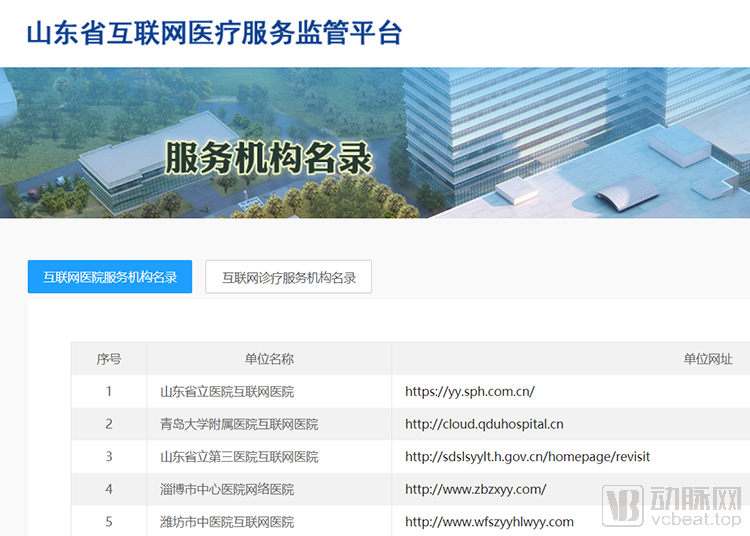
Screenshot of the Shandong Provincial Internet Medical Service Supervision Platform
We analyzed the composition of 150 internet hospitals.
First, in accordance with the provisions of the "Administrative Measures for Internet Hospitals (Trial)", the naming rules for internet hospitals are as follows:
Physical medical institutions applying independently for an Internet hospital as their secondary name shall include "Name of the Institution + Internet Hospital";
When a physical medical institution collaborates with a third-party entity to apply for an internet hospital as its secondary name, the name shall follow the format: “Name of the Institution + Identifier of the Partner + Internet Hospital.”
For independently established internet hospitals, the name shall include “Applicant’s Identifying Name + Internet Hospital”.
Thus, the name of an internet hospital reveals its primary sponsoring entity. Among the 150 internet hospitals in Shandong Province, 105 are led by physical hospitals, 32 are jointly established by physical hospitals and enterprises, and 13 are enterprise-led.
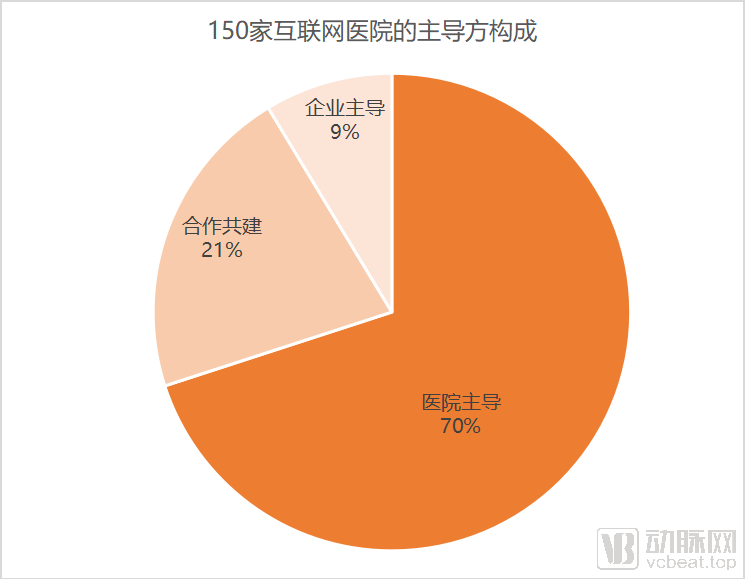
Composition of the Leading Entities for 150 Internet Hospitals in Shandong | Chart by VCBeat
In terms of the composition of leading entities, hospital-led models constitute the majority, consistent with the current national landscape of internet hospitals in China. Meanwhile, enterprise-led models and collaborative co-construction are also significant components. Notably, collaboratively built internet hospitals account for a relatively high proportion, indicating that enterprises are able to engage more extensively in post-establishment operations beyond merely building the internet hospital infrastructure.
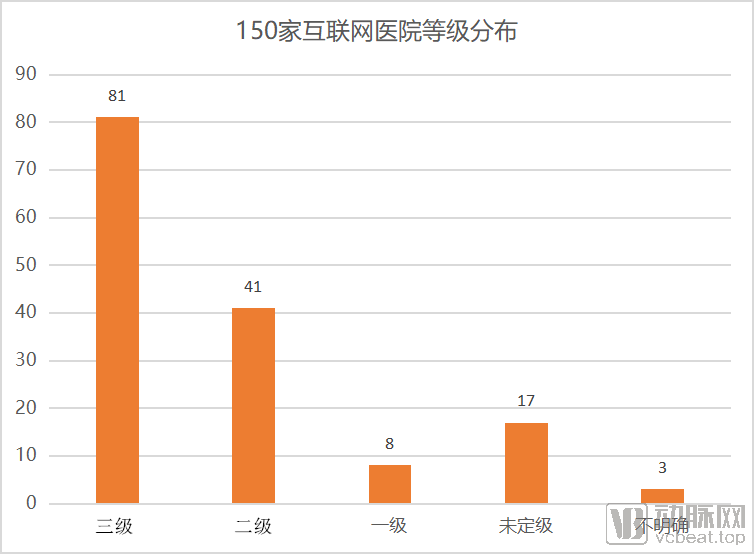
Distribution of Accreditation Levels Among 150 Internet Hospitals in Shandong Province
As shown in the figure above, among the 150 internet hospitals, tertiary hospitals constitute the majority, while secondary hospitals account for a significant proportion—half the number of tertiary hospitals—with a small number of primary hospitals included. In contrast, according to previously compiled basic data on internet hospitals across China by VCBeat, the number of tertiary hospitals far exceeded that of secondary hospitals. Compared with the national overall situation, Shandong has tilted its internet hospital development efforts more toward secondary medical institutions.
Meanwhile, among the 150 internet hospitals, 35 are affiliated with counties or county-level cities, accounting for 23%. In contrast, this proportion stands at only 15% among all internet hospitals in China.
Of course, a high proportion of county-level hospitals and secondary hospitals does not necessarily mean that internet hospitals are in a state of benign development. However, by connecting the data from the above dimensions, it can be found that Shandong Province currently has an overall open attitude towards various types of internet hospitals. Compared to other provinces where either physical hospitals or enterprises dominate, Shandong’s internet hospitals appear more diverse in terms of leading entities, hospital levels, and hospital locations.
This phase can be regarded as a stage of trial and exploration of various models in Shandong, characterized by a large number of internet hospitals, diverse types, and extensive corporate involvement.
In summary, the Detailed Rules formulated by Shandong Province at this stage may reflect improvements identified during previous trials, or they may represent necessary regulatory measures introduced as internet hospital development reached a certain level, aiming to prevent potential risks before they arise.
Although the Detailed Rules are not an official document, they have already sparked extensive discussion within the industry. We also interviewed multiple administrators of internet hospitals, and their viewpoints can be summarized into two distinctly different categories.
The first category of opinion holds that although the Detailed Rules fall short of industry expectations for the policy, their underlying logic is sound. For instance, community hospitals are excluded from the scope of internet hospitals because their primary mandate is to provide basic healthcare services to patients within their designated jurisdictions, and their capabilities are insufficient to support further expansion through internet hospital platforms. This approach does not contradict the principles of tiered diagnosis and treatment. Allowing every community hospital to establish its own internet hospital could lead to a waste of resources.
The requirements for Level 3 Electronic Medical Records (EMR) impose higher standards on the informatization construction of hospitals. It would be short-sighted and overly eager for quick success to establish an internet hospital if the physical hospital’s level of medical informatization has not reached a certain threshold.
In its 2018 “Notice on Issuing the Administrative Measures (Trial) and Evaluation Standards (Trial) for the Graded Evaluation of Electronic Medical Record System Application Levels,” the National Health Commission stipulated that by 2019, all tertiary hospitals must achieve a rating of Level 3 or above, and by 2020, secondary hospitals must reach Level 3 or above. If physical hospitals can complete the grading assessments on schedule, the establishment of internet hospitals by secondary hospitals will be minimally affected.
Furthermore, the widely circulated online claim that family doctor sign-up services are restricted is a misinterpretation. As community hospitals and other primary healthcare institutions can apply for qualifications to provide internet-based medical services, they are equally entitled to deliver “Internet+” family doctor services, as explicitly stipulated in the Detailed Rules.
The second viewpoint argues that the thresholds set forth in the Detailed Rules are excessively high. Requirements such as designation as a community hospital, Level 3 electronic medical record (EMR) system certification, and at least five years of independent clinical experience for physicians effectively exclude primary healthcare institutions and junior doctors. This may further intensify the “siphon effect” of large hospitals on patient flows. However, the core mandate of large hospitals and senior physicians is to manage complex and critical cases and engage in academic research, rather than to conduct online follow-up consultations for common and chronic diseases.
From this perspective, although the starting point of the Detailed Rules is to safeguard medical quality and safety, it should be recognized that online supervision is easier than offline supervision, so regulatory conditions should not be set excessively high. Excessively high thresholds prevent medical institutions with insufficient capabilities from participating in internet hospitals; however, enterprises can choose to partner with other institutions that meet the requirements. This situation also prevents medical resources and social resources from achieving optimal allocation.
The deadline for public comments on Shandong’s “Detailed Rules” is June 24. It remains unclear what feedback has been collected thus far, and how many provisions in the “Detailed Rules” will be adopted into the final version remains to be seen. What is certain, however, is that the development of internet hospitals has progressed through a continuous cycle of identifying and resolving issues. To address root causes effectively, solutions must be considered from multiple dimensions, and the same principle applies to policy formulation.