

Jiang Yangzhi of Delian Capital: Key to Innovative Healthcare Investment Lies in Risk Identification and Strategy Alignment

Delian Capital
Investment Institution Specializing in Technology and Innovative Healthcare Sectors
In the first half of 2020, the primary market remained in a prolonged winter due to the impact of the COVID-19 pandemic. Nevertheless, Delian Capital still secured a number of high-quality projects during this period. Over the first six months of the year, Delian Capital consecutively invested in three companies in the healthcare sector: Amunix, Meilian Taike, and Chenan Biologics. These investments spanned multiple healthcare subsectors, including biopharmaceuticals, in vitro diagnostics, and precision diagnostics.
Delian Capital focuses on three key areas: software-oriented frontier technologies, hardware-oriented high-end manufacturing, and innovative healthcare. In the field of innovative healthcare, Delian Capital continues to invest in hard-tech medical innovations, establishing a rigorous and precise investment strategy that has led to backing several star medical enterprises, including Venus Medtech, Sanbo Brain Hospital, and MicuRx Pharmaceuticals.
Delian Capital has gradually refined its investment logic through repeated investments:Innovative healthcare investment requires identifying the risks of individual projects and weighing their competitive factors to align with appropriate investment strategies. To date, Delian Capital has established a dual presence in China and the United States: investing in global first-in-class innovations in the U.S., while favoring fast-growing companies in China that leverage technology as an entry point.
Jiang Yangzhi stated that in the post-pandemic era, healthcare-focused funds have not actually slowed their investment pace. In practice, there is often a shortage of lead investors; once a lead investor is secured, co-investors rush to participate in the deal. This phenomenon reflects that many investors have yet to develop their own fundamental understanding and lack professional insights into industry trends.
How Does Delian Capital View Post-Pandemic Healthcare Investment Trends? From a Global Perspective on China-U.S. Investments, How Does Delian Capital Perceive the Dimensions of Innovation Across Different Markets? VCBeat (WeChat ID: vcbeat) conducted an exclusive interview with Jiang Yangzhi, Partner at Delian Capital. In his view, healthcare investment must be research-driven to develop a systematic understanding and identify the underlying “X” factor behind industry developments.

Jiang Yangzhi, Partner at Delian Capital
The COVID-19 pandemic once brought society to a standstill, significantly impacting healthcare investments. While the pandemic disrupted many industries, Delian Capital has consistently adhered to its strategy of betting on major trends; consequently, the pandemic had limited impact on Delian Capital’s investment layout in the healthcare sector.
“When the tide recedes, panic sets in among most market participants, but for us, it presents an opportune moment to invest.” Moving forward, Delian Capital will continue to strategically position its healthcare investments along high-potential sectors.
Investing in healthcare across the vastly different environments of China and the United States is akin to navigating distinct maritime domains; although one faces entirely new payment systems and medical landscapes, there are still common underlying principles to be found.
Jiang Yangzhi believes that, for medical investment in China and the United States, the core lies in defining different risks. The definitions of risks at various levels are shown in the figure below.
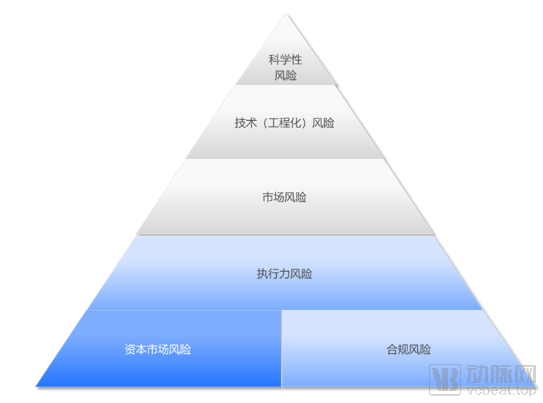
“We generally categorize the risks commonly encountered during corporate development into six types: scientific risk, technical risk (or engineering risk), marketization risk, execution risk, capital market risk, and compliance risk. The relative importance of these risks varies across different markets. In the United States, where innovative technologies are more advanced and the innovation ecosystem is more mature, scientific risk and market risk are the key competitive factors. In contrast, China’s healthcare industry is still undergoing transformation; in addition to scientific risk, startups must also contend with engineering risk and execution risk, which can prove fatal. Therefore, Delian Capital has always maintained that when selecting healthcare investment targets, the focus should be on novelty abroad and speed domestically.”
He added, “In the United States, we primarily invest in first-in-class global innovation projects, while also co-investing with renowned foreign funds to mitigate investment risks. In China, we favor ventures with scientifically validated concepts and relatively lower market risks, where products possess high technical barriers and teams demonstrate strong operational capabilities and localization execution. This defines Delian Capital’s strategy of seeking ‘novelty abroad’ and ‘speed at home.’”
In overseas investments, Delian Capital focuses on innovative life sciences companies that carry both scientific and market risks, prioritizing therapeutic projects addressing unmet clinical needs through novel targets and new molecules. Examples include Amunix, which specializes in developing prodrug therapies for immune activators to treat solid tumors; Hummingbird, which develops novel breakthrough precision antibody therapies for refractory diseases; Apexigen, an oncology immunotherapy company; and OnKure, which targets HDAC.
“The logic of ‘faster in China’ was well demonstrated when Delian Capital invested in Venus Medtech. In terms of risk identification, interventional therapy products have already undergone large-scale commercial validation in overseas clinical settings, resulting in relatively low market and scientific risks. Regarding critical engineering risks, Venus Medtech has established an R&D center in California, with its engineering capabilities significantly ahead of domestic competitors. In terms of localization and implementation, Venus Medtech collaborates with leading principal investigators (PIs) at major hospitals such as Fuwai Hospital, Zhongshan Hospital, and West China Hospital, while also boasting a highly efficient execution team. Therefore, the success of Venus Medtech is inevitable.”
The Meiliantaike project, recently invested in by Delian Capital, is a company in the POCT sector that leverages technological innovation and enjoys significant first-mover advantages. “Chemiluminescence has achieved mature application in core hospitals. Against the backdrop of tiered diagnosis and treatment and the development of the ‘Five Major Centers,’ there is strong demand for POCT solutions, with relatively low scientific and market risks. The company’s equipment platform and multiple supporting reagents have already obtained regulatory approvals, so technical risk is no longer a major concern. The key focus in evaluating such projects now lies in execution capability. This company is an angel investment from Dr. He Wei’s ETP Fund. Dr. He brings excellent international perspective, industry insight, industrial resources, and operational experience. The executive team, led by Li Feng, has many years of operational experience in the IVD field. With a solid foundation, strong momentum, and innovative technology, the company is poised to become a top player in this sector.”
Jiang Yangzhi stated that when Delian Capital chose to invest in hard technology back then, it was effectively “squeezed” into this sector. At that time, primary market healthcare investments were more focused on market-driven products and internet healthcare solutions, making the sector highly crowded. Delian Capital chose to swim against the tide, diving deep into the underexplored realm of hard-tech healthcare investments.
When initially selecting healthcare investments, Delian Capital sought companies that were relatively easy to understand yet still possessed technological barriers. Consequently, Delian Capital chose to focus on the medical devices and healthcare services sectors. Guided by this straightforward investment strategy, Delian Capital invested in Venus Medtech and Sanbo Brain Hospital when selecting portfolio companies.
When investing in Sanbo Brain Hospital, the ophthalmology, dentistry, and medical aesthetics sectors within healthcare services have attracted significant attention. However, Delian Capital is more interested in companies with strong hard-tech capabilities. In comparison, neurosurgery has a very high barrier to entry and is considered a technology-intensive segment within healthcare services, which is why Delian Capital chose to invest in Sanbo Brain Hospital. This May, Sanbo Brain Hospital completed its Series B equity financing, raising over RMB 800 million.
Following the thread of hard technology, Delian Capital has deepened its healthcare investments from medical services and devices to technically challenging generic drugs, and further into innovative drugs, biotechnology, and precision diagnosis and treatment. Adhering to this technology-driven investment strategy, which has been consistently validated across various sectors over the past decade, Delian Capital has continuously enriched its strategic framework and enhanced its industry insights.
In June 2020, Delian Capital consecutively announced its investments in Meilian Taike and Chenan Biologics. Maintaining a high deal frequency in the post-pandemic era requires a solid underlying investment thesis and the confidence to navigate turbulent markets.
ChenAn Bio aims to unlock the clinical applications of mass cytometry, positioning itself as the first among only two companies globally to break into this clinical arena. With a unit price ranging from RMB 8 million to 12 million, the high technical barriers of mass cytometers are evident in a market crowded with providers of high-end medical equipment. The company has made substantial progress in both its instruments and reagents, effectively mitigating scientific and technical risks. Regarding market risks, the metal ion-based labeling system offers distinct advantages in clinical subtyping. It is poised to replace flow cytometry in the well-established field of hematologic disease subtyping and shows strong potential in tumor subtyping and routine immune evaluation. Furthermore, it is set to make significant inroads in quality control for cell therapies, companion diagnostics, and personalized precision medicine. “The management team led by Yu Chong combines international vision with local execution capabilities; they are strategic and effective. The company is destined to become a global leading innovator in the clinical application of single-cell proteomics,” said Jiang Yangzhi, expressing full confidence in the future of ChenAn Bio.
Within Delian Capital, the team has consistently emphasized driving insights through profound and rigorous research, while making investment decisions with a reverence for fundamental investment principles. Regarding the underlying logic of sector selection, Delian Capital evaluates opportunities based on three fundamental aspects.
First, has a turning point opportunity emerged at the technical level? Delian Capital is more eager for explosive growth opportunities driven by technological inflection points.ThisOpportunities such as cell therapy and gene therapy, single-cell technologies, antibody-plus platforms (including bispecific antibodies, multispecific antibodies, ADCs, etc.), RNA-targeted therapies, PROTACs, and algorithmic platforms.From the perspective of Delian Capital’s strategic positioning in the single-cell sector, single-cell technology elevates human understanding of biological science to the level of individual cells, and this field is poised for explosive growth opportunities.
“Previously, whether for gene analysis or protein analysis, tissues were homogenized and analyzed in bulk. Now, it is possible to construct individual libraries for each cell, which we consider a dimension-level innovation. In the United States, the market capitalization of 10x Genomics has approached $9 billion. In this sector, Delian Capital has invested in companies with distinct strengths across the industry chain, such as Xunyin Bio, HiFiBio, and ChenAn Bio.”
In addition to technological inflection points, another fundamental factor observed by Delian Capital is policy impact. The influence of policy on the market is particularly pronounced in China. Taking the CRO and CDMO industries as an example, domestic healthcare policies underwent profound changes after 2015. Innovation-oriented policies have squeezed the survival space for traditional generic drugs, thereby driving the development of the entire pharmaceutical innovation chain. However, only two leading enterprises, Tigermed and WuXi Biologics, currently dominate the segments of clinical CROs and large-molecule CDMOs. Delian Capital believes that as pharmaceutical companies impose increasingly stringent requirements on clinical trial design and implementation, data management and statistics, as well as drug manufacturing processes and production, more companies will emerge and thrive in this sector.
Once the above two elements are in place, the final fundamental factor is whether the market landscape has taken shape. It is only in sectors where the market landscape has yet to crystallize that investment institutions will find greater opportunities.
From Jiang Yangzhi’s perspective, investors and enterprises are equal partners; successful investment is built on mutual recognition. A fund should not only provide capital to entrepreneurs but also continuously serve as a strategic guide throughout their entrepreneurial journey. In the field of healthcare investment, Delian Capital has maintained a lean and elite team, deeply cultivating the medical industry. By leveraging its years of accumulated industrial resources and expertise, the firm empowers entrepreneurs and supports a greater number of innovative healthcare companies.