

580,000 Viewers Tune In as Five Industry Leaders Discuss Innovation and Investment in China's Medical Device Sector
On the morning of June 24, five leading figures in the innovative medical device industry gathered together.
At the invitation of the organizers, Tang Haofu, Chairman of Chuangrui Investment Group; Cai Lie, CFO of Peijia Medical; Wang Guohui, Founder and CEO of Xinwei Medical; Zhang Junqi, Senior Product Manager for the APV Aortic Market at Medtronic; and Bart Boschmans (Lin Bosen), Consul for Flanders Commerce at the Consulate General of Belgium in Shanghai, traveled from various locations to Gaochun, Nanjing.
This event was hosted by the People's Government of Gaochun District, Nanjing City. In consideration of epidemic prevention and control measures, only about 100 attendees were present at the venue; however, at its peak, 580,000 viewers simultaneously watched the dialogue online.
The panel discussion featured these five individuals, moderated by Tang Haofu, under the theme “The Path to Industrializing Innovative Solutions in Cardiovascular Interventional Therapy.” During the session, they delved into topics of significant interest to the industry, including “Domestic Substitution and Local Innovation in Medical Devices,” “The Growth Logic of Medical Device Giants,” and “How to Launch a Startup in the Medical Device Sector.”
In their dialogue, they neither fully agreed nor sharply disagreed; instead, they shared and listened to profound insights, aiming solely to unlock the future of innovation in the medical device industry.
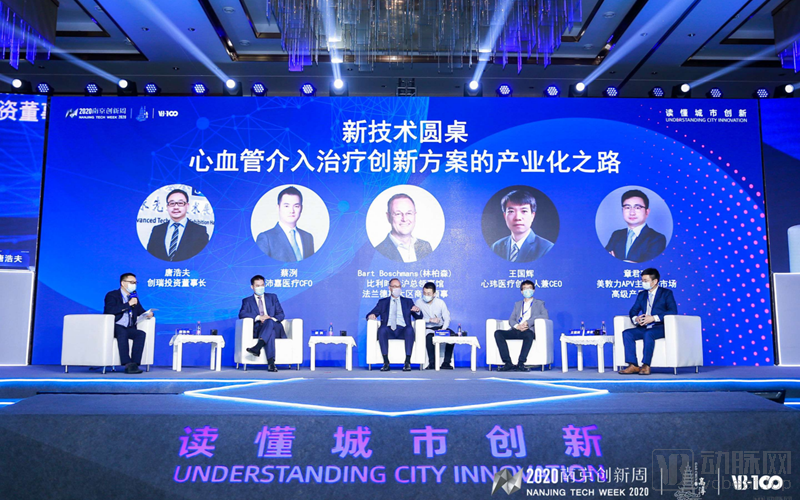
From left to right:Tang Haofu, Chairman of Chuangrui Investment Group; Cai Lie, CFO of Peijia Medical;Bart Boschmans (Lin Bosen), Commercial Consul of the Flanders Region at the Consulate General of Belgium in Shanghai; Wang Guohui, Founder and CEO of HeartCare Medical; Zhang Junqi, Senior Product Manager for the APV Aortic Market at Medtronic
In recent years, the domestic substitution rate of cardiovascular interventional products in China has been increasing. However, there is a commonly overlooked trend of “misaligned development.” Specifically, the industry is not simply engaged in substitution; it is not the case that whenever foreign companies introduce high-quality medical devices into the Chinese market, domestic manufacturers merely imitate and replace them. Instead, enterprises with strong innovation capabilities are likely breaking through toward higher-end product segments.
“Mr. Wang, how do you view this situation? Could you share your insights on the domestic substitution and local innovation of medical devices?” investor Tang Haofu posed this question to Wang Guohui, founder of Xinwei Medical.
In September 2019, Xinwei Medical completed a Series B financing round of nearly RMB 100 million. The company focuses on the development of novel minimally invasive interventional products for the prevention and treatment of ischemic stroke. Currently, it has four major product lines: “Stroke Prevention, Acute Stroke Thrombectomy, Stroke Access, and Treatment of Stenotic Stroke.”
Wang Guohui stated, “We recognize that the cardiovascular and cerebrovascular sector has experienced rapid growth over the past 15 years. As China ranks first globally in the number of patients with cardiovascular and cerebrovascular diseases, there is a substantial patient population with significant demand. Coupled with technological advancements and other factors, China has now established a favorable environment for industry development.”
In terms of import substitution, China initially played the role of a follower, while the United States was an undisputed leader in the medical device industry. Based on industry experience, the path to substitution begins with a “Me-too” approach, enabling Chinese physicians to first access domestically produced medical devices. Subsequently, clinicians can identify potential areas for improvement and innovation, paving the way for incremental advances and ultimately achieving true, comprehensive innovation. This, I believe, is the inevitable route for successful import substitution.
Looking at specific products, such as coronary stents, domestically produced devices hold over 75% of the market share in China. However, in many other niche segments, imported brands still dominate. In terms of development trends, on one hand, the market is growing annually, so replacement may not be an issue; on the other hand, introducing more domestically produced products would help reduce patients’ medical insurance burdens, making the advantages of domestic products very evident.
After listening to Wang Guohui’s account, Tang Haofu also shared the trends he has observed as an investor: “Looking at the development of the medical device industry in China and the United States in recent years, there are now only three major giants left in the U.S. market, such as Medtronic. For small startups in the United States, which previously had many potential acquirers, the options have narrowed to selling exclusively to these three giants. This trend indicates that entrepreneurship for small companies in the United States is effectively on the decline.”
“In China, the growth rate of small and medium-sized innovative medical device companies is the highest in the world, with both the pace of expansion and the volume of capital inflow being substantial. In contrast, the advantage of Europe and the United States lies in their consistently large-scale and sustained investment in pharmaceuticals.”
No sooner had the words been spoken than Tang Haofu, who was also moderating the roundtable, seized on the topic of medical device giants just discussed and directed a question to Zhang Junqi, Senior Product Manager for the APV Aortic Market at Medtronic.
“Medtronic, as the world’s leading medical device company, is generally perceived in two ways: first, it is a corporation with an annual output value reaching hundreds of billions of U.S. dollars; second, it boasts an extensive product portfolio.” Tang Haofu paused and continued, “These two points may represent the general impression of Medtronic held by the outside world. Could Mr. Zhang, drawing on your expertise as an insider, provide us with an introduction to Medtronic?”
Zhang Junqi stated, “You may not be particularly familiar with Medtronic, but if you have heard of cardiac pacemakers, you must know Medtronic. Many years ago, Medtronic created the world’s first cardiac pacemaker in a garage, using a car battery mounted on a small cart. Today, we are able to manufacture the smallest cardiac pacemaker in the world—so small that it is only the size of a capsule. Of course, Medtronic offers many other products, which will not be detailed here.”
“As an employee, I see Medtronic as a company that always puts life first. For every product about to be launched, we repeatedly evaluate its safety and efficacy during long-term use. If it fails our internal assessment, we would rather not launch it.”
“Alright, thank you, Mr. Zhang,” said Tang Haofu. “Mr. Zhang, could you please elaborate on Medtronic’s strategy and positioning in the Chinese market? Additionally, I’d like to ask a more direct question on behalf of everyone: Does Medtronic plan to acquire innovative medical device companies in China?”
Zhang Junqi stated, “As we all know, Medtronic has been continuously making acquisitions to sharpen its strategic focus. For instance, it acquired Kyphon in previous years; in China, it acquired Kanghui Medical and has also established a partnership with Lifetech Scientific.”
Over the past decade, Chuangrui Investment Group, led by Tang Haofu, has continuously invested in the medical device sector, successfully backing eight companies that have gone public, with seven additional companies currently in the process of filing for initial public offerings.
Having spent considerable time in the industry, Tang Haofu has developed deep insights into the current venture capital landscape in the medical device sector. His most notable observation is the rapid surge in valuations across several niche segments. For instance, valuations for gene diagnostics projects within the in vitro diagnostics (IVD) field are exceptionally high, while those in the cardiovascular sector are even more staggering. “Virtually no company with a project that has reached Phase II clinical trials is valued at less than RMB 1 billion,” said Tang Haofu.
Building on this finding, Tang Haofu posed two questions to Cai Lie, CFO of Peijia Medical: “Peijia Medical is already a relatively successful company in this field. How do you view this phenomenon? Could you offer some advice to us investors on what types of companies are worth investing in?”
Peijia Medical, established in 2012, is a medical device R&D and manufacturing company founded by an experienced team of R&D and management professionals from the U.S. and Chinese medical device industries. The company focuses on the development of medical devices for cardiovascular and neurovascular diseases. In May this year, Peijia Medical successfully listed on the Hong Kong Stock Exchange.
“Valuation is essentially the outcome of market pricing. We have indeed observed significant fluctuations in valuations corresponding to the waxing and waning enthusiasm within specific sectors. As Mr. Tang just mentioned, valuations for companies in certain niche fields are indeed quite high,” said Cai Lie. “However, regarding valuation, from the perspective of startups—where we are scientists engaged in research and development of new technologies—we naturally require capital. We hope our ambitious visions will be embraced by investors, enabling us to secure more resources to go further, which is beneficial for corporate growth. This is the first dimension. On another dimension, we must issue a reminder: when choosing which investment institutions to partner with during a company’s development, the decision should not be based solely on the amount of capital raised. I would like to remind startups to stay true to their original aspirations and keep their ultimate destinations in mind when making such choices. Therefore, a high valuation in a short-term financing round may not necessarily provide the greatest assistance in reaching your final goals. You may need to balance the knowledge an investor can bring with whether their long-term vision aligns with yours at the time of investment. After all, once you accept their funding, you will need to sit together on the board of directors and deliberate on the company’s strategic direction. If there is a fundamental mismatch in values and perspectives, it will be difficult to move forward.”
"Therefore, I believe that whether for institutions or enterprises, we must not lose sight of our ultimate purpose: to create products that can treat patients and improve their quality of life. This is the fundamental goal we all share."
Foreign guest Bart Boschmans shared an overview of national innovation and entrepreneurship in Belgium.