

Era of CHS-DRG Unification Begins: Wanghai Kangxin Launches Comprehensive CHS-DRG Solution
On June 18, the National Healthcare Security Administration issued the “Notice of the General Office of the National Healthcare Security Administration on Printing and Distributing the Scheme for Subgroups of China Healthcare Security Diagnosis-Related Groups (CHS-DRG) (Version 1.0).” This marks the formal completion of preparatory work on the grouping scheme prior to the nationwide implementation of CHS-DRG, representing another solid step forward in the three-phase deployment of DRG-based payment pilot programs.
On June 30, as a leading vendor in the DRG industry, Wanghai Kangxin closely followed the release of the CHS-DRG grouping scheme and took the lead in launching a comprehensive solution supporting CHS-DRG—the “Wanghai Kangxin DRG Lean Management Integrated Solution.” This solution will help hospitals cope with the impact of DRG-based payment on the healthcare industry and achieve an upgrade in their own lean management through organizational design, lean management practices, and IT support.
Ms. Duan Chenghui, Founder and CEO of Beijing Dongruan Wanghai Technology Co., Ltd., delivered the opening address at the press conference. She stated that DRG reform requires hospitals to focus not only on medical treatment but also on cost control and the rational allocation of limited healthcare resources. This necessitates a shift in traditional management thinking and the establishment of a new operational management model based on DRG. Essentially, DRG serves as both a payment mechanism and a tool supported by big data, with standardization forming the foundation of all its applications. Therefore, the release of the CHS-DRG grouping standards marks a significant milestone in the advent of China’s DRG era and will further advance the process of DRG reform.

Ms. Duan Chenghui, Founder and CEO of Wanghai Kangxin
As a key participant, Beijing Dongruan Wanghai Technology Co., Ltd. has been innovating hospital cost accounting systems since 2003. In 2016, the company became an official partner for Diagnosis-Related Groups (DRG), supporting the DRG payment reform in Yuxi City, Yunnan Province. Today, closely following the rollout of China Healthcare Security DRG (CHS-DRG), Beijing Dongruan Wanghai promptly launched a comprehensive lean management solution for DRG, actively responding to and supporting the needs of China’s healthcare insurance payment reforms.
For a long time, the existence of multiple versions of Diagnosis-Related Group (DRG) standards in China has posed a significant challenge to DRG reform. The release of the China Healthcare Security Diagnosis-Related Groups (CHS-DRG) represents a critical step forward in this reform. Wang Lili, a researcher at the Health Technology Assessment and Pharmaceutical Policy Research Center of Renmin University of China, and a member of the National Technical Guidance Group for the DRG Payment Pilot Program under the National Healthcare Security Administration, analyzed the national CHS-DRG subgrouping scheme from three perspectives: the necessity of DRG payment reform, the implementation status of CHS-DRG, and response strategies for healthcare insurance DRG payment reform. Furthermore, Director Wang emphasized that to maximize the comprehensive effectiveness of the healthcare insurance DRG payment reform, it is essential to actively promote the implementation of the scheme by conducting local simulation tests based on the national subgrouping plan, ensuring rigorous quality control of foundational data, and improving supporting policies for the DRG pilot programs.
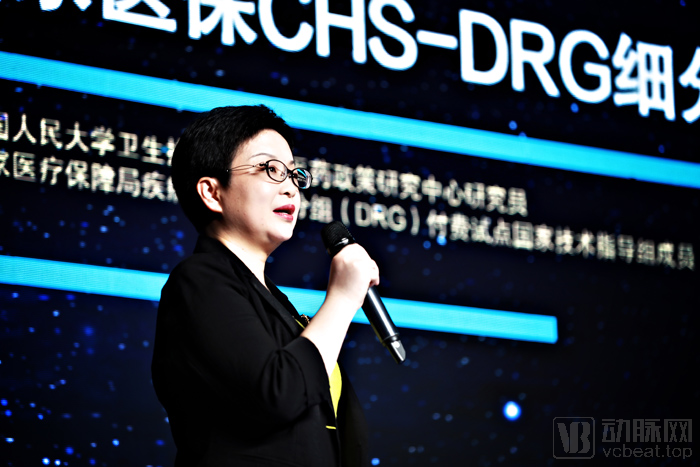
Wang Lili, Member of the National Technical Guidance Group for the Diagnosis-Related Groups (DRG) Payment Pilot Program under the National Healthcare Security Administration, and Researcher at the HTA and Pharmaceutical Policy Research Center, Renmin University
Professor Guo Qiyong, Chief Expert and Dean of the Research Institute at Beijing Dongruan Wanghai Technology Co., Ltd., and former President of Shengjing Hospital of China Medical University, interpreted the direction of DRG reform and hospital lean management from the perspectives of value-based healthcare and big data. Professor Guo stated that changes in medical payment methods are akin to a “butterfly effect,” exerting a significant impact on hospitals’ overall management models, clinical practices, medical quality, and operational efficiency. Payment reforms centered on Diagnosis-Related Groups (DRGs) will drive transformation within the healthcare system, foster tripartite collaboration among the National Health Commission, hospitals, and medical insurance agencies, and realize value-based healthcare. Furthermore, big data and emerging technologies will empower lean DRG management, playing a crucial role in enhancing the eight core competencies of hospital management and balancing the improvement of medical service quality with increased operational efficiency.
Professor Guo Qiyong, Chief Expert and Dean of the Research Institute at Wanghai Kangxin, and former President of Shengjing Hospital of China Medical University
At the conclusion of the press conference, Chen Chaoyang, Chief Product Manager for DRG at Wanghai Kangxin, provided a detailed introduction to Wanghai Kangxin’s comprehensive lean management solution for DRG. This solution encompasses: a DRG grouping and quality control solution based on intelligent coding and the CHS-DRG grouper; a DRG cost management solution constructed using activity-based costing models; a DRG cost containment solution leveraging pre-grouping technology to achieve integrated control of costs and expenses; a specialty disease operations solution aimed at optimizing the utilization of medical resources; and a performance evaluation solution that integrates DRG, cost management, and RBRVS.
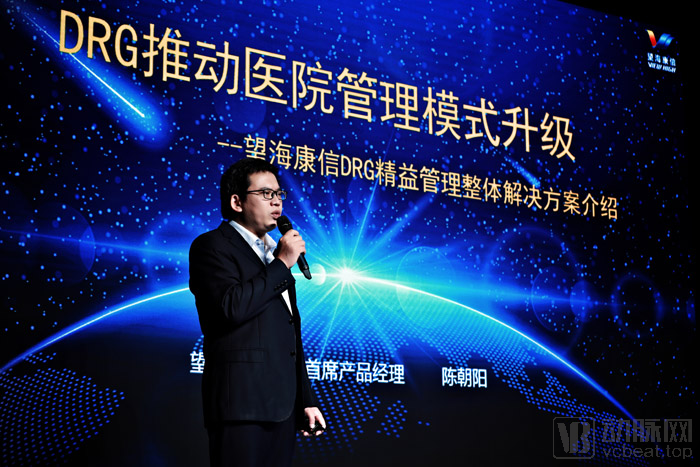
Chen Zhaoyang, Chief Product Manager of DRG at Beijing Dongruan Wanghai Technology Co., Ltd.
Based on the aforementioned DRG management solution, Wanghai assists hospitals in establishing a lean DRG management system. It enables pre-event calculation of management standards, in-process management and guidance during implementation, and precise post-event accounting with rational evaluation. This facilitates continuous cyclical improvement, thereby achieving an upgrade in hospital lean management.
Zhao Yan, Vice President of Zhongnan Hospital of Wuhan University, elaborated on the urgency and necessity of DRG reform from a hospital management perspective and shared the proactive measures adopted by the hospital. He stated that Zhongnan Hospital has engaged in multi-level, comprehensive cooperation with Beijing Dongruan Wanghai Technology Co., Ltd. to establish a lean operational management system adapted to the new healthcare environment. By combining IT technical support with seven major data application services in an innovative delivery model, Beijing Dongruan Wanghai Technology Co., Ltd. has built a core hospital management model under DRG-based payment. Significant milestone progress has been achieved in areas such as DRG medical record quality control, DRG performance evaluation, DRG cost management, and DRG expense monitoring.
Yu Wei, Executive Dean of the Shanghai Chuangqi Health Development Research Institute and Professor at the School of Public Economics and Administration, Shanghai University of Finance and Economics, stated that as payment method reforms continue to expand, hospitals must fundamentally reform their internal departmental management practices, performance assessment indicators, development strategies, and financial operational strategies. Under the DRG system, hospitals must focus not only on medical efficiency but also on operational efficiency, using DRGs as a management benchmark. The new model integrating “cost + performance + health insurance payment settlement + specialized disciplines and diseases” will generate synergistic momentum, imbuing hospital management with new significance under the new payment landscape. He noted that Beijing Dongruan Wanghai Technology Co., Ltd. achieved remarkable success in hospital cost accounting over a decade ago, and its current series of lean DRG management solutions effectively address the pain points and challenges faced by healthcare institutions in this new environment. In the future, both parties will integrate their advantageous resources and deepen cooperation in industry, academia, and research to jointly advance lean hospital management.
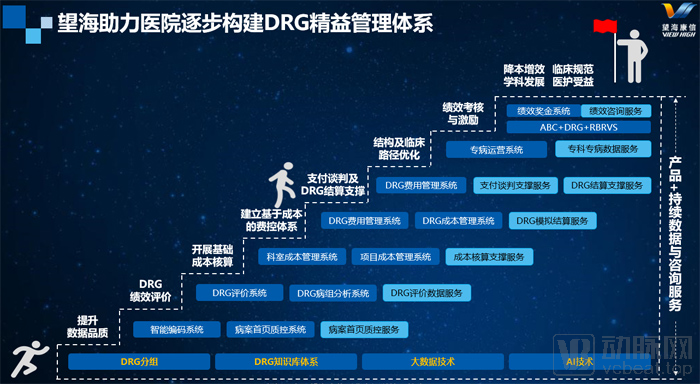
As a dedicated provider of information technology and data services for lean hospital operations, Beijing Dongruan Wanghai Technology Co., Ltd. recognized from its inception in 2003 that the shift toward Diagnosis-Related Groups (DRG) in China’s medical insurance payment system was an inevitable trend. Over more than a decade of experience in cost accounting and hospital operational management has laid a solid foundation and preparedness for DRG implementation, positioning the company as a core enterprise in the DRG field. The “Comprehensive Lean Management Solution for DRG” aligns with reform trends and hospital needs by integrating advanced management concepts, IT technologies, and data services. The launch of this solution will serve as a new engine driving healthcare institutions toward efficient development and actively empowering hospitals in their lean management initiatives.