

Shanghai Aijin AI Launches Clinically Deployed 3D Neural Imaging Platform for Leading Brain Science Institutions Following Over RMB 100 Million in Funding
The central nervous system consists of the human brain and spinal cord. Within it, a vast number of nerve cells aggregate to organically form networks or circuits, serving to transmit, store, and process information, generate various psychological activities, and govern and control all behaviors of the organism.
According to data from the Mental Health Center of the Chinese Center for Disease Control and Prevention in 2019, the number of patients with central nervous system (CNS) disorders in China has approached 200 million, with the prevalence rate projected to rise to 35% by 2020. Among these conditions, the incidence of CNS tumors has grown by 17%, ranking them among the top ten diseases in China in terms of both incidence and mortality. Cerebrovascular disease has become the leading cause of death, while the incidence of pediatric neurological tumors and other CNS disorders continues to rise year by year.
However,However, a drawback exists in the neurosurgery industry: current medical imaging technologies fail to fully meet the demands of neurological applications.. CT or MRI techniques fail to visualize nerve bundles, cannot differentiate functional neural areas, are limited to two-dimensional imaging, and do not provide intuitive three-dimensional visualization. Neurotractography techniques such as DTI cannot locally present specific regions of interest, cannot automatically and precisely distinguish functional neural areas, involve cumbersome operations, and exhibit discrepancies with actual anatomical and physiological conditions.Given the importance of neuroimaging in the brain, how to improve the current lack of central nervous system imaging technology through related research has become a problem that neurosurgery needs to face.。
Brain images presented by conventional medical imaging are mostly two-dimensional black-and-white films,Due to nerves being embedded within the brain's gray and white matter, traditional two-dimensional medical imaging techniques are unable to achieve reconstruction of cranial nerve structures.Parts not visible in two-dimensional images cannot be rendered as neurostructural imagery, even when three-dimensional brain images are obtained using traditional overlay methods.
So, how exactly is central nervous system imaging technology implemented? Ling Shuyuan, founder of Shanghai Aijin, told VCBeat, “Aijin’s technical team has mastered a unique, clinically validated 3D neuroimaging technology, which constitutes our core technological advantage.”
Shanghai Aijin’s technology stems from the technical team led by Professor Lin Qingbo, its founder, forResearch and Optimization of Diffusion Tensor Imaging (DTI). DTI technology can track the direction and location of water molecules in the human brain, display the orientation of neural tracts within white matter, provide high-resolution imaging of central nervous system fibers, and enable comprehensive observation of structural integrity and connectivity in living tissues. This technique will help assess the extent and scope of white matter tract damage caused by various diseases.
Although,Physicians familiar with brain anatomy can manually delineate neural structures based on this technique; however, the inherent errors in manual drawing render it unsuitable for clinical use due to failure to meet required standards. Therefore, there is a clinical need for a standardized, precise, and highly intelligent solution to achieve accurate visualization of patients’ neural structures.。
Recognizing the critical gap in central nervous system (CNS) imaging technologies within the industry, Shanghai Aijin initiated research and development in this field. By leveraging MRI image data and applying distinct imaging parameters and algorithms to neural pathways across different functional brain regions, the company achieves precise three-dimensional reconstruction of the nervous system and the entire brain structure. Building on its proprietary artificial intelligence algorithms, Shanghai Aijin employs automated intelligent tracing of water molecules to delineate neural structures, integrating vascular tissues, tumors, and other imagery with neural anatomy to produce comprehensive CNS imaging.
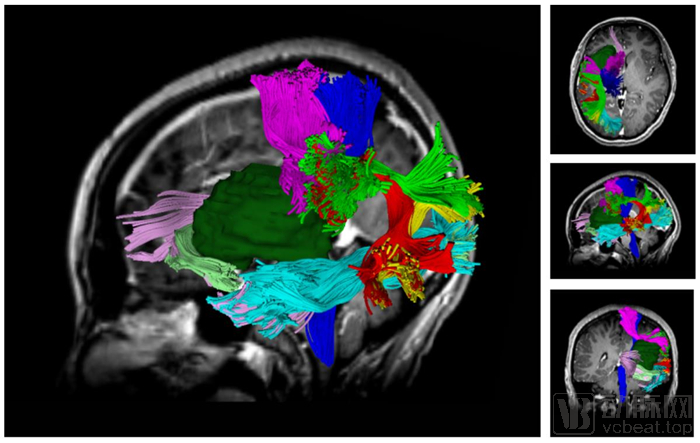
DiffusionGo Brain Nerve Tract Imaging
Leveraging technological breakthroughs, Shanghai Aijin has launched its inaugural product, DiffusionGo. Through 3D reconstruction, DiffusionGo visualizes cerebral nerve fibers, blood vessels, and lesion areas; displays the trajectory and morphology of nerves within the surgical field; delineates functional divisions of various nerve bundles; and automatically corrects errors associated with cranial brain shift. Furthermore, DiffusionGo is compatible with MRI data from different manufacturers featuring varying parameters, enabling rapid imaging through a one-click operation.
This technology achieves a leap from conceptual 3D images to intuitive 3D visualizations, helping doctors clarify the anatomical relationships between nerves and surrounding tissues, observe eloquent areas at risk along the surgical path, and identify vascular variations, thereby preventing intraoperative risks. By integrating lesion localization with equipment such as neurosurgical navigation systems, it provides guidance and support for neurosurgical procedures, assisting neurosurgeons in clinical diagnosis and surgical planning. This enhances surgical precision while reducing procedural complexity.。
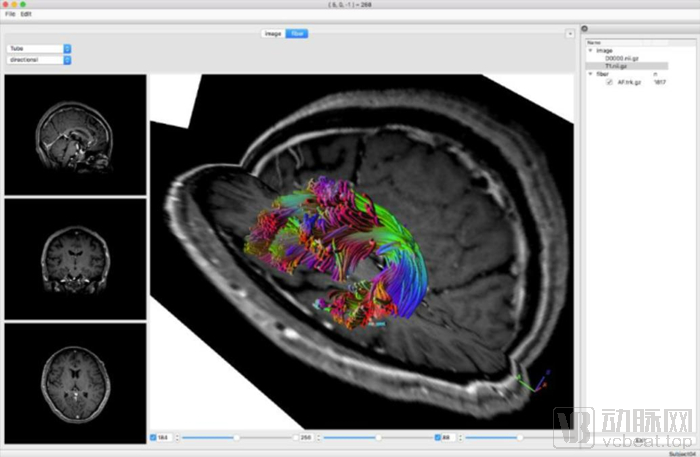
DiffusionGo Brain Nerve Tract Imaging
In addition to the three-dimensional reconstruction of the brain's internal neural system, DiffusionGo also provides3D Modeling Function of the Outer Brain Layer, enabling precise surgical localization. High-resolution reconstruction of the brain surface, along with the reconstruction of blood vessels and motor nerves, assists physicians in planning incisions, thereby reducing the risk of brain injury during neurosurgery.
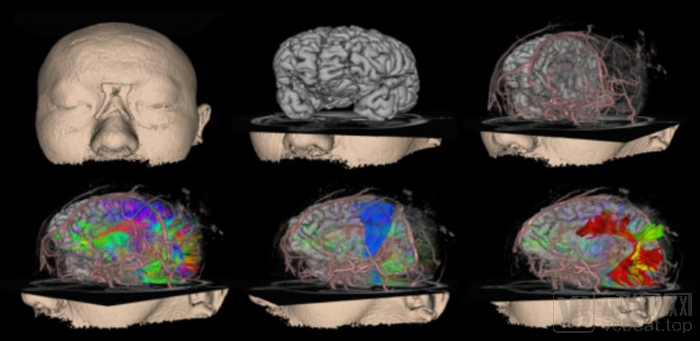
3D Model of the Outer Layer of the Brain
Meanwhile, DiffusionGo provides physicians with relevant medical imaging data via cloud services.
Ling Shuyuan told VCBeat, “The technical team conducted extensive data analysis on brain regions, established models for each area of the brain, and integrated these models into a unified framework to map neural points using artificial intelligence models.”
The precision of the results provided by DiffusionGo stems from Professor Lin Qingbo, the Chief Scientist’s approach of subdividing the brain into distinct regions, as well as Shanghai Aijin’s development of the underlying algorithms.
In terms of algorithm construction, Shanghai Aijin has accumulated DTI model data from 30,000 healthy individuals for foundational modeling, based on scientific research and clinical practice. Through collaborations with research institutions such as Fudan University, Huashan Hospital, and Bethune Medical College of Jilin University, the core algorithms have been validated over nearly two decades using methods including brain specimen dissection, intraoperative direct cortical electrical stimulation, and DTI comparisons with healthy populations.
In 2015, Shanghai Aijin collaborated with research institutions on clinical validation, comparing the concordance of artificial intelligence algorithm results with preoperative and intraoperative cerebral cortical sections. Through this clinical validation, it became the only neuro-3D imaging technology in China to have obtained clinical validation.。
Ling Shuyuan said, “Validation with a large sample size is precisely the validation of technological integrity.”
As the sole core technology provider, Shanghai Aijin collaborates with industry leaders across various sectors to jointly research and develop innovative products, achieving technological breakthroughs. These partners include Medtronic, Jingyu Medical, Roche, Johns Hopkins, Hainan Boao Super Hospital, and the Jiangxi Cloud Imaging Platform.
In 2016, the government introduced a series of relevant policies that officially permitted major hospitals in China to charge for three-dimensional (3D) medical imaging services. This development rapidly established effective revenue and profitability models in the field, thereby accelerating the commercialization of Shanghai Aijin’s products.
Meanwhile, national policy documents introduced the concept of “precision surgery,” affirming the clinical value of central nervous system imaging technologies. In 2018, the government officially launched the “China Brain Project” to strengthen extensive research in brain science and neuroscience, ushering in a new era for the industry as a whole.
With policy support and the backing of industry experts, Shanghai Aijin has secured tens of millions in investment from multiple renowned medical investment firms. The company provides services to over 30 hospitals and medical institutions across China, serving several leading neuroscience organizations nationwide. Meanwhile, through technological innovation, Shanghai Aijin has earned numerous accolades, including Champion of the 2019 SLUSH Global Competition (China Region), Top 50 Innovative and Entrepreneurial Enterprises in Shanghai, and Top 10 National Medical AI Enterprises in the 2020 Artificial Intelligence Competition.
Ling Shuyuan speaks with pride about the team and technology at Shanghai Aijin.
Ling Shuyuan does not have a medical background; rather, he is an MBA holder with many years of experience in corporate management and finance. His transition from business administration to the medical field was driven by a past experience that ignited his desire to help patients create better living environments and contribute to societal health. It was this very aspiration that led Ling Shuyuan into the healthcare sector. During his collaboration with Huashan Hospital, he met Professor Lin Qingbo, who shared his ideals. Based on their shared vision for healthcare, Ling Shuyuan and Professor Lin Qingbo decided to establish Shanghai Aijin Artificial Intelligence Technology Co., Ltd.
Professor Lin Qingbo has conducted research in the field of brain science for 30 years. He is currently a professor at National Yang Ming University, a visiting professor at Fudan University and Huashan Hospital, and a Chang Jiang Scholar. Professor Lin is also the patent holder for diffusion neuron tracking technology.
Shanghai Aijin is composed of a business team, a technical team, an operations team, and a medical advisory team.The technical team is primarily composed of experts from renowned overseas university neuroscience laboratories, including PhDs in neuroscience and software engineering, as well as senior specialists in 3D medical imaging. The team is mainly responsible for product research and development, technical support services, and the operation of the backend cloud service center.
All members of the business team come from families with a long-standing tradition in medicine. Ms. Hu, the Marketing Director, is the former Senior Medical Director at Eli Lilly and Company. She has previously worked for multinational corporations such as Baxter and Roche, accumulating over 15 years of experience in the healthcare industry, where she was responsible for the planning and design of medical products as well as market promotion. Mr. Tan, the Business Director, has previously held positions at Ping An Healthcare, Yiweixun, and Medlinker Technology, serving as the Director of Healthcare Business Development. In this role, he was responsible for liaising with partners and research projects, as well as establishing commercial channels.
Shanghai Aijin’s medical advisory team is composed entirely of young neurosurgeons from China’s top-tier tertiary hospitals. The team primarily provides feedback based on customer needs and contributes to the conceptual design of products.
Shanghai Aijin has structured its future corporate development strategy along horizontal and vertical dimensions. From a horizontal perspective, the company will promote broader applications of its products in additional areas, including the central nervous system and spine, brain-related fields, and hand surgery.
From a vertical perspective, the company will deepen its focus on the software itself. On the front end, Shanghai Aijin will provide high-quality 2D images to address the inconsistent quality of multi-source 2D imaging and improve the conversion rate to 3D imaging. On the back end, Shanghai Aijin will deploy further applications of the software, integrating it into high-end surgical instruments such as surgical navigation robots, thereby tapping into the deeper, essential demands for this technology in the medical field.
Currently, Shanghai Aijin has completed two rounds of financing exceeding RMB 10 million each and is now launching a new round of strategic fundraising.