

Startup Health Reports Record $9.1 Billion in Global Digital Health Funding for H1 2020 Amid Pandemic Surge

StartUp Health
Venture Capital Firms
Startup Health recently released its Mid-2020 Global Healthcare Innovation Financing Report. VCBeat has long tracked Startup Health’s reports on healthcare innovation financing, providing ongoing coverage of changes in the global healthcare innovation market. In the second quarter of 2020, total global healthcare innovation financing reached $4.2 billion, with a greater proportion of these funds earmarked for future healthcare infrastructure development. 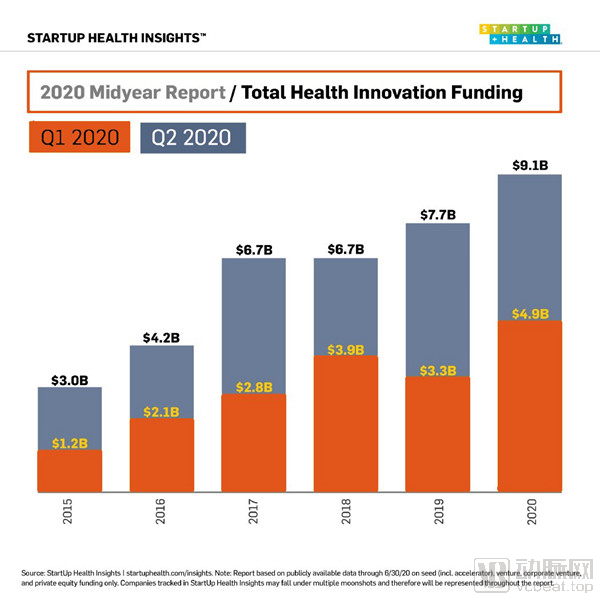
Impacted by the pandemic, global healthcare innovation financing was unstable in the first quarter of 2020. Although a total of $4.9 billion was raised in the first quarter, setting a new historical record for quarterly financing volume, the sudden outbreak of COVID-19 led the World Health Organization to declare a global pandemic two months after China reported its first death from the novel coronavirus. This public health emergency significantly affected the market, with many companies beginning to terminate contracts and lay off employees. All previous speculation about how the COVID-19 pandemic would impact global healthcare innovation financing proved unfounded. In analyzing the substantial financing figures for the first quarter, MedCity News wrote, “The trend of large-scale financing is unlikely to continue amid the COVID-19 pandemic.”
On the one hand, it is not surprising that global medical innovation has attracted substantial financing, as telemedicine is poised to enter its era of prominence. During the pandemic, with millions of people confined to their homes, telemedicine—long regarded as a promising sector—became a critical tool for meeting patients’ urgent healthcare needs. Take DOXY.me, a free SaaS-based telemedicine platform, as an example: in early March 2020, it averaged 100 new user registrations per day; by mid-March, daily new users surged to 50,000, averaging 20,000 new registrations per day; and by April, the figure stabilized at an average of 5,000 new users per day.
Steven Krein and Unity Stoakes, co-founders of Startup Health, stated, “For decades, this field could be described as having made virtually no progress, yet the past few weeks have witnessed earth-shaking changes. We are acutely aware that the transformations of recent weeks feel akin to several decades’ worth of change. Our entrepreneurs have demonstrated new healthcare technology solutions to frontline healthcare workers, caregivers, researchers and scientists, innovators, patients, and families at a scale and speed that we would not have dared to imagine before March this year.”
No matter how logical the surge in global healthcare innovation applications and investments may be, it cannot be overstated, as it demonstrates a significant deviation from standard market norms for healthcare innovation. [lz2] The total financing announced for the first half of this year has surpassed that of the same period in 2019 and greatly exceeded that of 2018, marking a stark contrast to previous conditions in the healthcare innovation market. From February 19 to the end of May, the S&P 500 Index fell by 13%. During this period, Teladoc’s stock price rose by more than 48%, with its current price-to-earnings (P/E) ratio standing at approximately 21 times, roughly double its five-year average. We are witnessing not only robust performance in healthcare innovation but also a notable divergence from broader market standards.
As the COVID-19 pandemic eased, the number of transactions in mid-2020 surpassed that of 2019, reaching 337 deals.
Despite the impact of the COVID-19 pandemic, which brought business activities across nearly all sectors to a standstill, 193 healthcare innovation deals were still completed globally in the second quarter of 2020, marking even greater activity than in the first quarter. Like total financing amounts, the number of transactions reflects investor confidence in healthcare innovation. We have not only witnessed the completion of mega-deals but also observed a broad and diverse investment landscape behind healthcare innovation, encompassing dozens of investor types and business categories.
StartUp Health’s portfolio perfectly reflects this dynamic and diversified investment landscape. In 2020, Virta Health closed a $93 million Series C financing round to improve diabetes care; Conversa secured $12 million in Series B funding to expand the application of its AI-powered chatbots; Cyclica completed a $16 million Series B round to accelerate machine learning-based drug discovery; and Particle Health raised $12 million in Series A financing to enhance the portability of health data. Cloudbreak and Fruit Street raised $10 million and $17 million in seed funding, respectively, to scale their telehealth services. These are merely examples of financing rounds exceeding $10 million.
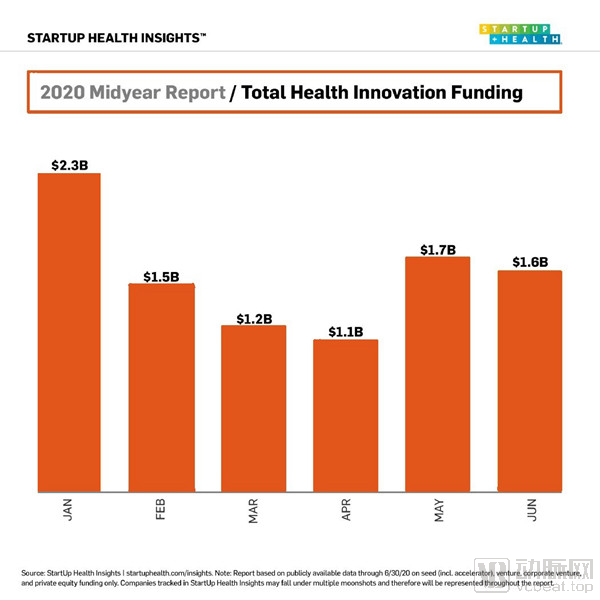
A month-by-month breakdown of the mid-2020 financing report reveals a trend line correlated with the COVID-19 pandemic. In January, when the Consumer Electronics Show (CES) and the J.P. Morgan Healthcare Conference were held, the pandemic had not yet taken hold; nevertheless, these events set a financing record of $2.26 billion. From January to April, financing amounts continued to decline, reaching a low of $100 million in April, which coincided with the peak of global lockdowns imposed in response to the COVID-19 pandemic.
Andrew Isaacs, a venture capital advisor at StartUp Health, recently stated on the Expert Office Hour program: “Multiple large venture capital firms and private equity funds are pausing their deal activities. They need to rebalance their portfolio companies and determine which enterprises truly require capital injections from their funds.”
This trading halt is also reflected in the data, but it is equally clear that capital activity picked up again in May and June, with a strong surge in financing and investment. The economic rebound appears to have been very rapid, although it is still too early to make predictions for the third quarter.
For years, multiple Chinese cities, such as Hangzhou, Beijing, and Guangzhou, consistently ranked at the top of the list for healthcare innovation center financing in non-U.S. regions. This ranking has shifted due to the impact of the COVID-19 pandemic on China; by mid-2020, European cities had risen to the top. Stockholm, Sweden, claimed the leading position, primarily driven by a substantial $155 million deal completed by the Swedish telemedicine company KRY. KRY operates in several European countries and is pursuing a planned international expansion. London, Paris, Oxford, and Berlin also ranked among the top ten; these five European cities collectively secured $801 million in financing.
China’s decline on this list is significant. By mid-2020, only four deals totaling $249 million had been completed in China. (Editor’s note: VCBeat strongly disagrees with this viewpoint, as the StartUp database contains insufficient data on Chinese investment and financing transactions. According to statistics from the VCBeat Orange Database, we monitored a total of 282 financing deals in China’s healthcare innovation sector during the first half of 2020, amounting to RMB 51.75 billion. The VCBeat Global Healthcare Innovation Financing Report for the first half of 2020, based on these figures, will be released soon. Stay tuned.) This data indicates a 56% decrease in financing amount compared to mid-2019 and a 41% decrease compared to mid-2018.
In addition to the total amount of financing, the number of financing transactions is equally important, as it reflects the diversity and vibrancy of transaction activities in international hubs. London tops the list of cities in non-U.S. regions for the number of healthcare innovation financing transactions, with a total of 16 deals completed. Quit Genius, a London-based healthcare startup, was interviewed and provided insights into London’s healthcare innovation ecosystem.
Yusuf Sherwani, Co-founder and CEO of Quit Genius, stated: “The UK has a long history in medical research and, in recent years, has successfully fostered many thriving health technology sectors. Four of the world’s top ten universities are located in London, turning the city into a melting pot where medical students collaborate with talented engineers, designers, and product managers to jointly create numerous solutions addressing current healthcare challenges.”
Toronto ranks second, just behind London, with a total of 10 financing rounds completed. “Over the past five to seven years, Toronto has emerged as one of the key hubs for digital and AI-driven healthcare innovation. Investments from the Canadian federal and Ontario provincial governments, coupled with support from local incubators and accelerators such as MaRS Discovery District, the Creative Destruction Lab, and JLABS, have created a favorable environment for entrepreneurs to establish companies and tap into the local pool of scientific and technical talent. These highly skilled professionals have made significant contributions to developing solutions for complex challenges in innovative healthcare,” said Naheed Kurji, CEO of the healthcare startup Cyclica.
Although no cities in Africa or South America ranked among the top ten non-U.S. cities by funding volume, we have witnessed remarkable entrepreneurial creativity in certain growth sectors. Cairo led Africa with $40 million in funding. In South America, São Paulo took the lead with five financing rounds totaling $19 million. According to the latest statistics, Brazil has become the country in the Southern Hemisphere with the highest number of confirmed novel coronavirus infections (1.37 million cases). We hope that such medical investment activities will further deepen, providing whatever assistance possible during this severe public health crisis.
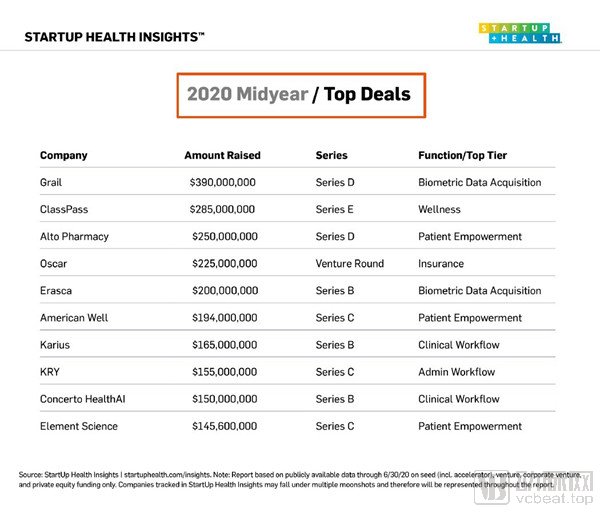
Financing Deal Rankings Reflect a Diversified, Future-Oriented Market
Where has the majority of global funding for healthcare innovation been allocated? In a sense, there is no single clear trend. Telemedicine, health insurance, the pharmaceutical industry, general wellness, cancer care, and wearable devices all appear in the top ten of this year-end report. Although adoption rates have risen in sectors such as telemedicine and remote care, these two areas do not dominate the market. Similarly, the market has not been overwhelmed by solutions specifically targeting the COVID-19 pandemic. This list of top-funded deals indicates that the pandemic has spurred investor enthusiasm for innovations that may seem futuristic but will remain as significant five years from now as they were at the onset of the outbreak. This is very encouraging news because, although we must continue to combat the pandemic, it will eventually end, just as every previous epidemic in history has. We will once again face the challenge of improving healthy lives for everyone on Earth.