

Multinational Pharma Giants Forge Ahead with Dedicated Digital Health Divisions: A Strategic Shift Toward Internet-Based Healthcare Ecosystems
Not long ago, according to relevant leaks, Pfizer Upjohn adjusted its business structure and reorganized it into three business units: hospital sales, retail, and innovative internet healthcare services, all reporting directly to the President of Greater China. This marks another multinational pharmaceutical company this year, following AstraZeneca’s internet healthcare strategic initiative, to directly promote an internet healthcare project.
Interactions between pharmaceutical giants and internet healthcare companies are nothing new. However, in 2020, the strategic importance of the internet healthcare sector within pharmaceutical companies’ business strategies appears to have further increased, evolving into one of their key priority business lines.
So, what exactly is Pfizer Upjohn’s internet healthcare division aiming to do? Why are pharmaceutical companies continuing to focus on the internet healthcare industry? And how does the internet healthcare sector empower pharmaceutical companies?
Pfizer Upjohn is not the first major pharmaceutical company to separately list its internet healthcare division. Relevant reports indicate that AstraZeneca established a strategic project team for internet hospitals in 2020.
Based on Pfizer Upjohn’s business segmentation, we can essentially determine its strategic logic for deploying in the internet healthcare sector.
Alongside “Innovative Internet Healthcare Services” are two other segments: “Hospital Sales” and “Retail.” These two segments represent the traditional endpoints for pharmaceutical sales, corresponding to the in-hospital and out-of-hospital markets, respectively. The inclusion of Innovative Internet Healthcare Services on par with these two indicates that, in Pfizer’s view, China’s internet healthcare industry has become, or is on the verge of becoming, a third major pharmaceutical endpoint market comparable in scale to the in-hospital and out-of-hospital markets.
For further analysis, we need to start with Pfizer Upjohn’s business.
Pfizer has held the top spot among global pharmaceutical companies by revenue for many years. Owing to its extensive product pipeline, Pfizer is often referred to by industry insiders and outsiders alike as the “Universal Big Pharma.”
Pfizer Upjohn is a newly established business unit created during Pfizer’s business restructuring in early 2019, operating alongside its Biopharmaceuticals and Consumer Healthcare divisions. It primarily took over a portfolio of Pfizer products that had lost patent protection, including former blockbuster drugs such as Lyrica (pregabalin), Lipitor (atorvastatin calcium tablets), and Viagra (sildenafil). Its key growth markets are regions outside the United States, with China being one of its primary battlegrounds.
It is precisely for this reason that Pfizer Upjohn has established its global headquarters in Shanghai, China.
The keyword defining Pfizer’s development over the past two years has been “focus.” In late 2018, Pfizer and GSK announced the merger of their respective consumer healthcare businesses into a joint venture, with Pfizer holding a 32% stake. In July 2019, Pfizer further announced that its Upjohn division would merge with Mylan, the second-largest generic drug manufacturer in the United States, with Pfizer retaining a 57% ownership interest in the newly combined entity. After divesting these two major business units, Pfizer will concentrate more intently on its biopharmaceutical operations.
Products that have exceeded their patent protection period inevitably face intense market competition. The contribution of Pfizer Upjohn’s revenue to Pfizer’s total revenue has indeed continued to decline in recent years, dropping from 25.6% in 2017 to 19.8% in 2019, with its 2019 revenue amounting to approximately USD 10.23 billion.
Pfizer itself is well aware of the sluggish growth of Upjohn, its legacy business unit. Consequently, in its 2020 financial outlook, Pfizer maintained a pessimistic stance on Upjohn’s performance, projecting that its revenue would further decline to $8–8.5 billion in 2020.
Following the announcement of its merger with Mylan, Pfizer Upjohn experienced a series of personnel changes. In September, the General Manager for China stepped down, followed by the departure of five additional business general managers in October. Meanwhile, Pfizer Upjohn also suffered successive setbacks in the “4+7” Volume-Based Procurement (VBP) program, as both Lipitor and Norvasc failed to be included in the centralized procurement list.
In this context, Pfizer Upjohn swiftly adjusted its strategy in 2020, adopting a clearer business structure to face the upcoming new round of centralized procurement. For products that failed to be included in the centralized procurement list, Pfizer Upjohn needed to maintain a steady mindset and continue promoting them as out-of-pocket medications. Internet healthcare may well be the optimal channel for promoting such out-of-pocket drugs.
Since the rise of the internet healthcare industry in China, major pharmaceutical companies have continuously and actively engaged with internet healthcare enterprises.
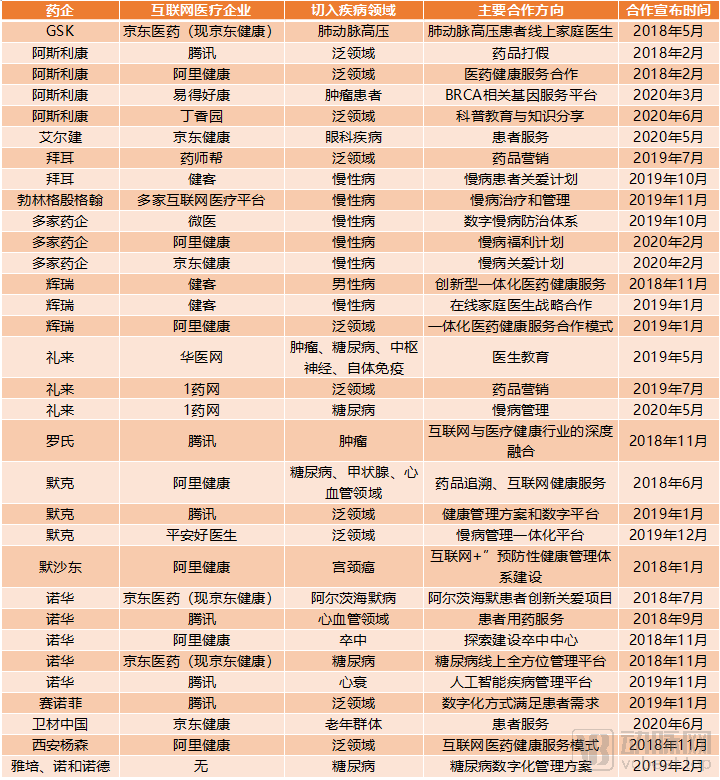
Multinational Pharmaceutical Companies’ Internet Healthcare Collaborations in China, 2019–2020
We have compiled statistics on the internet healthcare collaborations disclosed by major multinational pharmaceutical companies in China since 2018. Most pharmaceutical companies have demonstrated a proactive stance toward such partnerships, predominantly selecting leading domestic enterprises in the internet healthcare sector as their collaborators.
Of course, there are exceptions, such as the digital diabetes management solution jointly developed by Abbott and Novo Nordisk. This is also attributable to Novo Nordisk’s long-standing strategic investments in digital diabetes management.
In collaborations with internet healthcare providers, multinational pharmaceutical companies primarily focus on areas requiring long-term disease management, such as chronic diseases, oncology, cardiovascular diseases, and geriatric conditions, providing corresponding disease management services to patients in these fields.
We may certainly view health management systems as essentially a new marketing approach for pharmaceutical companies. However, from another perspective, these health management products provide tangible assistance in patients’ disease management. In this process, pharmaceutical companies primarily disseminate knowledge related to their own medications, enabling both physicians and patients to better understand their products and make informed choices. The establishment of such health management systems embodies a “patient-centric” mindset.
In the past two years, domestic pharmaceutical companies have also begun to move in this direction. For example, in July 2020, Hansoh Pharmaceutical and WeDoctor announced a strategic partnership to promote the construction of an “Internet + Chronic Disease Management” consortium and establish a “prevention, management, and treatment” service system.
Overall, pharmaceutical companies are indeed placing increasing emphasis on internet healthcare as an emerging channel. Behind this trend, in addition to the boom in internet healthcare in recent years, pharmaceutical companies themselves are facing growing survival pressures.
Just as Pfizer Upjohn faces its own predicament, major pharmaceutical companies are increasingly placing significant bets on internet healthcare. The key driver is that profit margins for drugs within the national medical insurance system are rapidly shrinking due to the impact of volume-based procurement and medical insurance negotiations.
The latest round of volume-based procurement (VBP) is influencing the strategies of major pharmaceutical companies. According to a leaked list submitted by the Hunan Provincial Healthcare Security Administration, several blockbuster drugs for chronic diseases—including the diabetes medication metformin, the hepatitis B and HIV drug lamivudine, and the schizophrenia drug aripiprazole—are included on the list. Commonly used medications such as amoxicillin and ibuprofen granules are also listed. The trend toward VBP is becoming increasingly evident, with chronic disease medications and commonly used drugs expected to enter the VBP process in large volumes in the future.
In terms of pricing, the in-hospital market has already been subject to a zero-markup policy for pharmaceuticals. In retail pharmacies, medical insurance bureaus across various regions are gradually implementing policies to control the sales prices of drugs included in volume-based procurement (VBP) at the retail terminal. For instance, a relevant plan issued by the Zhejiang Provincial Medical Insurance Bureau on June 29 stipulates that designated public and private medical institutions shall apply the same payment standards for medical insurance-covered drugs. The payment standard for such drugs at designated retail pharmacies is uniformly set at 15% above the payment standard applied by medical institutions (excluding drugs subject to national and provincial negotiations). This 15% figure is consistent with previous notifications issued by the Xinjiang Medical Insurance Bureau.
Another leaked policy document is also closely related to drug pricing. Recently, a document titled “Guiding Opinions of the National Healthcare Security Administration and the Ministry of Finance on the Retention and Use of Surplus Medical Insurance Funds in the National Centralized Drug Procurement” has begun circulating online and is expected to be officially released soon. The key focus of the document is “surplus retention,” whereby the difference between the cost of drugs after price reductions through volume-based procurement and the medical insurance payment budget will be returned to public healthcare institutions as a reward on a proportional basis.
Brands included in the centralized volume-based procurement (VBP) program naturally have significantly lower prices than those not included. Therefore, if hospitals increase their use of VBP-listed drugs, corresponding drug expenditures will decrease substantially, allowing for greater budget savings and thereby securing more support from medical insurance funds.
The National Healthcare Security Administration has introduced a policy allowing hospitals to retain surplus funds, aiming to financially incentivize greater use of volume-based procurement (VBP) drugs and reduce gray areas in pharmaceutical marketing. Following the elimination of drug markups, hospitals have lost a significant source of revenue. For hospitals currently facing revenue shortages, this funding serves as timely and crucial support. Therefore, such financial incentives remain highly attractive to hospitals.
In fact, the “global budget management with retention of surpluses” model has long been widely applied in the management of medical insurance funds across various regions, yielding remarkable results in many areas. If this policy is ultimately implemented, it will undoubtedly boost the enthusiasm for using volume-based procurement (VBP) drugs in VBP regions.
With the combined impact of several policies, the sales potential for drugs that fail to secure inclusion in volume-based procurement (VBP) is shrinking. Meanwhile, the emerging closed-loop model of online chronic disease management—integrating internet healthcare and pharmaceutical e-commerce across the entire process—has not yet been widely incorporated into medical insurance coverage. This sector may well become the final key battleground for major pharmaceutical companies focusing on generics and off-patent products in the future.
Therefore, with profit margins on drug sales strictly controlled in both hospital and retail pharmacy channels, internet healthcare has become virtually the only remaining avenue through which pharmaceutical companies can continue to conduct sales and promotional activities at their own pace.
In the traditional clinical practice setting, pharmaceutical companies’ demands on hospitals and pharmacies primarily focus on three areas. The first is drug sales, mainly conducted through hospital pharmacies and retail pharmacies; the second is drug promotion, largely achieved via offline communication between local medical representatives and physicians; and the third is data collection, primarily obtained by collaborating with hospitals to acquire relevant patient follow-up data.
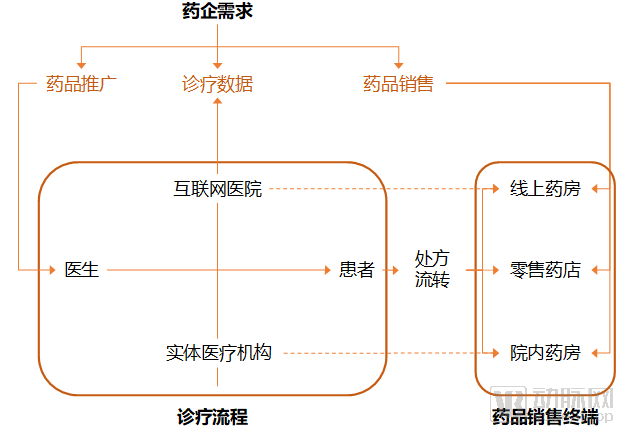
Pharmaceutical sales, drug promotion, and clinical diagnosis and treatment data represent the three core needs that pharmaceutical companies aim to fulfill. As long as internet healthcare can meet these basic requirements in the three areas, it has the opportunity to establish collaborations with pharmaceutical companies as an independent business unit.
Internet healthcare centers on internet hospitals to connect patients with physicians, thereby driving traffic to downstream pharmaceutical retail terminals. Online pharmacies can meet pharmaceutical companies’ needs for drug sales; the large pool of physicians collaborating with internet hospitals can help pharmaceutical companies fulfill their drug promotion requirements; and diagnosis and treatment services delivered via internet healthcare platforms are systematically recorded and ultimately made available to pharmaceutical companies.
Therefore, the entire process of internet-based healthcare can fully meet pharmaceutical companies’ various needs regarding medications, and may even outperform traditional medical institutions in terms of receipt collection and communication efficiency.
On the other hand, internet healthcare companies can broaden their profitability through collaborations with pharmaceutical firms. Currently, consumer-side (C-end) willingness to pay for internet healthcare services is not particularly strong; therefore, business clients (B-end) with higher payment willingness have gradually become the primary payers in the internet healthcare industry.
In terms of volume, online pharmaceutical sales still lag significantly behind public medical institutions and brick-and-mortar pharmacies. In 2019, the pharmaceutical e-commerce market exceeded RMB 100 billion in size. However, the majority of this gross merchandise value (GMV) was generated by B2B operations, with B2C accounting for only a small fraction. According to estimates by Menet, the market size of online pharmacies reached RMB 13.8 billion in 2019. Although it has maintained an annual growth rate of 40%, its scale remains considerably smaller than the hospital-based market, which exceeds RMB 1 trillion, and the retail pharmacy terminal market, valued at over RMB 400 billion. As a channel for pharmaceutical sales, online pharmacies still have substantial room for growth.
The next step in the collaboration between pharmaceutical companies and internet healthcare providers hinges on how to streamline the payment process.
After all, offline pharmacy purchases can be paid for using medical insurance, making self-paid internet medical services and online medication purchases less attractive to individual consumers. Therefore, integrating with insurance is the optimal strategy for internet healthcare providers. The primary payers are essentially two: public medical insurance and commercial health insurance.
In the realm of commercial insurance, the integration of health insurance with health management has become an inevitable trend. From an insurance perspective, leveraging high-frequency health management services can improve users’ health status, reduce the risk of complications among individuals with pre-existing conditions, achieve cost control, and lower claim incidence rates. Unlike social medical insurance, commercial insurance is not bound by a specific formulary; therefore, medications not covered by public health insurance have the potential to become collaborative products for commercial insurers. Internet healthcare platforms serve as a bridge between pharmaceutical companies and insurance providers.
For example, as one of the earliest companies in China to strategically position itself in health management, Miao Jiankang has established a closed-loop service ecosystem encompassing “health, medical care, pharmaceuticals, and insurance,” with pharmaceuticals serving as a critical component. Its core business logic operates on two fronts: First, leveraging its proprietary health management capabilities and data-driven insights, it integrates resources from pharmaceutical companies and commercial insurers to create an integrated “pharmaceuticals + services + insurance” solution. This approach opens new marketing channels for pharmaceutical companies while boosting insurance product sales. Second, Miao Jiankang deploys its comprehensive service capabilities in health management, internet hospitals, pharmaceutical e-commerce, and health technology to build a privatized prescription circulation and patient service platform, thereby helping pharmaceutical companies develop solutions that connect patients, physicians, and insurers.
During the pandemic, in response to epidemic prevention and control requirements, the National Healthcare Security Administration and the National Health Commission jointly issued a policy document to include eligible “Internet+” medical service fees within the scope of medical insurance reimbursement. In some regions, such as Wuhan, which faced the most severe outbreak, the national electronic medical insurance certificate was launched on internet healthcare platforms, enabling patients to enjoy convenient online services—including follow-up consultations, medication purchases, and medical insurance settlement—without leaving home or presenting a physical card.
Although internet healthcare made significant strides toward inclusion in the national medical insurance system during the pandemic, it remains uncertain whether this momentum will continue in the post-pandemic era. Regarding the impact of including online pharmaceutical purchases in medical insurance coverage on collaborations between pharmaceutical companies and internet healthcare providers, we can analyze the issue from both positive and negative perspectives.
If online pharmaceutical purchases remain excluded from medical insurance coverage in the future, online pharmacies will become a critical sales channel for pharmaceutical companies whose products fail to win bids in centralized volume-based procurement (VBP). Without the price pressure exerted by medical insurance reimbursement policies, most drugs will be sold at retail prices on e-commerce platforms, thereby providing pharmaceutical companies with an opportunity to continue generating profits through drug sales on these platforms.
If online pharmaceutical purchases are incorporated into the national medical insurance scheme in the future, patient enthusiasm for using online platforms for consultations and medication procurement will rise significantly. This will inevitably stimulate substantial growth in demand for internet-based healthcare services, establishing online channels as one of the new primary sales terminals within the medical insurance system. Consequently, their strategic importance in pharmaceutical companies’ marketing layouts will also increase.
Therefore, regardless of whether it is included in the national medical insurance coverage, internet healthcare will become a key component in the future marketing strategies of pharmaceutical companies, and may even emerge as a secondary battleground for drugs that fail to win bids in centralized procurement.