

ByteDance Acquires Baike Mingyi for Hundreds of Millions, Early Investor BlueRun Ventures Maps Out Next Moves in Healthcare

BlueRun Ventures China
Venture Capital Institution
Recently, ByteDance announced the completion of its full acquisition of Baike Mingyi, a medical science popularization platform, for hundreds of millions of yuan. BlueRun Ventures China was the lead investor in Baike Mingyi’s first funding round. Chen Weiguang, Managing Partner at BlueRun Ventures China, remarked with a smile, “This deal was closed quickly and is a win-win for both parties.”
The acquisition of Baike Mingyi by ByteDance signifies another milestone for BlueRun Ventures China, marking the fruition of its innovative healthcare investment strategy aligned with market demands across content, product, payment, and service sectors.
BlueRun Ventures China has not made extensive investments in the healthcare sector, yet it consistently demonstrates an acute ability to anticipate emerging trends. From its early investment in Chunyu Yisheng (Spring Rain Doctor) in 2012, before the internet healthcare boom took hold, to its strategic entry into innovative medical payment solutions in 2015, BlueRun has distinguished itself by pushing beyond conventional industry perspectives and identifying non-consensus opportunities at an earlier stage.
BlueRun Ventures China manages multiple dual-currency funds in USD and RMB, with assets under management exceeding RMB 10 billion and realized cash distributions surpassing RMB 5 billion. Its latest fund, with a size of over USD 500 million, provides long-term support to entrepreneurs from the early stages.
In terms of healthcare investment logic, BlueRun Ventures China also approaches its insights into the healthcare industry from a unique perspective. Centering on market demands, BlueRun Ventures China divides the sector into four quadrants: content, product, payment, and services. How does BlueRun Ventures China position itself within these four areas? VCBeat (WeChat ID: vcbeat) interviewed Chen Weiguang and Zhu Tianyu, Managing Partners at BlueRun Ventures China.
BlueRun Ventures China is one of the earliest venture capital firms in China to focus on the healthcare sector. The deeper it delves, the more BlueRun Ventures China recognizes the complexity of the entire healthcare system and the challenges inherent in driving its transformation.
Zhu Tianyu believes that the healthcare sector is characterized by both immense potential and complex systemic challenges, which is why China’s healthcare reform has been ongoing for many years and remains a work in progress.
“Market forces and new solutions may only shake a small corner of the existing system, and this process is often very painful. But as long as it addresses the current issues within complex systems, BlueRun Ventures China is willing to support those who are solving problems.”
Because problem-solvers are directly confronting needs, the fundamental reason BlueRun Ventures China is bullish on healthcare investments is the same as in other sectors: it stems from a straightforward aim to meet those needs.
However, simplicity does not equate to being simplistic. Zhu Tianyu pointed out, “The uniqueness of the healthcare sector lies in the fact that human needs related to birth, aging, illness, and death are inherently constant. On the supply side, however, China’s healthcare system faces the challenge of insufficient provision, leaving substantial room for optimization. Healthcare supply should be multi-tiered.”What makes it even more distinctive is the presence of a payer segment between demand and supply; the variable driving reforms on the supply side is often not demand, but rather the payer segment, which drives innovation in medical technologies and services.”
Adopting a payer-centric perspective and further addressing the demands of the healthcare market, BlueRun Ventures China has refined its investment strategy in the healthcare sector into a layout spanning content, services, products, and payment.
Among the four quadrants of BlueRun Ventures China’s healthcare investment framework, the content dimension is relatively easy to comprehend. After investing in Chunyu Doctor, BlueRun Ventures China keenly recognized the value of accumulating medical content. However, since the value of such content is constrained by its quantity and quality, this insight provided valuable guidance for BlueRun Ventures China.
Before investing in medical content, BlueRun Ventures China established two critical elements for the production of such content: first, whether the content is provided by professionals; and second, whether it has been endorsed by authoritative institutions. Guided by this industry map of insights into medical content, the identification of Baike Mingyi Network was a straightforward and natural process.
“When I discovered Baike Mingyi Wang, it was a breath of fresh air. Through years of collaboration with physicians, Baike Mingyi Wang has established a relatively comprehensive and professional system and ecosystem for medical science popularization,” said Chen Weiguang.
BlueRun Ventures China has also made advance predictions and analyses regarding the potential bottlenecks that Baike Mingyi Network may encounter in its development.
Chen Weiguang, Managing Partner at BlueRun Ventures China, recalled: “At that time, although Baike Mingyi had accumulated a certain user base, its user pool was not yet large enough. Therefore, in that investment round, we also facilitated the participation of strategic investor Sogou. Following our investment, the company established partnerships with numerous third-party platforms, including Sogou, Baidu, Tencent, and Toutiao. As these partners serve as major traffic gateways, the challenge of user reach was effectively addressed.”
BlueRun Ventures China anticipated whether third-party traffic portals creating their own content would impact Baike Mingyi Network. The subsequent reality was that major traffic portals such as Baidu and Tencent all decided to develop their own content.
“As we see the proportion of medical content increasing on traffic platforms, major third-party traffic aggregators will inevitably create their own content—it is only a matter of time. Therefore, the partnership with ByteDance presents a favorable opportunity,” said Chen Weiguang. The investment in Mingyi Baike has also reaffirmed BlueRun Ventures China’s observation that after users acquire popularized medical information, the ultimate goal is to convert them into patients for doctors and healthcare services. “Content is merely the first step; it must be translated into tangible medical services and integrated with payment solutions. This further validates our assessment of the value of healthcare service networks.”
In BlueRun Ventures China’s four-quadrant framework, in addition to the content dimension, the payment, service, and product dimensions are three closely interconnected domains. To understand the strategic layout across the payment, service, and product dimensions, it is essential first to grasp BlueRun’s perspective on innovation in healthcare payments.
In the early stages, after BlueRun Ventures China invested in a series of innovative healthcare projects such as Chunyu Doctor and Xingshulin, it discovered thatThe greatest challenge facing innovative healthcare service companies is neither user experience nor meeting user needs, but rather the lack of effective payers, which prevents the formation of a sustainable and profitable business model. This insight had a profound impact on BlueRun Ventures China at the time.
In the existing stock market, payment-side issues have always been one of the core problems in healthcare reform. One of the biggest pain points in the domestic medical market is the high proportion of out-of-pocket expenses for patients and the severe lack of supplementary payment methods. In China's total medical expenditure payment structure, the proportion of patient self-payment is as high as 40%. At the same time, the pressure on health insurance cost control is also very high, so a multi-level payment system is imperative.
Zhu Tianyu stated bluntly, “China’s medical insurance system can no longer bear the financial burden; the National Healthcare Security Administration must properly manage the healthcare insurance fund.” Two years after the establishment of the National Healthcare Security Administration, cost-containment policies such as the “4+7” volume-based procurement and Diagnosis-Related Groups (DRGs) were rapidly introduced.
Admittedly, the issue of medical insurance payment is not new. However, BlueRun Ventures China focuses on the potential of innovative healthcare payment models to optimize supply-side allocation, integrate market supply services, and stimulate high-quality medical care.
“On the one hand, innovative healthcare payment models can revitalize existing resources. For instance, an innovative healthcare payment system can integrate service networks to cater to individuals across different consumption tiers. In this regard, the current basic medical insurance primarily covers universal healthcare needs, whereas many individuals have the financial capacity to purchase higher-quality medical services.”“On the other hand, it can stimulate incremental growth and drive new technologies, as well as high-quality medical service techniques and environments, to deliver superior, differentiated healthcare services.”
Zhu Tianyu stated that the field of healthcare payment innovation is highly likely to give rise to China’s equivalent of UnitedHealth Group. Comparing fiscal year 2019 revenues, UnitedHealth reported annual revenue of $242.2 billion, Apple $260.2 billion, Microsoft $125.843 billion, and Alibaba RMB 509.7 billion. Thus, UnitedHealth’s revenue was roughly equivalent to one Apple, two Microsofts, or three Alibabas. From another perspective, the opportunity to provide integrated services is similar to the business models of Meituan and Alibaba. BlueRun Ventures China believes that the “Alibaba” and “Meituan” of the healthcare sector may emerge within the innovative payment space.
From the payer’s perspective, BlueRun Ventures China has invested in companies that empower innovation in healthcare payment, including Shuidi Mutual Aid, Nanyan Technology, ShanZhen, and Xiaobang Planning.
“In fact, when selecting payment innovations, we do not necessarily need to enter the market through insurance products; rather, we favor companies that leverage an innovative perspective to empower payers in their innovation efforts.”
When investing in Shuidi Mutual, BlueRun Ventures China was optimistic about its ability to aggregate online demand scenarios for individual health insurance and empower various payers to better serve users. Meanwhile, Nanyan Technology entered the market through insurance brokerage and corporate group insurance, positioning itself to reach services for many payers and integrate products and services for distribution to different online user segments.
Adopting an innovative payment perspective in healthcare investment has not only enabled BlueRun Ventures China to secure high-quality innovative healthcare payment companies at an early stage, but also prompted the firm to reevaluate and uncover innovations in healthcare services and products.
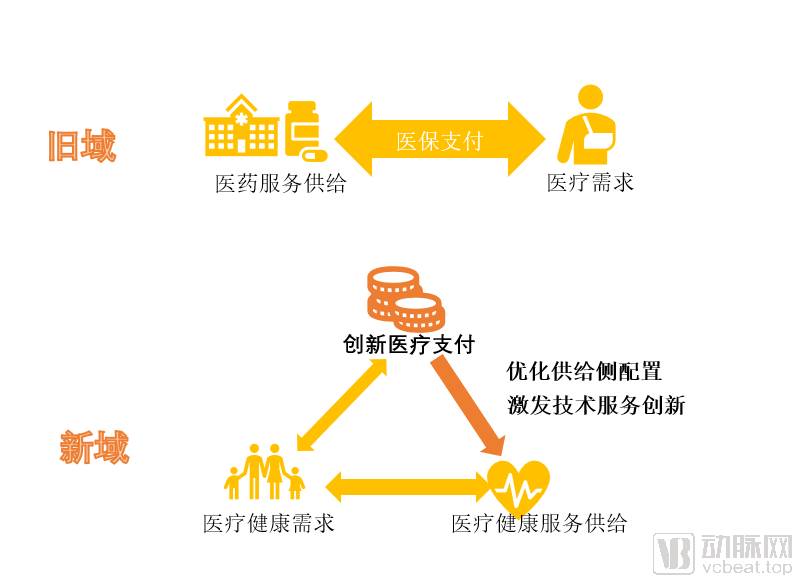
Medical Ecosystem Domain Migration Model (Graphic by VCBeat)
“Once we understand BlueRun Ventures China’s strategic layout on the payment side, adopting the payer’s perspective to re-examine the supply of services and products immediately broadens our thinking. The service and payment sides are inherently interconnected. The most significant change on the service side is that, as healthcare cost-containment measures restore drug values to a reasonable range, the service sector is undergoing repricing.”
Zhu Tianyu added, “Policies such as ‘4+7’ have effectively compressed the value space of pharmaceuticals across the entire industry chain, and the previously drug-centric ecosystem will undergo transformation. This is also driving a repricing of all services within the industry chain.”
This encompasses not only the services provided by doctors to patients, but also the repricing of hospital service value, leveraging information technology to enhance hospital management and the patient care experience. There is significant room for improvement on the service side. BlueRun Ventures China has identified four key stakeholders central to this service-side transformation: hospitals, pharmaceutical companies, pharmacies, and patients.
Regarding BlueRun Ventures China’s future strategic layout on the service side, Zhu Tianyu stated: “When we adopt the perspective of payers, the opportunities for optimizing the supply side of services can be divided into two directions: one is to improve efficiency, and the other is to provide incremental value. From the payer’s perspective, many necessary service systems have not yet been established within the existing healthcare framework. Taking underdeveloped specialties as an example, such as rehabilitation medicine, significant cost containment effects and service improvements could be achieved through more diversified payment methods; however, a systematic approach has not yet taken shape in China.”
On the product side, BlueRun Ventures China believes that whether in medical devices or life sciences technology, the essence of healthcare products is to deliver new value driven by technology. However, BlueRun places greater emphasis on witnessing breakthrough technological and product innovations.
“On the product side, we will also leverage BlueRun Ventures China’s DNA in TMT and technology investment to identify cutting-edge cross-disciplinary technologies. BlueRun Ventures China seeks new technologies that can solve previously unsolvable problems or address existing challenges in a more cost-effective manner.”
Returning to the initial question, why is BlueRun Ventures China always able to anticipate emerging trends in healthcare investment? One reason lies in its adherence to a “non-consensus” investment philosophy, constructing an investment framework tailored to its own strengths by analyzing the endogenous structures of the healthcare market. The other reason is rooted in BlueRun’s innovative and disciplined corporate DNA.
In the interview, Zhu Tianyu chose the words “innovation” and “discipline” to describe the style of BlueRun Ventures China. Innovation enables BlueRun to continuously break through industry conventions and persistently seek out non-consensus innovative opportunities within the sector. At its core, discipline is about focusing on value creation, allowing BlueRun to overcome impetuousness in a rapidly changing environment, filter out transient noise, and identify companies that truly create value.
BlueRun Ventures’ approach to early-stage venture capital is not about identifying companies with higher gross margins in existing markets, but rather about discovering organizations with greater societal significance by addressing social problems.
In the healthcare sector, BlueRun Ventures China believes that organizations with greater significance are those that hold a deep reverence for medicine while demonstrating a high degree of professionalism.
Zhu Tianyu said: “When making its early investment in Chunyu Yisheng, what most impressed BlueRun Ventures China was the founder’s sense of mission. Chunyu Yisheng sought to carve out a breakthrough within a complex system to address existing problems—this is precisely the kind of team we are committed to supporting.The founder of Shanzhen is also a member of the post-80s generation. He works in Shanghai, while his parents live in Yunnan. Effectively managing their health is actually a common struggle for the post-80s and post-90s generations. Shanzhen has established an entry point for elderly health management through customized physical examinations, family health services, and insurance risk control, thereby accumulating a substantial amount of data on elderly users. Therefore, it is not enough to merely have an original aspiration; one must also genuinely observe where that initial drive has truly led you.”
Engaging in early-stage investment requires BlueRun Ventures China not only to act as its own pathfinder, identifying innovative sectors and enterprises, but also, at times, to build bridges for entrepreneurs.
Many early-stage companies backed by BlueRun Ventures China are in the critical phase of breaking through from zero to one, with their business models still undergoing experimentation and iteration. Having witnessed how numerous companies successfully navigate this stage, we are well-positioned to provide them with strategic support.In essence, strategic support is about distinguishing between “what to do” and “what not to do.” We primarily provide guidance on the latter, helping companies maintain greater focus during their early stages when resources are limited.
BlueRun Ventures China has consistently maintained a diligent approach, embracing the patience to operate without chasing fleeting trends while having the courage to pioneer new frontiers. Looking ahead, BlueRun Ventures China will continue to deepen its engagement in the healthcare sector, leveraging its extensive industry resources and expertise accumulated over the years to empower entrepreneurs and support a greater number of innovative medical enterprises.