

China's First Inter-Provincial Traditional Chinese Medicine Materials Procurement Alliance Launched with Digital Platform Innovation
“Government sets the stage, market performs.” Shandong sees a surge of innovative initiatives! Following the launch of the provincial Internet-based Medical Insurance and Health Platform in April, the nation’s first inter-provincial Chinese herbal medicine procurement alliance—the “Twelve Provinces (Autonomous Regions, and Municipalities) Chinese Herbal Medicine Procurement Alliance” (hereinafter referred to as the “Procurement Alliance”)—was established in Jinan, Shandong on July 7. Concurrently, a series of supporting platforms and projects were launched, including the Shandong Internet Chinese Herbal Medicine Trading Platform, the Jinan Smart Traditional Chinese Medicine Pharmacy, and the Shandong Provincial Traditional Chinese Medicine Quality Testing Platform, forming the largest innovation consortium for the traditional Chinese medicine industry nationwide.
In recent years, the state has repeatedly issued policies to promote the development of traditional Chinese medicine (TCM) and the protection of Chinese herbal materials. During the COVID-19 pandemic this year, the prominent role of TCM in diagnosis and treatment has gained widespread recognition. Recently, the 2020 edition of the Pharmacopoeia of the People's Republic of China was promulgated, including 2,711 types of TCM, with 117 newly added and 452 revised. The TCM industry is ushering in unprecedented opportunities for development.
However, traditional Chinese medicine (TCM) is influenced by various specific factors such as cultivation and processing. Its distribution methods are traditional and inefficient, and the lack of mutually recognized uniform quality standards has constrained the modernization and industrialization of TCM.
Can this Shandong Traditional Chinese Medicine Industry Innovation Project address industry pain points and explore viable operational models? This article provides an analysis from multiple perspectives.
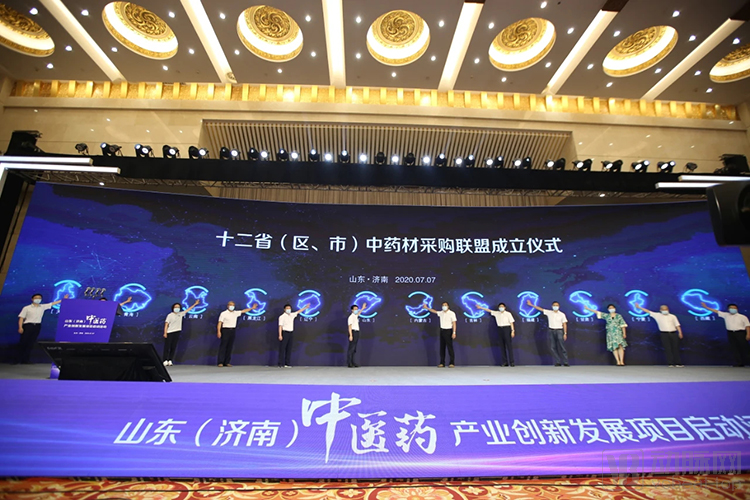
On-Site of the Procurement Alliance Establishment
Unlike the highly standardized production of Western pharmaceuticals, Traditional Chinese Medicine (TCM) is influenced by natural conditions such as soil and climate, as well as by human technical methods and processing techniques across multiple stages, including cultivation, storage, transportation, and processing. The primary factors affecting quality vary among different forms of TCM, ranging from raw herbal materials and prepared decoction pieces to proprietary Chinese medicines. These factors are closely linked to the quality of TCM, ultimately impacting its safety and efficacy, and significantly influencing the therapeutic outcomes of TCM practice.
However, precisely because traditional Chinese medicine involves complex stages and diverse processes from cultivation to clinical application, the industry faces numerous pain points.
Difficulty in Unifying Quality Standards for Traditional Chinese Medicine
According to the Drug Administration Law of the People's Republic of China, processed slices of Chinese crude drugs shall be processed in accordance with national drug standards; where no national drug standards are specified, they shall be processed in accordance with the processing norms formulated by the drug regulatory departments of the people's governments of provinces, autonomous regions, and municipalities directly under the Central Government.
In practice, the national standards adopt the Pharmacopoeia of the People's Republic of China (hereinafter referred to as the Chinese Pharmacopoeia; the current 2015 edition is in effect, and the 2020 edition will come into force on December 30 this year). Provincial standards refer to the local standards for Chinese crude drugs and processing specifications for Chinese herbal decoction pieces formulated by various provinces; these provincial standards serve as a supplement to the national standards.
An industry insider used processed deer tendon (Lu Jin) as an example to compare its varying quality standards across 13 regions.
Prepared Deer Tendon slices are not included in the 2015 edition of the Chinese Pharmacopoeia, but are simultaneously listed in the local standards of 13 regions, including Shandong, Zhejiang, and Shanghai. It is a type of Traditional Chinese Medicine (TCM) decoction piece that is adopted by a large number of provinces and involves relatively complex processing methods and techniques. Local processing specifications vary regarding medicinal parts, odor identification, texture identification, processing techniques, excipient requirements, and dosage and administration.
Variations in standards across regions reflect local clinical medication practices and regional characteristics, serving as a form of protection for these unique features. However, such disparities may also lead to inconsistent quality, ultimately resulting in significant differences in medication use. Meanwhile, the same traditional Chinese medicine product that meets quality standards in one region may fail to comply with requirements in another.
Quality standards have become one of the major factors constraining the modernization of traditional Chinese medicine.
Traditional distribution model with low efficiency and high costs
Chinese herbal medicines must be procured from cultivation sites and undergo processing and preparation before they can be sold to medical institutions and pharmaceutical wholesalers. This process involves multiple market entities across various stages. In contrast to the increasingly efficient procurement of Western medicines in recent years, the distribution chain for traditional Chinese medicine is lengthy, inefficient, and relies on traditional transaction methods.
Fragmented Cultivation, Multiple Production Stages, and Difficulty in Full-Process Traceability
There is a wide variety of Chinese herbal medicines, with different herbs requiring planting and harvesting in specific seasons, followed by multiple stages including initial processing at the source, decoction piece preparation, logistics and transportation, and sales.
The entire process exhibits characteristics of multiple industries, including agricultural products, fresh goods, food, and pharmaceuticals. As these stages directly impact the final quality of pharmaceutical products, full-process traceability is essential.
Compared with the research, development, and production of western medicine, the production of traditional Chinese medicine (TCM) is more fragmented, particularly in processes such as cultivation, harvesting, and primary processing at the source. Furthermore, as previously mentioned, the TCM distribution chain is lengthy and involves numerous market entities, all of which increase the difficulty of implementing full-process traceability for TCM.
In summary, the traditional Chinese medicine (TCM) industry faces challenges such as inconsistent quality standards across regions and a lack of mutual recognition of these standards. The long traceability chain, numerous links, and diverse market entities involved in the circulation of TCM products make full-process traceability unattainable. Without addressing the issues of trust and efficiency in the trading of TCM materials, it is difficult to achieve breakthrough improvements in the industry.
These major pain points are interconnected. If the industry establishes a unified quality standard system and a robust traceability system, trust among various transaction participants will be strengthened. Consequently, many protracted offline transaction processes can be addressed through more efficient means. With improved circulation efficiency, the risks associated with the distribution of traditional Chinese medicine (TCM) will be reduced, and its quality will be better assured.
So, can Shandong’s initiation of a 12-province (autonomous region and municipality) procurement alliance for Chinese herbal medicines, along with the launch of projects such as the Shandong Internet-based Trading Platform for Chinese Herbal Medicines, effectively address the industry’s pain points? Let us examine these initiatives and the core features of the underlying digital platforms.
Establishment of China’s First Inter-Provincial Procurement Alliance for Traditional Chinese Medicinal Materials to Promote Mutual Recognition of Standards
Step 1: Address the issue of trust.
It is reported that the 12-Province (Autonomous Region and Municipality) Chinese Herbal Medicine Procurement Alliance (hereinafter referred to as the “Procurement Alliance”) was jointly initiated and established by the Shandong Provincial Healthcare Security Administration together with the healthcare security administrations of Tianjin, Inner Mongolia, Liaoning, Jilin, Heilongjiang, Fujian, Yunnan, Tibet, Gansu, Qinghai, and Ningxia. As the first inter-provincial procurement alliance for Chinese herbal medicines in China, it covers six of the ten major authentic production regions for Chinese herbal medicines nationwide, with the alliance members’ planting area accounting for approximately 45% of the country’s total cultivation area.
The procurement alliance will establish unified, mutually recognized quality standards, leverage market mechanisms to achieve premium pricing for high-quality products, enhance the quality of traditional Chinese medicinal materials, and promote non-governmental market-based purchasing.
Launch of the Shandong Internet Traditional Chinese Medicine Materials Trading Platform: Seven Major Systems Empower Participants
Step 2: Addressing Tool-Related Issues. After establishing procurement rules, efficient tools are also needed to provide convenient and trustworthy services to all stakeholders.
Concurrently with the establishment of the Procurement Alliance, construction of the Shandong Internet Traditional Chinese Medicine (TCM) Trading Platform was officially launched to provide procurement service support for the Alliance. This digital trading platform operates under government guidance and supervision while employing market-oriented mechanisms. It is built and operated by the Shandong Internet Medical Insurance and Big Health Group, leveraging the Shandong Internet Medical Insurance and Big Health Service Platform.
The platform takes medicinal herbs as the source of quality control and covers varieties such as Traditional Chinese Medicine (TCM) decoction pieces and TCM formula granules. It supports participation from both upstream and downstream supply and demand parties in platform transactions. By establishing seven major systems—TCM quality standards, quality identification, full-process traceability, quality insurance, internet-based trading, TCM innovation, and international exchange—the platform promotes the transition of online trading for the entire category of TCM products, including medicinal herbs, decoction pieces, and formula granules, from offline to online.
The Shandong Internet Traditional Chinese Medicine (TCM) Materials Trading Platform extensively connects TCM material producers, wholesalers, TCM decoction piece manufacturers, TCM formula granule enterprises, medical institutions, and insurance agencies across China. By integrating commercial, logistics, capital, and information flows, the platform delivers an integrated online service encompassing quality control, trading, payment, settlement, and regulatory oversight.
Through the functional modules and operational models of these two major initiatives, their role in promoting unified quality standards for traditional Chinese medicine (TCM) and restructuring the TCM distribution system is already evident.
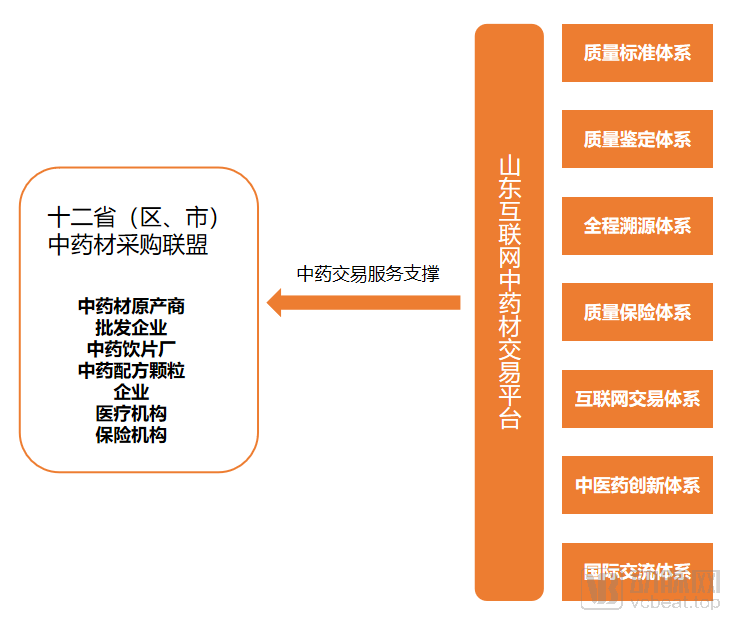
Operating Models of Procurement Alliances and Trading Platforms, Chart by VCBeat
By establishing a system for traditional Chinese medicine (TCM) classification standards, identification, quality control, quality insurance, digital trading, innovation, and cooperation and exchange through the Shandong Internet Traditional Chinese Medicinal Materials Trading Platform, the Procurement Alliance has built a digital TCM service system. This makes the entire supply chain more agile, efficient, and intelligent. The creation of this digital TCM platform addresses industry challenges that hinder the high-quality development of TCM, such as the difficulty in unifying quality standards, low industrial concentration, high circulation costs, opaque distribution channels, and weak international competitiveness.
Smart TCM Pharmacy: Integrating B-Side Resources to Deliver Integrated Services to C-End Consumers
Step 3: Addressing service-related issues.
By combining trust mechanisms with efficient tools, the ultimate goal is to ensure that “competent physicians can prescribe quality medications” and that “quality medications are accessible.” It is therefore crucial to explore more convenient services that earn the trust of consumer-end patients.
If procurement alliances and trading platforms primarily empower B-side entities, then the smart TCM pharmacy of innovative projects mainly reaches C-side patients.
Currently, the Jinan Smart Traditional Chinese Medicine (TCM) Pharmacy has commenced construction. Upon completion, it will enable full-chain innovation in pharmaceuticals, logistics, and supply distribution, providing comprehensive pharmaceutical services including medication dispensing, decoction of TCM herbal slices, home delivery, and medication consultation. By leveraging internet and Internet of Things (IoT) technologies, the facility will implement end-to-end informatization control and management across all processes—from automatic receipt of electronic prescriptions, barcode printing, dispensing of TCM herbal slices, verification, soaking, decoction, packaging, and dispensing, to delivery—thereby ensuring comprehensive quality control and information traceability throughout the decoction process.
Meanwhile, the Jinan Smart TCM Pharmacy leverages the Shandong Internet Medical Insurance and Digital Health Service Platform and the Shandong Internet Chinese Herbal Medicine Trading Center to provide integrated services—including prescription circulation, online medical insurance payment, intelligent decoction, and home delivery—to medical institutions and social pharmacies across Jinan. This service process reengineering reduces the cost of traditional Chinese medicine (TCM) services for these entities. Furthermore, through the Shandong Internet Medical Insurance and Digital Health Service Platform, the Jinan Smart TCM Pharmacy has established connectivity with medical institutions at all levels providing TCM diagnosis and treatment services throughout the city, achieving information interoperability and thereby enhancing efficiency and reducing costs in both TCM service delivery and medical insurance supervision.
Previously, Shandong had already implemented numerous innovations in health insurance reform. One such innovation is the provincial Internet-based Healthcare and Health Insurance Platform, which serves as the foundation for the Shandong Internet Traditional Chinese Medicine (TCM) Materials Trading Platform. The two platforms were launched just over two months apart, demonstrating intensive efforts and significant results—a trend equally evident in TCM innovation.
Accelerate Top-Down Innovation
The Development Plan for the Medical and Elderly Care Health Industry in Shandong Province (2018–2022), issued by the People’s Government of Shandong Province, states that the province should leverage its abundant resources of traditional Chinese medicinal materials to actively develop distinctive and competitive traditional Chinese medicine (TCM) industries, enhance TCM health services, vigorously promote TCM culture, and establish Shandong as a nationally significant base for TCM-based wellness and preservation. By 2022, the province aims to establish six provincial-level engineering technology centers for TCM and cultivate 60 leading TCM enterprises above the designated size.
Driven by a series of national policies, including the “Opinions of the Central Committee of the Communist Party of China and the State Council on Promoting the Inheritance, Innovation, and Development of Traditional Chinese Medicine,” Shandong has accelerated the pace of inheriting, innovating, and developing Traditional Chinese Medicine (TCM). This year alone, the province has promoted healthcare insurance reform and TCM industry innovation through multiple top-level designs and institutional innovations.
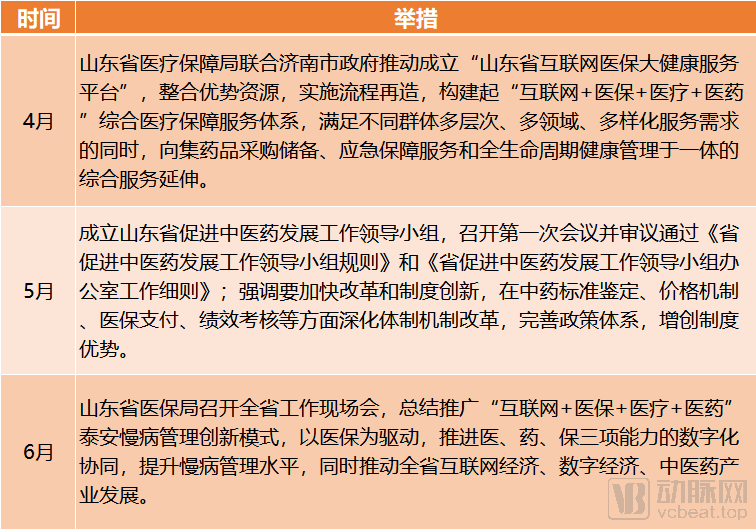
Recent Frequent Moves in Shandong’s Medical Insurance Reform and Traditional Chinese Medicine Industry Innovation, Source: Shandong Provincial People’s Government, Official Website of Shandong Provincial Healthcare Security Administration
The healthcare industry is significantly influenced by policy factors, with policies and government departments exerting the most direct and evident driving and promotional effects on the sector.
Abundant Natural Resources and Prominent Industrial Advantages
Of course, innovation cannot be truly achieved by relying solely on government promotion; Shandong also boasts a favorable environment for the development of the traditional Chinese medicine industry.
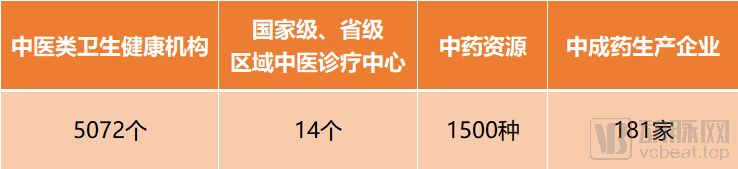
Data Reflecting the Foundation of Innovation in Traditional Chinese Medicine in Shandong Province; Source: Public Information; Chart by VCBeat
First, there is a rich cultural heritage and abundant natural resources. Shandong is the birthplace of pulse diagnosis, acupuncture, and herbal decoctions. The renowned physician Bian Que laid the foundation for Traditional Chinese Medicine (TCM) through his four diagnostic methods: inspection, auscultation and olfaction, inquiry, and palpation. Shandong is also a major province for TCM, boasting 1,500 types of Chinese medicinal resources, accounting for over 10% of the national total. It is a prolific source of authentic dao-di herbs, including Changqing Muyu Stone, Laiwu White Salvia miltiorrhiza, Queshan Pinellia ternata, Longshan Saposhnikovia divaricata, and Mashan Trichosanthes kirilowii.
Next are the clinical applications and industrial advantages. Shandong Province has 5,072 TCM health institutions and 14 national and provincial regional TCM diagnosis and treatment centers. According to the latest data from the "2019 China Health Statistics Yearbook," the number of outpatient visits and discharges at TCM medical institutions in Shandong Province ranks among the top in China, with a significant clinical demand for traditional Chinese medicine.
Shandong is also home to 181 manufacturers of proprietary Chinese medicines. Time-honored brands with centuries of history, such as Dong-E-E-Jiao, have witnessed the industrialization of traditional Chinese medicine (TCM) and possess sufficient industrial conditions to drive its innovative development.
Furthermore, Shandong boasts excellent traditional Chinese medicine (TCM) education and research capabilities. As a key TCM university under national development initiatives, Shandong University of Traditional Chinese Medicine is jointly established by the People’s Government of Shandong Province and the National Administration of Traditional Chinese Medicine, and is included in Shandong Province’s First-Class Discipline Construction Program. It provides sustained intellectual support for innovation in traditional Chinese medicine.
Therefore, whether in terms of policy support, high-level attention from government departments, or the actual industrial environment, Shandong possesses both the advantages and the momentum to explore innovative models for traditional Chinese medicine.
Having established foundational advantages and built out platforms and systems, what should be the next steps for innovation in the traditional Chinese medicine industry?
At the launch event for the Innovative Development Project of the Traditional Chinese Medicine Industry in Shandong (Jinan) on July 7, Zhang Ningbo, Director of the Shandong Provincial Healthcare Security Administration, stated that,Chinese Medicinal Materials from Twelve Provinces (Autonomous Regions, and Municipalities)The Procurement Alliance will adhere to the “12+X” principle, inviting more provinces (autonomous regions and municipalities) and international organizations to join, so as to expand cooperation and exchanges across broader scopes and fields, thereby promoting the branding, scaling, and internationalization of the traditional Chinese medicine (TCM) materials industry.
In other words, more provinces and a greater number of enterprises, medical institutions, and other entities can participate in the project, enabling them to procure high-quality, reliable traditional Chinese medicine (TCM) at competitive prices. Additionally, they can promote their specialty TCM products internationally through the Shandong Internet Traditional Chinese Medicinal Materials Trading Platform. In the future, smart TCM pharmacies are also expected to be rolled out across Shandong Province.
The National Administration of Traditional Chinese Medicine has also expressed strong support for this initiative jointly undertaken by Shandong and 11 other provinces. In his address at the inauguration of the alliance and platform, Yu Wenming, Director of the National Administration of Traditional Chinese Medicine, stated that Shandong, as the hometown of Confucius and Mencius and the birthplace of Bian Que, boasts a solid foundation for the development of traditional Chinese medicine (TCM). Hosting this event is of great significance to promoting the inheritance, innovation, and development of TCM. He expressed the hope that Shandong would thoroughly implement the decisions and deployments of the CPC Central Committee and the State Council, accelerate the revitalization and development of TCM, and strive to become a leading province in TCM development at an early date, thereby better safeguarding the health of the people and serving economic and social development, while providing a model and example for the rest of the country.
In summary, the industry value of Shandong's traditional Chinese medicine (TCM) industry innovation projects is mainly reflected in several aspects:
First, accumulate experience for the establishment of a standard system related to traditional Chinese medicine (TCM). The "Opinions of the Central Committee of the Communist Party of China and the State Council on Promoting the Inheritance, Innovation, and Development of Traditional Chinese Medicine" points out that it is necessary to improve the standard system for TCM decoction pieces, formulate and implement national processing specifications for TCM decoction pieces, and establish and improve safety and efficacy evaluation methods and technical standards that align with the characteristics of TCM.
The development of Traditional Chinese Medicine (TCM) requires both the preservation of local characteristics and the establishment of unified standards and norms. How can a balance be struck between these two objectives? This necessarily entails a long-term, gradual process. The exploration undertaken by Shandong’s TCM industry innovation projects in the areas of quality standards and quality assessment can provide valuable experience for the formulation of national standards across China, addressing a critical weakness that the TCM industry urgently needs to overcome.
Secondly, reshape the circulation system of traditional Chinese medicine (TCM) to promote the digital transformation of the TCM industry. Currently, the wave of digitization is sweeping across all sectors. By leveraging digital tools, it is possible to efficiently match supply with demand and streamline transaction processes. Furthermore, through the integration of logistics, information, and capital flows, a comprehensive traceability system can be established. This ensures quality control and full traceability of TCM products from their place of origin to patients, thereby enhancing efficiency while guaranteeing quality.
Finally, establishing a closed-loop TCM service system promotes cost reduction and efficiency improvement for multiple stakeholders. This innovative project integrates the entire value chain—from TCM distribution and traceability to quality assessment, followed by promotion to medical institutions across China and even international markets, ultimately reaching patients through smart TCM pharmacies. The centralized and large-scale service model reduces costs for all participating parties. Furthermore, the establishment of this comprehensive closed loop provides robust regulatory support for oversight authorities.
As “Internet+” transforms industries across the board, how can it truly serve as a connector and integrator within the specialized field of Traditional Chinese Medicine (TCM)? The continued advancement and implementation of innovative projects in Shandong are poised to provide answers.
Reference: Sun Shaomeng, Xie Ming. Comparative Study on Quality Standards of Chinese Herbal Pieces of Deer Tendon from 13 Regions in China. Asia-Pacific Traditional Medicine, Vol. 16, No. 5.