

Qiao Xin of Deepwise Healthcare: Exploring the New Normal of Healthcare through 5G and AI Development | WAIC 2020

DeepWise
Developer of Artificial Intelligence Medical Imaging Diagnosis System
What Does Primary Healthcare Need? Talent, Equipment, and Funding.
Generally, the means to address primary healthcare needs involve channeling talent to grassroots medical institutions, dispatching supplies, and donating equipment. However, in the era of AI and 5G, the answer to this challenge appears to be undergoing a shift.
The integration of next-generation communication technologies enables the geographic relocation of certain healthcare service delivery. In short, in the 5G era, not all medical services require face-to-face interactions with patients. This means we can leverage AI and 5G from the cloud to empower primary care providers within a defined scope, thereby enhancing the clinical capabilities of primary care physicians and improving the quality of primary healthcare services at a low cost.
At the 2020 World Artificial Intelligence Conference, the scope of primary healthcare capabilities and the construction of public health defense systems in the post-pandemic era once again became focal topics. As 5G and AI technologies gradually mature, telemedicine has been entrusted with greater expectations.
So, what is the future direction of AI in the post-pandemic era? How should primary healthcare be developed at present? What role will telemedicine play under the integration of AI and 5G? During WAIC 2020, VCBeat had the privilege of interviewing Qiao Xin, CEO of DeepWise, to seek answers to these questions.
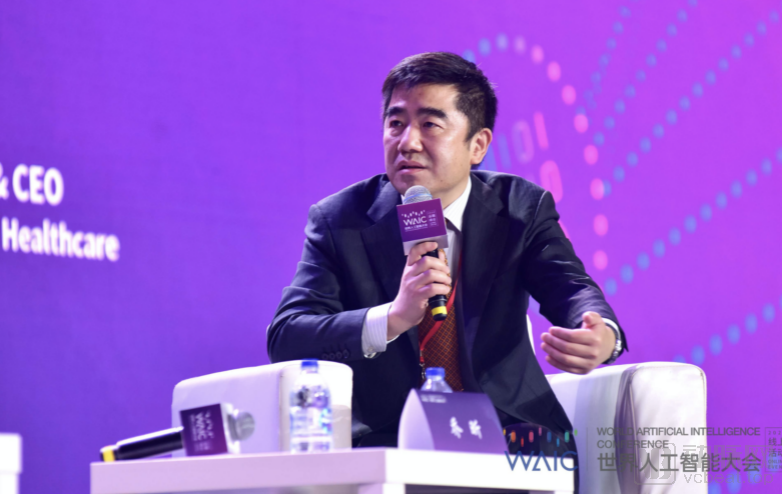
Qiao Xin Attends the Opening Ceremony of the 2020 World Artificial Intelligence Conference
The rapid development of 5G over the past year has been a hot topic at this WAIC, and its application in the healthcare sector has driven innovation in telemedicine.
Today, revisiting telemedicine reveals that its capabilities extend far beyond the lightweight consultations of the past. “Driven by the development of medical consortia, county-level medical communities, and regional imaging centers under the tiered diagnosis and treatment policy, as well as advancements in emerging technologies such as AI and 5G, the scope of telemedicine has become significantly richer. Specifically, the former addresses the structural issues of healthcare services, creating a reservoir for connectivity between different levels of care, while the latter provides a high-quality pipeline system for this reservoir, enabling broad coverage across extensive areas,” said Qiao Xin.
Leveraging the high-speed transmission capabilities of 5G networks, AI enterprises can help medical consortia establish remote diagnosis and treatment centers at tertiary hospitals. In certain specific regions, primary care hospitals only need to equip radiologic technologists to perform imaging scans for patients, while subsequent image interpretation and diagnostic processes can be handled by senior physicians at higher-level hospitals.
“This model was actually proposed earlier, but at that time, some technical issues urgently needed to be resolved. First, the level of informatization in primary healthcare varied significantly, making secure data exchange with higher-level medical institutions difficult. Second, there were transmission challenges: CT and DR medical imaging files captured at the primary care level were large in size and took a long time to transmit, hindering large-scale application. Finally, there was the issue of medical resource allocation. While major hospitals concentrated abundant medical resources, they also bore the burden of a vast number of patients, leading to shortages in medical resources. However, the situation has now changed. In recent years, the rapid advancement of informatization in primary healthcare has enabled seamless data connectivity between different levels of care. The rollout of 5G has made efficient image transmission routine, and the emergence of artificial intelligence has empowered tertiary hospitals to handle a greater volume of medical tasks originating from primary care facilities.”
Delving deeper into the field of medical imaging, the low-latency characteristic of 5G enables the implementation of remote precision surgeries. By integrating AI to empower the construction of telemedicine systems, we can achieve goals such as improving patient experience, reducing healthcare costs, expanding clinical diagnostic and therapeutic capabilities, and advancing the overall level of medical development, thereby making these applications accessible to the general public in the future. Driven by these two emerging technologies, multiple sectors—including disease prediction, health management, new drug research and development, precision surgery, auxiliary diagnostic tools, and hospital management—will undergo successive transformations.
In response to the "Implementation Plan for Promoting the 'Cloud Migration, Data Utilization, and AI Empowerment' Initiative to Foster the Development of the New Economy," jointly formulated by the National Development and Reform Commission and the Cyberspace Administration of China, DeepWise, leveraging its profound AI expertise, has begun to deeply integrate with 5G technology. By capitalizing on 5G's advantages of high bandwidth, low latency, and massive connectivity, DeepWise is accelerating the digital, mobile, remote, and intelligent transformation of medical services.
The emergence of COVID-19 has been a major event in the field of public health, which has in fact driven the development of many advanced technologies such as 5G and AI. Anna Shedletsky, CEO of Instrumental, a company that uses machine learning to help manufacturers improve processes, once cited an example from the electronics manufacturing sector: “In terms of intelligence, we need to achieve five years’ worth of innovation within the next 18 months.”
It is rare to witness such leaps and bounds in the medical field, yet with the onset of the pandemic, certain new models have indeed moved from the background to the forefront.
Qiao Xin cited DeepWise as an example, highlighting two cases: “First, during the pandemic, the Telemedicine Center of the Chinese PLA General Hospital applied artificial intelligence (AI)-assisted imaging diagnosis technology for the first time to provide remote consultation guidance for an elderly COVID-19 patient at Huoshenshan Hospital. DeepWise provided AI technical support for this remote consultation, leveraging the innovative advantages of artificial intelligence to offer essential imaging-based reference data for clinical experts’ remote consultations, thereby facilitating adjustments to clinical medication and treatment pathways and helping physicians make more effective decisions.”
“Second, when a major outbreak occurred at the Mudanjiang border port, DeepWise and China Unicom Heilongjiang Branch quickly joined forces to take the lead in deploying a 5G medical private network in Heilongjiang’s border cities. This enabled information interoperability with local hospitals, the development of smart hospitals, remote consultations, and other intelligent medical services. Furthermore, artificial intelligence technology was applied to assist Suifenhe People’s Hospital—the hospital in the area most severely affected by the epidemic—in its fight against COVID-19, significantly accelerating the pace of epidemic control. In retrospect, it was the construction of such 5G-based infrastructure that created the space for AI to demonstrate its value.”
As illustrated by the two examples above, 5G leverages networking to address the transmission and secure exchange of medical data, while AI employs algorithms to tackle data processing challenges involving large-scale datasets—much like how complex calculations were previously offloaded to computers, today’s complex problems are delegated to artificial intelligence. Consequently, the effective deployment and utilization of AI must align with current clinical pathways in hospitals and be integrated into existing workflow processes.
Although the efficacy of artificial intelligence (AI) technology has been confirmed in practice, how to quantitatively assess the quality of products from various enterprises and establish unified industry standards has remained a focal point for all sectors. At this World Artificial Intelligence Conference, the China Academy of Information and Communications Technology (CAICT), the China Artificial Intelligence Industry Development Alliance (AIIA), and the MIIT Key Laboratory of Medical AI Research and Validation achieved a breakthrough by conducting a unified evaluation of domestic “AI-based imaging assistance products for pneumonia” used during the epidemic prevention and control period. Ultimately, seven AI companies were selected, with DeepWise delivering outstanding performance and securing a place among them.
During the darkest hours of the pandemic, CT medical imaging played a critical role as a supplement to nucleic acid testing. To better combat COVID-19, DeepWise specially enhanced its products to meet specific requirements. Qiao Xin summarized these efforts into three key points:
First, AI must be capable of achieving early screening. In the initial stages of COVID-19 infection, many patients do not exhibit prominent clinical symptoms, yet imaging features are already present. Ground-glass opacities (GGOs) are commonly observed in the early phase of the disease. For physicians facing a large volume of patients requiring urgent screening, this poses a significant challenge. DeepWise’s AI can identify subtle details within these images, thereby assisting physicians by providing evidence for clinical decision-making.
Second, DeepWise’s proprietary five-follow-up system enables continuous tracking of patients’ conditions. The average treatment duration for COVID-19 is approximately 15 days, during which physicians need to conduct regular follow-ups using medical imaging. AI can provide quantitative analytical data on lesions based on imaging findings, which is of significant importance for patient condition assessment. Physicians can monitor disease progression and evaluate severity using scientifically intelligent follow-up data. Leveraging this capability, DeepWise’s AI system delivers intuitive, visual representations of the entire disease progression process through five follow-ups throughout the treatment course.
Third: Precision treatment services support clinical diagnosis. During the pandemic, CT imaging provided highly intuitive and clear visualization of pulmonary infection status and severity. In this context, quantitative data derived from medical images became critically important. Consequently, clinicians leveraged AI to monitor and predict disease progression, adjusting diagnostic and therapeutic plans based on quantified lesion metrics. This approach was particularly valuable in guiding the prudent use of sensitive medications, ultimately enabling precision medicine.
Leveraging these advantages, DeepWise’s AI products can be deployed in a wider range of primary-care-oriented fever clinics and designated treatment facilities, enabling physicians to detect outbreaks at the earliest stages across all levels of care, deliver more precise therapeutic interventions, and significantly enhance future public health epidemic prevention and control capabilities.
Despite significant technological advancements, DeepWise has never deviated from its core mission of “empowering physicians.” As Qiao Xin stated, “The ‘intelligence’ in artificial intelligence originates from physicians and is naturally directed toward empowering them. In the medical field, physicians are the primary agents, while technology serves as an aid. The development of AI will never detach from this central role. DeepWise remains committed to this responsibility, continuously advancing to serve clinical practice.”