

Digital Transformation of Chronic Disease Management: Emerging Models and Innovations Toward a Future-Ready Ecosystem
In its recently released "Report on Digital Innovation in Diabetes Management," VCBeat·VBInsight pointed out that digital technology, as a new force driving disruptive industrial transformation, is sweeping across all sectors of healthcare. As a vital component of the healthcare industry, chronic disease management is also undergoing the impact and transformation brought by digitalization, with its ecosystem being reshaped.
The aforementioned report points out that diabetes, as one of the major conditions in chronic disease management, has a patient population of nearly 100 million and a market size worth hundreds of billions of yuan. This has attracted various players to enter the field, aligning with the general trend of digital development, driving innovation and transformation, and fostering diverse business models. Beyond diabetes, other chronic diseases such as hypertension, heart disease, and cancer also hold broad prospects, making it imperative to build a digital management ecosystem.
Amid the broader trend of integrating digitalization with chronic disease management, how are major enterprises innovating their management models to adapt to the changes brought about by technological advancements? We have analyzed several representative cases in an attempt to gain insights into this phenomenon.
Traditional chronic disease management models primarily follow a workflow of “diagnosis, treatment, rehabilitation, and follow-up.” Healthcare professionals in hospitals and community settings serve as the main implementers, undertaking multiple responsibilities including prevention, healthcare, medical treatment, rehabilitation, and health education.
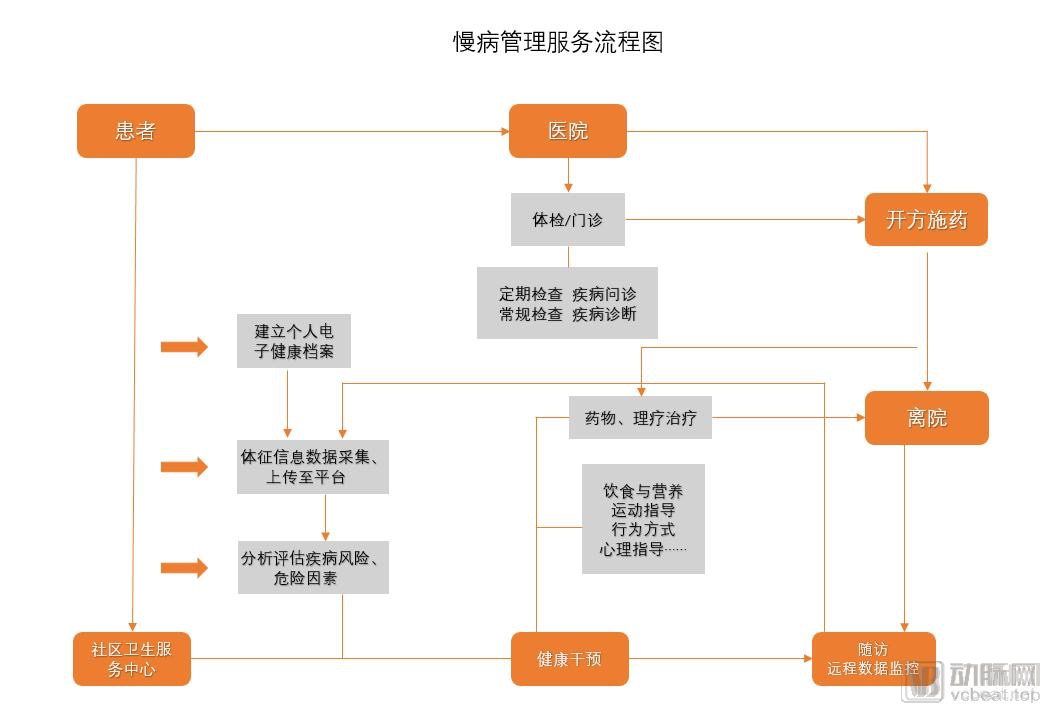
In traditional chronic disease management, the key to effective care still relies on “human” efforts. However, with the growing number of patients suffering from chronic conditions, human resources alone are clearly insufficient to meet the immense management demands, which significantly affects the effectiveness of current healthcare institutions. With technological advancements, various tools centered around big data, the Internet of Things (IoT), and artificial intelligence (AI) have begun to permeate every aspect of medical services, enhancing the efficiency of healthcare institutions in managing chronic diseases.
In November 2019, coinciding with the Second China International Import Expo, Novartis Pharmaceuticals and Tencent jointly launched “Hu Xin Xiao Ai (AI),” China’s first artificial intelligence-powered disease management platform dedicated to heart failure. Leveraging WeChat Mini Programs as its delivery vehicle and harnessing the advantages of AI, the platform offers interactive features such as voice and image recognition to help patients and their families manage heart failure health information more conveniently and accurately. This application scenario has provided significant convenience for patients.
Earlier, Alibaba Health, in collaboration with Academician Ning Guang’s team, incubated “Rui Ning Zhu Tang,” the first AI-powered doctor for diabetes, to provide general practitioners with auxiliary diagnostic and treatment plans. In March 2019, Alibaba Cloud unveiled China’s first machine intelligence-based knowledge graph for diabetes at the Tianchi Competition. This innovation maximally replicates experts’ medication reasoning in diabetes treatment, thereby assisting primary care clinicians in making more scientific decisions, enhancing their prescribing skills, further improving consultation efficiency, and lowering barriers to medical access.
In addition to internet giants such as BAT, leading domestic artificial intelligence companies like 4Paradigm are also venturing into the field of chronic disease management. Leveraging three-year follow-up records from 170,000 users to identify diabetes risks through data analytics, the company collaborated with the MMC Center of Ruijin Hospital to jointly launch “Rui Ning Zhi Tang,” China’s first AI-based product for managing diabetes and its complications.
Tech giant Apple also integrated an ECG feature into the Apple Watch Series 4, enabling alerts for abnormal heart rates to encourage timely medical consultation, along with a fall detection module that can automatically summon emergency assistance. By integrating sensors, cloud technology, and big data analytics into a seamless ecosystem, such smart hardware manufacturers aim to provide comprehensive solutions for chronic disease patients, ranging from health monitoring to medical intervention.
Despite the continuous emergence of new technologies, most efforts remain confined to incremental improvements on traditional chronic disease management models, yielding unsatisfactory results. Digital technologies can be integrated into various stages, including early-stage monitoring, follow-up management, and personalized chronic disease care services. However, throughout the entire process of chronic disease management, fundamental pain points persist. This is because chronic diseases are long-term conditions that coexist with individuals, and their core management hinges on the cultivation of healthy lifestyle habits. Consequently, while various technologies have enhanced management efficiency, they have yet to fully address these underlying challenges.
In summary, most current digital chronic disease management solutions exhibit the following issues:
1. Excessive online monitoring, insufficient offline services;
2. Lack of patient awareness in chronic disease management and poor adherence;
3. Chronic disease treatment and management have not formed a closed-loop service system, preventing hospitals from assuming the role of continuous care managers;
4. Following the traditional chronic disease management model, most approaches rely solely on pharmacological interventions, lacking systematic prevention and control strategies.
These pain points still need to be further addressed. In recent years, many companies have emerged in the digital chronic disease management sector, exploring new solutions and developing new business models within this market, gradually transforming the roles, processes, and ecosystem of traditional chronic disease management.
As digitalization reshapes the ecosystem for chronic disease management, business models that integrate various healthcare service providers—including medical institutions, pharmaceutical and medical device companies, internet healthcare enterprises, pharmaceutical e-commerce platforms, pharmacies, and commercial insurance companies—are gaining significant traction. These models primarily fall into the following three new categories:
1. Hospital-Oriented SaaS Model: Empowering Medical Professionals Comprehensively
SaaS model innovation targeting hospitals emerged in the aftermath of the “Hundred Glucose Meter Wars.” In recent years, the strategy of exchanging capital for user traffic in the diabetes management sector has proven ineffective, characterized by low user stickiness and extremely low conversion rates. Consequently, some companies have begun shifting their focus to the B2B segment, returning chronic disease management to its fundamentals.
From the hospital’s perspective, there are significant challenges in patient diagnosis, treatment, and management. Hospitals need to extend therapeutic services beyond their walls and provide professional guidance, but they often struggle to address this scenario effectively, necessitating practical tools provided by enterprises. Consequently, some companies have shifted their approach from offering management tools for patients to providing management solutions for hospitals.
Representative examples include Zhiyun Health and Tangning Weishi, which leverage their strengths in the digital management of diabetes to build standardized clinical workflow systems, tiered diagnosis and treatment platforms, and chronic disease management platforms for hospitals, thereby improving in-hospital service efficiency.
Another category, exemplified by AiYiSheng, targets the grassroots market in lower-tier regions by providing community health service centers with an intelligent medical engine for chronic disease management ecosystems—the GDS National Guideline AI-Based Chronic Disease Management System. This system already covers seven major conditions, including hypertension, diabetes, dyslipidemia, and coronary heart disease, enabling more people to access high-quality medical resources within their communities.
2. Personalized Customization Service Model to Meet Patients’ Multi-Level Needs
Notably, as health literacy continues to rise across China, personalized services—such as precision nutrition, personal fitness coaching, health screenings, and specialist consultations—will become primary demands for users in chronic disease management and represent a key direction for the future development of chronic care services.
With the rapid advancement of digital technologies, health management companies have accumulated vast amounts of health data by providing long-term monitoring of physiological indicators for patients with chronic diseases such as hypertension and diabetes, which require healthy lifestyle habits to alleviate symptoms. This data is further used to generate individualized health profiles and develop personalized intervention plans covering nutrition, exercise, and sleep, thereby helping users improve their health status and promoting effective health management.
As a pioneer in the field of digital health management, Miao Health has set a benchmark for personalized chronic disease management. As early as 2018, Miao Health entered into a strategic partnership with the Canada Wellness Institute (CWI), the number one chronic disease management organization in North America. By introducing internationally advanced lifestyle medicine concepts and extensive offline experience, and integrating them with its own advanced AIoT-based health management solutions, Miao Health has established a comprehensive online-to-offline (O2O) closed-loop management system. This approach effectively addresses the current pain point of insufficient offline services in the field of chronic disease management.
Over the past two decades, CWI has saved the Canadian government tens of millions of Canadian dollars in chronic disease expenditures. The model implemented by CWI in China similarly emphasizes a holistic approach encompassing exercise, nutrition, psychological well-being, and sleep. Leveraging advanced medical fitness facilities and a professional team, it adopts innovative strategies for chronic disease prevention, rehabilitation, and health management, thereby addressing the multidimensional needs of individuals with chronic conditions.
Today, the chronic disease management program jointly developed by Miao Health and CWI (China) not only integrates professional chronic disease assessments and risk evaluations to provide personalized intervention plans for patients with hypertension, diabetes, cancer, chronic obstructive pulmonary disease (COPD), and obesity, but also ensures ultimate management effectiveness through varying degrees of involvement by doctors, nutritionists, and other professionals who oversee the “AI Health Manager” system.
3. “Chronic Disease Management + Healthcare/Pharmaceuticals/Insurance” Model: Integrating the Entire Health Service Process
In reality, chronic disease management is merely one link in the chain of chronic disease treatment and health improvement. It must collaborate with primary care, pharmacies, and insurance providers to deliver effective services encompassing treatment, lifestyle interventions, long-term follow-up, and payment mechanisms, thereby forming a closed-loop ecosystem. Taking diabetes as an example, this condition requires long-term medication for control. Therefore, chronic disease management companies need not only to provide health guidance and risk warnings through popular science information but also to leverage AI-enabled monitoring devices to provide real-time feedback on users’ health indicators and remind them to take their medications.
During the medication phase, patients’ needs center on guidance for proper drug use and on accessing medications in a more affordable and convenient manner. At this stage, the advantages of digital chronic disease management companies become prominent. By leveraging their accumulated user data and integrating resources to meet patient needs, these companies can deepen collaborations with pharmaceutical and medical device manufacturers, thereby continuously providing patients with appropriate medications and intelligent monitoring devices.
At the payment stage, digital chronic disease management companies can also collaborate with insurance institutions, leveraging technology to jointly develop chronic disease insurance products—a trend that has become increasingly pronounced in recent years. The customization of chronic disease insurance not only encourages patients to adopt healthier lifestyles but also provides insurers with value-added services beyond claim settlements. Furthermore, it enables insurers to mitigate payout risks through effective disease management, ultimately reducing expenditures on chronic disease treatment.
In this model, Miao Health’s one-stop chronic disease management service solution also demonstrates distinct advantages. From a preventive perspective, it integrates with hospitals, pharmacies, and insurance providers, supported by robust chronic disease management capabilities. Miao Health matches high-quality medical and pharmaceutical resources with additional health insurance services that provide an extra layer of risk protection. As this mature closed-loop model is increasingly implemented, it is poised to become the mainstream approach to chronic disease management in the future.
The digital chronic disease management sector has always been rich with innovators, where technological advancements and model innovations have shaped several success stories. New technologies have liberated the chronic disease management ecosystem, which was previously reliant on manual, human-centric approaches, helping resource-constrained primary healthcare institutions improve management efficiency. The resulting changes are poised to sustain positive development.
Undoubtedly, in the new business ecosystem, an increasing number of enterprises will continuously innovate to adapt to market developments and patient needs. Embracing technology and change has become an inevitable trend, and it is believed that digitalization will bring higher-quality services to the chronic disease management market.