

Five Key Insights on Investing in the Medical Robotics Industry
By VINNO CAPITAL / Zhao Lü
Robots applied in the healthcare industry are referred to as medical robots.
In 1985, the first robot for medical surgery was born; in 2000, the FDA's approval of the Da Vinci (Intuitive Surgical) robotic surgical system became a milestone event; the first commercial application of rehabilitation robots was in 1987, and the milestone event was in 2013 when Cyberdyne's HAL exoskeleton robot received safety certification.
In 2016, the development of medical robots entered a fast lane, driven primarily by two particularly significant events. The first was the emergence of AlphaGo, which defeated Go champion Lee Sedol and later overcame “Go prodigy” Ke Jie. This event vividly demonstrated the “thinking” capabilities of robotic intelligence. The DeepMind concept swept the globe, instantly becoming a hotspot for startups and sparking an investment frenzy. The second was the Boston Dynamics Atlas robot’s stunning backflip, a maneuver of considerable difficulty that signaled major breakthroughs in technologies related to sensing, perception, object recognition, and materials.
Most medical robotics startups we see today fall into one of two categories: either they are “scholarly,” like AlphaGo, relying on artificial intelligence; or they are “martial,” such as automated IVD assembly lines, the da Vinci Surgical System, or exoskeleton robots. A small minority resemble a combination of AlphaGo and Atlas, entailing significantly greater technical challenges.
The healthcare sector is relatively traditional and conservative, subject to a wide array of regulatory frameworks. While technological advancements are the primary driver behind the development of medical robots, their commercialization hinges on robust market demand. First, population aging is leading to a higher prevalence of diseases, chronic conditions, and disabilities; with the global population aged 60 and above projected to grow by 56%, the pressure on healthcare systems is substantial. Second, there is a severe shortage of healthcare professionals. Third, demand for high-quality medical care is rising. Fourth, there is a growing need for disaster response capabilities.
In the field of medical robotics, the da Vinci Surgical System is an unavoidable benchmark, serving as the representative model among surgical robots. Technically speaking, surgical robots constitute the pinnacle of the medical robotics sector, characterized by high technical complexity, significant risks, and prolonged development cycles. The da Vinci Surgical System offers 20x magnification of the surgical field, precise seven-degree-of-freedom manipulation, and enables minimally invasive procedures through incisions as small as 1 centimeter. From a clinical perspective, surgeries performed with the da Vinci system are associated with reduced blood loss, faster recovery, and higher postoperative survival and rehabilitation rates. Since receiving FDA approval in 2000, the global installed base of da Vinci systems reached 5,582 units by 2019, with a cumulative total of 7.2 million surgeries performed.
From a financial perspective, Intuitive Surgical went public on the NASDAQ in 2000. Its stock price rose from an initial $6.02 to $574.59 (the closing price on June 1, 2020), representing a gain of 9,445% and a compound annual growth rate of approximately 26%. Arguably, Intuitive Surgical’s extraordinary performance has acted like a stimulant, inspiring numerous entrepreneurs in the medical robotics sector. This is also one of the reasons behind the current rise and prosperity of China’s medical robotics industry.
The primary functions of medical robots are to provide medical care or assist in medical procedures. Here, "medical care" encompasses both treatment and diagnosis. From a regulatory perspective, the varying levels of difficulty are evident: therapeutic interventions pose the greatest challenge, followed by assisted therapy, while diagnostic and assisted diagnostic applications are relatively easier to regulate and thus achieve certification more rapidly.
Medical robots can be broadly categorized into the following subsegments:
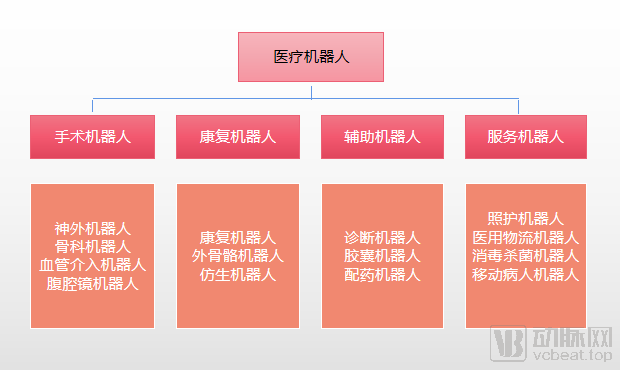
Surgical RobotUndoubtedly the crown jewel of medical robotics, surgery bears a resemblance to art. Patients undergoing surgery are typically afflicted with serious conditions, and the evaluation criteria are multifaceted: short operative time, minimal blood loss, reduced tissue trauma (minimally invasive), favorable healing outcomes, low complication rates, and cost-effectiveness. Meeting such a comprehensive set of requirements underscores the artistic nature of the procedure. The pursuit of improvement in these metrics is unending. For instance, what constitutes a “short” operative time? A decade ago, one hour might have been considered short; today, even twenty minutes may still be perceived as lengthy. From the patient’s perspective, any duration spent on the operating table, even a single minute, feels excessively long.
Secondly, there are high demands on physicians. Training a qualified surgeon is no easy task, and highly skilled surgeons are a scarce resource. Moreover, surgical work is characterized by monotony, tedium, high repetitiveness, significant risk, intense stress, and susceptibility to fatigue. The shortage of surgeons relative to the high volume of surgeries further underscores the critical need for surgical robots.
Third, surgical procedures are complex; after all, no two patients are exactly alike. Surgeons rely heavily on experiential judgment during operations. The digitalization of surgical processes is not yet fully realized, let alone their intelligent automation. Therefore, even the da Vinci Surgical System remains within the category of robotic-assisted surgery devices; a truly autonomous surgical robot does not yet exist.
Depending on the specific clinical applications, the field can be subdivided into neurosurgery, orthopedics, vascular intervention, and abdominal surgery. In terms of application complexity, laparoscopic robotic systems are considered the most intricate. Vascular intervention and neurosurgery carry higher risk profiles; for instance, Elon Musk’s implantation of brain-computer interface chips via a neurosurgical robot is commendable for its boldness. Neurosurgical and orthopedic robots demand high precision. Overall, the technical barrier for orthopedic robots is relatively lower, making them a key area for breakthroughs in domestically produced robots. Tinavi Medical Technologies stands as the leading player in China’s orthopedic robotics sector and has successfully listed on the STAR Market.
Rehabilitation RobotsUnlike surgical robotics, the rehabilitation sector is less high-stakes, where failures are not immediately life-threatening. The rise of the rehabilitation industry is driven more by national policy guidance aimed at addressing population aging; however, practical implementation hinges on the payment capacity of rehabilitation patients. The patient population primarily consists of two groups: those with physical disabilities and those with cognitive impairments. Addressing cognitive impairments is considered more critical and urgent than addressing physical disabilities. For this reason, it has become a hotspot for entrepreneurship, with numerous ventures focusing on conditions such as dementia, Alzheimer’s disease, and Parkinson’s disease.
The primary constraint on the commercialization of rehabilitation robots is affordability, as patients often lack sufficient financial means. Some entrepreneurs mistakenly focus on showcasing technical prowess in this area, which represents a strategic misalignment. Taking exoskeleton robots as an example, enabling a completely paralyzed individual to stand upright is indeed impressive. However, the prohibitive cost leaves those who have regained the ability to stand financially “paralyzed.” If costs are reduced, there may be a significant risk of secondary injury, which is strictly contraindicated in rehabilitation, creating a dilemma. Those interested may examine the current status and future prospects of ReWalk, Ekso Bionics, and Cyberdyne.
With the aging population in the future, rehabilitation will face a severe shortage of technicians and nursing staff. Therefore, robots that assist technicians and caregivers to improve care efficiency are expected to have promising prospects.
Assistive RobotHere, we focus on AI-assisted diagnosis, also known as artificial intelligence. The market for diagnostic solutions is primarily concentrated in three segments: medical imaging, in vitro diagnostics (IVD), and pathology. These areas represent the most successfully commercialized sectors within hospitals, and the startup landscape is highly competitive. This trend is driven by three main factors. First, commercialization in diagnostics is easier than in surgical interventions. Imaging equipment such as CT, DR, MRI, and ultrasound serves as a significant revenue source for hospitals; IVD offers even more promising commercial prospects; while pathology is somewhat more challenging, it remains indispensable for definitive diagnosis. Second, AI-assisted diagnosis is the application domain most closely aligned with AlphaGo’s capabilities. With its high level of digitalization, it is well-suited for deep learning, making medical imaging, in theory, an ideal breakthrough point for artificial intelligence. Third, since these tools do not involve direct treatment, they carry lower safety risks. Most are classified as Class II medical devices, and the “Atlas” component is often optional, resulting in a moderate level of technical difficulty.
AI projects are highly popular, launching with a high-profile image and commanding lofty valuations, leading some to mistakenly equate this with success. However, valuation is not an indicator of corporate success; capital can both sustain and undermine a business. The primary constraint for AI lies in the difficulty of monetization. In healthcare, patients bear the cost of services, while medical AI serves to assist healthcare professionals in delivering patient care. If AI is to be monetized, it will inevitably increase the financial burden on patients, which conflicts with the pressing need to address the challenges of difficult and expensive access to medical care. Therefore, the foremost challenge facing medical AI is the issue of willingness to pay.
Perhaps precision medicine combined with artificial intelligence, or fully automated equipment or assembly lines integrated with artificial intelligence, would be viable solutions.
Service Robots,This is not significantly different from other traditional fields and will not be discussed in detail.
In summary, the difficulty of launching a startup in the medical robotics sector varies by category. High-barrier segments face less competition and represent blue-ocean markets, yet ventures often fail before their products even reach the market (“the product dies before it is sold”). Low-barrier segments are characterized by intense competition and red-ocean struggles, akin to the poetic lament, “Do not laugh if I lie drunk on the battlefield; few have ever returned from war since ancient times.” Success is a low-probability event, requiring not only the accumulation of hard-core capabilities but also a touch of luck.
The risks of entrepreneurship begin with making multiple-choice decisions.
As with all startup ventures, the first questions to answer are: “Who are the customers?” and “What services are provided to them?” For the same medical robot product, risks vary across different teams; likewise, for the same team, risks differ depending on which medical robot product they choose to develop. Therefore, selection is crucial for startup teams.
VINNO CAPITAL has been closely monitoring the medical robotics sector, with a focus on early-stage investments (Angel and Series A rounds). The primary investment risks in the medical robotics sector at this stage include:
First, the technological barriers are excessively high. Products are launched without adequate validation of their definitions. This is particularly true for teams developing surgical robots; most boast impressive credentials, with their technological expertise accumulated abroad or in research institutes. Given the high cost of validating such technologies, these ventures are compelled to secure angel-round financing from the outset.
Second, the long cycle makes time the greatest risk. A prolonged cycle often entails extended development, regulatory registration, and marketing timelines. Some aspects of the timeline are within our control, while others are entirely beyond it. There are numerous concerns: worries about failed development, inability to obtain regulatory approval, and poor market performance.
Third, it is extremely capital-intensive; the long development cycle of robotics also means substantial cash burn. Round after round of financing resembles a relay race, where cash flow is the lifeblood of the enterprise, and each funding round becomes a matter of survival.
Fourth, the business model is unclear. Many people hold the view that a product with high quality and low price will inevitably achieve strong sales upon launch, leading them to selectively avoid considering the post-launch business model. This issue is particularly prevalent among rehabilitation products. Such projects are often tested not before but after the product hits the market.
Fifth, timing. Every market opportunity has a window period. Projects that are too far ahead are often difficult to understand and lack validation, while those that lag significantly behind have no chance in the market. Therefore, being half a step ahead is optimal, yet the most challenging to achieve.
“The most breathtaking views are found at the perilous peaks.” Stunning landscapes always coexist with risks; while recognizing these risks, we must also acknowledge the immense social value generated by overcoming them. VINNO CAPITAL focuses on early-stage venture capital, empowering startups to identify and mitigate risks. We remain unwavering in our optimism about the direction of medical robotics, firmly believing that China’s own “Da Vinci” surgical system will inevitably emerge in this great era.
References:
1. PwC: Macro Application Trends and Research Directions for Medical Robots
2. Ping An Securities – Champion Series Report on the Technology Sector (I): Medical Robotics Champion, Intuitive Surgical (da Vinci Surgical System)