

Yizhun Intelligence Launches China's First Real-Time AI-Powered Breast Ultrasound Detection System

MEDICAL AI
AI-Assisted Medical Imaging Diagnosis System Developer
On July 11, MEDICAL AI officially launched its Intelligent Breast Ultrasound Detection System at the World Artificial Intelligence Cloud Summit. Without altering existing ultrasound equipment or hospital workflows, the system leverages Neural Architecture Search (NAS) to perform real-time intelligent analysis of ultrasound signals, enabling real-time lesion detection, automatic segmentation, and benign-malignant classification. As the first AI-based detection system for ultrasound devices in China, it advances intelligent breast cancer screening into the AI 3.0 era of real-time video analysis.
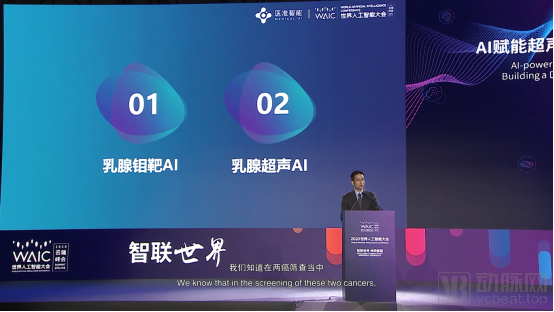
World AI Cloud Summit Launch Event
Breast cancer is the most common malignant tumor among women aged 30–59 and one of the leading causes of death in women under 45, accounting for 15% of all female cancer incidences. In China, the challenge posed by breast cancer is particularly pronounced, as it is one of the countries with the fastest-growing incidence rates, increasing at an annual rate of 2%.
Early screening is the most critical measure for improving breast cancer cure rates. However, China launched its early prevention and treatment screening programs relatively late, and physiological differences exist between Chinese and Western women. Relying solely on mammography may carry a risk of missed diagnoses. Therefore, the inaugural *Guidelines for Breast Cancer Screening, Early Diagnosis, and Early Treatment in China* (2018) emphasized that breast cancer screening in China should prioritize the combination of ultrasound and mammography.
“This is also a key reason why, after developing and promoting our intelligent mammography detection system, we dedicated significant R&D resources to focus on the development of intelligent ultrasound detection,” said Lü Chenchong, Founder and CEO of MEDICAL AI. Mammography is the gold standard in European and American countries, with widespread population coverage. However, due to the high technical barriers in developing AI for mammography and the lack of publicly available algorithms, papers, and data internationally, MEDICAL AI’s technical team overcame these challenges and launched China’s first commercialized intelligent breast cancer detection system, which was warmly received by the market. “Currently, our intelligent mammography detection system has assisted physicians in conducting precise breast cancer screening at hundreds of renowned hospitals and healthcare institutions across various levels in China, earning widespread acclaim.”
However, the application of AI in detection, transitioning from mammography to ultrasound, faces significant challenges within the field of artificial intelligence. This is because mammography detection systems belong to the AI 1.0 era, whereas ultrasound detection systems pertain to the AI 3.0 era, spanning two distinct generations of AI technological development. Specifically, the core technology of mammography detection systems is based on 2D imaging, a mature technology with a long development history. In contrast, the core technology of ultrasound detection systems relies on real-time video, which has accumulated less technical foundation. The practical difficulties in healthcare are even more pronounced. Due to the lack of standardized protocols for image acquisition, image quality control, and data transmission in ultrasound, coupled with the workflow constraints of physicians interpreting images and generating reports in real time, the majority of existing research remains confined to the processing of 2D static images. Consequently, these systems fail to provide real-time auxiliary diagnosis, thereby unable to effectively enhance diagnostic efficiency or optimize the allocation of medical resources.
How to Extend the Technological Advantages from the AI 1.0 Era to the 3.0 Era? As the earliest pioneer in the field of artificial intelligence for medical imaging, MEDICAL AI boasts profound R&D capabilities. After more than a year of exploration, innovation, and breakthroughs, it has achieved remarkable results, making significant progress in both technological breakthroughs and product applications. “Similar to the R&D process for mammography, the core algorithm of this system was not trained using conventional methods such as transfer learning or parameter tuning on existing models. Instead, a new model was creatively established specifically to address this problem,” said Lü Chenchong.
MEDICAL AI’s Intelligent Breast Ultrasound Detection System requires no modifications to existing equipment and no adjustments to current workflows. While physicians perform scans, the AI server conducts real-time analysis and provides on-screen annotations and alerts. It can accurately capture lesions that appear for only milliseconds, effectively preventing missed diagnoses caused by physician visual fatigue or insufficient visual sensitivity.
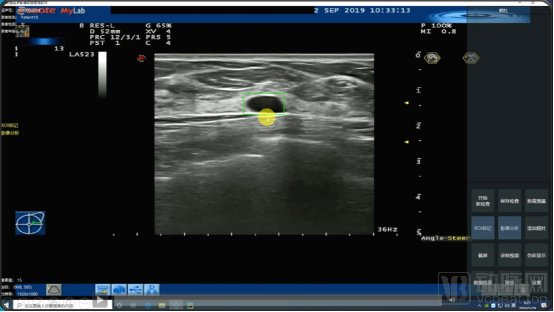
MEDICAL AI Breast Ultrasound Intelligent Detection System Interface
Specific Functional Implementation:
Lesion Detection
Automatic Lesion Segmentation and Capture of the Largest Cross-Sectional Image
Analysis of Lesion Benignity and Malignancy
Lesion BI-RADS Category
Detailed Lesion Attribute Analysis (Shape, Orientation, Margins, etc.)
Automated Generation of Image-Text Reports
Report Saving and Printing
As a clinically applied system, the MEDICAL AI Intelligent Breast Ultrasound Detection System also features the following five key highlights:
Fast computation speed, low latency;
The system employs Neural Architecture Search (NAS) and runs on an RTX 2080 Ti, achieving a processing speed of >50 frames per second with a detection latency of <0.09 seconds, enabling precise capture of lesions that flash for only milliseconds.
High lesion detection rate;
Simulating 3D reconstruction through convolutional neural network feature fusion to determine the benign or malignant nature of lesions.
Low false positive (false alarm) rate;
The system makes judgments by screening for meaningful frames across all images, thereby effectively reducing the false positive rate.
Intelligent Segmentation, Automatic Measurement;
Compared to merely analyzing lesion attributes based on a single cross-sectional feature, this system can analyze the entire video sequence containing all lesion information. By fully leveraging cross-sectional data from multiple planes, it enables a more comprehensive attribute analysis of the lesion as a whole, while also providing quantitative metrics such as the maximum cross-section, long and short diameters, and area.
Structured Report Generation
One-click access to accelerate the efficiency of imaging report diagnosis; intelligent ultrasound findings and diagnosis to assist clinicians in obtaining detailed textual data on diseases.
“The launch of the Intelligent Breast Ultrasound Detection System serves as a comprehensive review of our AI technological capabilities. From the AI 1.0 era to the AI 3.0 era, our technical team has consistently maintained industry-leading R&D standards,” said Lv Chenchong. “It also validates our sustained service capabilities in the healthcare sector. Our breast mammography system has already assisted physicians in conducting precise breast cancer screening at more than 100 renowned hospitals and healthcare institutions at various levels across China. We believe that the integration of breast ultrasound will enable us to serve more physicians and patients. As indicated in the Guidelines for Breast Cancer Screening, Early Diagnosis, and Early Treatment in China, we expect that combining ultrasound with mammography will achieve broader coverage in early breast cancer screening and further improve breast cancer cure rates.”