

70% of Clinic Managers Expect Recovery Within Six Months Post-Pandemic; Five Strategic Paths Identified to Enhance Clinic Competitiveness
During the pandemic, 93% of clinics suspended operations due to the impact. Among them, 96% were closed for 1–3 months. After resuming operations, outpatient volumes in pediatrics, surgery, and internal medicine were most severely affected, with 80% of pediatric clinics experiencing a decline in patient visits.
From July 11 to 12, at the 2020 Clinic Development Conference hosted by DXY, the DXY Clinic Development Alliance released the Report on the Development of Primary Care Clinics in China in the Post-Pandemic Era, which disclosed the aforementioned data. The pandemic has brought unprecedented challenges and opportunities to clinics. How to navigate these challenges and seize the opportunities became a key focus of the conference.
To illustrate the impact of the 2020 COVID-19 pandemic on the development of China’s clinic industry, the DXY Clinic Development Alliance conducted a survey of primary care clinics. At this conference, it released for the first time the “Report on the Development of Primary Care Clinics in China in the Post-Pandemic Era.” More than 4,000 clinics nationwide participated in the survey, yielding over 14,000 data points on clinic survival and development under the influence of the pandemic.

Xu Kenan, Head of the DXY Clinic Development Alliance, Releases “Report on the Development of Primary Care Clinics in China in the Post-Pandemic Era”
Survey data from the report indicates that during the pandemic, 93% of clinics suspended operations due to the impact of COVID-19. Among these, 24% were closed for less than one month, while the majority (96%) remained shut down for 1–3 months.
Following the resumption of operations, outpatient volumes in pediatrics, surgery, and internal medicine were most significantly impacted by the pandemic, with 80% of pediatric clinics experiencing a decline in patient visits. This was primarily because home quarantine measures implemented during the epidemic prevention and control period effectively blocked transmission routes. Although social life has gradually returned to normal in the post-pandemic era, the continued requirement to wear masks in public spaces has reduced the transmission probability of various common infectious diseases.
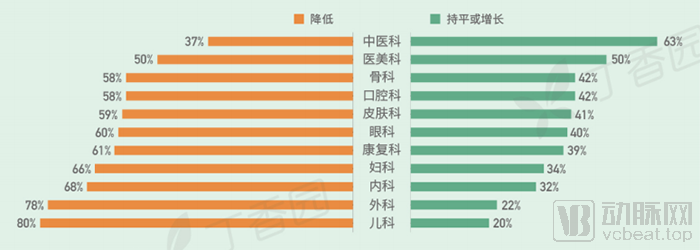
Changes in Outpatient Visits Across Different Departments Post-Pandemic, Source: "Report on the Development of Primary Care Clinics in China in the Post-Pandemic Era"
Notably, unlike other departments, the outpatient volume in medical aesthetics has remained largely stable compared to pre-pandemic levels. This trend aligns with the growing penetration of medical aesthetic services among the general public in recent years. Furthermore, 63% of Traditional Chinese Medicine (TCM) departments experienced an increase rather than a decline in outpatient visits. Specialties characterized by sustained customer management have demonstrated advantages during the post-pandemic recovery phase.
To mitigate the impact of the pandemic, clinics have primarily adopted measures such as launching online services, implementing cost control, and strengthening employee training.
Specifically, approximately 83% of clinics have launched online services, with WeChat (group) Q&A being the primary channel, accounting for 92%. For 56% of clinics, the main purpose of offering online services is to maintain patient relationships.
In terms of cost control, most clinics have maintained stable staffing levels; salary adjustments are the preferred approach to reducing costs, and decreasing the procurement of routine medical devices is another cost-saving measure.
During the pandemic-related suspension of clinical services, 91% of clinics conducted staff training. The top three training topics were: professional skills, service capabilities, and clinical workflows.
During this period, the DXY Clinic Development Alliance, which has brought together more than 2,000 primary healthcare institutions across China, shared case studies and experiences on pandemic response through community live streaming and new media content, while also organizing group purchases of anti-epidemic supplies to reduce clinic costs.
70% of clinic managers believe that their clinics can return to normal operational levels within six months. New-type clinics bearing the three labels of “located in Beijing, Shanghai, Guangzhou, or Shenzhen,” “in operation for five years or less,” and “fee-for-service model” demonstrate greater confidence and potential for recovery from the crisis.
So, in the post-pandemic era, from which aspects should the clinic industry improve its service volume and revenue? How can it enhance its long-term risk resilience?
At this Clinic Development Conference, over 40 guests, including Liao Xinbo, former Inspector and Deputy Director of the Guangdong Provincial Health Department; Li Tiantian, Founder and Chairman of DXY; Cui Yutao, Dean of Beijing Cui Yutao Parenting Academy Clinic; and He Haiyang, Chairman and CEO of Johnson Medical Group, delivered speeches. They explored topics such as core competencies of clinics in the post-pandemic era, chain development, and online services, attracting more than 800 industry professionals.
From the discussions at the conference, we have identified five pathways to promote clinic recovery and enhance competitiveness.
Liao Xinbo, former Inspector and Deputy Director of the Guangdong Provincial Health Department, believes that, based on experience in epidemic prevention and control, enhancing community-level medical capabilities and strengthening systemic preparedness are the most cost-effective and efficient measures for responding to epidemics.

Liao Xinbo, Former Inspector and Deputy Director of the Guangdong Provincial Department of Health
He cited as an example that makeshift hospitals are, in essence, large-scale medical and health service institutions, fulfilling a critical component of the tiered diagnosis and treatment system: namely, initial consultation at the primary care level, two-way referrals, triage between acute and chronic conditions, coordinated care across different levels of the healthcare hierarchy, patient stratification by severity, and the treatment of mild cases.
Therefore, the enhancement of service capacity in primary healthcare institutions should not only be reflected in public health services but also in improving the diagnosis and treatment capabilities for common and frequently occurring diseases.
Recognizing the value of primary care physicians is key to achieving tiered diagnosis and treatment.
“Dr. Zhang Qiang has left a tertiary hospital, yet he can still fulfill the same role he played within that institution.” Liao Xinbo believes that a physician’s value should not be determined by the size of the hospital, nor should the pricing of disease treatment be based on hospital size. Therefore, enhancing the quality and value of medical services is the direction for future healthcare reform. The value of primary care physicians will be fairly recognized, and administrative measures should not be used to define physicians’ worth.
It is the consensus among the panelists that improving diagnostic and treatment techniques as well as medical quality is essential; only after establishing a strong reputation on this foundation can primary healthcare institutions enter a virtuous cycle.
Yang Zefang, Vice President of DXY and Head of DXY Clinic, believes that for clinics, quality and reputation are paramount. While training in professional competence and service capabilities is a long-term effort for patient acquisition, its effects become visible after more than six months of accumulation; conversely, prioritizing marketing operations over medical quality may lead to crises at any time.

Yang Zefang, Vice President of DXY and Head of DXY Clinic
“During the peak flu season, everyone’s practice is saturated, and patient volumes hit record highs; can you really tell who is competent and who is not? Absolutely not.” Yang Zefang noted that after the onset of the pandemic, the disparities in physicians’ clinical proficiency and patient acquisition capabilities became immediately apparent. “The pandemic served as a filter for physicians’ competencies.”
In Yang Zefang’s view, in the post-pandemic era, clinic physicians should achieve a score of 90 or above, embrace more stringent challenges, and elevate quality standards to new heights.
Not only should the clinical diagnosis and treatment itself maintain high quality, but the service content and processes surrounding it also require continuous quality improvement.
Li Tao, Vice President of Distinct HealthCare, summarized the characteristics and implementation pathways of high-quality medical services. “Patient-centered care constitutes high-quality medical service, which requires addressing patients’ comprehensive needs rather than focusing on a single disease. It is not enough to merely treat the patient’s illness; factors such as their social, cultural, occupational, and family-related decision-making must also be taken into consideration.”
In summary, there are three objectives: to improve patient health outcomes by enhancing the quality of care, to reduce healthcare costs and save patients’ time, and to improve the patient experience.
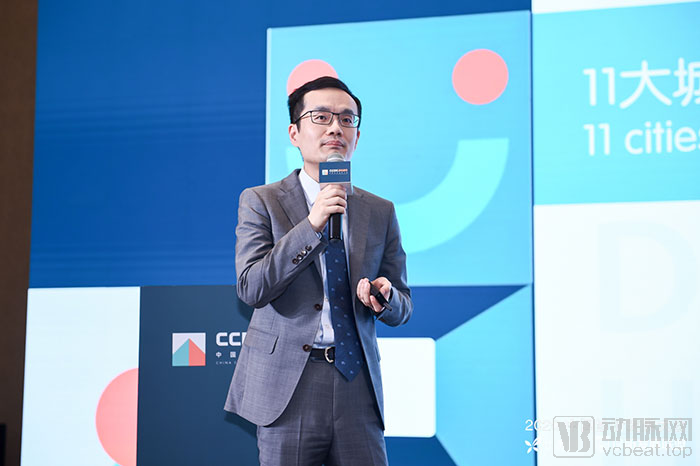
Li Tao, Vice President of Distinct HealthCare
To achieve these three objectives, a series of training programs must be implemented, including training physicians to comprehensively understand patient information, proactively establish service workflows for patients, appropriately arrange insurance payments, and conduct visit-based education.
Some clinics recorded “zero” revenue in February and March, yet still had to cover costs such as rent and staff salaries. Cash flow has become a lifeline for these clinics; those with insufficient cash reserves may be forced to shut down if they cannot sustain the losses during this period.
The pandemic has heightened the clinic industry’s emphasis on proactive planning in cash flow management and financial strategy.
In response, Zhang Qiang, founder of the Zhang Qiang Doctor Group, stated that during the pandemic, the group reduced costs by streamlining its administrative regions. Meanwhile, the group’s ability to maintain healthy cash flow was also attributable to his “conservative” approach. “Surgeons always prepare extra blood supplies before surgery as a precaution against unforeseen circumstances. I have applied this habit to business management, consistently maintaining a cash reserve, which proved invaluable during the pandemic. While others were debating whether they could survive for six or twelve months, I barely needed to consider this issue.”

Zhang Qiang, Founder of the Zhang Qiang Doctor Group
Zhang Qiang believes that applying the meticulousness of clinical work to business management is precisely the advantage of doctors becoming entrepreneurs.
Pan Jing, founder of Baohua Medical and partner at Leo Clinic, also shared insights on the clinic’s financial planning. She suggested appropriately adjusting financial goals and budgets, and resetting revenue plans based on costs.

Pan Jing, Founder of Baohua Medical and Partner at Rio Clinic
In terms of specific measures, she primarily proposed the following points: first, tightening expenditures to conserve resources, controlling cash outlays, and making appropriate staffing adjustments—for instance, counting suspension-of-service periods as annual leave with employee consent;
Second, appropriately reduce inventory of pharmaceuticals and medical consumables, align expenditures with revenues, and ensure monthly inventory turnover. Accounts payable should ideally be controlled within 90 days, while accounts receivable should be kept within 30 days.
Furthermore, a commercial insurance payment system for private healthcare institutions should be established, as it may help alleviate cash flow pressures at critical junctures.
Should you pursue chain expansion? How should the scale and pace of such expansion be managed? These are questions frequently encountered by single-site clinics that have reached a certain size, as well as by well-capitalized healthcare institutions.
Dr. Zhang Qiang noted that the pandemic has hindered physician mobility for physician groups, making scalability the future direction. “Chain operations can reduce our risks.”
Industrialization is also one of the development directions; for example, Dr. Zhang Qiang’s Doctor Group is advancing projects such as varicose vein compression stockings, e-commerce, and online education.
He Haiyang, Chairman and CEO of Johnson Medical, summarized several key lessons regarding the pace of chain expansion. He believes that for chain organizations operating under given constraints and limited resources, a slower approach is preferable to a faster one.

He Haiyang, Chairman and CEO of Johnson Medical
Is it better to have more or fewer stores? He Haiyang believes that the ratio of store numbers should be determined based on the spillover effect of one’s own management efficiency. Appropriately controlling the pace is becoming increasingly important, making each store expert more critical, especially for offline business operations.
Next is the issue of scale. He Haiyang stated that small clinics grow rapidly but have limited service offerings and reach, making it easier to hit their growth ceiling; they are more suitable for individual physicians starting their own practices. In contrast, large clinics offer a wider range of services and greater growth potential, but require stronger team-based operations. Therefore, choices should be made based on actual circumstances.
Meanwhile, the pandemic has accelerated the trend of digital transformation in healthcare. “In the short term, the industry has encountered difficulties; however, in the long run, given factors such as China’s aging population and the rising incidence of chronic diseases, the sector still holds significant promise. What we need is to rebuild confidence.”
The Dingxiang Clinic Alliance noted in the "Report on the Development of Primary Care Clinics in China in the Post-Pandemic Era" that since the onset of the pandemic, more than half of users have proactively sought online consultation services, with user habits remaining stable in the post-pandemic period.
Li Tiantian, founder and chairman of DXY, provided an interpretation using data from the DXY platform as an example. During the pandemic, the total traffic across all DXY platforms reached 10 billion visits. “Although we do not wish to see the pandemic or the growth it has driven, such growth did indeed occur.”

Li Tiantian, Founder and Chairman of DXY
Li Tiantian introduced that this traffic primarily stems from three major service categories: data, content, and online consultations. Among these, data services generated 4 billion visits, content services (specifically popular science articles) attracted 3.6 billion views, and online consultation services recorded a total of 1.2 million inquiries.
Three types of services have demonstrated that internet healthcare can also establish a tiered diagnosis and treatment model. By implementing a hierarchical structure that progresses from data to content, and then to medical consultations, internet healthcare addressed the severe shortage of medical supply during the pandemic, saved users’ time and economic costs, and ultimately achieved an overall improvement in social efficiency. “Without foundational front-end services, if all traffic were concentrated solely on the consultation stage, even the collective online participation of doctors across China would be insufficient to meet the demand.”
Therefore, Li Tiantian believes that primary care remains the most suitable setting for internet-based healthcare, a view that has not changed.
Cui Yutao, Director of the Beijing Cui Yutao Parenting Academy Clinic, also places great importance on the role of online science popularization and live streaming. He particularly emphasized the secondary dissemination of educational content. “Many self-media creators have excellent foundational skills, but it is a pity if high-effort content is only disseminated once.”
Cui Yutao has summarized the methods and processes for the secondary dissemination of popular science live streams: First, secondary dissemination can begin with internal employees and fan moderators, which not only enhances their health literacy but also helps expand the user base. Second, during online live streams, interactions with users and responses to their questions can be repurposed for secondary dissemination via WeChat. Third, the app or WeChat official account can post topics or engage with fans through fixed-day schedules and daily quotes. Fourth, in-depth explanations of the live stream content can be produced as short videos for release. “Sometimes, the peak of the second round of dissemination is even higher than that of the first.”
Live streaming facilitates long-term interaction with users, thereby enhancing user stickiness. To ensure that the delivery of science popularization content remains unaffected, Cui Yutao separates pure educational live streams from commercial and collaborative live streams, ensuring that no advertisements appear during the educational sessions.
As the pandemic situation stabilizes, service volumes at medical institutions across China are gradually recovering, with primary care facilities experiencing similar trends.
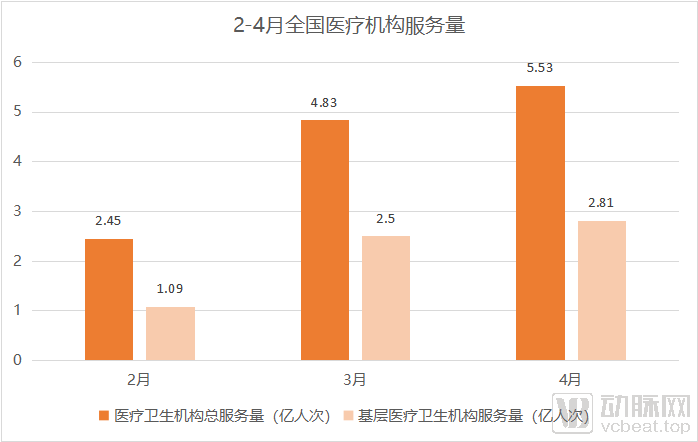
National Healthcare Institution Service Volume, February–April; Data Source: National Health Commission; Chart by VCBeat
Statistical data from the National Health Commission shows that the service volume of primary healthcare institutions increased from 100 million to 280 million patient visits between February and April. Among these, clinic (infirmary) visits were not statistically recorded in February due to the impact of the epidemic, while March and April saw 30 million and 38 million visits, respectively.
The gradual recovery of data has boosted industry confidence in clinics. However, as many panelists noted, in the post-pandemic era, primary healthcare institutions must not only address short-term survival challenges but also focus on long-term upgrading and development, thereby enhancing their resilience against future unexpected events.