

Eleven Companies, Including Seven Domestic Firms, Shortlisted in China's National Coronary Stent Centralized Volume-Based Procurement Draft Proposal
Recently, the National Healthcare Security Administration released the “National Centralized Volume-Based Procurement Plan for Coronary Stents (Draft for Comment)” to solicit public opinions. With the release of this document, coronary stents will be procured through a unified national centralized procurement program, while all provincial-level centralized procurement initiatives will be discontinued. Meanwhile, the issuance of this document is expected to bring about significant changes to the future landscape of the coronary intervention industry.
Coronary intervention in China began in the 1990s, spanning nearly 30 years to date. In 2019, the number of percutaneous coronary intervention (PCI) procedures nationwide exceeded 1.03 million, with stent usage surpassing 1.6 million units;
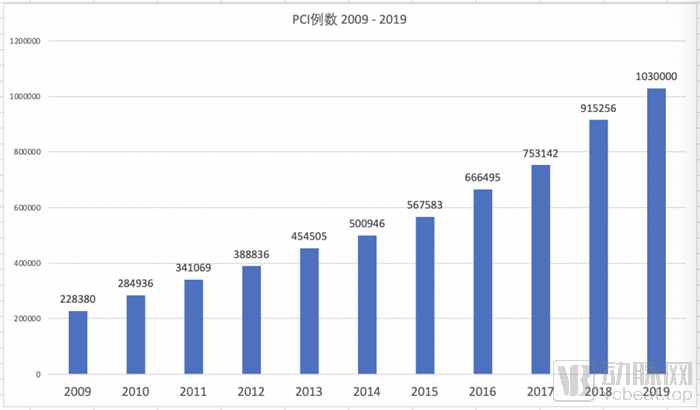
Figure 1: Trend in the Number of PCI Cases from 2009 to 2019 (Image Source: CCIF)
Originally, the manufacturing technology for stents was entirely controlled by foreign companies. Since 2003, domestic enterprises have begun producing coronary drug-eluting stents, with their R&D capabilities and manufacturing processes steadily improving. Today, domestically produced stents match imported ones in terms of raw material sourcing, processing equipment, manufacturing techniques, and quality control, while the technical proficiency of workers even surpasses that of their foreign counterparts. Domestic drug-eluting stents offer comparable ease of use, therapeutic efficacy, and product stability to imported stents, but at a significantly lower price. This reduction in stent prices has transformed percutaneous coronary intervention from an expensive treatment accessible only to a few patients into a widely available, mainstream therapy. Currently, domestically produced drug-eluting stents account for 80% of total usage.
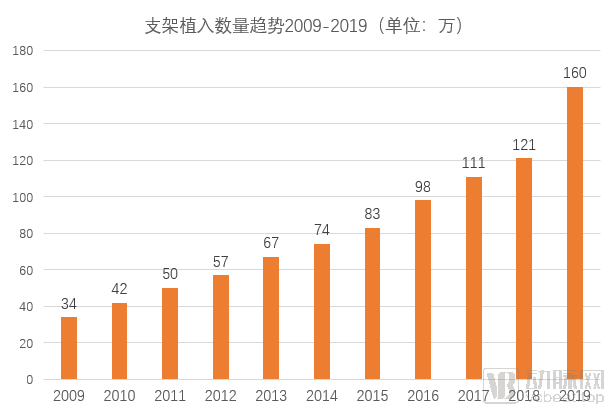
Figure 2: Trend Chart of Stent Usage from 2009 to 2019 (Chart by VCBeat)
Inclusion Criteria for Coronary Stents in This Request for Comments:
1. Stent material: Cobalt-chromium alloy/Platinum-chromium alloy
2. Drug types: Rapamycin and its derivatives
3. Drug carrier coating: non-polytetrafluoroethylene
Currently, the materials used for drug-eluting stents on the market include stainless steel, cobalt-chromium alloys, and platinum-chromium alloys. Metallic materials offer superior biocompatibility, resulting in fewer thrombotic and inflammatory reactions within blood vessels, making them ideal for drug-eluting stents. Stainless steel was the first material used for coronary stents. However, with advancements in medicine, requirements for stents have become increasingly stringent. While maintaining adequate radial strength, there is a growing preference for thinner stent struts. Consequently, stainless steel stents have become less able to meet clinical needs. Subsequently, cobalt-chromium alloys began to be used in stent manufacturing. Cobalt-chromium alloys have higher density and hardness; under equivalent radial strength, cobalt-chromium alloy stents are thinner than stainless steel stents, with significantly better deliverability and radiopacity. Over the past decade, cobalt-chromium alloy stents have completely replaced stainless steel stents in the international market. Imported products from companies such as Abbott, Medtronic, Boston Scientific, and Biotronik all utilize cobalt-chromium or platinum-chromium alloys. Mainstream domestic manufacturers also exclusively use cobalt-chromium alloys for their stents.
Rapamycin, as an anti-smooth muscle cell proliferative agent applied to drug-eluting stents, can significantly reduce the incidence of restenosis. After more than two decades of use, it remains the most effective drug for stents to date. All other effective drugs on the market are derivatives of rapamycin, possessing similar properties.
The primary function of the drug carrier coating is to enable drug adhesion to the surface of metallic stents and to control drug release; however, the presence of the coating poses a risk of thrombosis. Currently, two types of coatings are available on the market: biodegradable and non-biodegradable. Polytetrafluoroethylene (PTFE) is toxic and is rarely used in coronary drug-eluting stents.
It is evident from the establishment of the inclusion criteria that the National Healthcare Security Administration (NHSA) has a thorough understanding of the development, utilization, and product characteristics of coronary stents. The formulation of these criteria has effectively excluded stent products with suboptimal therapeutic outcomes. Furthermore, the integration of domestically produced and imported stents into a unified centralized procurement process has broken away from the previous practice of separate bidding for domestic and imported products, thereby eliminating the phenomenon of high profit margins maintained by imported products. This approach is commendable and suggests that the NHSA has extensively consulted with cardiologists.
Currently, there are four importers and eleven domestic manufacturers in the Chinese market. A total of eleven companies (four importers and seven domestic manufacturers) meet the selection criteria. Details of the selected companies are as follows:
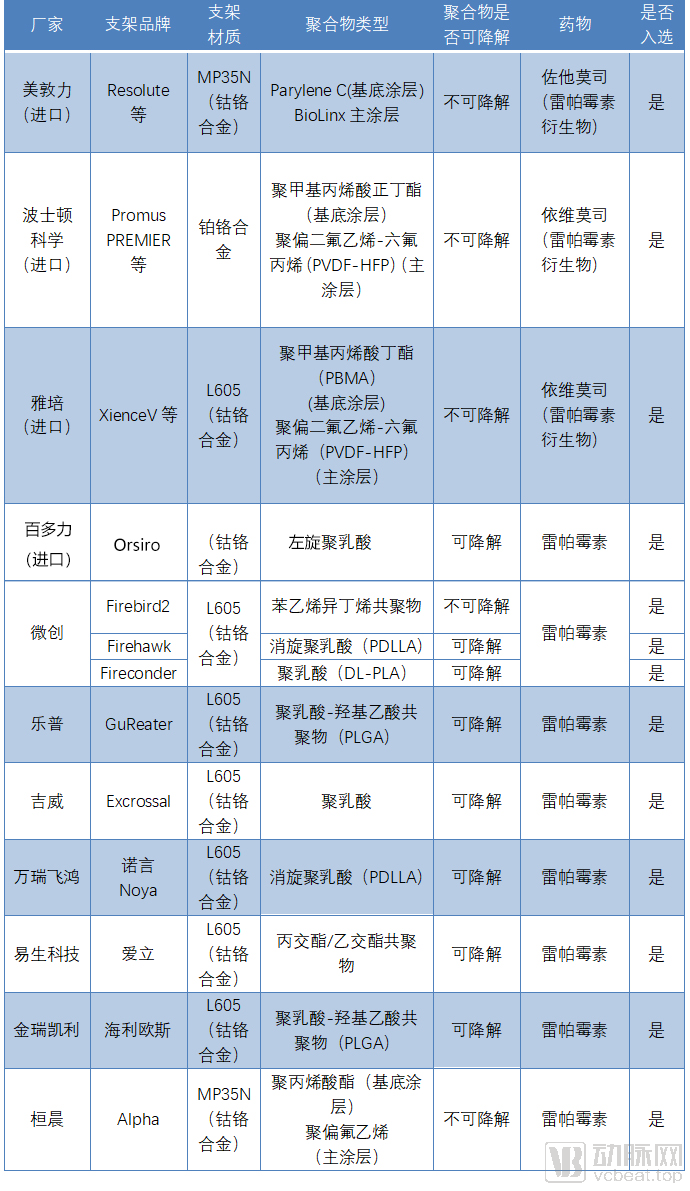
Based on the procurement items selected in this draft for comments, and with reference to the information on coronary stent manufacturers compiled by the National Medical Products Administration (NMPA)
1. Centralized procurement led by enterprises is a fair and reasonable approach:
This centralized volume-based procurement includes seven domestic stent manufacturers and four imported stent manufacturers, which is a favorable development for Chinese enterprises. Conducting centralized procurement on a per-company basis is a fair and reasonable approach. Each of the four imported manufacturers currently markets two to three stent products. These products differ only marginally; according to the national standards for coronary stents, there are no changes in material, drug composition, or carrier coating, and there is no difference in therapeutic function or efficacy. Essentially, these are the same stents marketed under different names to generate higher profits. If individual products were used as the unit for this procurement, the four imported manufacturers would have seven to eight products competing, giving them a significant advantage. This could likely result in a scenario where imported products dominate over domestic ones, thereby suppressing Chinese manufacturers.
2、Regarding the Reduction:
The document states that “products meeting the requirements will be selected based on lower prices and larger price reductions.” However, the term “larger price reductions” does not specify the initial price. It is estimated that during centralized procurement, the National Healthcare Security Administration will provide a uniform reference price, upon which companies will base their price cuts. The ultimately selected companies must meet the criteria of offering lower prices and achieving greater percentage reductions. After all, due to past bidding processes and historical factors, some products have been artificially overpriced, yielding substantial profits. This is particularly true for imported products, whose current sales prices are very high—even though their costs may be lower than those of domestically produced alternatives. If the magnitude of price reduction from current market prices were used as the selection criterion, it would severely disadvantage domestic manufacturers.
3. Determination of Volume for Volume-Based Procurement:
The policy clearly establishes a national centralized volume-based procurement system, adopting a "price-for-volume" strategy. On the premise of ensuring quality, the National Healthcare Security Administration awards the largest procurement volume to the enterprise submitting the lowest bid. This approach is fair and reasonable. After all, historical product utilization was influenced by numerous factors, many of which were irregular or non-compliant. Exchanging price for volume is not only an effective measure but also the fairest and most reasonable method.
China has a population of over one billion, and many patients with coronary heart disease are unable to receive percutaneous coronary intervention (PCI) due to financial constraints. The national centralized volume-based procurement policy will have a profound impact on the PCI industry and significantly promote the development of China’s interventional cardiology sector.