

Huake Precision Secures Strategic Investment from Medtronic China Fund, Neurosurgical Robot Routinely Used in Over 40 Hospitals

Sinovation
Neurosurgical Surgical Robot Developer
VCBeat (WeChat ID: vcbeat) has learned that Huake Jingzhun (Beijing) Medical Technology Co., Ltd. (hereinafter referred to as “Huake Jingzhun”) has secured a strategic investment of tens of millions of RMB from the Medtronic China Fund. In the future, both parties will explore multi-level strategic cooperation in the field of neurosurgery.
Sinovation, founded in 2015, is dedicated to driving the transformation of precision intelligent neurosurgery. Over the past five years since its establishment, Sinovation has obtained Class III medical device registration certificates from the National Medical Products Administration (NMPA) for two products; two products have entered the Special Review Channel for Innovative Medical Devices (the neurosurgical robot and the Magnetic Resonance-Guided Laser Interstitial Thermal Therapy [LITT] Ablation System, both being the only products in China approved through this green channel); robotic surgeries are routinely performed at more than 40 hospitals; and the company boasts over 1,000 clinical expert users in neurosurgery. Sinovation’s robotic surgical planning software and surgical navigation software have been more widely adopted, with an estimated cumulative volume of related procedures exceeding 10,000 cases.
Not long ago, the successful listing of Tinavi Medical Technologies, a manufacturer of orthopedic surgical robots, on the STAR Market not only boosted market confidence in the surgical robotics sector but also signaled that the future landscape will no longer be dominated solely by the da Vinci laparoscopic surgical robot. Instead, surgical robotics is trending toward specialization. Undoubtedly, neurosurgery will emerge as a key segment within this specialized field.
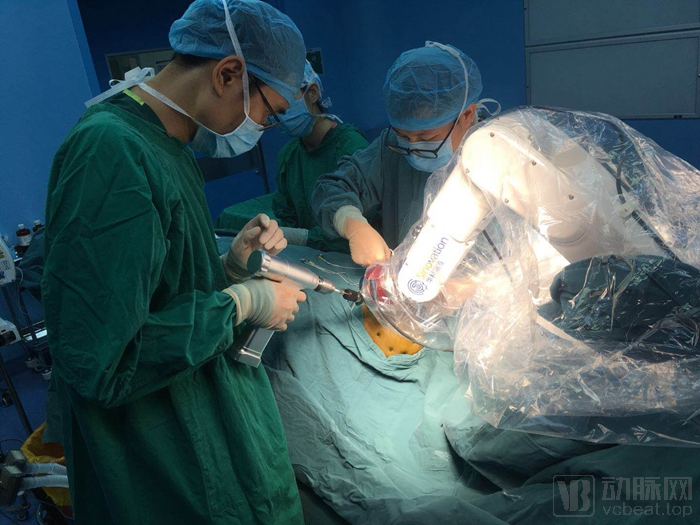
Wuhan Tongji Hospital Performs SEEG Surgery Using Sinovation Surgical Robot
Within the broad field of surgical robotics, categorized by procedure type, the primary specialties for application are laparoscopy, orthopedics, neurosurgery, bronchoscopy, and vascular intervention.
Neurosurgical procedures demand high precision, are technically challenging, and carry significant risks, which has led to greater recognition and acceptance of surgical robots among clinicians. Multiple companies have already received approval for their neurosurgical robotic systems, which are now in clinical use.
The Accelerating Commercialization of Neurosurgical Robots Indicates That Clinical Application and Implementation Are No Longer Challenges; the Industry Must Now Address More Complex Application Issues. Expanding Indications to Enable Routine Use Across a Broader Range of Conditions Is Widely Recognized as the Key Step for Current Industrialization.
At the current stage, neurosurgical robots have achieved the highest penetration rate in stereoelectroencephalography (SEEG) electrode implantation surgery for epilepsy, with Sinovation’s neurosurgical robot already in routine clinical use.
For refractory epilepsy, physicians need to implant deep brain electrodes into the patient’s cranium to collect electroencephalographic (EEG) signals. The high penetration rate of surgical robots is attributed to the fact that a single stereoelectroencephalography (SEEG) procedure often requires the implantation of ten or more electrodes. Neurosurgical robots can significantly reduce operative time, enhance surgical precision, and ensure consistent stability across multiple electrode implantations.
Wang Lanfen, COO of Sinovation, stated, “By integrating with the intracranial electrode product series from Huake Hengsheng, another enterprise within the Huake group, Sinovation’s surgical robot ranks among the top in terms of clinical application rates in China. Notably, it has achieved the highest penetration rate in stereotactic electrode implantation surgery for epilepsy, exceeding 80% in major epilepsy centers across the country. The clinical application rate of Sinovation’s surgical robot in SEEG (stereoelectroencephalography) robotic surgery for epilepsy approaches 100%.”
Currently, neurosurgical robots are continuously expanding their indications. Among these, the rapid growth of deep brain stimulation electrode implantation surgery for Parkinson’s disease is drawing increasing attention.
Currently, the application of neurosurgical robots for deep brain stimulation (DBS) implantation worldwide remains in an exploratory phase focused on accumulating experience. Sinovation has conducted extensive research and exploration in collaboration with more than ten clinical institutions, including Peking Union Medical College Hospital, Xuanwu Hospital of Capital Medical University, Nanfang Hospital of Southern Medical University, the Second Affiliated Hospital of Zhejiang University School of Medicine, and Shenzhen General Hospital. Sinovation has developed mature solutions encompassing surgical software, supporting instruments, and standardized surgical procedures. Since 2020, both the demand for and volume of DBS surgeries performed using Sinovation’s robotic systems have grown rapidly.
Integrating with clinical practice to expand indications is a key challenge that neurosurgical robotic systems must address through collaboration with clinicians at this stage. For manufacturers, it also represents a pathway to maintain differentiation in a highly competitive market.
As an innovative emerging product, the neurosurgical surgical robot will give the first-mover advantage to those who can achieve the fastest and most in-depth innovation in clinical implementation.
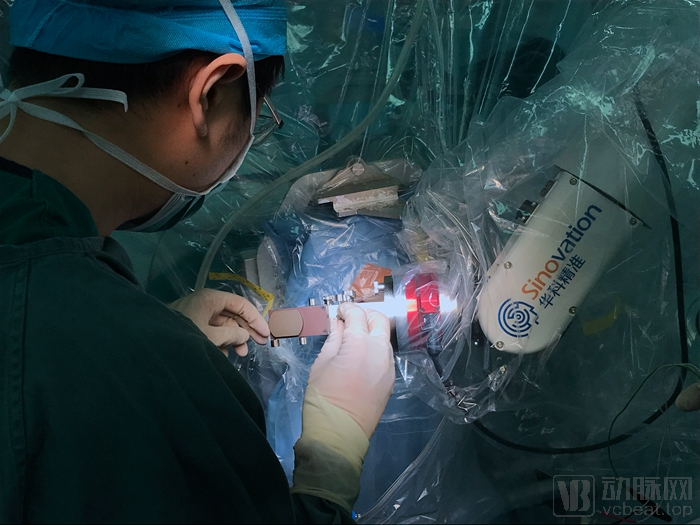
Peking Union Medical College Hospital Performs DBS Surgery
The global surgical robotics landscape is shifting away from the long-standing dominance of the da Vinci Surgical System. Major medical device companies—including Medtronic, Johnson & Johnson, Zimmer Biomet, Stryker, and Smith & Nephew—have entered the surgical robotics market through in-house development or acquisitions.
The EvaluateMedTech® World Preview 2018, Outlook to 2024 report predicts that from 2017 to 2024, the neuroscience sector will be the fastest-growing device segment, with a compound annual growth rate (CAGR) of 9.1%. Neurosurgical robotic systems will have enormous market potential.
Furthermore, by leveraging new platforms for neurosurgical robots, device manufacturers can achieve business synergy between these robotic platforms and their existing product portfolios. Taking deep brain stimulation (DBS) surgery as an example, more than 20,000 Parkinson’s disease patients in China have undergone implantation of deep brain stimulators, representing only about 1% of the total Parkinson’s patient population in the country. In contrast, this proportion is approximately 8% in the United States. The integration of surgical robot manufacturers with deep brain stimulator producers can better serve clinicians and patients.
Integration with therapeutic devices encompasses not only collaboration across the upstream and downstream industry chains, but also deep integration and transformation in product form. VCBeat has learned that Sinovation is currently developing a domestically pioneering laser interstitial thermal therapy (LITT) system for precise minimally invasive ablation under real-time MRI monitoring, which is about to commence formal clinical trials.
Surgical robots are still undergoing continuous evolution. It is reported that Sinovation is developing multi-form surgical robots tailored for users at various levels, which could bring about a historical transformation in neurosurgery departments at municipal and county-level hospitals through the advancement of precise and intelligent surgical instruments. More flexible and user-friendly intelligent surgical robots will significantly lower the threshold for procedures such as cerebrovascular disease surgery and brain tumor biopsies, thereby enhancing patient benefits. Additional developments include robots with more efficient and precise 3D facial recognition, miniaturized and portable robots, and surgical robots designed for neurological procedures beyond the brain.
About the Medtronic China Foundation:
Founded in Minnesota, USA, in 1949, Medtronic is currently the world’s leading medical technology company. Its products and therapies cover more than 70 disease areas, with operations in over 150 countries and regions worldwide. In fiscal year 2018, its revenue reached nearly $30 billion. Medtronic is dedicated to alleviating pain, restoring health, and extending life for patients through collaborative innovation. Every second, more than two patients around the globe benefit from Medtronic’s medical technologies or therapies.
The Medtronic China Fund was established in Suzhou in 2016, dedicated to investing in early-stage Chinese medical technology innovators and overseas innovative technologies that meet the needs of the Chinese market. It aims to accelerate the translation and implementation of innovative technologies, providing novel solutions for pressing unmet medical needs in China.