

LianDa Era Files IPO Prospectus: Integrated Hardware-Software Medication Adherence Management System Addresses Critical Industry Pain Points, Initial Domestic Batch Sold Out
As the ancient saying goes, “Treatment should be adapted to the timing, and medication administered on schedule.” Adhering to prescribed timing and dosage significantly impacts therapeutic outcomes, a concept referred to in modern medicine as “medication adherence.” As the “last mile” challenge in the pharmaceutical industry, adherence not only affects patients’ quality of life but is also regarded by the industry as the “final frontier” for effectively improving return on investment.
In disease management, there has been a persistent lack of systematic approaches to address medication adherence. For patients with chronic conditions, the struggle involves not only combating the disease itself but also overcoming human inertia. In addition to well-known conditions such as diabetes and hypertension, diseases that particularly demand high adherence during treatment include Parkinson’s disease, Alzheimer’s disease (commonly known as senile dementia), epilepsy, asthma, depression, cancer, and AIDS (commonly known as acquired immunodeficiency syndrome).
Where there are pain points, there are opportunities. Some digital health companies focusing on medication adherence advocate the use of innovative approaches—such as sensors, software, Internet of Things (IoT) technology, cloud-based intelligence, and hardware—to encourage patients to adhere to their treatment regimens and improve patient compliance.
2018–2019: A Wave of Positive Developments in Medication Adherence Management
In November 2018, AdhereTech, a company focused on adherence in DTP pharmacies, received approximately $10 million in investment from Argentum;
In June 2018, Amazon acquired PillPack, an online pharmacy that effectively improves patient adherence, for $1 billion.
On November 11, 2019, AiCure, a company focused on clinical trials, secured $24.5 million in Series C funding to leverage artificial intelligence technology for measuring patients' medication adherence behavior;
On December 6, 2019, the FDA approved the ID-Cap system launched by etectRx, which utilizes sensors to track medication adherence.
In China, there are few companies focused on the field of medication adherence, and LianDa Times (Nanjing) Intelligent Technology Co., Ltd. (hereinafter referred to as: LianDa Times) is one of the few.
Lianda Times is committed to leveraging technologies such as artificial intelligence, the Internet of Things (IoT), cloud computing, and big data to enhance medication adherence, ensure drug efficacy, reduce medication risks, and promote prescription refills. Meanwhile, Lianda Times is digitizing, online-enabling, and intelligently transforming pharmaceutical care services, connecting patients (medication users) with healthcare service providers to deliver more specialized and personalized pharmaceutical care, thereby realizing its vision of “For Health, For a Better Life.”
“Non-adherence is a widespread issue, with approximately half of the global population taking medications failing to follow medical advice,” said Qian Haiyang, founder of Lianda Times. “In the United States alone, non-adherence among cardiovascular disease patients results in an additional $300 billion in annual healthcare costs and directly causes 125,000 deaths. Globally, pharmaceutical companies suffer annual revenue losses of up to $600 billion due to medication non-adherence. This represents a significant loss of both lives and financial resources.”
Qian Haiyang explained that there are many reasons for non-adherence, which can be summarized as patient-related factors, condition-related factors, treatment-related factors, health system factors, and social and economic factors.
Among these causes, patient behavior-related factors account for 70%, such as forgetfulness and procrastination. The reasons for missing medication doses vary among individuals of different ages and social backgrounds. For instance, older adults often forget due to declining memory, children because they lack the executive functioning skills of adults, and young people due to the fast pace of work and daily life. “For business-to-business (B2B) stakeholders, non-adherence can lead to suboptimal treatment outcomes, biased efficacy data, decreased sales volume, and even damage to brand reputation.”
“Therefore, there is an urgent need for an intelligent platform tailored to home-based care scenarios. On one hand, it leverages artificial intelligence and the Internet of Things (IoT) to create a ‘virtual pharmacist’ that guides patients in medication adherence and ensures therapeutic efficacy; on the other hand, it connects patients with real-world pharmacists (or other healthcare service providers).” This was also the original motivation behind the founding of the LianDa Times team.
Qian Haiyang and Gao Ge are the two founders of Lianda Shidai, who met while studying at the University of Missouri in the United States. After earning his Ph.D. in Computer Science, Qian Haiyang engaged in research and development and product roles at companies such as PhoneFactor (acquired by Microsoft) in both the U.S. and China, the China Mobile USA Research Center, and Alibaba. He is also a successful serial entrepreneur. Gao Ge, who holds a Ph.D. in Pharmacy, previously worked as a pharmacist at CVS and UnitedHealth Group in the United States.
Currently, Lianda Times has assembled a team comprising talent from leading domestic and international enterprises such as Alibaba, Amazon, Microsoft, Google, China Mobile, CVS, Fosun Health, and UnitedHealth Group. The team possesses multidisciplinary expertise spanning the Internet, Internet of Things (IoT), pharmaceuticals, and smart hardware, demonstrating outstanding R&D and innovation capabilities.
Drawing on his experience in the development of medication adherence management and pharmaceutical care service products, Dr. Qian Haiyang summarized four fundamental requirements for health-related smart IoT products:
First, demand comes first.Requirements are categorized into explicit and implicit needs. Only through continuous communication and engagement with clients and users can these needs be clearly identified. The most effective way to validate requirements is to launch the product to the market in the shortest possible time and iterate rapidly based on user feedback. By following this process, it becomes possible to uncover more authentic needs and expand the product horizontally. For instance, other services in Lianda Shidai’s pharmaceutical care management—such as pharmacovigilance, drug-drug interaction management, and follow-up surveys—are all extensions centered around the single core service of medication adherence.
Second, safety first.The device must be safe and cause no harm to the human body; furthermore, it comprehensively ensures user data security and privacy across hardware, communication, and cloud infrastructure. To this end, Lianda Shidai products have strictly adhered to the HIPAA (Health Insurance Portability and Accountability Act) standards since the initial design phase.
Third, it must exhibit a high level of intelligence.Health-related products are highly serious in nature, requiring precise information for users and “genuine intelligence” in cloud-based systems. For instance, the adherence management system by Lianda Shidai leverages various IoT technologies to ensure timely and accurate data transmission. Furthermore, it utilizes a cloud-based intelligent engine to tailor personalized adherence management plans based on each user’s specific circumstances, thereby delivering medication reminders—traditionally an “intrusive” form of interaction—in a more customized and human-centric manner.
Fourth, “The greatest form has no shape; the greatest sound is faint.”“High-quality health products should ideally be unobtrusive. For instance, the comfort of a wearable bracelet is a key criterion in product evaluations; vital sign monitoring is best performed without the user’s awareness.” Ideally, such products should meet both low-power consumption and high-performance requirements. Low power consumption means users do not need to frequently monitor battery levels—a pain point deeply felt in smartphone usage—while high performance demands superior hardware and cloud architecture design.
Based on the aforementioned requirements, Lianda Times has developed a comprehensive solution for medication adherence management and pharmaceutical care services. This includes smart pillbox hardware and software for patients, a user management platform for institutions, a robust pharmaceutical care SaaS and API suite, and a cloud-based intelligent system independently developed by its team. For clients without a need for smart pillboxes, Lianda Times also offers a software-only solution.
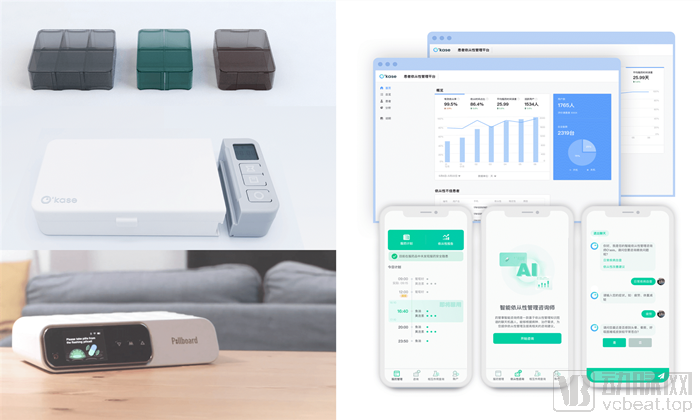
Lianda Times Medication Adherence Management and Pharmaceutical Care Products
Lianda Times’ current smart pillbox product lineup includes two models: O’kase and Pillboard.
O’kase adopts a modular design concept, allowing its components to be freely disassembled and reconfigured according to user needs. This flexibility accommodates various usage scenarios at home or while traveling, as well as diverse medication requirements. The device can store pharmaceuticals commonly packaged in aluminum-plastic blister packs in China, loose medications, and certain small medical devices (such as sprays).
Pillboard is a premium product designed for more refined medication management needs. It consists of a base, 28 medication cells, and a magnetic controller. Each medication cell holds all the medications required for a single dose, allowing storage of one week’s, two weeks’, or one month’s supply depending on the daily dosing frequency. In addition to standard medication reminders, both device models support features such as accidental ingestion alerts, customized reminders, remote configuration, dual Bluetooth and cellular connectivity, adherence reporting, and SOS functionality.
The solution uploads patient medication adherence behaviors and other data collected from devices and user-facing frontends—including demographic information, medication details, dosing schedules, medication-taking behaviors, and other health metrics—to its cloud-based adherence management and pharmaceutical care platform. By leveraging artificial intelligence technologies, particularly cloud-based intelligent engines powered by reinforcement learning algorithms, the system conducts pharmacovigilance and drug interaction alerts for current medications based on pharmacokinetics and medication behavior models. It adaptively optimizes reminder strategies to achieve collaborative management of rational drug use and adherence, thereby improving user medication feedback rates and mitigating medication risks. Through this approach, users, pharmaceutical service providers, and the cloud system form a closed-loop ecosystem that continuously optimizes and enhances patient adherence outcomes.
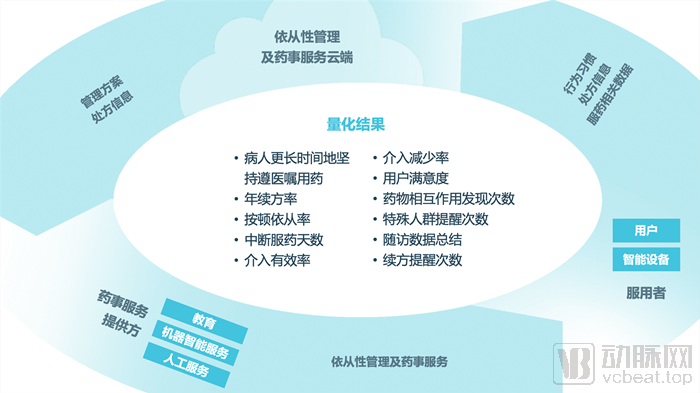
Lianda Era Compliance Management System Closed Loop
“Yao Guanshi,” a front-end application developed by Lianda Times, is positioned as a user’s “personal pharmacist.” It not only helps patients adhere to their medication schedules but also provides pharmaceutical care services such as medication guidance, drug interaction checks, pharmacovigilance, follow-up consultations, prescription renewal reminders, and basic self-assessment for common conditions. For special populations with unique medication needs—including the elderly, children, pregnant women, and breastfeeding mothers—the system offers tailored prompts on dosage and administration, alerts for allergies and intolerances, and risk warnings related to medication use in these groups.
Furthermore, traditional methods for measuring adherence—including the Medication Possession Ratio (MPR), Proportion of Days Covered (PDC), patient-completed treatment diaries, and direct observation—tend to overestimate patients’ medication adherence. Qian Haiyang noted that in physician-patient or pharmacist-patient communication scenarios, more than 40% of patients have concealed their non-adherence, posing significant challenges to accurately assessing patient adherence and directly leading to wasted R&D or healthcare costs in clinical trials or clinical practice settings.
To address this issue, Lianda Shidai’s solution enables the monitoring and acquisition of more accurate, granular, and real-time adherence data. Leveraging data collected from front-end products, the team has designed adherence metrics and evaluation methods with greater granularity than traditional approaches. This provides a reliable tool for precisely observing patient adherence and empowers healthcare service providers to expand their pharmaceutical care services based on these insights.
The Lianda Times system holds immense value for pharmaceutical companies, pharmacies, insurers, and future home-based medication services. This is primarily reflected in areas such as clinical trials, drug sales, and patient management.
In clinical trials conducted by pharmaceutical companies, subject compliance is critical. Non-compliance not only undermines the statistical power of study results but also leads to opportunity costs due to prolonged trial durations and increased operational expenses from recruiting additional subjects (to ensure the validity of study outcomes). Statistics show that for each day a trial is delayed, a niche drug product incurs an opportunity revenue loss of $600,000, while a blockbuster drug can lose up to $8 million per day.
According to Lianda Times’ estimates, its solution is expected to help pharmaceutical companies reduce clinical trial costs by 23% by improving subject compliance, while providing researchers with more accurate, comprehensive, and actionable subject compliance data that differs from traditional compliance measurement methods. This is particularly relevant for Phase III and IV clinical trials, which involve the highest costs and the largest number of participants. A simple and effective compliance management product for both subjects and researchers will help pharmaceutical manufacturers, CROs, and other institutions strictly control trial processes, reduce costs, and ensure the validity and authenticity of trial results.
For pharmacies, Lianda Shidai’s products enhance pharmaceutical care capabilities, facilitating the transformation of traditional retail pharmacies into patient-centered pharmaceutical care service centers. This transition improves treatment efficiency and drives sales; U.S. data indicates that such systems can increase patients’ annual spending by 10–20%. Furthermore, these solutions integrate the entire workflow—from prescription issuance and review to medication purchase and therapeutic monitoring—through internet hospitals. In China, amid healthcare policy reforms, more than half of all prescriptions are expected to shift from hospitals to external pharmacies. Lianda Shidai’s products will empower sales channels, led by Direct-to-Patient (DTP) pharmacies, to capture market share in the RMB 610 billion incremental market by elevating the quality of pharmaceutical care services.
Through such services, insurance companies can enhance their health management capabilities, enabling patients to achieve optimal therapeutic outcomes from medication while effectively controlling costs. Furthermore, adherence data can serve as a new dimension input into risk control systems, thereby facilitating the design of superior insurance products.
In the realm of home-based medical care, the relevant guidance issued by the National Health and Family Planning Commission in 2016 proposed striving to expand family doctor contracted services to cover the entire population by 2020. In addition to routine health management services, these providers would primarily assume responsibility for home-based chronic disease management. However, due to insufficient salary incentives, unbalanced regional socioeconomic development, and an inadequate number of trained general practitioners, the family doctor market in China currently faces a supply shortage.
Lianda Times’ solutions facilitate the digital and online management and connectivity of community patients, effectively reducing labor and operational costs while alleviating supply-side pressures. Particularly for chronic disease patients requiring long-term medication and disease management, adherence management and other pharmaceutical services help record patients’ medication and treatment histories, thereby enhancing patient retention. Furthermore, by leveraging patient data captured at the front end, Lianda Times’ products enable community health centers and family doctors to coordinate with other medical institutions. This is especially valuable in the tiered diagnosis and treatment system, where it assists physicians in rapidly accessing detailed patient medication records to inform clinical judgments and diagnostic plans.
Qian Haiyang stated that pharmaceutical care services, including medication adherence, play a crucial role in controlling healthcare costs. Pharmacists need to establish connections with patients to extend their services beyond hospitals and pharmacies, covering application scenarios such as chronic disease management, health management, Direct-to-Patient (DTP) pharmacies, home-based elderly care, smart community elderly care, and post-acute care.
LianDa Times’ products are now on sale in both the Chinese and U.S. markets, with the first batch of mass-produced hardware in China already sold out to B-side institutions. Currently, LianDa Times is also beginning to consider entering the domestic C-side market.