BHC Software Unveils Flagship Solution: Building the Urban Health Brain and Future Communities
B-Soft Co., Ltd. Unveils Comprehensive IT Solutions for Future Community DevelopmentBy seamlessly integrating with smart city infrastructure and establishing a “City Health Brain,” B-Soft Co., Ltd. is building future-ready communities to accelerate the development of primary healthcare through technological innovation.
The development of future communities is not only a crucial component of the Healthy China 2030 strategy but also a concrete measure for its implementation. The Work Plan for Pilot Projects on Future Community Development in Zhejiang Province points out that, guided by the “1339” top-level design framework, efforts should be made to achieve full coverage of basic health services, establish a lifecycle electronic health record system, and improve the family doctor contract service mechanism, all aimed at realizing the goal of universal health and wellness. Furthermore, the application of smart terminals such as wearable devices should be promoted, online-to-offline (O2O) models for community health management explored, and interoperability and sharing of big health data facilitated.
B-Soft Launches an Innovative Model: Building a New “Urban Health Brain + Future Community” Framework Supported by Health City Data Flows, Anchored by Health City Functional Flows, and Operated Through Health City Scenario Flows.
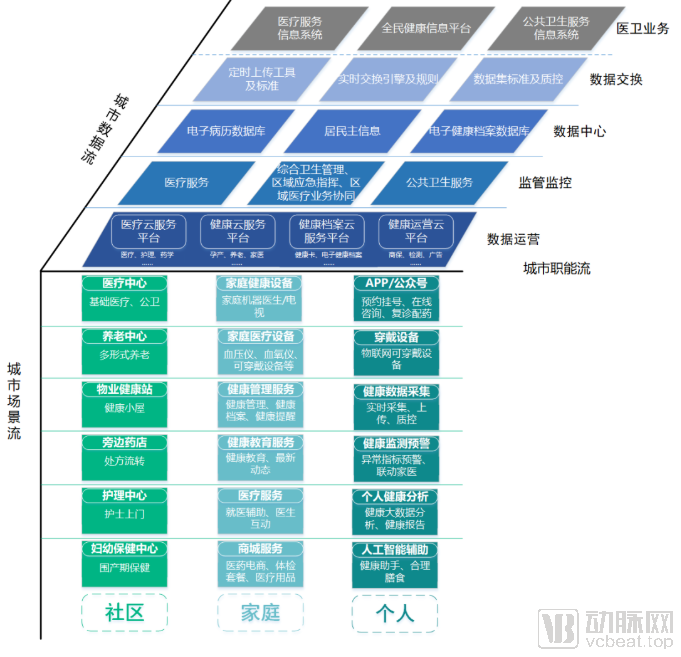
The Urban Data Stream connects city-level health and medical data sources, such as the Urban Medical Service Information System, the National Health Information Platform, and the Public Health Service Information System. It facilitates the aggregation, exchange, sharing, and application of health and medical data through real-time exchange and scheduled uploads, ultimately building city-level health and medical data assets across various themes, including electronic medical record databases, master patient indices, and electronic health record data.
Urban data flows permeate the entire operational spectrum of urban medical institutions, primary healthcare facilities, and administrative bodies. Centered on service functions, these flows form an urban functional stream that shapes a “City Health Brain” integrating four core components: medical cloud services, health cloud services, electronic health record (EHR) cloud services, and health operations cloud services. This system provides platform-level services to the city-wide health industry and offers technical support for the operation of health and medical services across diverse scenarios for individuals, families, and communities.
Healthy Cities is the healthcare sector within the functional framework of Smart Cities. B-Soft Co., Ltd. organically integrates smart city planning by using urban functions as the longitudinal axis, social scenarios as the latitudinal axis, and future communities as nodes. Through comprehensive innovative solutions, it covers informatization construction across four dimensions of social scenarios: City Brain, Healthy Communities, Harmonious Families, and Happy Individuals. This approach promotes full coverage of residents’ medical and health services, achieving the goal of an integrated, end-to-end “medical care, rehabilitation, nursing, and elderly care” service process for urban residents.
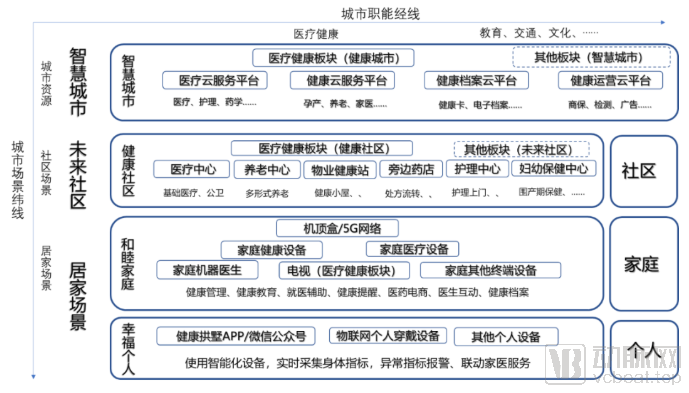
1. City Brain: As the healthcare segment of the City Brain, this initiative builds upon city-level medical and health informatics resources to deepen the development of four major cloud service platforms: medical services, health services, electronic health records, and health industry operation management. It enables unified allocation of municipal medical and health service resources, establishes a centralized and interoperable data center for regional data sharing, and leverages big data analytics to construct a comprehensive management system, serving as the healthcare component of the City Brain.
2. Healthy Community (Healthcare Scenario within the Future Community Framework): As one of the nine key scenarios of the Future Community initiative, the Healthy Community implements the “1339” top-level design framework for Future Communities.
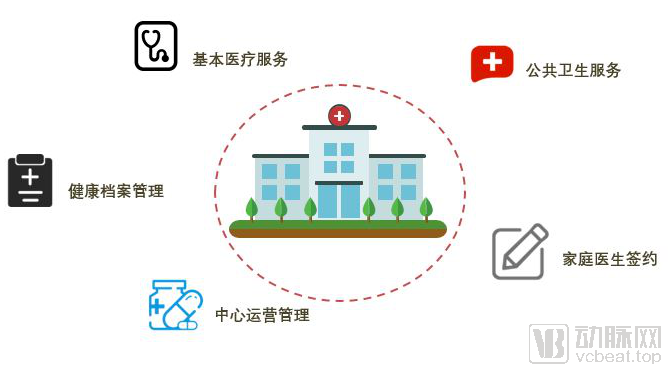
Establish medical centers and leverage the unified cloud service platform built under the Healthy City initiative to foster specialized-general practitioner collaboration between urban hospitals and community health centers. This will enable integrated, one-stop healthcare services for residents, thereby achieving the goal of zero-distance access to renowned doctors and premier hospitals within future communities.
The Smart Health Platform of Minhang District, Shanghai, facilitates the flow of business data among medical institutions at all levels and integrates the advantages of online and offline medical resources. By leveraging mechanisms such as two-way referrals, multidisciplinary remote consultations, and regional medical centers, the platform enables residents to access medical services with “only one visit.” Guided by information technology to expand service coverage, it allows residents to enjoy high-quality medical resources from tertiary hospitals right at their doorstep.
Through data collection and accumulation via the Minhang District Smart Health Platform, resident information and healthcare-seeking behaviors are analyzed to categorize different types of medical needs, such as chronic disease management, elderly care, maternal and child health, and rehabilitation services. Family doctors then leverage the Family Doctor Service Platform to deliver more proactive and targeted healthcare services to residents within their jurisdictions.
Establish Elderly Care Centers to Achieve Full Coverage of Community- and Home-Based Medical and Nursing Services for the Elderly and Disabled, Realizing “Smart Elderly Care” for Health and Well-being.
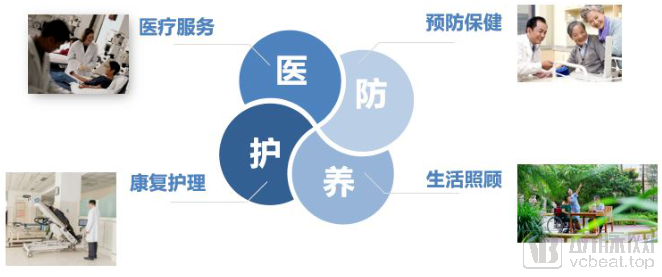
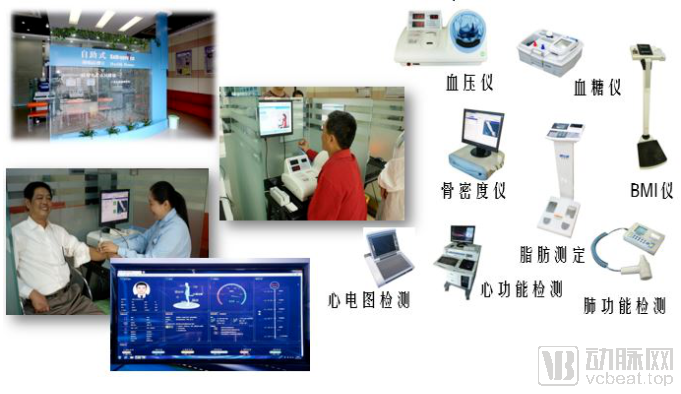
Establish community health stations to enable self-service health monitoring, enhance residents’ health awareness and proactive healthy habits, popularize wellness knowledge such as nutritional diets and therapeutic care, and provide basic medical and healthcare services at the doorstep for vulnerable populations.
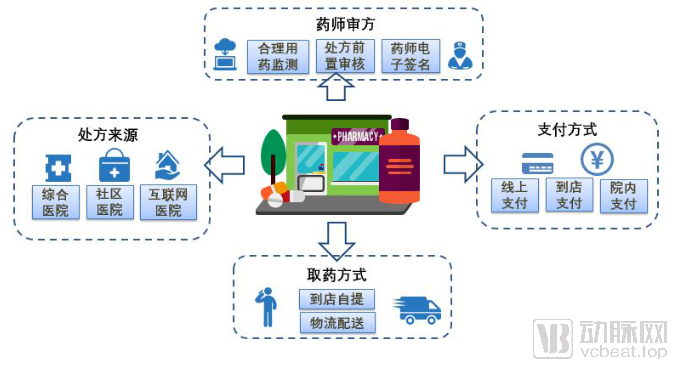
Establish an adjacent pharmacy to enable multi-source prescription payments through various methods, online verification, and offline delivery, providing the public with convenient and reliable access to essential medications.
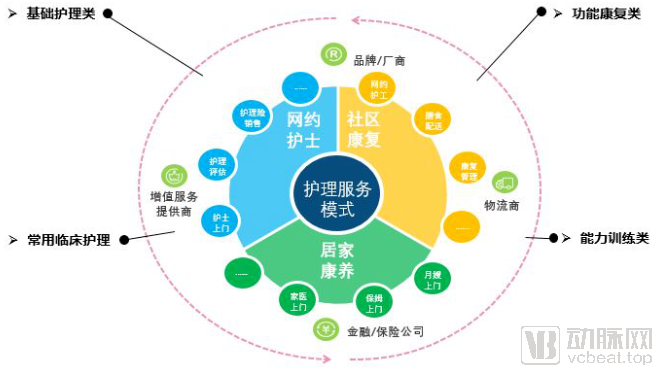
Establish a nursing center to enable online booking of nurses and caregivers for home visits, providing basic clinical nursing, rehabilitative functional care, and other services, thereby implementing and operationalizing the “Internet + Nursing” model.
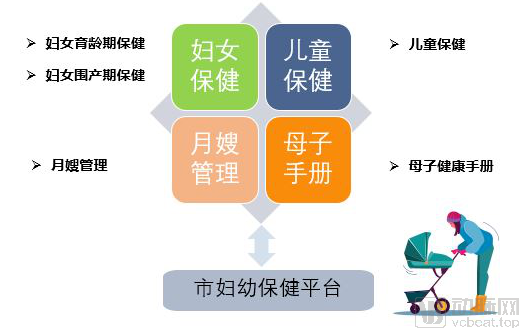
Establish a Maternal and Child Health Center, integrate with the municipal maternal and child health platform, and implement functions such as perinatal healthcare management for women, child healthcare management, maternal and child health handbooks, and postpartum doula management, to provide efficient and continuous health management services for women and children in the community.
3. Harmonious Family: As an integral component of healthy cities and healthy communities, centered on the smart home station, leveraging smart devices to achieve the goal of home-based health management for family members.
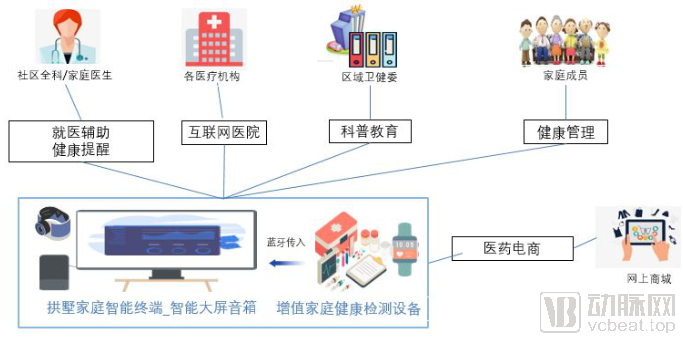
4. Healthy Individuals: Leveraging smart devices such as personal intelligent terminals and wearables, this approach enables real-time monitoring of various health and medical vital signs. By connecting to the Urban Health Brain, it facilitates personal health management, identifies individuals at health risk, and links them with diverse healthcare service resources within the city for targeted health intervention and promotion.