

State Council Endorses Inclusion of Internet Healthcare in National Insurance, Sparking Sector Surge and New IPO Filings
New Favorable Policies for Internet Healthcare! Following the joint issuance of a document by 13 departments on July 15 to encourage the optimization of medical experience through the internet and the creation of a new ecosystem for health consumption, the General Office of the State Council issued the "Implementation Opinions on Further Optimizing the Business Environment and Better Serving Market Entities" on July 21. This document addresses several industry hot topics, specifically regarding the scope of diagnosis and treatment, medical insurance payment, and approval requirements.
In the first half of the year, driven by epidemic prevention and control efforts, internet healthcare has seen continuous and intensive policy encouragement. From the current perspective, as epidemic control enters a normalized phase, policy support continues and has gained endorsement at higher levels.
However, policy encouragement is merely a good start; its implementation may still face a tortuous process. What significance does this document hold for the sustainable development of the industry? What difficulties exist in the implementation process? And how can these difficulties be resolved? VCBeat promptly invited industry insiders to discuss these issues.
On July 21, the General Office of the State Council issued the “Implementation Opinions on Further Optimizing the Business Environment to Better Serve Market Entities” (hereinafter referred to as the “Opinions”), pointing out the need to improve inclusive and prudent regulation of new business formats. It called for accelerating the assessment of existing market access and regulatory policies for new business formats, and resolutely eliminating all unreasonable administrative measures.
This opinion highlights three key points regarding internet-based healthcare: further expanding the scope of online diagnosis and treatment under the premise of ensuring medical safety and quality, including eligible internet-based medical services in the national health insurance reimbursement scheme, and formulating and publishing unified national approval standards for internet-based healthcare.
Although the “Opinions” dedicate limited space to internet healthcare, they at least signal two key messages:
First, top-level design requires a more inclusive attitude toward the new business model of internet healthcare, and subsequent supporting policies are expected to demonstrate greater openness and support for the industry.
Secondly, the scope of diagnosis and treatment, medical insurance payment, and approval standards mentioned in the “Opinions” are all topics that have sparked heated discussion within the industry and hold significant practical relevance. The document outlines the next steps in these three areas, indicating greater room for development in the sector.
A representative from WeDoctor stated that, compared with the series of favorable policies previously introduced, the current "Opinions" demonstrate both continuity and new advancements. This move represents a significant step in deepening the “decentralization, control, and service” reform and optimizing the business environment. It also effectively normalizes the special policies implemented during the pandemic. The further optimization of the policy and regulatory environments, coupled with support from payers such as basic medical insurance and commercial health insurance, will help overcome long-standing bottlenecks in the internet healthcare industry and further drive industrial innovation.
The “Opinions” not only quickly drew the attention of internet healthcare companies and went viral on social media, but also delivered substantial benefits by including eligible internet medical services in the scope of medical insurance reimbursement. This move further boosted performance in the secondary market, with the internet healthcare sector surging sharply. As of the close of trading on July 21, Ping An Good Doctor rose by 9.62%, while Alibaba Health jumped 13.82%. In the A-share market, Winning Health Technology Group, SinoCare, Wonders Information, and B-Soft also posted varying degrees of gains.
Since the introduction of new policies in April 2018, the internet healthcare industry has undergone more than two years of development, initially establishing a policy framework encompassing guidance, payment, and regulation. In light of the current state of the internet healthcare sector, apart from the aforementioned direct impact on the secondary market, the “Opinions” are expected to deliver benefits primarily in three areas.
Promote Standardization and Industry Normalization
Previously, documents such as the “Administrative Measures for Internet Hospitals (Trial)” and the “Administrative Measures for Internet Diagnosis and Treatment (Trial)” issued by the National Health Commission had already stipulated approval requirements for internet hospitals and practice requirements for internet diagnosis and treatment. However, in actual approval processes, many regions have established more detailed standards, and the materials required for application vary. From the perspective of approval outcomes, the composition of internet hospitals across different regions exhibits distinct characteristics; for instance, enterprise-led internet hospitals predominate in Hainan and Ningxia, whereas those led by physical hospitals are predominant in Beijing, Shanghai, Guangzhou, and other areas.
Where Is It Relatively Easier to Apply for an Internet Hospital? For most enterprises, seeking the answer to this question is almost the first step before establishing an internet hospital. Differences across regions in market access, approval processes, and practice requirements lead to variations in service delivery.
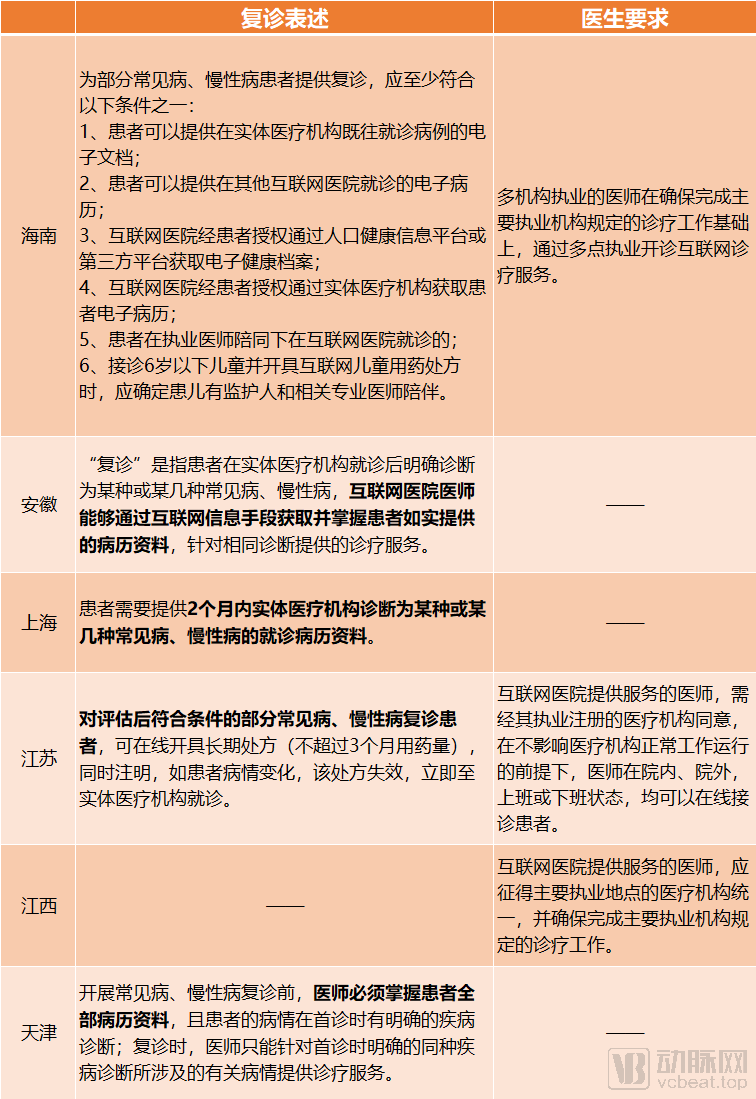
Variations in Regulations Governing Practice at Internet Hospitals Across Certain Regions. Data source: Official websites of local Health Commissions; graphic by VCBeat.
An analysis of internet hospital regulations in provinces and municipalities such as Hainan, Anhui, and Shanghai reveals that while provisions concerning follow-up consultations and physician practice requirements remain within the framework established by the National Health Commission, various localities have developed their own detailed implementation rules.
A relevant official from WeDoctor believes that, under the guidance of the “Opinions,” internet hospitals may see clearer definitions in areas such as approval processes, physician practice regulations, the scope of online medical specialties, and service workflows. The supplementation of industry standards and the unification of regulatory policies will, to a certain extent, improve the current uneven quality of institutions and services in the market, thereby promoting more standardized and healthy development of the industry.
Although the phrase “nationwide unified approval standards for internet-based healthcare” in the document may encompass many aspects, such as access criteria, approval procedures, or the degree of openness to different entities, achieving the greatest possible uniformity in these areas will help further standardize the industry.
Promoting Service Enhancement and Industry Scalability
During the pandemic this year, prescription refills for patients with chronic diseases became a major challenge. The National Healthcare Security Administration issued a policy to include internet-based medical services in the national health insurance scheme. Hospitals across many regions accelerated the upgrading of their information systems to enable real-time online settlement. This segment, long regarded as a bottleneck in industry development, has achieved substantial breakthroughs. According to incomplete statistics, by the end of June, more than 60 internet hospitals nationwide had enabled health insurance payment.
The "Opinions" affirm the role of health insurance payment in internet medical services from a higher level.
Wang Hang, founder and CEO of Haodf Online, believes that it is evident that the driving force of medical insurance payment is becoming increasingly strong. In the future, what constitutes good service? Medical insurance will provide the answer and also promote the scaled development of the entire industry.
A representative from Medlinker stated that since the outbreak of the pandemic, a series of top-level policies issued by the state have demonstrated the rapidly growing importance of internet healthcare within China’s overall medical system. Patients are gradually forming the habit of seeking online consultations and obtaining prescriptions for follow-up visits. Once the issue of health insurance reimbursement is resolved, the advantages of internet healthcare—such as being contactless, convenient, and traceable—will be fully realized ahead of schedule. This is particularly relevant to the online management of chronic diseases, where a closed-loop service model encompassing diagnosis, medication, and payment can be more effectively implemented.
“The document not only provides guidance for accelerating the digital transformation of healthcare institutions but also lowers the overall entry barriers to medical services, thereby expanding the supply of healthcare services,” said Zhai Xuelian, Vice President and Chief Strategy Officer at Zhuojian Technology. He noted that this means the development of online services by hospitals is no longer merely a procedural move; rather, it drives patient-friendly adoption through key factors such as health insurance reimbursement, thereby normalizing compliant and appropriate online diagnosis and treatment. In this process, enterprises can gain greater market space.
Promoting Interconnectivity of Medical Information
Data silos and low levels of information interoperability have long been persistent pain points in healthcare informatization. Internet-based healthcare can connect multiple stakeholders, while health insurance reimbursement further requires data integration across medical services and pharmaceuticals, enabling end-to-end traceability.
According to Hu Wei, Chief Medical Officer at Weimai, patient trust in online consultations has grown since the pandemic, leading to an increase in internet-based diagnosis and treatment activities; as such services expand, related clinical guidelines and standards will be strengthened. Meanwhile, the interoperability of medical data will accelerate. “Healthcare is a continuous process, and internet healthcare relies on data interoperability for its development. Currently, certain regions have already implemented applications such as electronic health cards and unified medical service cards, laying the foundation for data integration.”
Cai Ting, Vice President of Jiahe Meikang, believes that the implementation of these policies has led to a more rational allocation of national medical resources. For hospitals, seizing this opportunity can further extend medical services and significantly improve service efficiency. For patients, the healthcare experience is greatly enhanced, with certain processes completed without leaving home. For internet-based medical informatics companies, it enables closer integration and process optimization between online and offline services, further promoting the interconnectivity of medical information.
A representative from Miao Health stated that data is a critical driver for the development of internet-based healthcare. Only by integrating data across internet hospitals, new retail pharmaceuticals, health management, and insurance coverage can a comprehensive service system encompassing “wellness, medical care, pharmaceuticals, and insurance” be provided to consumer-end patients, thereby establishing a viable business model. Therefore, vigorously promoting measures such as medical insurance reimbursement for internet-based healthcare, facilitating the integration of commercial insurance, and breaking down data silos between medical and pharmaceutical sectors will all serve to accelerate this progress.
Looking at the development path of internet healthcare since the beginning of this year, policies have played a significant guiding and promoting role; moreover, the focus of policy guidance has varied across different stages of the pandemic.
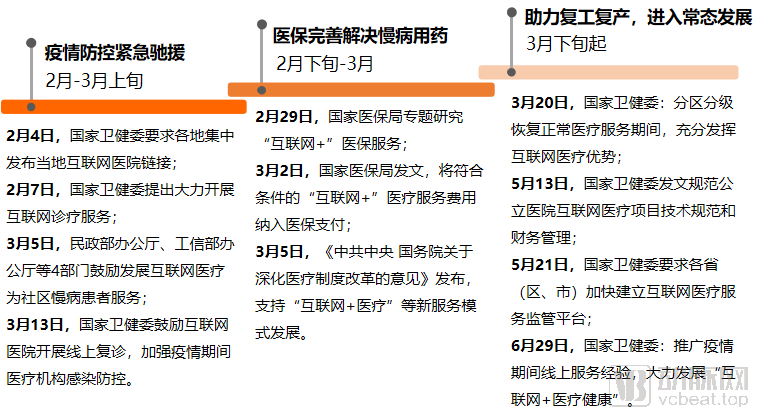
Focus of Internet Healthcare Policies in the First Half of 2020, by Phase; Source: Official Websites of the National Health Commission and the National Healthcare Security Administration; Graphic by VCBeat
As shown in the figure above, as the pandemic progressed through its outbreak, spread, and stabilization phases, policies successively encouraged internet healthcare to provide emergency support for epidemic prevention and control, improved health insurance reimbursement mechanisms to ensure medication access for patients with chronic diseases, and then promoted the role of internet healthcare in facilitating work resumption and production recovery. Finally, following the establishment of normalized epidemic prevention and control measures, prior experience with online services was widely disseminated.
During the economic reconstruction phase following the stabilization of the pandemic, the internet healthcare industry can also assume its corresponding responsibilities.
Therefore, overall, policy support for internet healthcare has been sufficiently intensive over the past six months; the key lies in implementation. The transition from policy formulation to execution, and from the central government to local authorities, will inevitably encounter various specific challenges. Accurately identifying these issues will help accelerate the pace of policy implementation.
Accelerating the Promotion of Medical Insurance Payment Reforms
Regarding the challenges of policy implementation, most enterprises have focused their attention on medical insurance reimbursement. Indeed, medical insurance itself faces issues such as fund supervision security and cost containment. Furthermore, there are regional disparities in medical insurance fund surpluses and fiscal subsidy capabilities. Consequently, the inclusion of internet healthcare in medical insurance reimbursement is unlikely to be widely rolled out in the short term.
A representative from WeDoctor stated that while the national government has gradually relaxed policy barriers for medical insurance reimbursement and provided guidance, the pace at which local medical insurance departments across China incorporate internet-based diagnosis and treatment into coverage still needs to accelerate. "Few third-party platform-based internet hospitals have been included in the scope of medical insurance payment. This objectively hinders such platforms from providing patients with a complete and convenient closed-loop service integrating online consultations, follow-up visits, and medication purchases, and also impedes, to some extent, the pace of service innovation among digital health enterprises."
Cai Ting also highlighted a practical issue: medical insurance policies across China are not yet unified, and some regions have not yet implemented real-time settlement without the need for physical insurance cards.
“Compliance reviews for medical insurance and quality control for internet-based diagnosis and treatment are both challenges in the process of policy implementation,” said Hu Wei, Chief Medical Officer at Weimai.
In Wang Hang’s view, the fundamental role of medical insurance is to provide basic coverage. Therefore, internet-based medical services included in medical insurance reimbursement must be those that deliver core value and offer high cost-effectiveness. “The greatest challenge for third-party internet healthcare platforms is that we are not designated medical insurance institutions, have no allocated insurance quotas, and hold no preferential status. However, this also has its advantages: it compels us to demonstrate superior service quality and lower costs, thereby helping medical insurance reduce expenses and improve efficiency. Once we achieve this, medical insurance will certainly grant us opportunities. Thus, our primary focus lies on how to reduce costs, enhance quality, combat insurance fraud, and ensure that medical insurance funds are not misused.”
Difficulty in Unifying Approval Standards
During the approval process, provincial-level internet healthcare regulatory platforms serve as a fundamental prerequisite for the approval of internet hospitals across various regions. According to statistics from the National Health Commission, 27 provinces in China have currently established such regulatory platforms.
Zhai Xuelian stated that establishing a unified national approval standard for internet-based healthcare presents significant challenges. The provincial-level regulatory platform model, which combines “regulation and approval,” means that approval standards encompass not only the establishment and launch of internet hospitals but also extend to areas such as medical technology, medication management, and even Diagnosis-Related Groups (DRGs), making it difficult to achieve a cohesive nationwide framework.
Meanwhile, the industry also faces a series of challenges. Zhai Xuelian noted that for hospitals and regional health system authorities, internet hospitals must accelerate not only their construction but also their management and operational capabilities. “A journey that originally would have taken five years may now need to be completed in one year. Conversely, looking at the broader market, challenges will arise regarding whether there is sufficient supply of information technology services and products, as well as medical and technical personnel resources.”
Two-Pronged Recommendations to Tackle the Challenge
Industry insiders have also put forward corresponding suggestions to address challenges such as health insurance reimbursement and the operation of internet hospitals.
First, public health insurance and commercial health insurance are complementary.
A representative from WeDoctor suggested accelerating the introduction and implementation of detailed policies under the “Opinions,” noting that once a unified national standard for internet medical services is established, the safety and quality of online healthcare will be better safeguarded. Meanwhile, it was recommended that relevant authorities consider allocating a certain quota of medical insurance coverage to platform-based internet hospitals to further unlock their potential. “As the scope of internet diagnosis and treatment services is further expanded and inclusion in medical insurance reimbursement becomes the norm, it will further facilitate the integration of the online and offline healthcare service loop. This will not only provide users with higher-quality and more convenient healthcare services but also usher in a period of rapid growth for the internet healthcare industry.”
Relevant executives at WeDoctor noted that since the onset of the pandemic, patients have gradually developed the habit of seeking online medical consultations and obtaining prescription refills. They recommended expanding health insurance coverage to include more third-party internet hospitals to enhance patient convenience, while simultaneously promoting the development of commercial health insurance. This would help establish a multi-tiered healthcare security system and create a closed-loop chronic disease management service integrating “medical care, pharmaceuticals, and insurance.”
“Commercial health insurance has long been a key focus area for supplementing China’s basic medical insurance,” said Zhai Xuelian. With pandemic prevention and control now normalized, public attention to health is highly concentrated. This presents an opportune moment to integrate commercial health insurance with basic medical insurance, implementing region-based initiatives—including resident health management, disease prevention and control, critical illness assistance, and rational drug use—to achieve a win-win outcome for patients, healthcare institutions, basic medical insurance funds, and commercial insurers.
Wang Hang believes that whether online or offline, as long as services can help society reduce costs, improve efficiency, and provide patient satisfaction, they will definitely receive support from medical insurance. Furthermore, increasing investment in health services and raising health awareness will naturally strengthen the concept of health consumption, driving market growth in the health sector. This is a fully open, market-driven field; if the services are good, people will naturally be willing to pay. This also represents the primary profit growth point for most enterprises in the future.
Second, strengthen cooperation and pilot programs.
Cai Ting believes that when facing difficulties, one can first formulate implementable standards in accordance with policy guidelines, then address specific issues, conduct small-scale pilot trials in designated areas, and subsequently promote them nationwide.
In fact, the National Health Commission had previously designated 11 provinces and municipalities, including Ningxia and Shandong, as demonstration regions for internet-based healthcare. These areas have indeed achieved significant breakthroughs in policy formulation and model innovation, and are expected to undertake deeper-level pilot programs in the near future.
Furthermore, Hu Wei recommended innovating operational mechanisms by fostering greater collaboration between enterprises and public hospitals, thereby improving the accessibility of high-quality resources within public hospitals.
With the increasing number of internet hospitals affiliated with public hospitals and rising policy requirements for their service capabilities, achieving efficient operations has become a critical challenge for all public hospitals. Operational models are also expected to yield replicable best practices among select regions, hospitals, and enterprises.
In summary, the inclusion of internet-based healthcare services in medical insurance reimbursement is an inevitable trend. Approval criteria and the scope of diagnosis and treatment will become more clearly defined. However, numerous practical challenges remain during policy implementation, requiring strong top-down promotion by competent authorities as well as collaborative efforts from market participants to devise strategies and effectively address difficulties encountered in the implementation process.