

Relay Therapeutics Raises $920M in Four Years and $400M in IPO to Advance Allosteric Cancer Therapies

Relay Therapeutics
New Drug Discovery Technology Developer
Recently,Biopharmaceutical company Relay Therapeutics has officially listed on the Nasdaq under the ticker symbol RLAY. In this IPO, Relay issued a total of 20 million shares at $20 per share, raising $400 million.At the end of 2018, Relay Therapeutics completed its Series C financing round, raising $400 million to expand its R&D operations and grow its team. This amount was reportedly the largest single financing in the history of the biotechnology sector at that time.
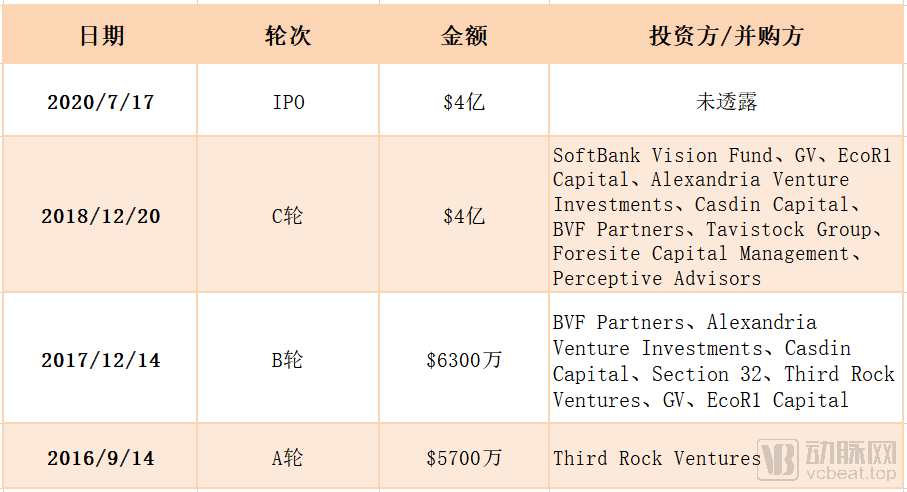
Relay Therapeutics' Historical Financing Overview
To date, Relay has secured $920 million (approximately RMB 6.3 billion) in financing within just four years.
Relay Therapeutics, founded in 2014, is an emerging pharmaceutical company bridging the fields of computing and biotechnology, headquartered in Cambridge, Massachusetts, USA. It integrates computational technologies with experimental approaches from structural biology, biophysics, and chemical biology to pioneer precision therapies for cancer.

Relay Therapeutics Founding Team
Relay was co-founded by four individuals. These four founders are all prominent scientists in their respective fields, including Dr. David E. Shaw, Chief Scientist at DE Shaw Research; Dr. Matthew Jacobson, Professor and Chair of the Department of Pharmaceutical Chemistry at the University of California, San Francisco; Dr. Dorothee Kern, Professor of Biochemistry at Brandeis University and Investigator at the Howard Hughes Medical Institute; and Dr. Mark Murcko, Senior Lecturer in the Department of Biological Engineering at the Massachusetts Institute of Technology.
Targeted Novel Drugs Developed Based on Protease Allosteric Sites
Relay’s Technical Backbone—The Dynamo PlatformBy leveraging experimental techniques such as room-temperature crystallography and cryo-electron microscopy, along with computational methods including long-timescale molecular dynamics simulations and machine learning, we conduct extended simulations of molecular dynamics to gain deeper insights into protein motions, thereby facilitating the development of novel therapeutics.
Relay’s approach to targeted drug development does not involve simply “fitting and docking” into the active sites of proteases in the traditional sense; instead, it designs drugs that bind to allosteric sites on proteases to modulate their functional activity. Allosteric sites are typically located far from the protein’s active site but play a critical role in protein function. Compared with protease active sites, allosteric sites exhibit more distinctive structural features.
Relay’s confidence in securing substantial financing is primarily reflected in two aspects:First, it enables the design and development of novel targeted drugs by focusing on allosteric sites of proteins, thereby avoiding the side effects associated with traditional drugs that target the active sites or catalytic functions of proteases. Second, leveraging its powerful computational platform—Dynamo—to simulate the dynamic processes of target proteases, it has conducted in-depth research into the precise allosteric regulatory networks of proteases, thus enhancing the precision of novel targeted drug design and development.
So, in what aspects does the precision of this targeted new drug manifest?
As previously mentioned, allosteric sites possess more unique structural features compared to the active sites of proteases. Therefore, small-molecule drugs targeting the allosteric sites of proteases offer higher selectivity, efficacy, and safety. Drugs designed and developed to target protein allosteric sites avoid the side effects associated with traditional drugs that target protease active sites or catalytic functions. For instance, certain protease substrates may compete with drugs, thereby reducing in vivo efficacy and leading to drug tolerance. Furthermore, because the active sites of some proteases are highly similar, drugs targeting these active sites may cause a series of cross-reactions with other similar proteases, subsequently disrupting homeostasis in the human body.
Designing drugs targeting allosteric sites of proteases is akin to the “facial recognition” feature now prevalent in payment systems: consumers cannot complete a transaction with just any photograph; instead, they are required to perform specific actions such as nodding, blinking, or smiling. Similarly, drugs targeting allosteric sites of proteases exert more precise control by modulating various functional activities of the protease through binding to these allosteric sites.
Modulating Protein Conformation for Precision Cancer Therapy
The immense development potential of drug molecules designed to target protease allosteric sites, along with their significant and distinct advantages over traditional targeted therapies, has attracted numerous biotechnology companies and major pharmaceutical firms to flock to this hot field.
In addition to Relay Therapeutics, other notable players in the field of allosteric protease drug development include emerging biotechnology companies such as HotSpot Therapeutics, Revolution Medicines, Vividion Therapeutics, Nimbus Therapeutics, Schrödinger, and Black Diamond Therapeutics, as well as pharmaceutical giants like Gilead and Novartis.
Currently, phosphatase inhibitors that have entered clinical trials include Novartis’s SHP2 inhibitor TNO155, Sanofi’s SHP2 inhibitor TNO155, and InFlectis BioScience’s PPP1R15A inhibitor IFB-088. While these phosphatase inhibitors possess active binding sites, they predominantly bind to allosteric sites on the phosphatases to achieve precise regulation.
SHP2 belongs to the protein tyrosine phosphatase (PTP) family and is closely associated with the pathogenesis of various cancers, including breast cancer and lung cancer. SHP2 modulates PD-1-mediated signal transduction and participates in the regulation of immune checkpoint pathways. By transducing signals downstream of receptor tyrosine kinases (RTKs), SHP2 promotes the survival and proliferation of cancer cells via the RAS pathway.
Relay Therapeutics has managed to capture a significant share of a highly competitive market. Its core competitiveness is underpinned not only by its in-depth research into allosteric sites of proteases but also by its innovative approach that integrates powerful computational simulation platforms with cutting-edge experimental techniques.
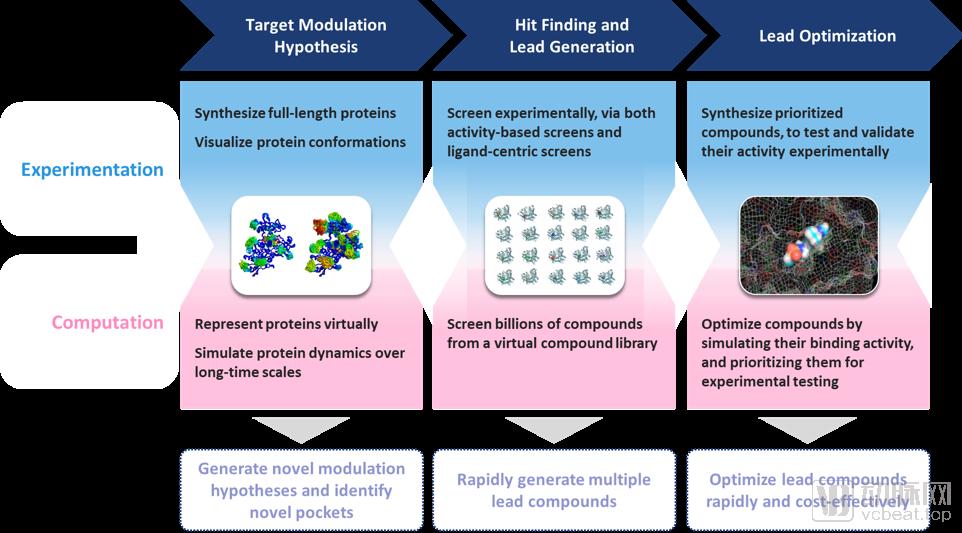
Relay Therapeutics’ “Computer + Biological Experiment” Research Model
Relay’s Dynamo platform focuses on “understanding the relationship between protein conformation and function.”
Previous protein imaging methods were limited to static images. In contrast, Relay Therapeutics adopted an approach focused on the subtle modulation of protein conformations and their allosteric sites. By bridging structural biology, biophysics, and chemical biology, and integrating computational technologies with biological experiments, the company elucidated the full dynamic nature of proteins for the first time, providing key insights into “how the dynamic properties of protein conformations regulate function.” Leveraging these insights, Relay Therapeutics achieves precision cancer therapy by modulating protein conformations.
Three Major Small-Molecule Inhibitors Make Their Debut, Boasting Huge Potential
Currently, Relay’s candidate products mainly include three small-molecule inhibitors targeting cancer: RLY-1971, RLY-4008, and RLY-PI3K1047.
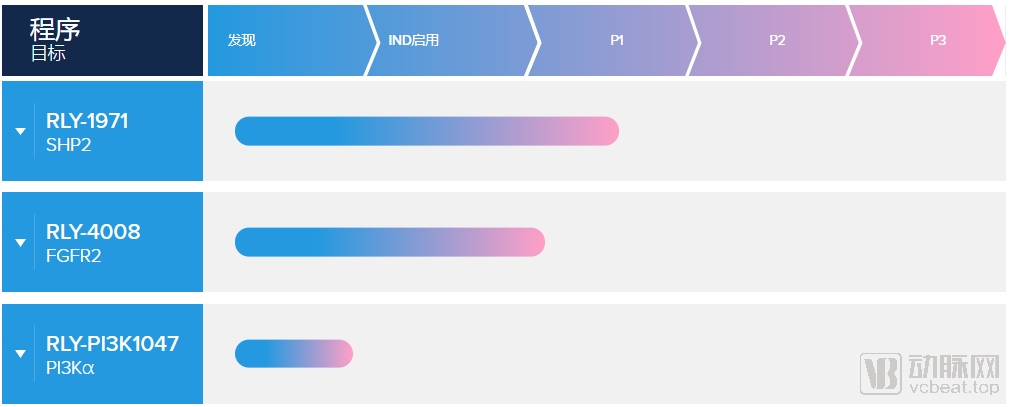
Relay Therapeutics' R&D Pipeline
RLY-1971
RLY-1971 is an oral, small-molecule, selective inhibitor of the protein tyrosine phosphatase SHP2 that binds to and stabilizes the inactive conformation of SHP2. As previously mentioned, SHP2, a key signal transduction and regulatory factor, drives cancer cell proliferation and plays a critical role in the development of resistance to targeted therapies. Inhibition of SHP2 can serve as an effective monotherapy for cancer treatment. Currently, Relay Therapeutics is conducting a Phase 1 dose-escalation study in patients with advanced metastatic solid tumors to evaluate the safety and tolerability of RLY-1971.
RLY-4008
RLY-4008 is an oral, small-molecule selective inhibitor of FGFR2 that binds to and stabilizes the inactive conformation of FGFR2. FGFR2 is a receptor tyrosine kinase frequently altered in cancer and one of the four members of the FGFR family. The FGFR family comprises FGFR1, FGFR2, FGFR3, and FGFR4, which are closely related proteins with highly similar sequences and properties. Current FGFR-targeted therapies are limited by hyperphosphatemia, a dose-limiting adverse event caused by the concomitant inhibition of FGFR1 alongside FGFR2.
Relay has leveraged its expertise in computational modeling and experimental structural analysis to identify motion-based differences between FGFR2 and other members of the FGFR family, utilizing these dynamic distinctions to develop its drug candidate. RLY-4008 exhibits high selectivity for FGFR2 while showing minimal inhibition of other targets (other FGFR family members), thereby avoiding the side effects associated with traditional targeted therapies.
RLY-PI3K1047
RLY-PI3K1047 is an inhibitor of PI3Kα. PI3Kα is a central regulator of cellular signaling pathways and plays a critical role in the growth, proliferation, and survival of cancer cells. PI3Kα is the most frequently mutated kinase in cancer. Current PI3Kα inhibitors target the catalytic site of PI3Kα but also inhibit wild-type PI3Kα and other PI3K isoforms, thereby causing various adverse effects that pose significant tolerability challenges for many patients.
Relay has elucidated the first full-length protein structure of PI3Kα, laying a solid foundation for further research into its activation mechanism and the impact of mutations on its function. Currently, Relay is developing a series of programs selectively targeting cancer-associated mutant variants of PI3Kα.
# Final Thoughts
“The beauty of enzyme proteins lies in their ‘movement,’” said Professor Dorothee Kern, one of the four scientific founders of Relay. This is the underlying logic behind Relay’s research.
Although the path to future allosteric drug development may be fraught with numerous obstacles and uncertainties, this field will continue to attract strong investor interest due to the high selectivity of allosteric modulators and their immense potential to expand the druggable space.