

SenseTime's SenseCare Platform Achieves 'Heart' Upgrade with Federated Learning Research Accepted at ECCV
As artificial intelligence is integrated into national strategy and the “New Infrastructure” framework, AI technology will play a positive role in facilitating the upgrading of China’s healthcare industry.
At the recently concluded 2020 World Artificial Intelligence Conference, Professor Jin Zhengyu, Chairman of the Chinese Society of Radiology and Vice Chairman of the China Medical Equipment AI Alliance, stated in his speech at the Sensetime AI Enterprise Forum, “AI is an important assistant for future radiologists, helping doctors understand patients’ conditions more quickly, and is a crucial method for rapidly improving healthcare standards in remote and underdeveloped areas.” However, he also pointed out that “the application of AI in the medical field still faces many ethical, privacy, and information security issues that urgently need to be addressed. AI research must shift from being driven purely by commercial interests to being driven by public policy, and accept supervision from the government and society.”

Amid the wave of “new infrastructure” development, AI will fulfill its three major missions: promoting good governance, benefiting the public, and driving industrial growth. SenseTime not only leverages AI to provide intelligent auxiliary tools for physicians, thereby enhancing diagnostic and treatment efficiency in hospitals, but also continuously explores frontiers. By employing innovative technologies such as federated learning and adhering to sustainable AI development principles, SenseTime is breaking the boundaries of AI applications and leading the sustainable development of the AI healthcare industry.
AI for Coronary Arteries Helps Doctors Reduce Burden and Improve Efficiency
In recent years, despite the leapfrog development of China's socio-economy, the labor force has been declining year by year, and the pace of population aging is accelerating. Meanwhile, China's medical resources are facing problems such as "shortage in quantity and uneven distribution." The rise of AI and big data technologies is expected to help solve the problem of insufficient and unbalanced medical resources in China by promoting the intelligent upgrading of the industry.
From assisted diagnosis and treatment, precision surgery to drug discovery, AI in healthcare boasts a wide range of application scenarios. Professor Jin Zhengyu stated that “medical image analysis is the area with the greatest demand,” citing SenseCare®, Sensetime’s intelligent diagnosis and treatment platform, as an example. He highlighted that “labor-saving, time-saving, effort-reducing, and high-precision” are the four major values that AI-assisted imaging diagnosis brings to hospitals.
Professor Jin Zhengyu believes that “good medical AI must meet clinical needs.” Adhering to the philosophy of “leveraging medical big data to serve clinical diagnosis and treatment,” SenseTime’s SenseCare® Intelligent Diagnosis and Treatment Platform has, thanks to its flexible scalability, launched a range of product solutions to date. These include solutions for chest CT, chest X-ray, coronary arteries, pathology, and bone tumors, covering more than 13 human body parts and organs. The platform provides AI support for the clinical diagnostic and therapeutic needs of multiple departments, assisting clinicians in conducting multi-dimensional analyses such as high-precision disease detection, classification, and benign-malignant prediction, as well as in designing treatment plans including 3D preoperative planning and simulation.
During the COVID-19 pandemic this year, the SenseCare®️ Chest CT Intelligent Clinical Solution was rapidly deployed to key hospitals conducting COVID-19 screening in multiple provinces and municipalities, including Beijing, Shanghai, Tianjin, Shandong, Hebei, and Fujian, providing frontline healthcare workers with efficient and accurate decision support. At this year’s World Artificial Intelligence Conference (WAIC), Sensetime also showcased the SenseCare®️ Cardiac Coronary Artery Intelligent Clinical Solution for the intelligent diagnosis and treatment of cardiovascular diseases.
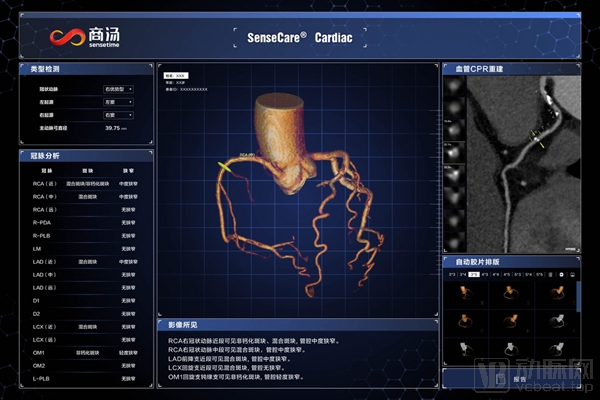
As a critical tool for diagnosing cardiovascular diseases, coronary computed tomography angiography (CTA) requires physicians to perform complex three-dimensional reconstructions of coronary CT images to assess conditions such as plaque-induced stenosis. The diagnostic process for a single case, from image review to report generation, typically takes 20–30 minutes. Leveraging SenseTime’s leading AI algorithms and integrating various 3D visualization and interaction technologies, the SenseCare®️ Cardiac Coronary Intelligent Clinical Solution automates heart segmentation, coronary artery segmentation, centerline extraction, and other 3D reconstruction tasks, along with quantitative plaque analysis, automatic film generation, and structured reporting. This entire workflow is completed in approximately one minute, comprehensively enhancing the efficiency and completeness of cardiac coronary diagnosis and treatment while reducing physicians’ workload.
From aiding physicians in enhancing clinical decision-making and diagnostic efficiency to assisting less-experienced doctors in remote areas in improving their diagnostic capabilities, the innovation and application of AI medical technologies are now gaining significant momentum, continuously helping to balance healthcare resources across China. However, as Professor Jin Zhengyu clearly pointed out, “AI ethical guidelines have seriously lagged behind,” emphasizing that “ethical standards must be integrated into AI systems from the very beginning.” This has become a critical issue for the industry today.
“Federated Learning” Empowers the Sustainable Development of AI in Healthcare
To promote the development of norms and guidelines for AI applications, Sensetime established an AI Ethics Committee last year. The company rigorously conducts AI ethics reviews in various internal processes, including product audits. In June this year, it jointly released the White Paper on Sustainable AI Development with the Qingyuan Research Institute at Shanghai Jiao Tong University, offering normative recommendations for ethical development in the AI industry. Meanwhile, during the development of underlying product frameworks and technological R&D, Sensetime has also engaged in forward-looking exploration to mitigate data security risks at their source.
Due to privacy concerns and other issues, countries around the world have established relevant protection policies for medical data, making collaborative multi-center data training increasingly difficult. However, this is an essential step in the development and iteration of medical AI models. In the past two years, “federated learning” has emerged as a novel approach to address this challenge. Federated learning is a distributed machine learning method that enables joint modeling across multiple centers without sharing raw data, thereby technically achieving collaboration while ensuring data security. The introduction of federated learning has attracted widespread attention from industry, academia, and research institutions, becoming a cutting-edge topic in the field of AI.
Leveraging its profound academic R&D heritage and keen insights into industry trends, Sensetime embarked on forward-looking research into federated learning as early as 2019. Recently, in collaboration with the Center for Computational Biomedical Imaging and Modeling within the Department of Computer Science at Rutgers University, Sensetime published a new research finding at the European Conference on Computer Vision (ECCV), a top-tier global conference in the field. This work innovatively employs a architecture based on distributed Generative Adversarial Networks (GANs) to implement federated learning, paving a “new path” to bridge the last mile in the application of AI in healthcare.
This study constructs an adversarial network by integrating distributed asynchronous discriminators located across multiple data silos with a central generator. This architecture enables the central generator to undergo synthetic training without accessing raw private data, thereby generating synthetic data samples that closely approximate the original data within each data silo for downstream tasks. Furthermore, two loss functions are employed to equip the central generator with lifelong learning capabilities, allowing it to continuously learn in a dynamic environment of data silos (discriminators), such as when new institutions join or existing ones withdraw during the learning process. Experimental simulations demonstrate that this learning approach can progressively approximate the distributions of both homogeneous and heterogeneous data from different data silos, achieving satisfactory performance in medical image segmentation tasks.
By avoiding direct access to raw data, this research methodology upholds the core advantages of federated learning and effectively addresses privacy protection concerns in medical data. Furthermore, by adopting a novel implementation approach distinct from traditional federated learning, this research significantly reduces the volume of communication data between the central server and data silos. It requires only the transmission of synthetic image data and feedback errors, rather than all model parameters, while eliminating the need for any data or parameter exchange among data silos. Consequently, it substantially lowers the cost of collaborative research among healthcare institutions via federated learning, thereby accelerating research efficiency and the development speed of AI models.
Furthermore, this innovative, low-cost federated learning model can drive the upgrade of inefficient, decentralized data centers into efficient, centralized data networks, thereby better facilitating the establishment of regional data centers or industry-standard databases. This aligns with the national strategic guidelines for “New Infrastructure,” accelerating the development of “data intelligence” infrastructure, reducing costs, and creating value for healthcare and many other industries.
Since the rapid development of AI in China, the government has successively introduced policies to encourage the growth of the AI industry, promoting the deep integration and practical application of AI technologies across various sectors. The concept of sustainable development will further drive the continuous innovation and enduring application of AI. In the healthcare and wellness industry, SenseTime will continue to be driven by the dual engines of research and application. It will horizontally expand the capabilities of its SenseCare® intelligent diagnosis and treatment platform to serve more clinical scenarios, while vertically bridging underlying technological innovations with upper-layer applications. On the basis of ensuring data security and patient privacy, SenseTime aims to provide comprehensive support for the digitalization, intelligence, and safety of the medical industry, allowing the value of AI to continually flourish and benefit the public.
As Professor Jin Zhengyu stated in his speech, “We believe that the medical community can leverage AI to equip itself with ideal wings, thereby making greater contributions to science and human development.”