

1111.com Releases 'Post-Pandemic User Behavior Report on Internet Healthcare Platforms' Amid IPO Filing
The sudden onset of the COVID-19 pandemic has fueled unprecedented growth in internet-based pharmaceutical and healthcare platforms. Throughout the pandemic, a large number of people turned to online consultations, e-pharmacy services for prescription refills, and digital health management solutions to meet their medical needs. Now, as the pandemic situation improves, whether these platforms can sustain their rapid growth has become a major focus of attention for both the industry and capital markets.
Recently, the Big Data Research Institute of 1 Drug Network released the "Report on User Behavior of Internet Pharmaceutical and Health Platforms After the Epidemic" (hereinafter referred to as the "Report"), providing comprehensive answers.
The Report shows that individuals born in the 1970s and 1980s, along with male users, are becoming the primary consumer base for online pharmaceutical and healthcare platforms. Throughout the pandemic, male users accounted for as high as 64% of orders, driven by their preference for the convenience and efficiency of online consultation and medication purchasing, as well as the enhanced privacy protection offered for certain conditions. Among these ordering users, those born in the 1970s and 1980s comprised 53%, as they are increasingly becoming the pillars of their families and facing the early onset of various health issues. Consequently, they are placing greater emphasis on their personal health status and are willing to obtain health management services through online consultations and medication purchases.
In terms of user geographic distribution, users in super-first-tier cities and the sinking markets of third- and fourth-tier cities are becoming the primary audience for internet-based pharmaceutical and healthcare platforms. For the former, this is mainly driven by the high time costs associated with offline medical visits; the convenience and efficiency of online pharmaceutical and healthcare services better suit the fast-paced lifestyle of major metropolitan areas. For the latter, it is due to the relatively “limited” medical resources in third- and fourth-tier cities, where users can access more comprehensive and diverse options for diagnosis, treatment, and medication purchases through internet-based pharmaceutical and healthcare platforms.
Dr. Yu Gang, Co-founder and Executive Chairman of 111.com, pointed out that internet-based pharmaceutical and healthcare platforms have effectively addressed the distinct pain points related to diagnosis, treatment, and medication purchase for various user groups. This has enabled users to rapidly cultivate habits of seeking online medical consultations and purchasing medications, thereby laying a solid user foundation for the sustained high-speed growth of internet-based pharmaceutical and healthcare platforms in the post-pandemic era.
This is also vividly reflected in the relevant data. According to 1 Drug Network, from January to June this year, the number of newly registered users on 1 Drug Network increased by 128% year-on-year, and the number of newly registered users conducting online consultations increased by 221% year-on-year. Especially after the epidemic situation improved significantly in April, a large number of new users still logged into 1 Drug Network for online consultations and medication purchases.
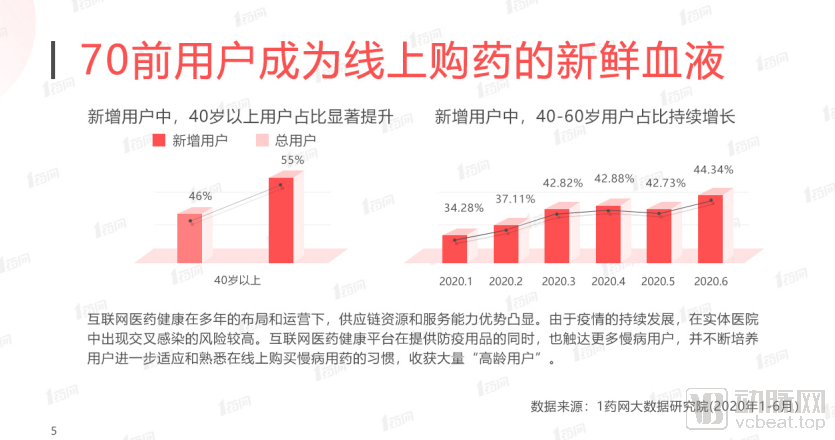
Notably, users born before the 1970s, long perceived as “less digitally engaged,” are emerging as a “fresh blood” force in online pharmaceutical purchases. In the first half of this year, the proportion of new users aged 40–60 on 111.com demonstrated a steady month-on-month growth. This trend is driven by two key factors: first, an increasing number of pre-1970s users are concerned about the high risk of cross-infection associated with hospital visits; second, internet-based healthcare platforms provide comprehensive prescription renewal and consultation services for older adults with chronic diseases, thereby fostering their habit of purchasing chronic-disease medications online.
“Through big data analysis, we found that demand for medications treating chronic conditions—particularly those affecting the cardiovascular, endocrine, and nervous systems—is strongest, with chronic disease medications accounting for 61% of total revenue,” pointed out Yu Gang. This indicates that online consultation and medication purchasing based on chronic disease management are becoming a major engine driving the sustained high growth of internet healthcare platforms in the post-pandemic era.
“The Report” also leverages big data analytics to gain insights into a series of emerging trends in users’ demands for online medical consultations and medication purchases. For instance, men place greater emphasis on nutritional supplementation and health conditioning, with a particularly notable surge in demand among those aged 30 to 50. This trend is largely driven by the dual pressures of family and career faced by many middle-aged men, who require substantial nutritional supplements to replenish their mental and physical energy, thereby enabling them to confront life’s challenges in better condition. Notably, many middle-aged men highly value the privacy of their personal physiological health. Purchasing nutritional supplements through internet-based pharmaceutical and healthcare platforms allows them to avoid the embarrassment associated with offline medical visits and pharmacy purchases, while ensuring greater confidentiality throughout the entire purchasing process.
Across China, there are significant regional differences in users’ health needs. For instance, users in eastern regions are prone to “shanghuo” (internal heat), those in northern regions need to “replenish qi and nourish blood,” users in western regions are most concerned about diarrhea, asthma is highly prevalent in central regions, and users in southern regions place the greatest emphasis on “kidney tonification.” Nevertheless, hypertension remains the most prevalent cardiovascular disease across all regions, consistently ranking first. In particular, among the national cardiovascular patient population on 1 Drug Network (1 Yao Wang), individuals with hypertension in eastern China account for over 40%. Nationwide, the prevalence of hypertension among individuals aged 30 and above is on the rise, leading to an increasing trend of younger-onset hypertension.
Furthermore, coronary heart disease (CHD) and hyperlipidemia exhibit a high prevalence among elderly users. According to big data statistics from 1YaoWang, during the period from January to June this year, the proportion of users purchasing medications for CHD and hyperlipidemia increased with age across all age groups. This indirectly suggests that elderly users are not necessarily hindered by their later adoption of internet technologies; rather, they are actively embracing online medical consultations and pharmaceutical purchases.
“This fully highlights the value of internet-based pharmaceutical and healthcare platforms to users—effectively addressing their privacy concerns when seeking medical care and purchasing medications for certain conditions, while also enabling them to enjoy a superior online consultation and medication-purchasing experience in a more convenient and efficient manner,” analysts pointed out. This suggests that in the post-pandemic era, users’ habits of online diagnosis and medication purchase will not only fail to significantly “recede,” but will instead grow increasingly popular as a new model of healthcare delivery, driven by the fulfillment of a range of emerging diagnostic and treatment needs.
For instance, the Report reveals through big data analysis that the diabetic population is trending younger, with a growing number of cases in eastern regions and first- and second-tier cities. However, due to busy work schedules, patients in these urban areas may not be able to visit medical facilities frequently; therefore, they are more inclined to use internet-based healthcare platforms for prescription refills, medication purchases, and online medical consultations.
"In lower-tier markets such as third- and fourth-tier cities, local patients with epilepsy and depression are also more inclined to obtain pharmaceutical services through internet-based healthcare platforms."

1Yao.com stated that the growing demand for online diagnosis and medication purchases among users across different regions is driving the company to continuously enhance its efficient pharmaceutical supply chain management system and intelligent customer relationship management system, in order to provide users with a superior online medical consultation and medication purchasing experience, thereby encouraging an increasing number of users to consistently prefer internet-based pharmaceutical and health platforms for their healthcare management needs.
Recently, the General Office of the State Council issued the "Implementation Opinions on Further Optimizing the Business Environment to Better Serve Market Entities," explicitly proposing to further broaden the scope of internet-based medical consultations and include eligible internet healthcare services in the medical insurance reimbursement scheme. This move is expected to drive more people to further "solidify" their habits of seeking medical consultations and purchasing medications online, thereby propelling internet pharmaceutical and health platforms into a new phase of rapid development.