

Amid Pandemic-Induced Crises, Medical SaaS Providers Offer “Ride-the-Wave” Solutions for Primary Care Institutions
In the late 20th century, the United States began promoting and developing strategic technologies for “Health Information Transmission Standards,” ushering in a new era of hospital informationization.
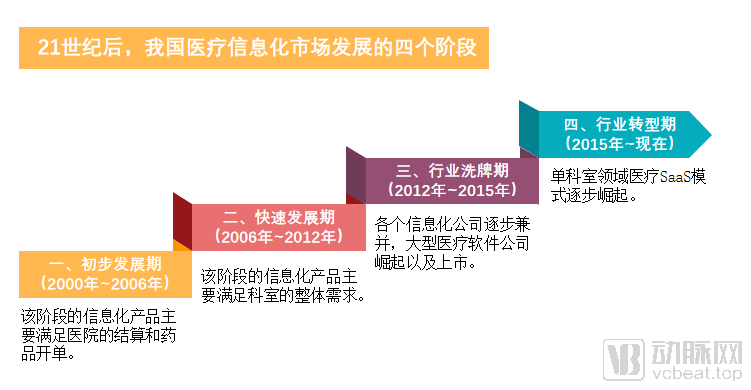
Since the beginning of the 21st century, China’s healthcare informatics market has also experienced rapid development. To date, it has gone through four distinct phases. The first phase, from 2000 to 2006, was a period of initial development, during which informatics products primarily addressed hospital billing and prescription processing. The second phase, from 2006 to 2012, marked a period of rapid growth, with informatics solutions mainly meeting the comprehensive needs of individual clinical departments. The third phase, from 2012 to 2015, was a period of industry consolidation, characterized by gradual mergers and acquisitions among informatics companies, the rise of large-scale medical software firms, and their initial public offerings. The fourth phase, from 2015 to the present, represents a transitional period, during which the medical SaaS model focused on single-department applications has gradually gained prominence.
Why Is Medical SaaS Gaining Increasing Popularity Among Primary-Level and Small-to-Medium-Sized Private Healthcare Institutions? The reason is that, as a standardized information technology product, medical SaaS does not involve custom software development or secondary customization by vendors for users, unlike traditional software. Instead, it deploys application software on the vendor’s servers and delivers online software services via the internet, thereby offering certain advantages in third-party service capabilities and cost optimization.In simple terms, medical SaaS companies can provide bundled solutions for healthcare institutions’ clinical workflows, medical record management, internal operational issues, as well as external marketing, promotion, and patient acquisition, all at a lower cost compared to traditional health IT software.
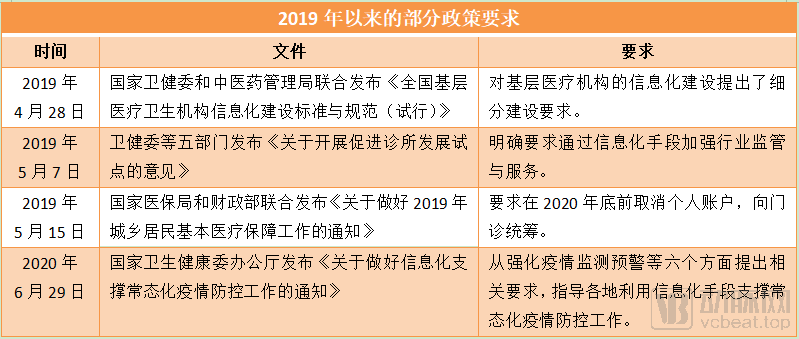
Certainly,In addition to the intrinsic need for upgrading and transformation within medical institutions, informatization is also a policy requirement from multiple departments—including the government, the National Health Commission, the National Medical Products Administration, and the National Healthcare Security Administration—to strengthen medical supervision and services.On May 7, 2019, the National Health Commission and four other departments issued the “Opinions on Launching Pilot Programs to Promote the Development of Clinics,” which explicitly required strengthening industry supervision and services through informatization. On June 29, 2020, the General Office of the National Health Commission released the “Notice on Doing a Good Job in Informatization Support for Regular Epidemic Prevention and Control,” putting forward relevant requirements in six areas, including strengthening epidemic monitoring and early warning, and guiding localities to leverage informatization to support routine epidemic prevention and control efforts. This requirement will inevitably strengthen the development of informatization in medical institutions.
Impacted by the “black swan” event of the COVID-19 pandemic this year, the development of primary-care and private medical institutions has faced challenges. Yet crisis breeds opportunity; as a result, many healthcare organizations have placed information technology (IT) infrastructure on their “urgent agenda,” thereby compressing, to some extent, the originally protracted market cultivation period for healthcare IT.
What are the demands of primary-care and private medical institutions for SaaS? What services are currently offered by medical SaaS providers on the market, and how effective have they been? How does the investment community view medical SaaS solutions? In which direction will future trends evolve? To address these questions, VCBeat has interviewed companies deeply entrenched in the medical SaaS sector, investors with long-standing focus on this field, and key executives from primary-care and private medical institutions, synthesizing their insights to provide a preliminary understanding.
SaaS is an abbreviation for Software-as-a-Service. It engages customers by providing software services rather than selling software products. Customers can pay for services based on duration or usage volume, eliminating the need to incur high costs for purchasing or developing related software.
“As customer acquisition costs have risen in recent years, how to better develop and maintain clients, enhance patient stickiness, and build talent pipelines has become an issue that primary care and private medical institutions must confront,” Wang Shineng, Investment Director at Qingtong Capital, told VCBeat. He noted that medical SaaS can help healthcare institutions address these challenges while improving efficiency and management standards.
In the healthcare sector, SaaS can provide services to medical institutions across three dimensions: internal process optimization, external expansion, and medical technology support., including pre-consultation marketing, consultation, and appointment scheduling; in-consultation treatment tracking and bundled service packages; as well as post-treatment follow-up and patient management. It also encompasses functions such as physician training and financial services.
From the perspective of Wu Zhijia, Founder and CEO of LinkCare, medical SaaS can deliver advantages in three areas.
First, medical SaaS facilitates the integration of online and offline services., patients can conduct online consultations and appointments via digital platforms (such as WeChat, Meituan-Dianping, Ali Health, and SoYoung). This approach not only enhances the patient care experience and improves clinic operational efficiency but also helps alleviate the difficulty of accessing medical services. Anytime, anywhere doctor-patient communication (Patient Engagement, including text, images, and video) can foster mutual trust, improve patient adherence, reduce doctor-patient disputes, and increase patient satisfaction.
Second, medical SaaS facilitates the integration of clinical and management functions, as well as the integration of business and finance.. Traditional hospital HIS systems are modeled around personnel, finances, and materials, rather than being patient-centric or clinically oriented. Consequently, traditional hospitals employ numerous information systems provided by different vendors, leading to information silos between systems, a disconnect between clinical practice and management, and a separation of operational and financial processes. In contrast, next-generation medical SaaS platforms are built on a patient-centric underlying architecture, with electronic medical records (EMR) as the core thread and clinical staff as the primary users, achieving integration of clinical care and management, operations and finance, and online and offline services.
Third, medical SaaS will play an indispensable role in standardizing clinic management, socializing marketing efforts, normalizing diagnosis and treatment protocols, enabling mobile office operations, digitizing storefronts, and data-driven decision-making, thereby facilitating the development of smart clinics within primary healthcare.。
Furthermore, from a cost perspective, most private medical institutions cannot afford to invest heavily in IT infrastructure construction like large hospitals, nor can they sustain ongoing expenditures for subsequent system maintenance. Therefore, compared with traditional, expensive Hospital Information Systems (HIS),More Cost-Effective SaaS Solutions Hold Greater Appeal for Primary Care and Small-to-Medium Private Healthcare Institutions。
What are the key considerations when building a SaaS platform? Xue Chong, founder and CEO of Quanzhentong, told VCBeat,There are four major challenges in building medical SaaS.
First, it features strong professional expertise., in addition to technical personnel, it also requires the involvement of healthcare industry professionals, and will involve specialized knowledge such as health insurance and medical regulations.
Second, the advanced age of users leads to high transition costs.“Medical SaaS is an important tool in the digital transformation of medical institutions. Older physicians are accustomed to traditional handwritten prescriptions and manual ledger-keeping, making it relatively difficult to change their clinical and operational models.”
3. Significant Challenges in Online Sales and Service, the enablement and migration of medical SaaS involve the maintenance of drug and patient information. However, small and medium-sized healthcare institutions often lack dedicated IT staff, making it difficult for them to self-learn and use these systems without adequate tools.
4. High Requirements for Information Security, the healthcare industry requires strict protection of patient privacy. If healthcare institutions entrust SaaS deployment to service providers, it means that medical SaaS enterprises must prioritize data security and work with healthcare institutions to jointly protect patient privacy. “At this point, healthcare institutions need to be cautious: the selected medical SaaS enterprise must be an independent IT company to ensure that medical data is not exploited arbitrarily.”
As an information technology tool,Selecting a medical SaaS solution also requires alignment with your enterprise’s business operations., making the classification of SaaS crucial. Wang Shineng, Investment Director at Qingtong Capital, believes that there are mainly two types:One category is comprehensive healthcare SaaS management service systems, and the other is specialty-specific healthcare SaaS management service systems.。
Comprehensive medical SaaS management service systems need to rely on a large user base to connect related services and must have strong information integration capabilities to improve the management efficiency of medical institutions.Taking the Ping An Wanjia Medical Cloud Clinic System as an example, it helps pharmacy-clinics rapidly align with informatized management through information systems and intelligent devices. The system also enables multi-role, cross-platform interaction, offering user-friendly access anytime and anywhere across multiple terminals, including computers, mobile apps, iPads, WeChat, and all-in-one machines. By integrating all resources and services required for pharmacy-clinic operations, the platform assists these facilities in achieving lean operations and improving operational efficiency.
ForSpecialized medical SaaS management service systems need to delve into more granular niches, providing precise and targeted services based on industry pain points.. Li Jingwei, founder of Zizai Rehabilitation, told VCBeat that the rehabilitation sector places significant emphasis on connectivity in home-based rehabilitation, specifically whether SaaS platforms possess the functionality to manage clients’ home rehabilitation training. “We need to know whether clients are performing their rehabilitation exercises at home, how they are performing them, and whether their techniques are standardized. Only with this information can we provide clients with the highest quality experience and outcomes.”
After completing the classification and clarifying their own positioning, how can one identify high-quality SaaS service providers? Zu Kai, Founder and CEO of Kangbojia, believes that this should primarily be considered from four aspects.
First, whether the SaaS service provider has a formal service department and service processes, thereby enabling rapid and effective responses to customer inquiries.Second, whether regular follow-ups and feedback collection are conducted with customers., proactively remind customers of key points for system usage based on their usage patterns, and provide timely alerts according to how they are using the service. “When customers are unable to use the product effectively or are not leveraging it to its full potential, SaaS providers have a responsibility to guide them on how to maximize its efficacy.”
3. Whether there is a Customer Success DepartmentUnlike typical departments, the Customer Success Department has a clear mandate: to help clients achieve growth and enhance their management capabilities. “For instance, we (Kangbojia) not only guide clients on system usage from an operational maintenance perspective but also share our practical experience based on their specific business characteristics, helping them leverage the system to improve their operational and management capabilities.”Fourth, the system needs to continuously iterate based on customer needs and industry development., “Only by continuously responding to demands can value be realized.”
For healthcare institutions, different enterprises have varying demands for medical SaaS. In response to these diverse needs, a number of medical SaaS service providers have emerged in the market in recent years.
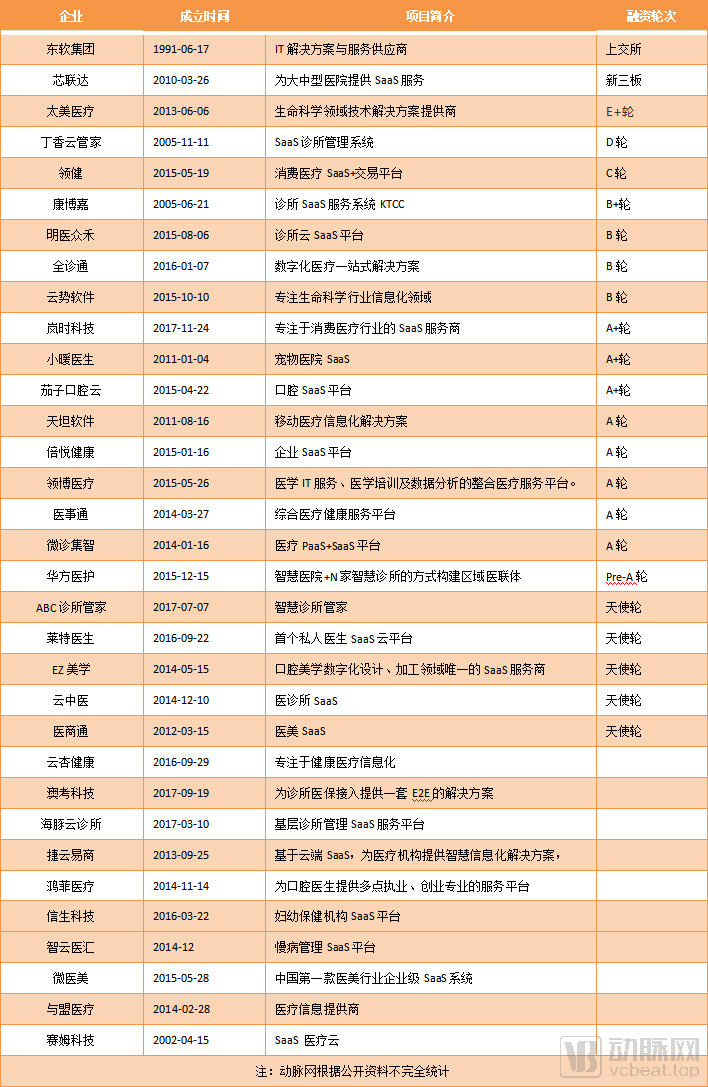
Unlike traditional medical SaaS providers that offer relatively standardized system solutions, modern healthcare institutions have put forward more refined demands for informatization construction due to the continuous evolution of business models, which has also madeMedical SaaS companies are deepening their focus on more specialized niches and delivering more customized services for specific audiences.. Below is a brief list of several innovative medical SaaS companies, offering a glimpse into the industry’s potential development directions.
Kangbojia
Kangbojia’s primary customer base consists of mid-to-high-end chain medical institutions. These clients typically have international-level demands for financial management, supply chain management, and human resources management, necessitating a more enterprise-oriented Hospital Resource Planning (HRP) system to standardize their operations.
To address these needs, Kangbojia has developed a “Three Cores and One Cloud” product ecosystem, comprising three core products—KTHIS, KTHRP, and KTHCRM—alongside the KTCC Clinic SaaS Service System. As a next-generation SaaS platform, KTCC distills best practices from successful healthcare institutions both domestically and internationally, integrating outpatient medical records, patient services, customer relationship management, marketing campaigns, and inventory management. It provides end-to-end closed-loop management covering pre-consultation communication, in-consultation services, and post-consultation follow-up. By seamlessly connecting with third-party mobile traffic channels such as WeChat, Alipay, and Meituan, KTCC essentially fulfills all IT requirements for clinic operations through “a single network cable,” thereby helping healthcare institutions enhance operational management and drive greater revenue.
LinkedCare
LinkCare’s primary customer base consists of consumer healthcare institutions, such as dental and medical aesthetics clinics. Core needs in this sector include clinical informatization, chain management, multi-site practice, and mobile office solutions. As consumer healthcare involves mid-to-low frequency purchases, its logic differs from the internet-driven model of user acquisition, retention, and conversion; instead, it places greater emphasis on user acquisition, conversion, and retention.
With the rise of decentralization trends and social marketing, LinkDoctor has developed a Social CRM (SCRM) cloud solution tailored for dental and medical aesthetics practices. In addition to integrating with broad-traffic platforms such as Meituan, Dianping, Alipay/AliHealth, and Tencent WeSure, it also connects with vertical industry platforms like SoYoung. This helps clinics acquire new customers, drive conversion and retention through social marketing via WeChat and WeCom, and leverage referral programs. Furthermore, given the high customer acquisition costs in consumer healthcare, there is a strong demand for customer profiling, precision marketing, and unlocking data value, creating a rigid need for Business Intelligence (BI) solutions.
To address these challenges, LinkedCare has developed the LinkedCare Dental Cloud Integrated System and the LinkedCare Medical Aesthetics Cloud Integrated System, both delivered as SaaS solutions. These platforms encompass electronic medical records (EMR), outpatient management, multi-site chain management, channel management, inpatient management, ambulatory surgery center (ASC) management, clinical decision support systems (CDSS), pharmacy and inventory management, customer relationship management (CRM), LinkedCare Marketing Cloud SCRM, LinkedCare YouShu BI, mobile office apps, and cloud-based customer service. This comprehensive suite enables clinics to achieve integration across online and offline operations, clinical and administrative workflows, and business and financial functions.
Mingyi Zhonghe
Mingyi Zhonghe’s primary customer base consists of grassroots medical institutions. Their core needs include accessing accurate knowledge via the internet, enhancing professional skills, identifying precise and distinctive collaborative projects, developing specialized departments with unique features, and expanding promotional channels.
In response to the aforementioned challenges, Mingyi Zhonghe has made sustained investments over many years and established an integrated information system for primary healthcare institutions. This system encompasses Hospital Information Systems (HIS), Laboratory Information Systems (LIS), Enterprise Resource Planning (ERP), Customer Relationship Management (CRM), unified medical insurance settlement, and public health services, thereby helping clinics enhance their operational and management efficiency. Empowering primary care through informatization improves efficiency, pharmaceutical empowerment reduces costs, and clinical empowerment increases revenue for grassroots institutions. With the advancement of AI technologies in internet healthcare, primary healthcare institutions need to leverage new technologies, environments, and facilities, while adopting innovative marketing strategies and business models. These efforts aim to further elevate the standard of medical care, expand integrated service capabilities encompassing medical treatment, rehabilitation, elderly care, and nursing, and build “New Clinics.”
QuanZhentong
QuanZhentong’s primary customer base consists of small and medium-sized medical institutions. Although micro-sized medical institutions are small in scale, they possess all essential functions. They require comprehensive capabilities spanning patient appointment scheduling, prescription issuance, treatment delivery, follow-up management, medication dispensing, billing, and inventory control (including procurement, sales, and stock management). Once a medical institution adopts one feature, it necessitates the fulfillment of its entire suite of functional requirements.
To address the aforementioned challenges, QuanZhentong delivers end-to-end services through its comprehensive functional framework. By integrating medical and informatics technologies, it has built a digital clinic workflow platform that enables physicians to continuously and dynamically manage every health indicator of their patients. In terms of intelligent clinical decision support, an AI-assisted decision-making module has been embedded into the outpatient system to provide clinicians with diagnostic support and medication guidance. Currently, QuanZhentong incorporates rational drug-use rules for 120,000 medications and offers auxiliary diagnosis and treatment support for over 30,000 diseases, meeting the daily clinical needs of clinic physicians and making the diagnostic and therapeutic process safer and more precise.
Lanshi Technology
Lanshi Technology’s primary customer base consists of consumer healthcare institutions. The consumer healthcare sector faces key pain points, including a scarcity of direct-to-consumer (C-end) traffic, high customer acquisition costs driven by advertising-dominated strategies, and insufficient levels of data-driven and standardized operations. Coupled with information asymmetry, these factors leave end consumers unable to effectively differentiate among healthcare providers and lacking trust in them.
To address these challenges, Lanshi Technology has adopted a dual approach focusing on internal management and external marketing, providing consumer healthcare institutions with comprehensive, one-stop solutions for intelligent operations and smart marketing. These solutions encompass big data computing, customer relationship management, and management consulting. First, the company enhances data-driven capabilities to improve management efficiency and operational performance. Second, it shifts away from advertising-dominated customer acquisition strategies, instead leveraging content creation and community management to attract clients, thereby strengthening patient-provider engagement and satisfaction.
Can medical SaaS “cure all ills” and comprehensively address enterprises’ informatization challenges? Clearly not. So, what is the core logic behind building medical SaaS solutions?
“If companies merely purchase and install two software programs, this does not solve any problems,” said Jiang Xiaodong, Managing Partner of Changling Capital.The development of information systems must drive tangible improvements in a company’s core business operations; only then can the resulting financial strength be leveraged to further advance digital transformation, as the two are mutually reinforcing..” For example, Gushengtang, the leading enterprise in the chain of traditional Chinese medicine outpatient clinics, has consistently invested in informatization during the five years following Changling Capital’s exclusive Series A investment, with expenditures exceeding RMB 50 million.
However, for many grassroots and small- to medium-sized private medical institutions, the adoption of medical SaaS solutions has been relatively sluggish due to their small scale and limited financial resources. This challenge is often difficult to overcome: in the early stages of development, these institutions need to implement medical SaaS systems to improve operational efficiency, yet they lack the funds to purchase more advanced systems or hire high-quality technical operations and maintenance personnel.
“Our advice to all portfolio companies is that they mustFrom day one of our founding, we have embraced a mindset centered on informatization and internet integration.“This has little to do with how much you spend building a SaaS system. For primary-care and small- to medium-sized private medical institutions, informatization is a very important means to promote business development, but it is only a means,” said Jiang Xiaodong, Managing Partner at Changling Capital.The Construction of Medical SaaS Is Essentially a Matter of Mindset. Whether from the perspective of business models, clinical diagnosis and treatment and service processes, or the management of healthcare institutions and efficiency improvements, its logicLogic entails transforming ideas into a concrete, quantifiable, decomposable, and manageable process, with SaaS being merely one specific manifestation of such a process.。
Specifically,Internet-oriented thinking refers to approaching problems from a customer-centric perspective., all services and products must be designed around customer needs."Informatization thinking is the thinking of efficiency and input-output ratio.", therefore, in terms of IT investment, decisions on when to spend, how much to spend, and what to spend on must all leverage optimal strategies to achieve the highest return.
Similarly, in the view of Huang Sen, founder of Haoyunbang, the value of SaaS can be understood as the value of the Internet. It brings benefits at three levels,First, it signifies the enterprise’s capability to build a “strong headquarters”; second, it indicates the enterprise’s ability to rapidly replicate its model; and third, it enables data accumulation from the outset, thereby creating value for subsequent data mining.。
Therefore, SaaS is no longer just an isolated information system; it needs to continuously align with the enterprise’s business operations:The continuous improvement of SaaS systems is the process by which corporate business processes become increasingly standardized.
Although the COVID-19 pandemic has posed certain challenges to primary care institutions and small- and medium-sized private medical facilities, driven by the organic forces of marketization as well as the continuous advancement of government policies—such as tiered diagnosis and treatment systems and support for the development of primary care and private medical institutions—these entities will continue to navigate forward and thrive. Underpinning this resilience is an ongoing process of adaptation, evolution, and iteration in the alignment between healthcare informatics and the operational needs of primary care and private medical institutions.
Riding the Wind: Regarding Future Trends in Medical SaaS, Wang Shineng, Investment Director at Qingtong Capital, Highlights Two Key Areas to Watch.
First, at the data level, future patient data will not be limited to digitizing single online process functions. Instead, while ensuring data privacy and security, it will fully integrate online and offline channels to achieve comprehensive digital records across the pre-diagnosis, intra-diagnosis, and post-diagnosis stages.Optimize the design of optimal treatment plans using data to better match patients with healthcare resources.
Secondly, at the service level. Under policies such as physicians’ independent practice and encouragement of private healthcare provision, more diagnostic and treatment institutions catering to personalized service needs—similar to those in developed countries—will gradually emerge.. With the development of mobile healthcare, driven by mobile internet, smart terminal devices, and wearable technology, there remains significant potential to enhance medical services across various scenarios and achieve effective health management.
Therefore, for primary-level and private medical institutions, it is essential toEstablish a data-driven mindset from the early stages of entrepreneurship, and actively embrace new technologies and innovative business models.“Healthcare institutions need to broaden their horizons and embrace change, particularly in how they budget for investments in infrastructure and software costs,”We cannot rely solely on infrastructure investment or adopt a "build-it-all-at-once" investment approach.“, unless there is strong operational and maintenance capability, the lifecycle will be shortened and even gradually decline.” said Xue Chong, Founder and CEO of Quanzhentong.The Advantage of SaaS Lies in Its Ability to Continuously Self-Improve, as long as the company operates healthily, it will “flourish” and continue to improve.
“For medical SaaS providers, Jiang Xiaodong, Managing Partner at Changling Capital, advises that in addition to enhancing technical expertise, they must clearly recognize the unique characteristics of primary-care and private medical institutions. They should embrace a mindset of growing and thriving alongside these enterprises and the industry as a whole, rather than merely installing SaaS systems for clients. It is the follow-up services that deliver the greatest value.”As the grassroots and private healthcare sectors continue to grow, I believe everyone will be a beneficiary.”
Special Thanks:
Jiang Xiaodong, Managing Partner at Changling Capital
Wang Shineng, Investment Director at Qingtong Capital
Wu Zhijia, Founder and CEO of LinkCare
Zu Kai, Founder and CEO of Kangbojia
Xue Chong, Founder and CEO of Quanzhentong
Jiang Qiang, Founder and Chairman of Mingyi Zhonghe
Wu Dani, Co-founder of Lanshi Technology
From the Founder, Li Jingwei
Hao Yun Bang Founder Huang Sen
(The above list is in no particular order.)