

Activ Surgical Files for IPO Following $15M Funding Round to Advance Real-Time Surgical Visualization Platform

Activ Surgical
Surgical Software Platform Developer
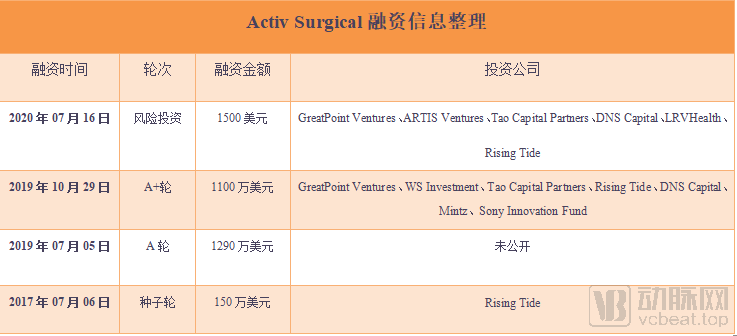
Activ Surgical Completes New $15 Million Funding RoundRecently, VCBeat learned that Activ Surgical has completed a new round of financing amounting to $15 million. The round was led by Artis Ventures, with participation from LRVHealth and existing investors DNS Capital, GreatPoint Ventures (GPV), Tao Capital Partners, and Rising Tide VC. The proceeds will be used to continue the development and refinement of the company’s products.
As a digital surgery company, Activ Surgical secured $35 million in funding across four rounds within just three years of its founding. Why has it attracted such strong investor interest? Amid the proliferation of surgical robotic products in the 21st century, what sets it apart? VCBeat provides an in-depth analysis.
Activ Surgical, founded in 2017, is dedicated to enhancing the efficiency and accuracy of endoscopic and robot-assisted surgeries. The company’s patented surgical software technology platform leverages computer vision and machine learning to assist surgeons in intraoperative decision-making, thereby reducing preventable surgical errors.
The founder has been deeply engaged in the field of surgical medicine for decades.
Peter Kim is the co-founder of Activ Surgical and eKare. Dr. Kim is an internationally renowned pediatrician and scientist. He serves as the director of the National Capital Consortium for Pediatric Device Innovation (NCC-PDI), a consortium funded by the U.S. Food and Drug Administration (FDA).
During his academic training, Dr. Kim received his medical education at McGill University, where he earned a Master’s degree in Medicine and Surgery. He completed his surgical residency at the University of Toronto and pursued a fellowship in pediatric surgery at the university’s Hospital for Sick Children.
Dr. Kim has extensive experience in surgical practice. From 1996 to 2011, he served as a surgeon at Mount Sinai Hospital and The Hospital for Sick Children. Between 2006 and 2011, he also worked as a surgeon at North York General Hospital. For the following seven years, Dr. Kim held the position of Vice Chair at the Sheikh Zayed Institute for Pediatric Surgical Innovation. He previously served as the Senior Associate Chief of Surgery at the Center for Surgical Care of Children’s National Hospital and was a Professor of Surgery at George Washington University.

Dr. Kim, Founder of Activ Surgical
Development of Assistive Surgical Products Based on Machine Learning (ML)
ActivEdge serves as the foundation for Activ Surgical’s surgical intelligence software and other technologies. Powered by machine learning, ActivEdge provides surgeons with critical real-time guidance. The platform based on ActivEdge and its related products will initially be launched in the United States, with plans to achieve global commercialization in 2021.
Each year, preventable medical errors cause 400,000 deaths in the United States, making them the third leading cause of death after heart disease and cancer. In addition to the loss of life, these medical errors carry a high financial burden, costing U.S. healthcare institutions approximately $36 billion. Activ Surgical develops software aimed at helping surgeons reduce the occurrence of medical errors.
Activ Surgical is dedicated to integrating its technology into the most common laparoscopic procedures, including cholecystectomy, colectomy, hysterectomy, and gastrectomy. The instruments used in these surgeries have high requirements for the identification of blood flow and critical structures.

Currently, the most widely used surgical imaging technology, ICG, relies on a fluorescent dye invented over 70 years ago. When surgeons need this fluorescent dye to identify patient tissues during operations, it fails to provide them with real-time, objective physiological information. In response to the demands of surgical procedures for instrumentation, Activ Surgical has developed an imaging module called ActivSight. ActivSight can seamlessly connect to laparoscopic and arthroscopic systems and integrate real-time, on-demand analytics into standard displays, thereby improving surgical outcomes.
Activ Surgical, Inc.’s hardware-based technology is compatible with existing visualization systems, providing real-time data and enabling visualization of the surgical environment without the need for contrast agents. The technology has not yet received FDA approval but is currently undergoing pilot testing with eight hospital networks in the United States.
In addition to its hardware products, Activ Surgical is developing a software tool called ActivInsight. ActivInsight can transform the vast amounts of data collected during surgery to help physicians identify tissues and critical structures, enhancing surgeons’ visualization and providing real-time guidance.
ActivPilot continuously learns during the surgeon’s use of the program, records optimal procedural workflows, and assists the physician in performing subsequent surgeries based on this accumulated experience.
Future Development Trends
Currently, both surgical robots and robot-assisted surgical systems are designed to enhance surgical precision and reduce error rates, but they have not yet achieved haptic feedback.
Surgeons perform procedures indirectly via a console when using surgical robots; however, this process requires continuous practice to enhance surgical precision. Currently, surgical robots are unable to predict the extent of the surgeon’s next maneuver.
Two Potential Future Trends:
The first aspect is interaction, which emphasizes bidirectional human-machine engagement. This involves achieving mutual feedback through haptic technology to enhance the sense of presence and realism. By leveraging multimodal interaction, 3D sensing, and other technical approaches, recognition accuracy can be improved. Furthermore, integrating these technologies with Augmented Reality (AR) enables more effective identification of objects and environments, thereby allowing robots to execute more precise actions and responses.
The second is cognition, entirely based on an AR perspective. Cognitive algorithms will enable robots to work alongside surgeons and predict their actions. During interactions, high-resolution sensors will provide visual feedback during surgery and enhance precision.
Furthermore, current surgical robots lack sufficient intelligence; they merely execute commands to perform the next step and are not yet capable of predicting the surgeon’s subsequent actions. The skeletal robot developed by the University of Electronic Science and Technology of China enables paralyzed patients to stand. It operates on the principle of using the patient’s electroencephalogram (EEG) signals to issue commands to the robot, allowing the system to learn and recognize the patient’s specific EEG patterns through continuous training.
This provides a predictive direction; perhaps such an approach can be applied to surgical procedures, enabling the prediction of the surgeon’s next steps and even the anticipation of subsequent outcomes, while issuing alerts when issues arise.
Currently, medical robotics has become a focal point of attention. In the future, increasingly intelligent machines will provide greater assistance in healthcare delivery. It is foreseeable that there will be more surgical robots, with both assistive and rehabilitation-oriented systems becoming more convenient and intelligent. For instance, building on current minimally invasive surgical techniques, many future procedures are likely to be performed minimally invasively, enabling patients to recover more rapidly from surgery.