

Caption Health Secures $53M Series B Funding to Advance FDA-Approved AI-Guided Cardiac Ultrasound Platform for Non-Specialists

Caption Health
AI Diagnosis and Treatment Software and Device Developer
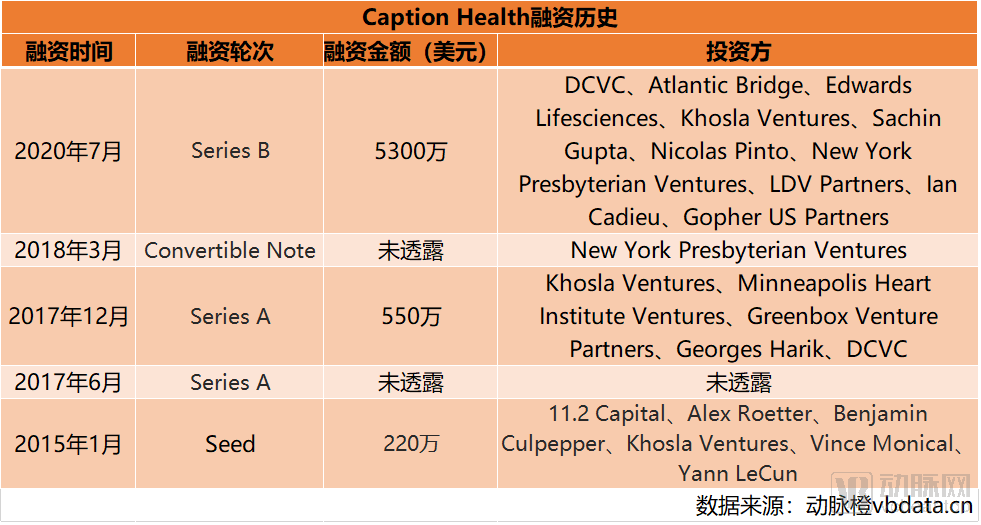
Recently, VCBeat learned that Caption Health, a medical innovation device company, announced the completion of a $53 million Series B financing round. The round was led by DCVC, with participation from Atlantic Bridge, Edwards Lifesciences, Khosla Ventures, and other investors. The funds will primarily be used to develop and commercialize its FDA-approved AI ultrasound technology, expand the company’s business model, and establish new partnerships.
Traditional ultrasound imaging analysis requires high-level professional expertise.
According to data from the U.S. Centers for Disease Control and Prevention, approximately 647,000 people die from heart disease annually in the United States. The detection and treatment of heart disease are urgently needed.
Echocardiography is a preferred non-invasive technique that utilizes the unique physical properties of ultrasound to examine the anatomical and functional status of the heart and great vessels. As the most commonly used cardiac diagnostic method in clinical practice, it serves as a routine examination primarily for identifying organic heart diseases by visualizing cardiac and vascular structures and motion, as well as measuring blood flow velocity.
Echocardiography can display the tomographic structures and spatial relationships of the heart and great vessels from various perspectives in both two-dimensional and three-dimensional views. It also displays on the monitor the curves representing the temporal relationships of the motion of each structure, which are recorded using a recorder.
Ultrasound is a safe, non-invasive, and powerful diagnostic tool that has demonstrated its benefits in detecting patient conditions across various clinical settings. However, performing ultrasound imaging and examinations requires a high level of professional expertise from physicians. Even general practitioners need specialized training in image acquisition and analysis to master these skills, which raises the barrier to entry for echocardiography to some extent.
On the other hand, physicians’ expertise also affects diagnostic outcomes, as visual analysis of images by the naked eye is inherently limited. Therefore, the introduction of artificial intelligence technologies can significantly enhance hospitals’ capabilities in disease diagnosis.
Pioneering New Technologies in Cardiac Ultrasound Imaging with AI
Caption Health, founded in 2013 and formerly known as Bay Labs, was co-founded by Charles Cadieu and Kilian Koepsell. The company primarily leverages AI technology to assist in the acquisition of echocardiographic images. It has been recognized by NVIDIA as one of the most promising AI startups and was listed among the Top 10 Most Innovative Deep Learning Solution Providers of 2018 by Analytics Insights.
Charles Cadieu currently serves as the CEO of Caption Health. A deep learning expert with affiliations to the Massachusetts Institute of Technology (MIT) and the University of California, Berkeley, he was a founding member of IQ Engines (now acquired by Yahoo) prior to establishing Caption Health. Leveraging his expertise in engineering, computer science, and neuroscience, he leads his team in product development, integrating deep learning into the healthcare sector.
Kilian Koepsell is the CTO of Caption Health. He previously developed computational models of visual processing in biological and artificial neural networks at the University of California, Berkeley. Like Charles Cadieu, Kilian Koepsell was also a founding team member of IQ Engines.
Caption Health acquires large volumes of data for algorithm training through agreements with experts and medical institutions. Meanwhile, its development team leverages deep neural networks to enable rapid algorithm iteration, laying the technical foundation for product development. Ultimately, the developed products are delivered to various healthcare institutions and medical professionals.
AI Technology Enables Non-Specialists to Perform Ultrasound Imaging
Caption Guidance is a compatible ultrasound imaging software. On February 7 this year, Caption Health announced that Caption Guidance had received FDA approval via the De Novo pathway, becoming the first AI-assisted cardiac ultrasound acquisition system to gain FDA clearance. The system leverages AI to help healthcare professionals capture diagnostically quality cardiac images of patients.
Robert Och, Deputy Director of the FDA’s Center for Devices and Radiological Health, stated, “Our clearance of Caption Guidance enables healthcare providers who are not ultrasound specialists, such as registered nurses in primary care clinics, to use the system for patient assessment. This is particularly significant because Caption Guidance demonstrates the potential of artificial intelligence and machine learning technologies to help clinicians obtain safer and more effective cardiac diagnostic images, thereby saving patients’ lives.”
This software is suitable for analyzing echocardiographic examinations or two-dimensional transthoracic echocardiography (2D-TTE) in adult patients. It enables the acquisition of standard cardiac views from multiple angles, which can assist in the diagnosis of various heart diseases.
Caption Guidance leverages machine learning algorithms to perform quality control by distinguishing between acceptable and unacceptable image quality, thereby creating an interactive artificial intelligence interface. It also provides real-time feedback on potential image quality, automatically capturing and saving high-quality views.
During its review of Caption Guidance, the FDA evaluated two sets of experimental data related to Caption Guidance to assess its performance.
This trial enrolled 50 experienced ultrasound physicians and 8 registered nurses without expertise in ultrasonography. All participants were required to perform ultrasound examinations on 240 patients and acquire standard echocardiographic images. The ultrasound physicians used conventional methods for examination and image acquisition, while the nurses utilized Caption Guidance to complete the trial.
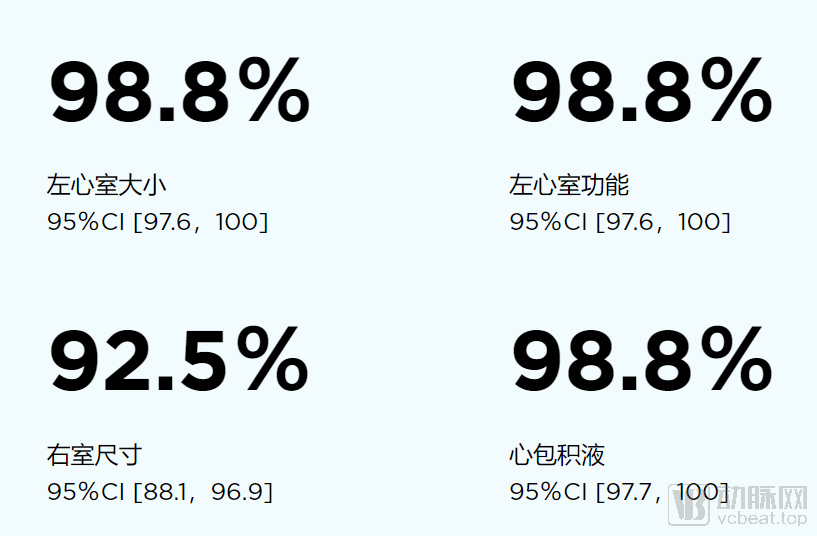
Subsequently, five cardiologists evaluated the image acquisition results obtained by physicians and nurses in the field of ultrasound. The primary evaluation criteria included left ventricular size, left ventricular function, right ventricular size, and pericardial effusion. The results indicated that sonographers were able to acquire valid, high-quality diagnostic images regardless of whether Caption Guidance was used; however, Caption Guidance helped non-ultrasound specialists obtain images of formal diagnostic-grade quality.
Currently, Caption Guidance is planned for deployment in the Emergency Department, Anesthesia Room, and Intensive Care Unit, with subsequent expansion to other departments.
Caption Guidance + Intelligent Translation + Quality Assessment = Caption AI
On March 3, 2020, Caption Health announced the official market launch of its flagship product, Caption AI, which is now available for order by various healthcare providers. The product primarily comprises three modules: image acquisition guidance, intelligent translation, and automated quality assessment. Notably, the image acquisition guidance module was developed through the integration of the Caption Guidance software.
Caption AI is a transformative new ultrasound technology. Like Caption Guidance, traditional ultrasound examinations rely on trained sonographers to identify anatomical structures, whereas Caption AI assists sonographers and other healthcare practitioners without specialized ultrasound expertise in performing rapid and accurate image analysis through automated quality assessment and intelligent interpretation.
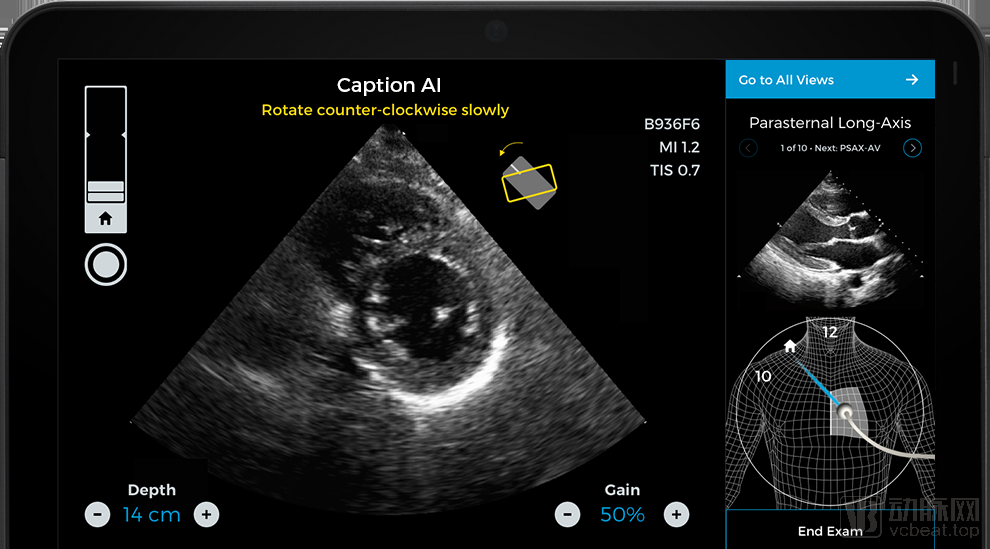
With each use, Caption AI provides users with a probe position map to indicate the correct placement of the probe. During image acquisition, Caption AI mimics professional sonographers by offering 90 types of adaptive instructions and real-time feedback, prompting users to adjust the scanning area to capture and optimize higher-quality images.
An image quality indicator bar is displayed in the upper-left corner of the monitor, allowing users to monitor in real time the disparity between the acquired image and the optimal diagnostic image. As the captured image approaches optimal diagnostic quality, the indicator bar changes color from white to green, and the image is automatically saved, ensuring that high-quality images are not missed.
After the images are saved, users can filter for the desired images by selecting specific ultrasound examination content, thereby improving workflow efficiency and flexibility.
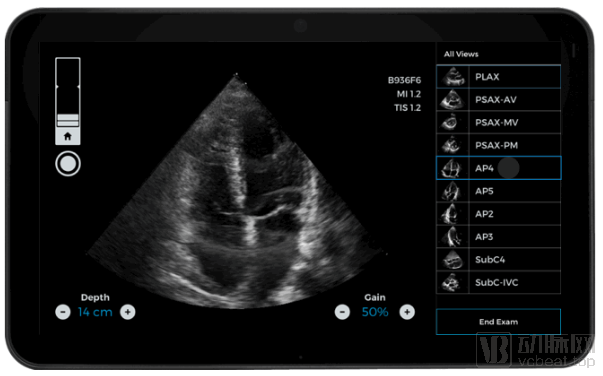
Caption AI also features a particularly important intelligent “translation” function. Here, “translation” does not refer to conversion between languages, but rather to the transformation of information. After image acquisition is completed, Caption AI uses this translation function to automatically scan the content within the images, collect image data, and assign quality scores. It then selects the highest-quality images to calculate the patient’s ejection fraction (EF).
Ejection fraction (EF) is a reliable indicator of left ventricular systolic function, characterized by high accuracy, good reproducibility, and widespread clinical application. In calculating EF, Caption AI typically relies on information from three types of images: apical four-chamber (AP4), apical two-chamber (AP2), and parasternal long-axis (PLAX). In traditional EF calculations, many physicians do not incorporate PLAX image data.
Caption AI currently works with the Terason 3200T comprehensive service ultrasound system to perform ultrasound examinations, supporting a variety of clinical ultrasound scanning services including lung, vascular, and abdominal scans. After purchasing Caption AI, users can promptly receive updates and upgrade information regarding Caption AI.
China’s Large Ultrasound Patient Base Signals Huge Market Potential for AI Ultrasound
Recently, several AI-powered cardiac products have sequentially received FDA approval, such as the atrial fibrillation and heart murmur detection algorithm from medical AI company Eko. This algorithm can be used in conjunction with Eko’s digital stethoscope to screen for serious cardiac conditions.
At the 2019 Radiological Society of North America (RSNA) annual meeting, DiA Imaging Analysis announced the launch of LVivo, an AI-powered diagnostic software for automated analysis of cardiac ultrasound images, which enables rapid and accurate assessment of echocardiograms.
In China, the AI ultrasound sector is less crowded than the AI+CT field, and it has received far less attention than AI-enhanced CT imaging. However, with approximately 2 billion ultrasound examinations performed annually in China—significantly exceeding the 200 million CT scans—the AI ultrasound sector faces substantial opportunities.
In terms of population coverage, AI ultrasound holds greater market potential. Regarding product forms, unlike the AI+CT sector, which is experiencing product homogenization, AI ultrasound can empower both high-end ultrasound systems and handheld devices, offering a diverse range of product formats.
Taking Deshang Yunxing as an example, the company specializes in ultrasound-based artificial intelligence (AI), applying AI technology to preoperative planning, intraoperative navigation, and postoperative assessment for tumor interventional surgeries. Its AI-assisted diagnostic product for breast cancer leverages ultrasound and X-ray imaging modalities, augmented by AI technologies. The product’s development process involved the cleaning and organization of massive datasets. Senior breast specialists personally annotated and extracted breast imaging features in strict accordance with the international ACR (American College of Radiology) standards, performing repeated validations to ensure high accuracy.
Although the development of ultrasound AI still faces certain challenges, such as the lack of large-scale data for training, major companies remain enthusiastic about this field. Tencent, Samsung, and Mindray, among others, have all made strategic investments in ultrasound AI.
When we discuss the future of healthcare, we often envision scenes from science fiction films: high-tech aesthetics, intelligence, and precision—all underpinned by artificial intelligence (AI). Perhaps one day, AI will permeate the entire healthcare sector; however, there is still a long road ahead before that vision becomes reality.