

Global Stem Cell Market Transformation Amid the Pandemic: Opportunities, Growth, and Clinical Advancements
In 2020, the COVID-19 pandemic impacted many industries; however, its effects were multifaceted. While it led to a decline in demand for some sectors, it also spurred stable or even accelerated growth in others, creating encouraging market expansion opportunities. For instance, the healthcare industry experienced a high growth rate during the pandemic.
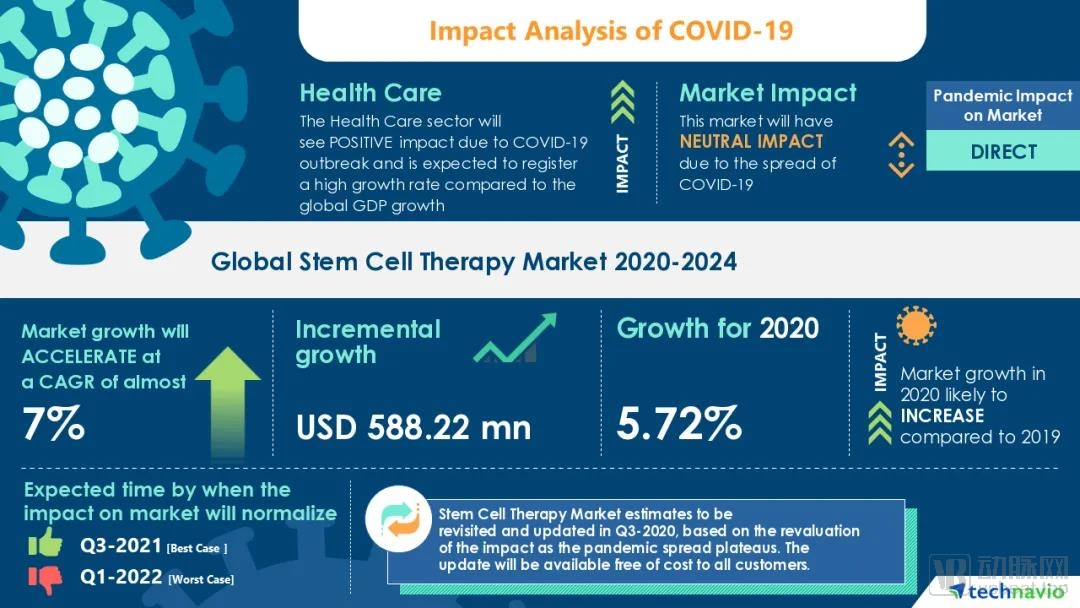
Stem cell therapy, considered to usher in a new wave of medical revolution, has demonstrated broader application prospects during the pandemic, with multiple countries successively launching clinical projects. The impact of the pandemic has brought new development opportunities to the global stem cell market. According to a report released by the well-known global research firm Technavio,The global stem cell therapy market is expected to grow by approximately $580 million between 2020 and 2024, with a projected compound annual growth rate (CAGR) of 7%.[1]。
The report points out that an important factor driving the growth of the global stem cell therapy market is the increasing awareness of stem cell therapy among people.
As the demand for personalized medicine in modern healthcare continues to rise, an increasing number of people are storing stem cells for future therapeutic use. According to an analysis by the international research firm MRFP [2], the global stem cell storage market is projected to grow at a compound annual growth rate (CAGR) of 9.8% from 2019 to 2025, exceeding USD 12 billion by 2025.
According to MRFP data, the global stem cell storage market can be segmented by cell type into neonatal stem cells (umbilical cord blood, umbilical cord, and placenta), adult stem cells, and embryonic stem cells. Based on MRFP’s analysis, umbilical cord stem cells are projected to maintain the largest market share during the forecast period.
This aligns with the findings of a market research report released in 2018 by Markets and Markets, the world’s second-largest market research consulting firm: within the global stem cell storage market, the placental stem cell segment is projected to exhibit the fastest growth. This trend is primarily driven by the year-over-year increase in the number of placenta and umbilical cord units stored globally, as well as the rapidly growing public awareness of the therapeutic potential of stem cells.
Thus, it is evident that neonatal stem cell storage has become the mainstream in the stem cell storage market.
According to Technavio data [1], the global stem cell therapy market was valued at USD 1.58 billion in 2019 and is projected to reach USD 2.16 billion by 2024. The industry insights section of the Stem Cell Market Size Analysis Report (2019–2025), published by the U.S. market research firm Grand View Research, presents the following data: between 2005 and 2013, the number of diseases treatable with stem cells increased by 300%. With the aid of stem cell technology, the number of treatable diseases is expected to continue rising in the future.
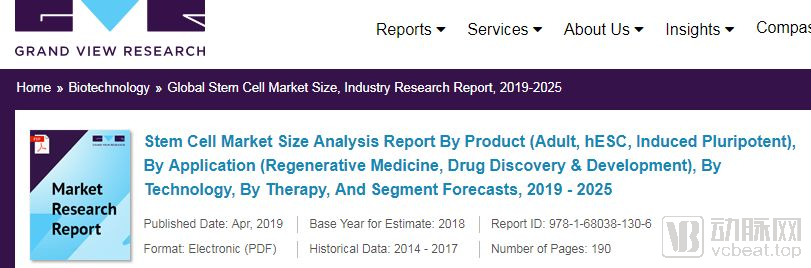

https://www.grandviewresearch.com/industry-analysis/stem-cells-market
From the perspective of downstream clinical applications, the global stem cell therapy market can be categorized by disease type into thalassemia, cerebral palsy, diabetes, leukemia, autism, and others.Due to the increasing global burden of diabetes,This application area is likely the fastest-growing segment of the stem cell therapy market, thereby driving up demand for stem cell therapies.[2]. According to statistical data released by the International Diabetes Federation, nearly 425 million adults worldwide had diabetes in 2017, and this number is projected to rise to 629 million by 2025.
In recent years, the capital markets have shown strong interest in stem cell therapy for diabetes. In 2019, Vertex Pharmaceuticals acquired a company developing stem cell therapies for diabetes for $950 million. In 2018, ViaCyte, a regenerative medicine company based in San Diego, USA, secured over $100 million in financing. In 2017, Semma Therapeutics, an emerging U.S. biotechnology firm, raised $114 million to develop stem cell therapies for type 1 diabetes.
Currently, companies worldwide engaged in the research and development of stem cell therapies for diabetes include Athersys, Mesoblast, Caladrius Biosciences, ViaCyte, Sernova, Eli Lilly, Sanofi, and Novo Nordisk. Multiple products have already entered clinical trials, moving increasingly closer to market approval.
Thus, it is evident that the downstream market for stem cell therapy will usher in greater opportunities in the future.
The global stem cell market encompasses upstream and midstream stem cell storage and preparation, as well as downstream clinical applications. According to a report by Transparency Market Research, by the end of 2025,The global stem cell market is projected to reach $270.5 billion, with a compound annual growth rate (CAGR) of 13.8% expected over the past eight years.[3]。
The report estimates that the significant increase in the clinical application of stem cells, coupled with the emergence of new therapies for chronic diseases, will drive the growth of the global stem cell market in the coming years. Additionally, factors propelling the expansion of the global stem cell market include rising investments by biopharmaceutical and pharmaceutical companies in stem cell research projects, rapid advancements in infrastructure required for stem cell storage and processing, growing public awareness of stem cell-based disease treatments, and favorable government regulations regarding stem cells.
Stem cells are considered to create new opportunities for pharmaceutical companies. As seen in the field of diabetes, pharmaceutical giants such as Eli Lilly, Novo Nordisk, and Sanofi, along with startups, are increasingly shifting their focus to stem cell research. Beyond developing new stem cell-based therapies, pharmaceutical companies can also leverage stem cell technology to identify drug candidates, thereby accelerating the development of novel drugs. For instance, induced pluripotent stem cells (iPSCs) can be used to generate organoids—three-dimensional human tissue models—that serve as disease models for researching and developing targeted therapies.
In 2020, stem cell therapy for COVID-19 achieved phased success, demonstrating the vast potential of stem cell therapies in downstream applications. At the end of February this year, a preprint published on ChinaXiv, the Chinese Academy of Sciences’ platform for pre-release scientific papers, reported clinical outcomes of intravenous infusion of mesenchymal stem cells (MSCs) in critically ill COVID-19 patients. Nine days after the first infusion, the patient was transferred out of the intensive care unit (ICU), with most vital signs and clinical trial indicators returning to normal; two consecutive throat swab tests were negative for SARS-CoV-2 [4]. In March, the U.S. Biomedical Advanced Research and Development Authority (BARDA) evaluated MultiStem®, a mesenchymal stem cell therapeutic product, as a highly relevant therapy for COVID-19, noting its potential to significantly improve patient outcomes and its promise as a resource for treating COVID-19 and other respiratory diseases [5].
Currently, more than ten stem cell drugs have been approved for marketing worldwide, with indications including knee cartilage defects, graft-versus-host disease (GVHD), Crohn’s disease, acute myocardial infarction, hereditary or acquired hematopoietic disorders, degenerative arthritis, Hurler syndrome, moderate-to-severe limbal stem cell deficiency, and thromboangiitis obliterans. With the advancement of stem cell technology, the range of treatable indications will continue to expand, unlocking even broader market prospects.
References:
[1] Global Stem Cell Therapy Market Analysis Highlights the Impact of COVID-19 2020-2024| Increase in Awareness of Stem Cell Therapy to Boost Market Growth.
https://www.businesswire.com/news/home/20200727005226/en/
[2] Stem Cell Banking Market Analysis 2020 Outlook, Industry Trends, Key Players, Share
https://medium.com/healthandhealthcareresearchreports/stem-cell-banking-market-analysis-2020-outlook-industry-trends-key-players-share-53022392f48d
[3] Global Stem Cell Market Revenue
[4] Clinical remission of a critically ill COVID-19 patient treated by human umbilical cord mesenchymal stem cells.[ChinaXiv:202002.00084]
http://chinaxiv.org/abs/202002.00084
[5]https://www.biospace.com/article/barda-says-athersys-cell-therapy-highly-relevant-for-covid-19/