

Can the At-Home Testing Market Produce the Next Clearblue? Exploring Pathways to Convenient Health Management
Home Testing Is on Fire!
In February this year, Kangliming Bio’s Chang’an Xin received approval for market launch in the European Union. In April, New Horizon Health, a company specializing in at-home early cancer screening, announced the completion of a $20 million Series D financing round. In May, Dian Diagnostics launched its online testing brand “Xiao Fei Jian,” enabling users to undergo tests without leaving home. Also in May, Tsinghua University developed an integrated self-service SARS-CoV-2 nucleic acid testing cassette (BINAS), aiming to facilitate at-home COVID-19 testing. According to JD.com’s 618 consumer health services flash report, transaction volume for Xiao Niao Kuai Yan surged 80-fold year-on-year during the 618 shopping festival. In July, New Horizon Health announced another new round of financing, securing $30 million in Series E funding...
It is evident that the home testing sector has gained significant momentum in the past two years. From early consumer-grade genetic testing products to medical-grade genetic testing offerings, numerous researchers have been consistently driving advancements in this field. Many emerging companies, such as ClearMed Biotech, have begun to focus on the home testing segment. Established in vitro diagnostics (IVD) companies, including Dian Diagnostics, are also actively participating in this market.
With the introduction of policies related to tiered diagnosis and treatment and family doctor contract services, along with technological advancements, an increasing number of diagnostic tests can now be performed at home. Home-based testing allows users to avoid visiting medical institutions, eliminating the need for long-distance travel and prolonged waiting times for sample collection by healthcare professionals. Instead, individuals can collect samples themselves at home or with the assistance of visiting medical personnel, then send the specimens to a laboratory for analysis. Test results can be viewed via a mobile app or instantly at home using compact diagnostic devices.
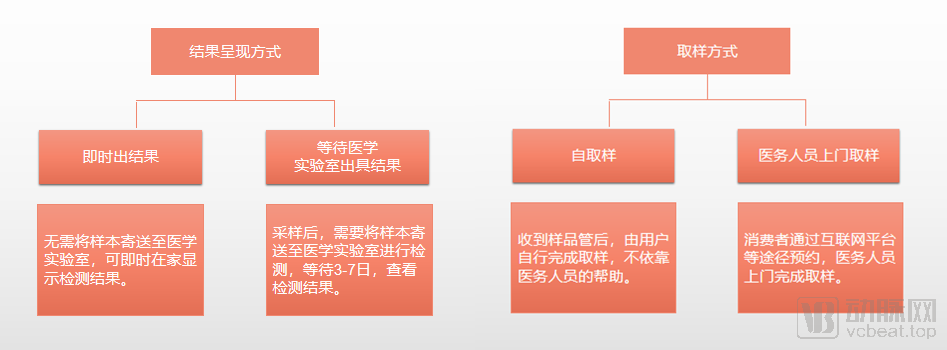
VCBeat has categorized home testing products based on the dimensions of result presentation and sampling methods. In terms of result presentation, they can be divided into those providing immediate results and those requiring results from a testing laboratory. Regarding sampling methods, they can be classified into self-sampling and sample collection by healthcare professionals at home.
Home-based testing is one of the effective measures to alleviate the imbalance in medical resources in China. There is a significant disparity in the distribution of medical resources across the country, with abundant resources in the eastern regions and relative scarcity in the western regions. High-quality medical resources are concentrated in central cities, while grassroots areas and remote mountainous regions suffer from a lack of medical institutions and low levels of medical services. According to the "2019 China Health and Family Planning Statistical Yearbook," tertiary hospitals account for 46% in the eastern region, 30% in the central region, and only 24% in the western region. Home-based testing enables in vitro diagnostic items to cover more populations and regions with scarce medical resources.
Meanwhile, home-based testing enables users to complete tests at home without visiting hospitals, thereby conserving hospital resources, enhancing user convenience, and meeting users’ needs for privacy. Furthermore, given its direct-to-consumer (DTC) nature, home-testing products can help companies build end-user brand influence, acquire highly loyal customers, and enable advanced testing technologies to better reach consumers.
As a novel testing paradigm, home-based testing has opened up new application scenarios for in vitro diagnostics (IVD), freeing testing from the confines of hospitals, health checkup centers, and medical laboratories. Home-based testing is now gradually emerging as a prominent trend, attracting significant attention. Which companies are positioning themselves in the home-based testing sector? Which IVD tests have the potential to be adapted for home use? What challenges does this field still face? VCBeat has compiled an overview of relevant companies and products in the home-based testing space and interviewed Zou Hongzhi, founder of ClearMed Biotech, a company specializing in early cancer screening, and Xu Ke, CEO of Jiajian Health, a home health testing enterprise, in an effort to answer these questions.
Note: Home testing devices such as urinalysis analyzers and blood glucose meters are not covered in this article, which primarily discusses the application of in vitro diagnostic reagents in home settings.
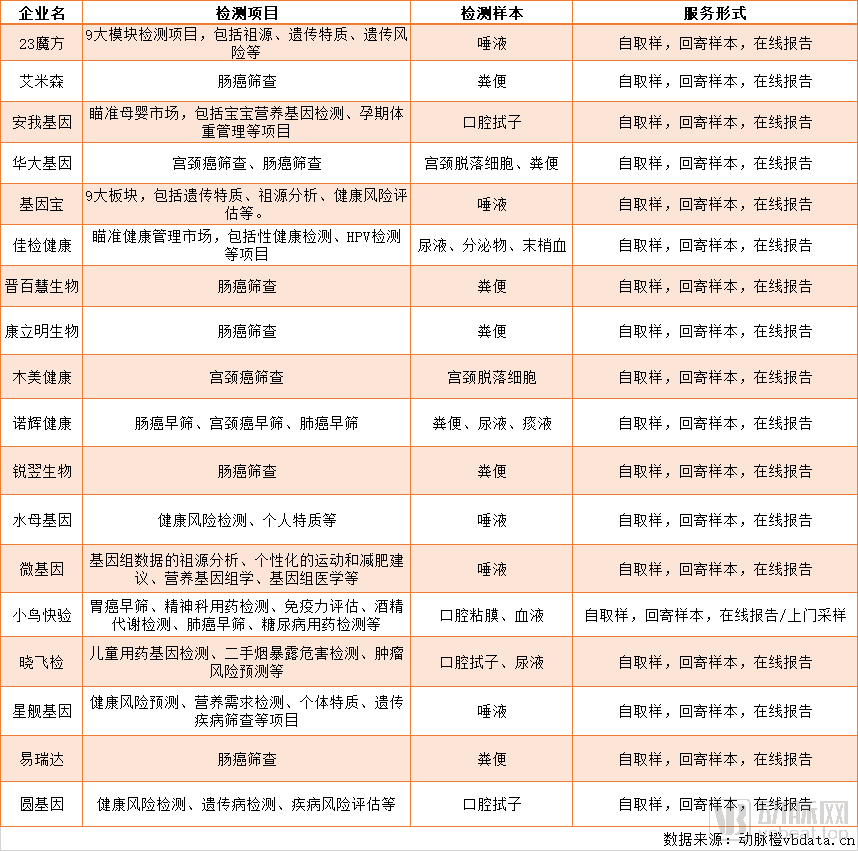
VCBeat has compiled an overview of companies and related products involved in the home testing sector, covering dimensions such as company name, test items, and sample types.
Established IVD Companies Enter the Fray, Bullish on the Home Testing Market
From the perspective of corporate typology, companies entering the home-based testing market include both emerging startups and established in vitro diagnostics (IVD) enterprises. Among the emerging players, ClearMed Biotech is a representative example; its independently developed colorectal cancer early screening product, “Chang’an Xin,” has received marketing approval from both China’s National Medical Products Administration (NMPA) and the European Union. Among established IVD companies, Dian Diagnostics serves as a key representative. In May this year, Dian Diagnostics launched its online testing brand, “Xiao Fei Jian,” offering home-based testing services such as pediatric pharmacogenetic testing and assessment of secondhand smoke exposure risks. This move clearly demonstrates Dian Diagnostics’ determination to expand into the home-based testing sector.
Self-sampling technology can reach more remote areas, promoting balanced distribution of medical resources
Home-based testing sample collection methods are categorized into self-sampling and healthcare professional home visit sampling. Self-sampling technology refers to a process where users collect their own samples, mail them to a testing laboratory, and view the results online. This approach has introduced significant improvements in sample preservation and collection standardization, disrupting the traditional model that confined in vitro diagnostic (IVD) testing to medical institutions. In contrast, sample collection by visiting healthcare professionals is largely similar to hospital-based collection, with the primary aim of enhancing user convenience.
Currently, self-sampling technology is widely applied in the field of early cancer screening. Home-based early screening via self-sampling can address the shortage of healthcare personnel in primary care settings, improve cancer screening rates in these areas, facilitate earlier cancer detection, and reduce the risk of cancer-related mortality. Notably, both domestic and international studies have demonstrated that HPV self-sampling has been successfully implemented in cervical cancer screening programs utilizing community-based, centralized instruction, and online models.
Self-sampling technology has been in existence for over two decades, developed by the US-based Prevention Organization International (POI) through years of scientific research and validation. In 2017, self-sampled HPV testing was recognized as one of the “Top Ten Global Medical Innovations Shaping the Future.” Studies have shown that among 13,000 samples, there was no difference in effectiveness between self-sampling and clinician-collected sampling.
A limitation of self-sampling technology is that it can only collect non-invasive samples such as sputum, feces, and saliva, or capillary blood from fingersticks, significantly reducing the range of detectable parameters. Zou Hongzhi, founder of ClearMed Biotech, stated, “Taking the cancer early screening industry as an example, although there are many types of cancer, very few can be screened via at-home testing due to sample limitations. Currently, significant breakthroughs have been made only in colorectal cancer screening.”
Zou Hongzhi stated, “Many genetic testing programs use venous blood as the sample; however, venipuncture requires a professional nurse. Given the current state of technological development, self-sampling of venous blood at home will not be feasible for a considerable period.” Home sample collection by medical personnel addresses this limitation, significantly expanding the range of tests available for home-based detection.
At the same time, home-based sample collection offers greater convenience to users, sparing them the hassle of traveling to hospitals. The professionalism of medical personnel also mitigates the risks associated with non-standardized sampling practices. However, a limitation of this model is that it can only be implemented in urban areas and regions with abundant medical resources, catering primarily to the high-end healthcare needs of certain populations, which makes it difficult to extend to grassroots-level areas.
Regarding self-sampling and at-home phlebotomy services, a genetic testing industry expert expressed greater optimism about self-sampling technology. He stated, “At-home testing products should offer high quality at an affordable price. The high cost of having medical personnel perform sample collection at patients’ homes will prevent it from becoming the mainstream method for at-home testing.”
Although sample limitations have, to some extent, hindered the development of the home-testing sector, the field comprises numerous niche segments. From early cancer screening and disease risk prediction to pharmacogenomic testing for precision medication, these sub-sectors alone offer a sufficiently vast market opportunity.
Expand Sales Channels Through Online-Offline Integration, with Attention to Profit Models
VCBeat has observed that the business models for home testing products all adopt an online-to-offline (O2O) approach, selling directly to consumers. A defining characteristic of home testing products is their high degree of internet integration, with most companies relying on digital channels such as e-commerce platforms and official websites for sales. Meanwhile, these companies also partner with hospitals and health examination centers to achieve online-offline synergy and reach a broader population. Retail pharmacies serve as another effective sales channel, enabling consumers to purchase products more conveniently and quickly for timely testing.
In addition to consumer-facing sales, some companies also target the B2B sector with greater purchasing power by offering customized genetic testing services to corporate clients. For instance, Jellyfish Genetics has launched a health insurance industry solution to help insurance companies achieve strategic upgrades in “genetic testing + health insurance,” shifting health management upstream to improve the health status of policyholders and reduce claims expenditures for insurers. It has also introduced a Life Coach corporate wellness service that analyzes employees’ potential disease risks to enhance individual employee health outcomes.
Profitability is a critical issue for at-home testing companies to address. Disease prevention and screening products generate repeat purchase demand, providing companies with sustained and stable revenue. However, most at-home testing products, such as consumer-grade genetic tests and pediatric pharmacogenetic tests, are essentially “one-time transactions,” where customers do not need to make repeat purchases, resulting in limited profit margins. To address this challenge, companies must leverage their genetic data, technologies, and resources to expand into additional business areas.
From Consumer-Grade to Medical-Grade: Greater Emphasis on Clinical Value
From the perspective of product categories, the at-home testing products listed in the table can be divided into consumer-grade genetic testing products and medical-grade genetic testing products.
Consumer-grade genetic testing products were a major trend in recent years. Driven by rising consumer interest in genetics and health management, a large number of consumer-grade genetic testing companies have emerged, with the capital market investing heavily in this niche sector. Notably, 23Mofang secured over RMB 100 million in financing in 2018, making it the company with the largest publicly disclosed funding round in China’s consumer-grade genetic testing industry.
Opinions within the industry vary regarding consumer-grade genetic products. Some argue that consumer genetic testing is an effective means of rapidly acquiring large-scale population genomic data and exhibits synergies with many segments of the broader health industry. Others, however, dismiss consumer genetic testing products as “scientific fortune-telling,” citing severe homogenization, low market entry barriers, and a lack of rigorous clinical value, suggesting they merely satisfy users’ entertainment and science popularization needs.
VCBeat believes that the value of consumer-grade genetic testing should be viewed dialectically. Driven by the “Healthy China 2030” Planning Outline, disease risk prediction is a promising application for consumer-grade genetic testing products. However, the market for disease risk prediction is still immature at this stage. In addition to genetics, the occurrence of diseases is associated with various factors such as lifestyle, sleep, and exercise; therefore, predicting disease risk based solely on genetic testing is not sufficiently rigorous. If tools such as wearable devices are used to monitor sleep and exercise, thereby generating multi-omics data, disease prediction can become more objective.
In contrast to the decline of consumer-grade home testing products in recent years, medical-grade home testing products have emerged as a powerful new force. Oriented toward clinical practice, these products aim to provide users with accurate and reliable test results, offering guidance for subsequent diagnosis and treatment.
Medical-grade at-home testing products primarily consist of disease screening and medication monitoring tests, representing the most promising niche within this sector. With China’s increasing investment in healthcare and growing public awareness of health management, the market for medical-grade at-home genetic testing holds significant future potential.
In addition to early cancer screening, consumer-grade genetic testing, sexual health testing, and pharmacogenetic testing for pediatric medication, which other in vitro diagnostic (IVD) tests have the potential to be performed at home? Based on the analysis above, VCBeat has summarized home-based testing options and identified their common characteristics:
In terms of product categories, home-based testing services are primarily focused on disease screening and prevention, and do not involve disease treatment. Therefore, home-based testing products should be predominantly health management-oriented.
Regarding sampling methods, home testing kits primarily focus on non-invasive sample collection. Before breakthroughs in self-sampling technology are achieved, samples such as venous blood remain difficult to collect for home testing. For the foreseeable future, home testing will continue to rely mainly on non-invasive samples and capillary blood obtained via fingerstick self-sampling.
From the perspective of profitability models, disease diagnostic projects such as cancer early screening and disease testing exhibit higher repurchase rates. Therefore, when selecting home-based testing products, priority should be given to their repurchase rates and profitability.
As the prospects for the home testing market become increasingly clear, many in vitro diagnostics (IVD) companies are eager to capture a share of this emerging sector. Xu Ke, CEO of Jiajian Health, which focuses on at-home health testing, emphasizes that IVD offerings must be precisely positioned in the market and that companies should not blindly enter the home testing space. Jiajian Health aims to shift numerous testing scenarios into the home environment through at-home sample collection, enabling users to conveniently monitor their health data on a regular basis. “Jiajian Health does not pursue ‘at-home’ solutions for their own sake; when selecting test items, we prioritize those best suited to the home setting.”
Zou Hongzhi, however, believes that for in vitro diagnostic (IVD) tests to be suitable for home use, they must first meet the criteria of simplicity and accuracy. Simplicity encompasses both ease of sample collection and ease of result interpretation. Accuracy means that users can obtain reliable results after testing, providing a trustworthy basis for subsequent health management actions. “Lung cancer and bladder cancer both have the potential for home-based testing, which is the current focus of ClearMed Biotech’s efforts.”
Of course, the most iconic product in the home testing segment is Clearblue. By delivering instant results at home without the need to send samples to a laboratory, Clearblue has achieved tremendous success through its rapid, convenient, reliable, and private home-testing model, establishing itself as the leading brand in the global pregnancy testing and preconception care market.
Can the home testing sector produce another blockbuster product akin to Clearblue? Zou Hongzhi stated, “Such a possibility exists, but it is quite challenging. Several key conditions must be met: first, the market must be sufficiently large, such as those for colorectal cancer, diabetes, and cardiovascular diseases, where there is high demand and frequent usage; second, the product must be convenient, with ideal features including at-home readability and immediate result delivery.”
Addressing this issue, Xu Ke also expressed a similar view: “If the entire testing process can be completed at home, eliminating the need for sample transport and laboratory-based testing, and if the product effectively addresses users’ actual pain points—much like home blood glucose monitoring solutions for diabetes—it has the potential to become the next major player in the home-testing market.”
“However, the current bottleneck lies in the fact that most in vitro diagnostic tests, including various biochemical and enzyme immunoassay-based items as well as early cancer screening, involve complex detection technologies requiring multiple indicators to be measured, making them unsuitable for miniaturization and home use in the short term.”
Issues with Sampling Standardization. Since home-based testing primarily relies on self-sampling by consumers, ensuring standardized sampling procedures and the collection of qualified specimens is the primary challenge for companies to address. This issue can be resolved by establishing a comprehensive service system, developing detailed sampling instructions, and setting up a 24/7 online support team. For instance, ClearMed Biotech has built a professional customer service team to assist users with inquiries, including those related to sampling, enabling even elderly users to complete the sampling process correctly and efficiently.
Sample Degradation Issues. After sample collection, the process moves to the shipping stage. Some respondents indicated that companies generally avoid using blood as a testing sample to prevent degradation during long-distance transportation, as blood contains numerous heterogeneous components and is difficult to preserve.
Meanwhile, Conmed Biotech’s colorectal cancer early screening product, “Chang’an Xin,” has achieved a technological breakthrough in its preservative solution, ensuring that samples remain stable even under extreme temperature conditions. New Horizon Health has developed a sample stabilization buffer that effectively maintains the stability of fecal samples at room temperature for up to seven days; this technology has been filed for patent protection. Ameson has pioneered a proprietary sample preservation technology that significantly extends sample storage duration. Additionally, some companies have partnered with courier services to shorten transit times, ensuring rapid delivery of samples to laboratories.
Regulatory Issues. Zou Hongzhi believes that all home-testing products (including consumer-grade genetic testing) should obtain approval from the National Medical Products Administration (NMPA) before being marketed and sold. However, many home-testing products currently engage in “gray-area” practices and are sold without proper certification, indicating a need for further standardization of the industry.
Xu Ke stated that screening and prevention and control of chronic diseases are among the key priorities of the Healthy China initiative. As a lightweight and convenient approach to chronic disease screening, home-based testing can make valuable contributions to national efforts in chronic disease screening and condition monitoring. As an innovative model still in its early stages of development, home-based testing calls for greater support and recognition from regulatory authorities, while remaining fully compliant with existing regulations.
The Challenge of Market Education. The superiority of the home-testing model is undeniable. Zou Hongzhi stated, “Selling directly to consumers (C-end), bypassing hospitals, can significantly reduce product prices.” However, 80% of “Chang’an Xin”’s business still targets hospitals, a situation attributable to immature market education. Consumers’ understanding of the application scenarios for in vitro diagnostic (IVD) tests remains confined to medical institutions. Moving forward, companies need to continuously educate end-users and enhance consumer awareness of the home-testing model.
In summary, although many issues remain to be addressed, the prospects for the home testing market are promising. Abroad, the home testing market is also flourishing; LetsGetChecked, a company specializing in at-home health testing, completed a $71 million Series C financing round this June, and the FDA has approved at-home COVID-19 test kits. Xu Ke stated, “From the perspectives of policy attention and technological development, the overseas home testing market is relatively mature and offers valuable lessons for China.”