

Beihang University and West China Hospital Jointly Develop Portable Pathogen Nucleic Acid Rapid Testing Device
Numerous microscopic organisms exist all around us; however, due to the limitations of human vision, we cannot observe these microbes—such as fungi, bacteria, and viruses—with the naked eye. Some of these organisms are pathogenic to humans, capable of initiating attacks on the human body, and are therefore referred to as pathogens.
Since the late 1970s, we have been exploring how to detect pathogen invasion, continuously searching for the “signatures” of microbial pathogens to identify their presence.
To date, we have been able to accurately detect the presence of pathogens through scientific methods, yet a new round of challenges has quietly emerged. With the outbreak of the COVID-19 pandemic in early 2020, public healthcare systems were pushed beyond capacity. Testing for SARS-CoV-2 required not only high accuracy but also rapid turnaround and enhanced safety.
Although China has entered a phase of normalized prevention and control for the COVID-19 pandemic, the number of confirmed cases worldwide continues to rise. SARS-CoV-2 testing is now entering its next stage, where the key challenge to be addressed is how to achieve rapid, accurate, and convenient detection across a wide range of settings, such as airports, railway stations, community hospitals, rural health clinics, and home self-testing environments.
In early February, the Sichuan Provincial Department of Science and Technology urgently established a special research project for joint prevention and control of the novel coronavirus pneumonia outbreak. Led by the Department of Laboratory Medicine at West China Hospital of Sichuan University, the initiative brought together leading domestic experts in precision diagnostic testing to collaboratively develop nucleic acid detection instruments for pathogens.
The research group led by Professor Chang Lingqian at the Advanced Innovation Center for Biomedical Engineering and the School of Biological Science and Medical Engineering, Beihang University, is engaged inBio-Micro/Nano Chipsand its application in single-cell gene detection andRapid Molecular Detection of PathogensHe has been engaged in research in these fields for over a decade. In collaboration with Professor Fan Yubo and Associate Researcher Wang Yang from Beihang University, and supported by funding from the Sichuan Provincial Department of Science and Technology and the Beijing Advanced Innovation Center for Biomedical Engineering, he worked together with a joint team comprising Professor Li Weimin, Professor Ying Binwu, and Researcher Geng Jia from the Department of Clinical Laboratory at West China Hospital of Sichuan University to jointly design and develop a point-of-care rapid pathogen detection platform.
In the early stages of the pandemic, everyone was under home quarantine, and nearly all research laboratories were at a standstill, making the acquisition of raw materials the primary challenge to overcome. Professor Chang’s research team rose to the occasion, completing everything from determining the nucleic acid amplification method, designing primer sequences, and configuring channels on the nucleic acid amplification chip, to conducting tests for SARS-CoV-2 nucleic acid detection in just two weeks, thereby securing valuable time for frontline clinical workers.
Recalling the heart-stopping two weeks, Professor Chang remains exhilarated: “Time was pressing, and our spirits were highly concentrated. We shifted from initially designing microfluidic chips to designing microarray chips, and moved from being unable to normally order amplification primers and polymerases to completing primer solution encapsulation in the warehouse. Our entire research group was operating at high speed, ultimately succeeding in completing this arduous task within two weeks.”
This point-of-care rapid pathogen detection platform consists of a portable analyzer and an isothermal amplification microarray chip, enabling highly sensitive, rapid, and high-throughput nucleic acid testing for pathogens. The platform offers high flexibility in testing.This approach not only enables nucleic acid testing for SARS-CoV-2 but also facilitates rapid and convenient nucleic acid detection of other epidemic pathogens, such as those causing malaria, tuberculosis, and dengue fever, thereby offering significant timeliness and clinical importance.
Pathogen detection is closely linked to human health. Research in this field began in the late 1970s, evolving from microbial culture-based phenotypic observation to antibody and nucleic acid testing. Rapid, convenient, and accurate pathogen detection has always been the ultimate goal of such research.
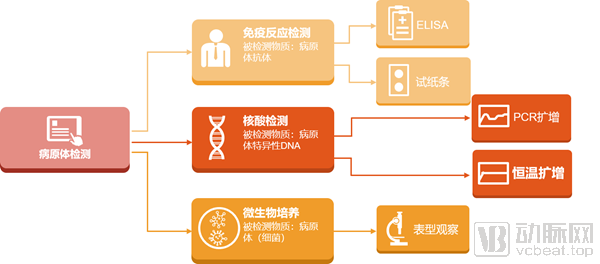
Pathogen Detection Methods
During peak periods of pathogen outbreaks, inexpensive and rapid antibody tests are often employed as a tool for large-scale screening; however, the efficacy of antibody testing depends on the individual’s immune response and typically exhibits a certain lag. Nucleic acid testing is widely regarded as the gold standard for pathogen detection, offering higher accuracy and sensitivity. Common nucleic acid analyzers utilize polymerase chain reaction (PCR) to amplify pathogen nucleic acids, achieving a limit of detection as low as one copy per milliliter, making them the preferred choice for nucleic acid testing of throat swab samples.
However, PCR amplification is not suitable for pathogen nucleic acid detection in widespread scenarios due to the need for precise control of multiple temperatures and high instrument manufacturing costs. Consequently, isothermal nucleic acid amplification detection, which requires only a single temperature control module, has entered the market. Although isothermal nucleic acid amplification detection is not new, the field currently remains at the stage of combining isothermal amplification kits with PCR nucleic acid amplifiers, and the development of low-cost isothermal nucleic acid amplifiers is still in the exploratory phase.
Compared with commercial viral nucleic acid PCR testing equipment (costing RMB 100,000–1,000,000 per unit and requiring approximately 1 hour), the integrated isothermal pathogen nucleic acid amplification detector jointly developed by Beihang University and West China Hospital demonstrates significant technical advantages in terms of cost (RMB 10,000 per unit), high throughput, high sensitivity, and rapid detection (25 minutes). It is highly suitable for rapid pathogen testing in primary healthcare settings, rural areas, and crowded environments. This all-in-one device provides a portable, open-platform solution for isothermal nucleic acid amplification testing.
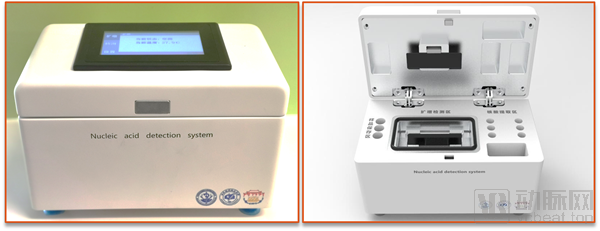
Appearance and Functional Modules of Portable Devices for Rapid Pathogen Detection
This all-in-one device employs loop-mediated isothermal amplification (LAMP), utilizing six self-designed primers targeting the pathogen's3 characteristic gene lociPerform specific amplification,25 minutescan be output via colorimetric reactionVisualization of Detection Results; InstrumentBuilt-in positive and negative controls, improving detection accuracy.
In addition, Professor Chang’s research group modified the micro- and nanochannels for nucleic acid detection by designing specialized conical structuresMicroarray High-Throughput Chip, requiring only trace amounts of reagents to simultaneously perform nucleic acid preservation, extraction and enrichment, amplification, and colorimetric detection of the samples under test, thereby achievingHigh-Throughput Testing of 64 Samples to Be Tested. For example, detection can be performed on the same chip3–64 SARS-CoV-2 nucleic acid samples from throat swabs, or simultaneously detect 1 to 16 different pathogens, includingMalaria, Tuberculosis, Dengue Feveretc. The chip structure is fabricated using plastic laser processing, and when paired with the corresponding detection reagents, the total cost remains within RMB 10 per test.
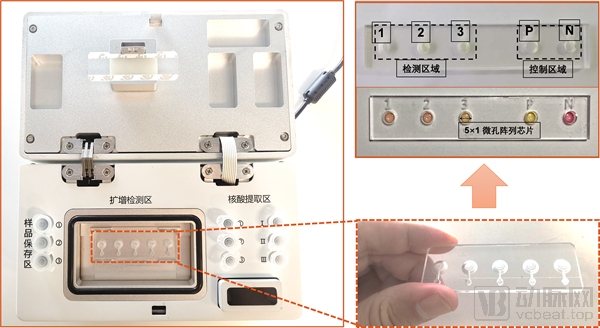
Novel Nucleic Acid Testing Microwell Array Chip
West China Hospital of Sichuan University has remained at the forefront of the fight against the pandemic. It not only provided a clinical testing environment for the all-in-one nucleic acid detection device targeting this pathogen, but also offered guidance on its deployment across diverse scenarios. For instance, the proposal to design an open-lid all-in-one device would facilitate healthcare workers in transitioning between testing settings and replacing detection chips.
Designed specifically for SARS-CoV-2, the isothermal amplification primers simultaneously target the ORF, N, and E gene loci. An endogenous control is used to verify the presence of human genomic DNA, thereby enhancing detection sensitivity and specificity. A single chip can process nucleic acid samples from 3 to 64 SARS-CoV-2 throat swabs. This all-in-one pathogen nucleic acid detection device has been employed at West China Hospital to test over 200 nucleic acid samples.Sensitivity >95%, specificity >95.3%.
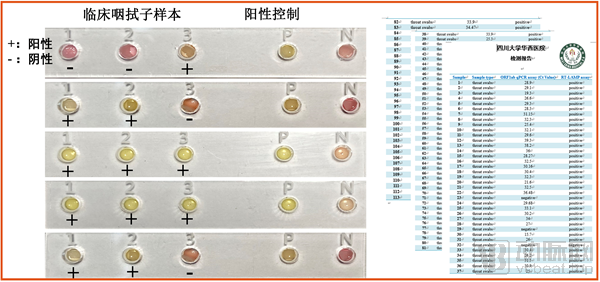
West China Hospital Clinical Sample Test Results
Supported by the Zhongguancun Concept Validation Support Program, the project has completed functional testing and preliminary evaluation of the prototype. The next steps include regulatory testing and clinical sample validation in preparation for regulatory submission.
Professor Chang’s team is currently planning the commercial deployment of an integrated device for pathogen nucleic acid testing. They are confident that, whether through patent licensing, equity-based technology transfer, or collaboration with companies on medical device registration and clinical validation, the product’s rapid, precise detection capabilities and broad application scenarios will secure its place in the pathogen nucleic acid testing market.