

Policy Tailwinds Meet Digital Mental Healthcare: Yining Internet Psychiatric Hospital Files IPO Prospectus
This article is reprinted from E-Drug Manager, with authorization granted to VCBeat.
Introduction: Recently, within Zhejiang Province’s strictly regulated healthcare system, the issuance of the third such license in the province—and the first in Wenzhou—for an internet hospital operating independently of any offline physical medical institution has drawn industry attention. This entity, named “Yining Mental Health Internet Hospital,” has sparked considerable interest. With its closed-loop online-to-offline diagnostic and treatment model, self-developed health information systems, a robust pharmaceutical supply chain, and a physician group affiliated with tertiary Grade A hospitals, what sets this specialized psychiatric and psychological internet hospital apart?
In recent years, the incidence of mental and psychological disorders has been continuously rising. Due to concerns over privacy breaches and other factors, a large number of patients with mild psychological conditions have failed to receive effective prevention and early intervention.
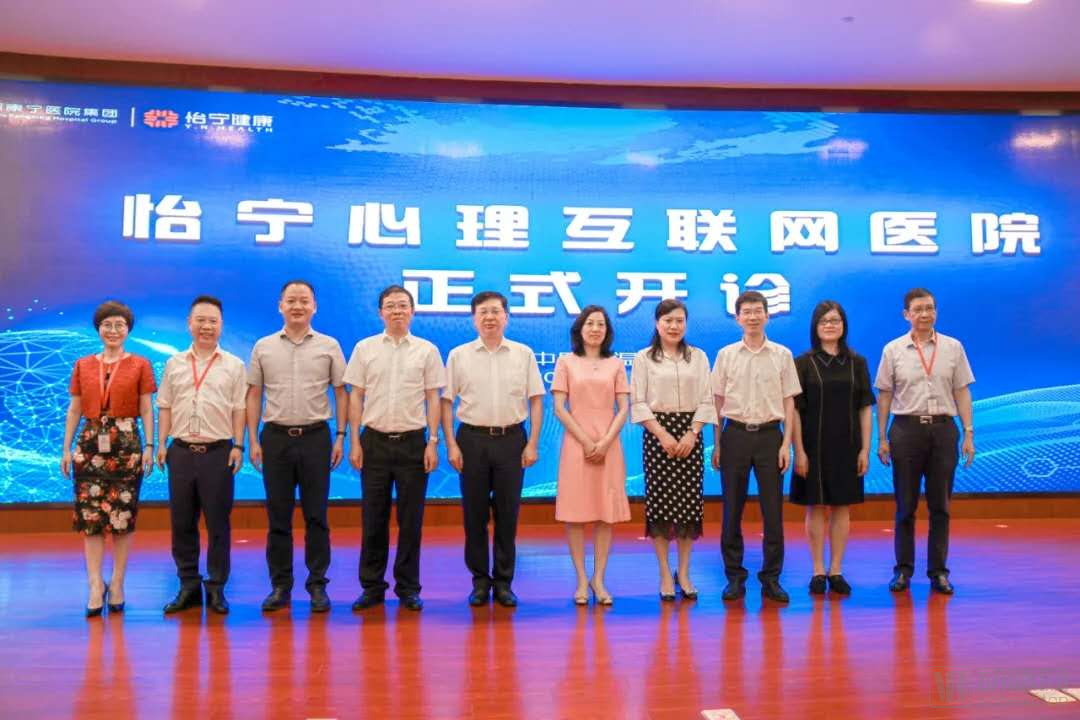
On July 29, YiNing Mental Health Internet Hospital (hereinafter referred to as “YiNing Mental Health”) officially commenced operations. In its first phase, the internet hospital will primarily serve southern Zhejiang Province (covering Wenzhou, Taizhou, Lishui, and Jinhua), with a total investment of approximately RMB 40 million. It aims to provide mental health education to 30 million people, deliver online mental health services to one million individuals with mild mental health concerns, and offer chronic disease management support to 50,000 psychiatric patients already receiving inpatient treatment.
It is understood that Yining Psychology is an online diagnosis and treatment platform established by Wenzhou Kangning, which has been deeply engaged in the field of mental health for more than 20 years and is known as the first listed specialty psychiatric hospital in China. Wang Jian, Deputy General Manager of Wenzhou Kangning Group and Dean of Yining Psychology Internet Hospital, introduced that on the basis of the successful implementation of the project in the first phase, the scope of this project will be expanded to the entire Zhejiang Province, with an additional investment of 10 million yuan, and the expected number of people served will also double.
Although competition in the internet healthcare sector is becoming increasingly fierce, China’s remote psychiatric and psychological care market has previously remained a blue ocean. With Yining Psychology successfully obtaining the Medical Institution Practice License for its internet hospital, how it will leverage this platform to make significant strides in internet healthcare is highly anticipated by the industry.
Currently, there are three main forms of internet hospitals in China: simple extensions of physical medical institutions, online hospitals operating under a secondary name and affiliated with physical hospitals, and online hospitals independent of offline physical medical institutions.
Compared with the first two models, online hospitals that operate independently of offline physical medical institutions face substantially higher entry barriers and are subject to the most stringent approval processes. Since the establishment of China’s first internet hospital, Wuzhen Internet Hospital, in Zhejiang Province in 2015, only two such Medical Institution Practice Licenses had been issued in the province over the subsequent four years by 2019, deterring many prospective market entrants.
The license secured by Yining Psychology falls under this model.
Wenzhou Kangning’s establishment of an internet hospital was not a whimsical decision. Since 2018, Kangning has been strategically developing an online platform specialized in psychiatry and mental health. In contrast to traditional public hospitals launching online services or tech companies venturing into online consultations, Yining Psychology possesses its own distinctive features and advantages.
“With over two decades of immersion in the industry, Wenzhou Kangning’s understanding of patient needs, along with its values and vision, has led us to place greater emphasis on ensuring that patients can seek medical care with dignity.” Regarding the original intention behind establishing Yining Psychology, Wang Jian candidly stated, “Due to the general public’s insufficient awareness and attention toward mental health, as well as concerns about privacy breaches affecting personal reputation, many mild psychological issues have not received prevention or early intervention. This has often resulted in worsening conditions and family tragedies, thereby making the burden of mental and psychological disorders an increasingly significant component of the overall healthcare burden.”
Wang Jian introduced that, against the backdrop of the rapid development of “Internet Plus,” Kangning has established an independent internet hospital based on its physical hospital facilities, created a patient-centered three-tier diagnosis and treatment system, and built an integrated online-offline medical health service platform. Through this platform, Kangning has achieved the joint development of internet hospitals for Wenzhou Kangning Group’s main hospital and its branch hospitals, thereby establishing a high-quality service platform and building a strong service brand in the field of mental health and psychology.
With“Physical Hospitals + Internet”: A Closed Loop of Online and Offline Diagnosis and Treatment Processes,Patients using YiNing Mental Health can conduct online consultations and obtain follow-up prescriptions through the internet hospital. For hospitalization or treatment, they can access offline medical services at Kangning’s nationwide network of hospitals. In essence, YiNing Mental Health meets the multi-level and diversified healthcare needs in the psychiatric and psychological fields by delivering remote, precise, and intelligent mental health services. In addition to patients, YiNing Mental Health also serves moreOnline pharmacies provide prescription support.
It is worth noting that the successful deployment of Yining Psychology also benefited from the synergistic efforts of Kangning’s IT subsidiary, pharmaceutical supply chain system, and physician group, which collectively formed the “Yining Health Technology Platform.”
Yining Psychology, leveraging Dening Pharmaceutical, a wholly-owned pharmaceutical company under the “Yining Health Technology Platform”Streamlined the pharmaceutical supply chain:After an initial offline consultation at a hospital, patients can log in to the internet hospital for follow-up visits. Upon issuance and approval of a prescription, the platform will directly place an order for the prescribed medications, which are then delivered to the patient’s doorstep via an external logistics network. This enables patients to obtain prescriptions and receive medications without leaving home, thereby providing greater convenience and cost benefits in pharmaceutical supply through internet hospitals.
In addition to the pharmaceutical supply chain, Jeremiah, an IT company under the Yinings Health Platform, possessesSelf-developed Hospital Management System,It can be provided to psychiatric specialty hospitals, while inviting their physicians to join the Yining Psychology Internet Hospital as contracted doctors, thereby enriching the hospital’s physician resources. Meanwhile, the information technology system provided by the Yining Health Platform can also collect more big data, laying the foundation for intelligent big data applications.
Regarding the future of this platform, Wang Jian stated that the Yining Health Platform will uphold its core values of “revering life and serving with humility,” leverage technological advantages, utilize data services, empower hospitals and physicians, safeguard the public’s mental health, and is committed to serving and empowering the development of China’s psychiatric and psychological healthcare industry.
Recently, the Chinese government has frequently introduced favorable policies for internet healthcare.
On July 15, the “Opinions on Supporting the Healthy Development of New Business Formats and Models to Stimulate Consumer Markets and Drive Employment Expansion,” jointly issued by the National Development and Reform Commission and 12 other departments, was publicly released. The document proposes including eligible “Internet+” medical service fees within the scope of medical insurance reimbursement, and standardizing and promoting models such as online follow-up consultations for chronic diseases, telemedicine, and internet-based health counseling.
On July 21, the General Office of the State Council issued the “Implementation Opinions on Further Optimizing the Business Environment to Better Serve Market Entities,” which again addressed the issue of “relaxing” medical insurance policies. The document requires that, under the premise of ensuring medical safety and quality, the scope of internet-based diagnosis and treatment be further expanded, eligible internet medical services be included in the medical insurance reimbursement coverage, nationally unified approval standards for internet medical services be formulated and published, and the review and approval process for innovative medical devices be accelerated to promote their clinical application.
The continuous release of policy signals has also fueled market expectations for new business models in internet healthcare.
Data shows that in 2019, China recorded approximately 560 million online consultations, with an online penetration rate of about 6.2%. However, as of November 2019, only 269 internet hospital licenses had been issued nationwide. The relaxation of policies is expected to boost the development of the internet healthcare industry and further increase enthusiasm for building internet hospitals. Assuming that all 12,801 secondary-level and above hospitals in China will establish internet hospitals, the market size for hospital-side internet infrastructure construction is estimated to reach RMB 26.1 billion.
Wang Jian stated that key development milestones in internet healthcare, such as online consultations, integration with medical insurance, and the outflow of prescriptions, are currently in a historical golden period driven by policy support. The top-level design of internet healthcare policies is being continuously strengthened, which is expected to significantly accelerate the formulation of detailed implementation rules in the later stages, thereby playing a decisive role in shaping the internet healthcare industry.
Industry analysts generally believe that, as an emerging technological approach, “Internet Plus” enjoys bright prospects under the support of a series of national policies, including the Outline of the Healthy China 2030 Plan. The emergence of Yining Psychology Internet Hospital is bound to have a profound impact on the development of internet hospitals specializing in mental health and psychological care.
The report of the 19th National Congress of the Communist Party of China proposed strengthening the construction of a social psychological service system and fostering a social mindset characterized by self-esteem, self-confidence, rationality, peace, and positivity. With the rise of the “Internet + Healthcare” model, more solutions have become available to enhance this system. Remote consultations provided by psychiatric internet hospitals have, to some extent, increased public attention to mental health and improved the overall psychological well-being of the population.
From the perspective of social responsibility, the emergence of internet hospitals specializing in mental health can effectively assist patients with mental disorders in managing chronic conditions at home, benefiting both the nation and society. For instance, platforms like Yining Psychology can provide timed medication reminders, automatically generate chronic disease follow-up plans, promptly alert patients to schedule in-person follow-up visits, and offer remote consultation and prescription services for those who find it inconvenient to visit the hospital. These measures help reduce relapse rates and shorten hospital stays. Additionally, by establishing doctor-patient communication modules, physicians can timely monitor the condition of discharged patients and formulate appropriate rehabilitation plans. This approach alleviates the problem of prolonged hospitalization, conserves medical resources, and reduces the burden on medical insurance. Telemedicine also saves patients and their families from travel expenses, inpatient fees, bed charges, and other costs associated with hospital visits, thereby easing the financial burden on patients and facilitating their reintegration into society.
From a technical perspective, with the advent of the 5G era, upgrades to technologies such as remote diagnosis, remote imaging consultation, and remote monitoring—enabled by online video and virtual reality—will meet the healthcare sector’s demands for real-time performance, efficiency, and stability, thereby facilitating physicians’ ability to conduct remote diagnoses and consultations for patients.
The information system under the Yining Health Grand Platform can establish a mental health big data platform to collect information and data generated during diagnosis and treatment through terminal devices, including patients’ basic data, electronic medical records, diagnostic data, and medical equipment data. By enabling multi-party interactive sharing with timely examinations, it allows for real-time monitoring of medical conditions and prompt problem resolution. Meanwhile, big data technologies are applied to analyze and process relevant information and data, assisting healthcare professionals in conducting deeper analyses of mental health-related data, thereby improving the prevention and treatment of psychological disorders and laying the foundation for future intelligent big data applications. “We will also strive to build a platform for translating new technologies, conduct clinical trials of new drugs, and integrate 5G technology for virtual consultations, providing big data support for scientific research and auxiliary diagnosis, thus accelerating the development of the smart healthcare industry.”
From an industry development perspective, the level of informatization construction, as well as data collection and application, in most psychiatric hospitals and psychiatric departments of public hospitals currently lags significantly behind that of developed countries. Psychiatric medical institutions urgently need informational means and intelligent tools to enhance operational efficiency and service capabilities.
Taking the United States as an example, Teladoc (TDOC.N), a global benchmark company in internet healthcare, has seen its mental health segment become one of the key drivers of its performance growth after acquiring BetterHelp, a specialized mental health platform. According to Barclays’ estimates, Teladoc’s mental health business generated approximately $90–100 million in revenue in 2019, accounting for about 17% of the company’s total revenue, with an expected growth rate exceeding 50%.
“As a key strategic focus of the Yining Health Technology Platform, Yining Psychology will aim to empower physicians and enhance patient management efficiency. We will concentrate on product development, marketing, and scientific research, continuously encouraging physicians to join the platform and accumulating user data. Our product offerings will be refined across multiple dimensions, including follow-up services, data solutions, premium private physician services, auxiliary diagnosis, intelligent applications, and the Internet of Things (IoT).” Regarding the future development of the Yining Health Technology Platform, Wang Jian expressed strong confidence: “Although Yining Health was incubated by Kangning, it is not confined to Kangning. While continuing to leverage Kangning’s endorsement and resource support, we plan to introduce pharmaceutical companies, insurance firms, or third-party platforms as strategic investors. We will operate independently from the Kangning Group and engage with the capital markets.”