

Innovative Multifunctional Balloon Dilation Catheter System for Respiratory Intervention Emerges from COVID-19 Clinical Insights
In 2020, a disaster swept across countries worldwide. To date, this disaster has not yet subsided. It is the COVID-19 pandemic.
Since the onset of the COVID-19 pandemic, we have witnessed both the terrifying nature of the virus and the warmth of human compassion. Medical institutions, pharmaceutical companies, and major medical device manufacturers have leveraged their respective strengths to save lives, while internet enterprises and information technology platforms have utilized innovative technologies for epidemic monitoring and prevention. Other teams identified critical pain points during the outbreak, rapidly proposed solutions, and developed corresponding products; the Wu Tiangen team is one such example.
As is well known, during the pandemic, ventilators and ECMO (Extracorporeal Membrane Oxygenation) were critical emergency devices for patients with COVID-19. Ventilators assist patient ventilation by creating an oxygen-enriched environment, helping to reduce pulmonary burden, improve blood gas oxygenation indices, and buy time for other clinical interventions. ECMO, on the other hand, draws blood from large veins outside the body for oxygenation and then returns the oxygenated blood to large arteries or veins, thereby partially or completely substituting for cardiopulmonary function and alleviating pulmonary pressure. Both ventilators and ECMO establish temporary life-support pathways for patients, allowing medical personnel time to implement additional clinical measures to save lives.
Ventilators and ECMO have made indispensable contributions, yet they are not without certain limitations. The working principle of a ventilator involves using external mechanical means to generate a positive pressure gradient between the patient’s airway opening and the alveoli, thereby passively facilitating inhalation; subsequently, the external mechanical drive is withdrawn, allowing the thoracic cage and lungs to elastically recoil, which creates a passive positive pressure gradient between the alveoli and the airway opening, thus passively completing exhalation.
Wu Tiangen stated, “During positive pressure ventilation, inflammatory substances are also delivered to the basal regions of the lungs. The longer a ventilator is used, the greater the accumulation of inflammatory substances in the patient’s lungs, potentially leading to more severe consequences. Secondly, ventilator use requires intubation; however, if the patient needs sputum expectoration, the endotracheal tube must be removed and reinserted, making the procedure cumbersome and posing an infection risk to healthcare workers.”
Professor Liu Liang also stated, “In patients with COVID-19, alveolar function may be impaired, and the airways may be obstructed by mucus. In clinical treatment, if the mucus components are not resolved, oxygen therapy alone may fail to achieve the desired therapeutic effect and could sometimes even produce adverse effects.”Positive-pressure oxygenation may push mucus deeper and more extensively, exacerbating the patient's hypoxia.”
As for ECMO, the equipment is expensive, complex to operate, and difficult to popularize. Therefore, current treatment methods fail to meet clinical needs, prompting Wu Tiangen’s team to aim at developing a product that addresses this pain point.
Dr. Wu Tiangen, with a background in clinical medicine, later pursued studies in polymer materials engineering in the United States, establishing an interdisciplinary expertise. In 2012, Dr. Wu founded Tiantian Xiangshang Medical Technology, focusing on the development of high-end interventional devices for cardiovascular applications. Addressing the pain points associated with ventilators and ECMO (Extracorporeal Membrane Oxygenation), his immediate response was to develop a multifunctional interventional therapy product.
“We aim to develop an ‘Intrapulmonary Membrane Oxygenation Multifunctional Balloon Dilation Catheter System,’ an interventional device that integrates airway dilation, sputum clearance, oxygen delivery, and endoscopic sampling, enabling patients to clear secretions at any time without interrupting oxygen therapy,” Dr. Wu Tiangen told VCBeat.
The multi-functional balloon dilation catheter system for intracorporeal lung membrane oxygenation project is incubated by Tiantian Xiangshang Medical Technology, founded by Dr. Wu Tiangen, and is currently planning a new round of financing. Dr. Wu Tiangen revealed, “This project will establish an independent company for standalone operations, with subsequent development of other related products.”
Leveraging the project team’s innovative capabilities, the intravascular pulmonary membrane oxygenation multifunctional balloon dilation catheter system was rapidly developed within just a few months. Additionally, Dr. Wu Tiangen led the project to compete in the 2020 Maker Guangdong · Biomedical Special Competition, achieving outstanding results.
Dr. Wu Tiangen explained, “By participating in the 2020 ‘Maker Guangdong’ Biopharmaceutical Special Competition, we aimed to raise awareness of our product and refine our project with the guidance of experts. Indeed, the experience proved invaluable, as we fully achieved all our objectives. First, our participation in the competition and roadshows significantly boosted product visibility. Second, through these roadshows, we garnered government attention and support, while also connecting with numerous investment institutions and potential corporate partners. Finally, we continuously refined our project and clarified our business plan throughout the various roadshows and competitions, which will accelerate the R&D progress of other products, enable faster and more rational realization of commercial benefits, and complete our strategic layout.”
One reason this project has garnered favor from judges, experts, and government agencies is that it proposes viable solutions addressing clinical needs.
The Intracorporeal Pulmonary Membrane Oxygenation Multifunctional Balloon Dilation Catheter System features multi-channel and multi-stage dilation balloons. The multi-channel design enables simultaneous execution of critical emergency interventions, including dilation, sputum suction, and oxygen delivery, at the earliest possible moment. The multi-stage dilation balloons are available in various sizes ranging from 8 to 20 mm, accommodating nearly all airway anatomies. Wu Tiangen stated, “This product is also compatible with ventilators, allowing it to remain indwelling in the airway for extended periods, similar to an intravenous catheter. Furthermore, with a maximum outer diameter of 7F, the device can be introduced into the patient’s airway at the bedside via conventional endotracheal intubation or bronchoscopy. Emergency measures such as dilation and oxygen delivery are performed through a single catheter, eliminating the need for catheter replacement, thereby saving critical time during resuscitation and reducing the risk of infection among healthcare workers.”
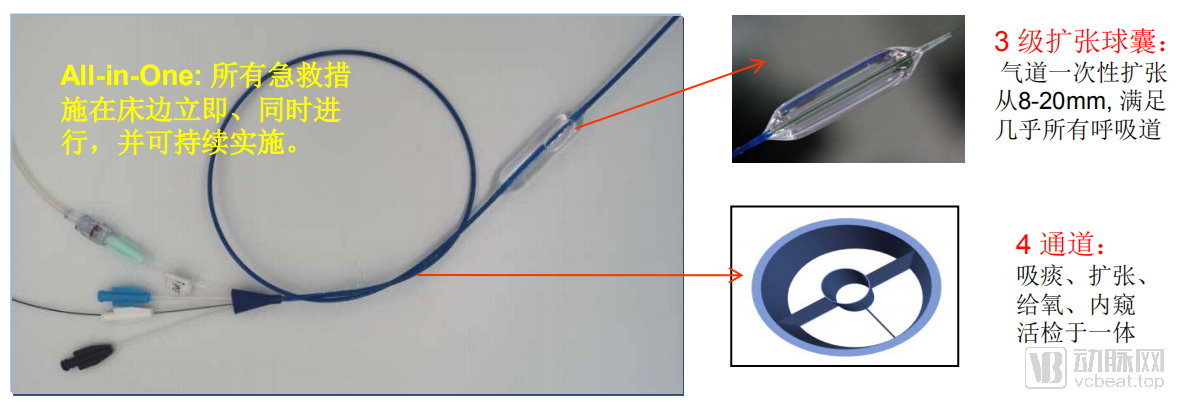 (Intracorporeal Pulmonary Membrane Oxygenation Multifunctional Balloon Dilatation Catheter System, image provided by the company)
According to the introduction, the intrapulmonary membrane oxygenation multifunctional balloon dilation catheter system features four channels. The first channel houses a triple-stage dilation balloon, whose primary function is to maintain airway patency. The second channel is designed for sputum evacuation, enabling the removal of foreign bodies from the patient’s lungs; it also allows for the infusion of saline or medications for pulmonary lavage. The third channel is dedicated to oxygen delivery, ensuring that oxygenation does not interfere with dilation or sputum evacuation functions. The fourth channel, located centrally among the other three, accommodates a fiber-optic endoscope, facilitating physician assessment of pulmonary conditions and enabling sample retrieval for examination.
Another feature of the intracorporeal pulmonary membrane oxygenation multifunctional balloon dilation catheter system is that its multiple channels can be utilized as needed, either individually or simultaneously. Furthermore, this product can be rapidly deployed in conjunction with bedside medical devices such as sputum evacuation machines and ventilators, facilitating prompt emergency intervention.
Through its four channels, the intracorporeal pleural membrane oxygenation multifunctional balloon dilation catheter system becomes a device capable of rapid bedside implementation, integrating airway dilation, sputum clearance, oxygen delivery, and endoscopic sampling, which holds significant importance for the treatment of patients with COVID-19.
It is worth noting that, in addition to COVID-19, the Intracorporeal Pulmonary Membrane Oxygenation Multifunctional Balloon Dilation Catheter System can also be used for pneumonia caused by any other etiology, offering diverse application scenarios and a broad market prospect.
The rapid development and completion of the multifunctional balloon dilation catheter system for in vivo lung membrane oxygenation were made possible by the seamless collaboration and complementary strengths of Dr. Wu Tiangen’s team.
Dr. Wu Tiangen is the team leader. He holds a postdoctoral fellowship in medicine from Harvard University and a Ph.D. in Polymer Materials Engineering from the University of Massachusetts. As a review expert for the U.S. National Institutes of Health (NIH) Innovation Fund, he is fully responsible for product development.
Roger Laham is a Professor of Clinical Medicine at Harvard University, Director of Interventional Cardiology at BIDMC, an FDA medical device review expert, and a Fellow of the American College of Cardiology, with responsibility for clinical research.
Ed Kislauskis is responsible for regulatory affairs and market strategy. He holds a Ph.D. in Biomedical Engineering from the University of Massachusetts and has 20 years of experience in the development, management, and sales of biomedical products in the United States.
Dr. Bi Yuying oversees product research and development as well as production. She holds a Ph.D. in Materials Engineering from the University of Massachusetts and possesses extensive experience in polymer materials engineering.
Dr. Wu Tiangen stated, “We have been collaborating for over two decades with strong synergy. Previously, we focused on the field of interventional consumables and jointly developed high-end medical devices such as bioresorbable vascular scaffolds and coronary balloon dilation catheters. Our team comprises frontline clinicians and experienced engineers, offering complementary expertise. The team is capable of independently handling all stages from product design and manufacturing to regulatory registration and submission.”
Currently, the project for the multifunctional balloon dilation catheter system for in vivo pulmonary membrane oxygenation has completed product development and process validation, with approximately 1,000 units produced in batch.
Dr. Wu Tiangen revealed, “One of the product’s components, the triple-expansion balloon, is currently manufactured exclusively by our team in China. Since April, sales of the triple-expansion balloon have exceeded 600,000 units, and we expect sales volume to surpass one million units in the second half of the year.”
To protect the intellectual property rights of the Intracorporeal Pulmonary Membrane Oxygenation Multifunctional Balloon Dilatation Catheter System, Dr. Wu Tiangen’s team has filed multiple patents in China, Europe, the United States, and other regions, achieving comprehensive patent coverage for the relevant technologies.
“In the future, Dr. Wu Tiangen’s team will leverage the intracorporeal pulmonary membrane oxygenation multifunctional balloon dilation catheter system to establish a complete product chain for airway management. ‘Currently, we have developed products such as the intracorporeal pulmonary membrane oxygenation multifunctional balloon dilation catheter system and the three-stage respiratory tract balloon dilation catheter. In the future, we plan to develop visible bronchial intubation tubes, disposable endoscopes, and other products.’”
In terms of marketing, Dr. Wu Tiangen’s team plans to collaborate with capable and well-resourced distributors across various regions to promote their products. Meanwhile, they intend to partner with ventilator manufacturers, endotracheal tube manufacturers, and companies in the respiratory field to bundle and co-sell their products.
Finally, Dr. Wu Tiangen stated, “We are launching a new round of financing, aiming to raise RMB 10 million, which will be primarily used for production capacity expansion and market promotion.”
The 2020 “Maker Guangdong” Biomedical SME Innovation and Entrepreneurship Competition, guided by the Provincial Department of Industry and Information Technology and the Provincial Department of Finance, and hosted by Guangdong Medical Valley, focused on the biomedical sector. With over 100 registered projects, the competition comprised five online preliminary rounds and one offline special final round. Twelve high-quality projects were recommended to advance to the provincial semi-finals, all of which ranked within the top 10 in their respective Enterprise and Maker categories.
Guangdong Medical Valley is a service provider for medical industry clusters, specializing in investment and incubation within the biopharmaceutical and medical device sectors. Its first medical industrial park, located in Nansha, Guangzhou, is a key municipal project with a total gross floor area of 180,000 square meters. To date, it has attracted over 180 enterprises, including two founded by academicians and 13 selected for national major projects. Leading companies such as Boya Life Sciences, Genetron Health, and Tiankeya have been introduced, covering various niche segments including biopharmaceuticals, gene editing, vaccines, immunotherapy, high-end medical devices, stem cells, and medical industry funds. The park is committed to building a world-class international innovation center for the medical industry.
References:What Exactly Is the “Cytokine Storm” That Causes Sudden Deterioration in COVID-19 Patients? Authors: Shu Long, Hu Chunhong, Hu Yusong from the Second Xiangya Hospital of Central South University