

How Peking University Cancer Hospital Achieved 30% of Outpatient Volume via Internet-Based Consultations
“Our internet-based diagnosis and treatment services are not intended as a supplement, but rather to partially replace traditional care.” This was a statement repeatedly emphasized by Heng Fanxiu, Director of the Information Department at Peking University Cancer Hospital, when introducing the hospital’s strategy for developing internet-based diagnosis and treatment.
As a top-tier tertiary hospital specializing in oncology, Peking University Cancer Hospital has accelerated the promotion of internet-based medical services this year. In the nearly one month since the official launch of online follow-up consultations, the daily volume of internet-based diagnoses and treatments has accounted for 30% of the offline outpatient volume. Notably, this 30% comprises exclusively follow-up visits involving specific therapeutic interventions, such as prescription issuance or ordering of laboratory and imaging tests, excluding online consultations. Although this proportion has recently declined amid the broader trend of resuming work and production, the total volume continues to rise steadily.
How Did Peking University Cancer Hospital Achieve This? We conducted an on-site visit to the hospital, gathering insights from the Director of the Information Department, clinicians, and patients to outline the hospital’s pathway and experience in building its internet-based diagnosis and treatment services.
On the 2018 Fudan University Hospital Reputation Rankings for Oncology, Peking University Cancer Hospital ranked fifth. As one of the most authoritative medical institutions in the field of oncology in China, Peking University Cancer Hospital faces both internal challenges—such as its outpatient service structure and patient demographics—and external factors—including epidemic prevention and control measures and policy-driven initiatives—in advancing its internet-based diagnosis and treatment services.
Internal Factors: Prolonged patient survival and a high proportion of follow-up visits
Peking University Cancer Hospital currently comprises 34 clinical departments, 14 medical technology departments, and 17 basic research departments. Oncology is a National Key Discipline of the hospital, while its Department of Oncology and Department of Pathology are designated as National Key Clinical Specialties. Additionally, the hospital hosts multiple Beijing Municipal Key Disciplines and Key Disciplines under the Beijing Administration of Traditional Chinese Medicine. The hospital is also home to the Key Laboratory of Carcinogenesis and Translational Research (Ministry of Education) and the Beijing Key Laboratory of Translational Research in Malignant Tumors.
Peking University Cancer Hospital has achieved innovative and leading accomplishments in basic theoretical research in oncology, clinical diagnosis and treatment of common major cancers, and field-based preventive intervention studies in high-incidence areas for gastric and esophageal cancers, earning significant recognition both domestically and internationally.
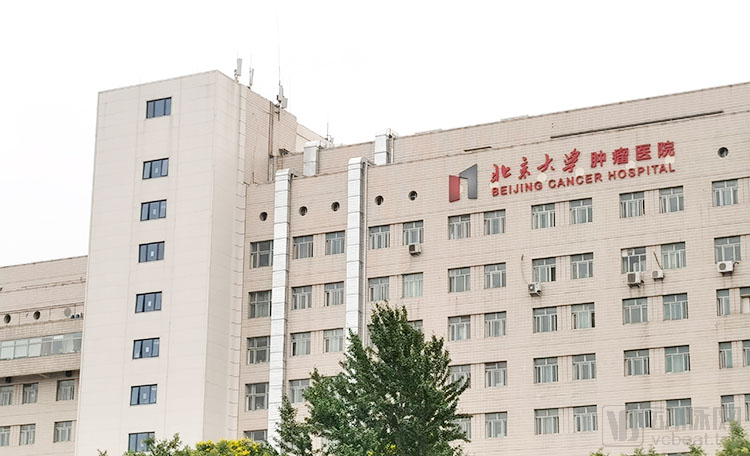 Peking University Cancer Hospital
As the hospital’s research capabilities, diagnostic and treatment capacities, and overall reputation have continued to grow, its volume of medical services has also risen steadily. In 2019, outpatient visits exceeded 737,000, surgical procedures totaled 16,000, and discharges reached 89,000.
“Currently, we generally regard cancer as a chronic disease, but it has its own specificities,” said Sun Junyong, a head and neck surgeon at Peking University Cancer Hospital. While colds and common chronic diseases already have highly standardized diagnosis and treatment pathways, oncology remains a field full of uncertainties. It is widely believed that cancer carries higher risks than other diseases, and thus mostly adopts expert-led diagnostic and therapeutic approaches. Therefore, patients are more inclined to follow up with their attending physicians after discharge.
The unique nature of diseases and the specific psychological needs of patients necessitate that hospitals, in addition to admitting new patients, provide services to a large volume of follow-up patients. A single discharged or post-surgical patient often requires multiple follow-up visits. In recent years, with advancements in oncology diagnosis and treatment technologies, patient survival rates have increased, leading to a gradual rise in the number of follow-up patients. According to hospital statistics, follow-up patients currently account for 87% of outpatient visits.
Due to limited appointment availability, a high proportion of follow-up patients squeezes out opportunities for initial consultations. If new patients struggle to secure appointments, the hospital’s high-quality medical resources cannot be fully utilized.
With its strong diagnostic and treatment capabilities and prominent reputation, the hospital attracts patients with complex and critical conditions from other regions. For these non-local patients, seeking medical care inevitably involves arduous travel. This is particularly burdensome for follow-up visits after discharge, which require strenuous commuting between Beijing and their places of residence. The need to purchase air tickets, book accommodation, and arrive in Beijing in advance for waiting results in substantial time and financial costs.
The high proportion of follow-up patients and the high medical costs for out-of-town patients are two key indicators driving hospitals to urgently leverage the internet to improve follow-up efficiency. Efficient follow-up visits not only facilitate patient access and reduce their costs, but also free up more appointment slots and time for new patients, particularly those with complex and severe conditions, thereby enhancing the accessibility of high-quality medical care.
External Factors: Pandemic Control Needs Serve as a Catalyst for Development
In addition to internal factors, external drivers also present opportunities for hospitals to advance internet-based medical services.
Since the onset of the pandemic this year, Beijing has undergone several phases of stringent epidemic prevention and control: first, the nationwide joint response in January and February; followed by the phase focused on preventing imported cases in March; and subsequently, the outbreak control efforts at the Xinfadi Market in June.
To meet patients’ healthcare needs during the pandemic, Beijing has accelerated the development of internet-based medical services, successively granting online consultation qualifications to a number of renowned hospitals, including Peking Union Medical College Hospital, Fuwai Hospital, and China-Japan Friendship Hospital. The Beijing Municipal Healthcare Security Administration has also established pricing for internet-based follow-up consultations and formulated health insurance reimbursement policies, launching “Internet+” healthcare insurance services while clarifying settlement procedures and standards.
Following the transition to normalized epidemic prevention and control, medical institutions at the secondary level and above in Beijing have fully implemented a routine appointment-based system for non-emergency services to improve outpatient order and guide staggered visits. Meanwhile, services such as internet-based diagnosis and treatment, online settlement, and medication delivery continue to be encouraged.
Driven by policies and competent authorities, and in light of the current status of epidemic prevention and control, Peking University Cancer Hospital, which already had a demand for internet-based diagnosis and treatment infrastructure, seized the opportunity to initiate work on process design, system development, qualification applications, and integration with medical insurance systems.
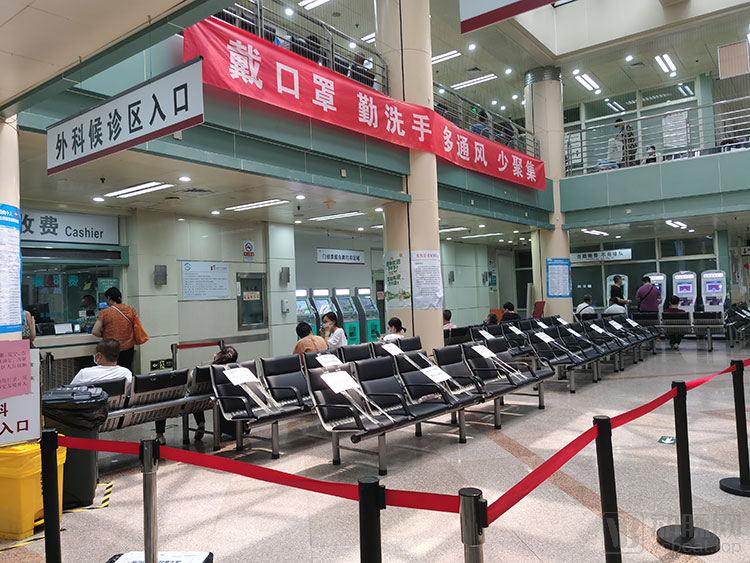
To Prevent Crowds During the Epidemic, Seats in the Outpatient Hall of Peking University Cancer Hospital Are to Be Used Every Other Seat
After receiving approval for internet-based medical consultation services in April, Peking University Cancer Hospital launched its online consultation platform in June. During the initial phase, the focus was primarily on enhancing functionality and optimizing workflows. Heng Fanxiu introduced that, in the early stages, the internet-based follow-up consultation feature mainly relied on mutual notifications among cancer patients and clinical trial participants within patient support groups.
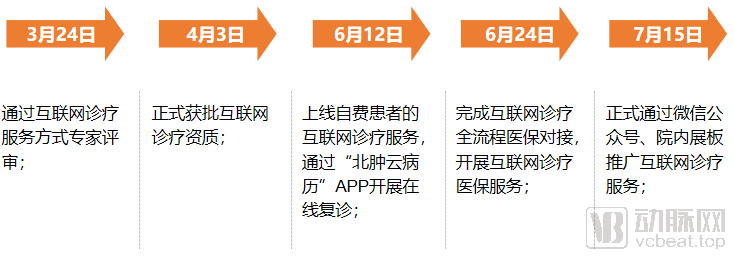
The Progress of Internet Diagnosis and Treatment at Peking University Cancer Hospital, Chart by VCBeat
On June 24, Peking University Cancer Hospital enabled medical insurance payment for internet-based diagnosis and treatment. On the same day, this feature went live at the West Campus, with online follow-up visits accounting for 33% of the total outpatient volume at that campus.
After an initial period of adjustment, the hospital officially launched its internet-based medical consultation services on July 15, promoting them through its WeChat official account and in-hospital display boards.
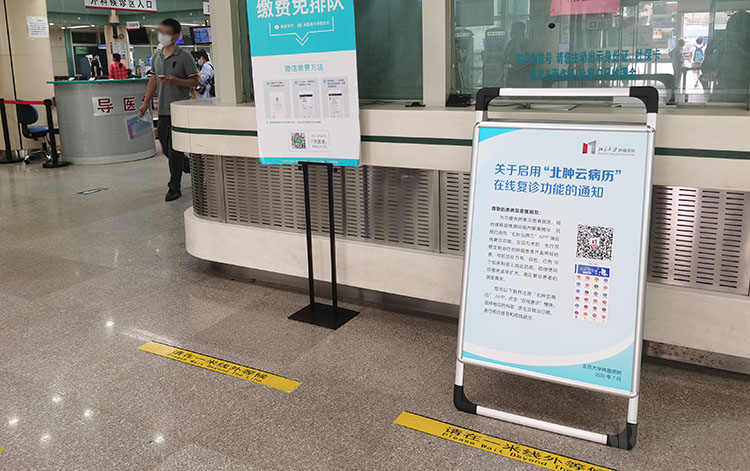 Promotional Display Board for Internet-Based Medical Consultations in the Outpatient Hall of Peking University Cancer Hospital
Since the launch of online outpatient services, the number of patients returning for follow-up consultations has gradually increased, rising from dozens to hundreds per day. As of August 7, a total of 125 physicians across 20 departments were providing internet-based outpatient care, having completed over 7,400 online follow-up visits cumulatively. On average, more than 25 physicians—including renowned specialists and professors—provide online services to follow-up patients each day, with nearly 400 consultations conducted on peak days, accounting for approximately 20% to 30% of the hospital’s average daily outpatient volume. Notably, these figures represent genuine clinical encounters addressing patients’ actual medical needs, excluding simple inquiries resulting from issues such as incorrect appointment bookings, for which the hospital processes refunds and cancellations.
Since the beginning of this year, Wuhan has vigorously developed internet healthcare in response to the needs of epidemic prevention and control. According to a report by Hubei Daily, data from the Wuhan Municipal Health Commission shows that in mid-May, the city’s daily online consultations averaged 8,626 visits over six consecutive days, accounting for 7.4% of offline consultations. As epidemic prevention and control measures become normalized, the volume of online consultations is showing a downward trend, while offline consultations are gradually recovering.
In contrast, during the period of routine epidemic prevention and control, Peking University Cancer Hospital still saw a gradual increase in the volume of internet-based medical consultations, which accounted for a high proportion of its total outpatient visits.
From Heng Fanxiu’s introduction, it is evident that Peking University Cancer Hospital has established two fundamental positionings for its internet-based medical services.
First, the focus is on addressing substantive follow-up visits, such as prescribing medications and ordering laboratory tests or examinations, rather than handling minor consultations or online inquiries. Second, unlike many public hospitals that view internet-based medical services as a complementary enhancement to offline care, Peking University Cancer Hospital regards online consultations as a substitute for offline visits, aiming to gradually transition more follow-up patients to the online platform.
These two strategic orientations are driven not only by patient needs and the characteristics of clinical diagnosis and treatment, but also by the hospital’s desire to allocate limited resources to substantive medical care rather than merely providing advisory consultation services.
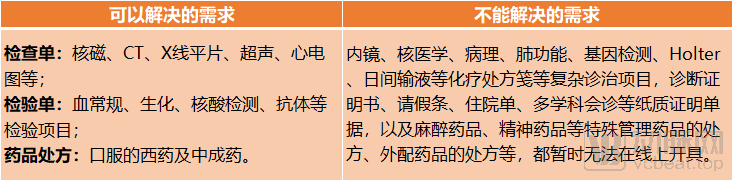 Peking University Cancer Hospital’s Internet Diagnosis and Treatment Project. Source: The hospital’s official WeChat account; graphic by VCBeat.
Meanwhile, the hospital has also established strict criteria for examination and laboratory tests prescribed via the Internet. Routine items such as complete blood count (CBC), biochemical assays, CT scans, and ultrasounds can be ordered online, whereas complex procedures—including pathology examinations, genetic testing, and chemotherapy prescriptions—are temporarily unavailable for online ordering due to considerations of diagnostic and treatment safety.
Having clarified the positioning of internet-based medical consultations, the hospital focused on process design and optimization from the perspectives of both patient and physician user interfaces during system development.
Integrated Online-Offline Patient Consultation Services Have Basically Taken Shape
Currently, the process for patients to receive medical consultations via the Internet is as follows:
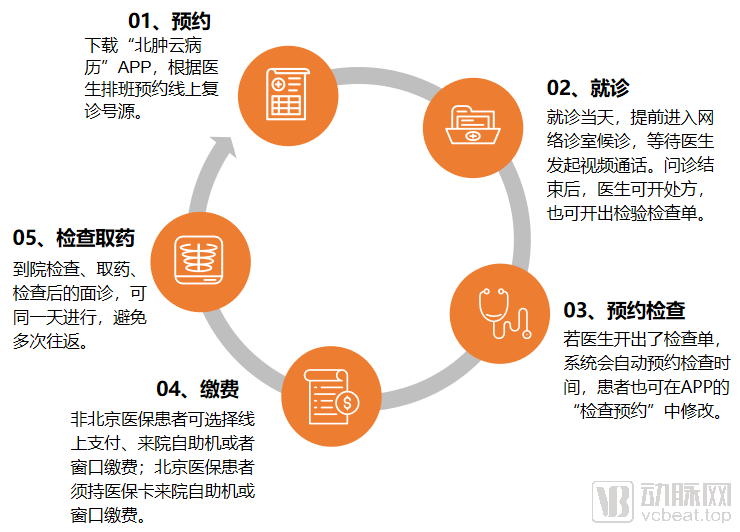 Patient Consultation Process for Internet-Based Medical Services at Peking University Cancer Hospital, Source: Hospital’s Official WeChat Account, Graphic by VCBeat
The entire process is broadly divided into five steps:
Online Appointment.Hospitals release appointment slots one week in advance, allowing patients to schedule based on physicians’ rosters; upon successful booking, patients receive notifications via SMS and app push alerts.
Online Consultation.Online appointment slots are valid for half a day. On the day of your visit, please have your mobile phone ready and ensure a stable internet connection, allowing you to wait for your consultation from any location. During the consultation, the physician can issue electronic prescriptions and order diagnostic tests and laboratory examinations online.
Appointment for Examination.If a physician orders laboratory or imaging tests, the system will automatically schedule the appointment for the patient. Patients may also modify their appointment time via the mobile app according to their own schedules.
Payment.Non-Beijing medical insurance patients can make payments both online and offline. For Beijing medical insurance patients, except for the medical service fee which can be paid online, other fees must be paid at the hospital. Additionally, there are time limits for payment.
Medication pickup.Patients can undergo examinations and collect medications at the hospital on the same day; patients from other regions may also purchase medications and undergo routine tests locally.
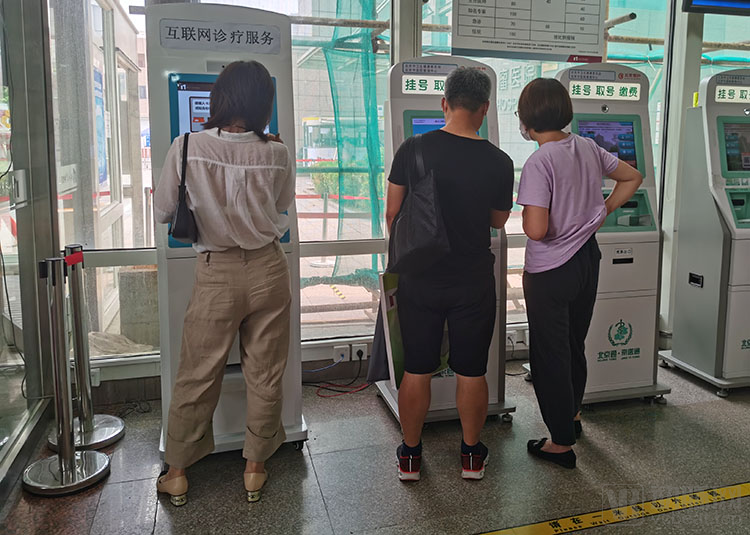 The Internet Diagnosis and Treatment Self-Service Kiosks in the Hospital Lobby Serve as the Connection Point Between Online and Offline Processes (e.g., Printing Test Orders)
At this point, the online and offline workflows for patients have been basically established. Since Beijing has not yet implemented card-free medical insurance settlement, physical cards must be used, requiring patients to settle payments in person at the hospital. Furthermore, for imaging examinations that rely on physicians’ clinical judgment, hospitals still recommend that non-local patients return for an annual check-up.
Convenient for doctors, no need to change existing habits
“Backend functionalities must always be designed around physicians’ needs. If the system is not user-friendly for doctors, it will be difficult to promote internet-based medical consultations,” said Heng Fanxiu.
The hospital’s Information Department collaborated with its IT service provider on technical development and system integration. For instance, the Information Department was responsible for offline modifications to the Hospital Information System (HIS), while Beijing Jiahe Meikang, the vendor of the hospital’s original online patient service platform—the “Beijing Cancer Hospital Cloud Medical Record” app—handled the online development for internet-based medical consultations. Ultimately, the internet consultation platform was integrated with core systems such as HIS, LIS, and PACS. During consultations, physicians only needed to use an additional video and text-chat window; prescriptions and laboratory or imaging orders could be processed directly within the existing HIS outpatient physician workstation and sent to patients with a single click. Patients could also receive important information, such as prescriptions and test results, via the app, thereby enabling rapid and direct doctor–patient communication.
On July 30, during an online consultation, Dr. Sun Junyong had two computers on his desk: the one on the left was running the hospital’s legacy information system, while the one on the right, equipped with a camera, was used for internet-based medical consultations. The screen of the right-hand computer displayed the patient’s appointment, check-in, and consultation status, along with video and text chat windows.
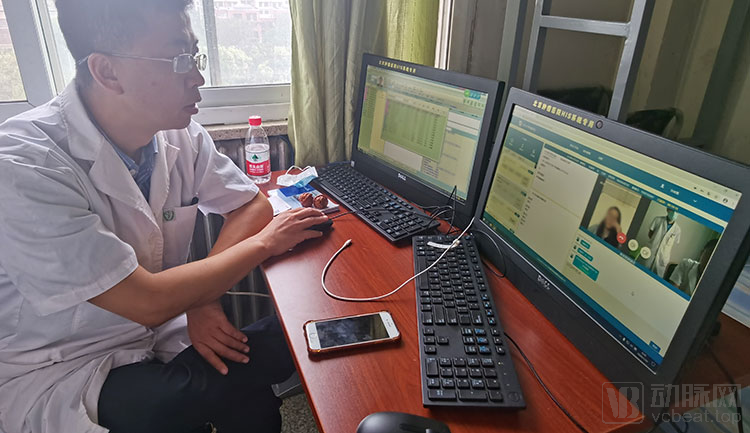 Dr. Sun Junyong, a head and neck surgeon at Peking University Cancer Hospital, conducts an online consultation
A postoperative follow-up visit for a thyroid cancer patient was due. Sun Junyong clicked the video icon and quickly connected with the patient. The patient reported recent pain around the surgical site. Sun Junyong guided the patient to adjust the camera angle, and after visual inspection, he preliminarily determined that the issue was not serious, recommending an ultrasound examination. Subsequently, Sun Junyong issued the test order on his left-side computer and sent it to the patient with a single click. “For physicians, there is no need to change their established routines. Video consultations and text-based communication are straightforward, much like chatting online,” said Sun Junyong.
Meanwhile, thanks to the high degree of interoperability between internet diagnosis and treatment platforms and hospitals’ legacy systems, physicians can arrange a range of services for patients during online consultations. During a follow-up visit, a physician prescribed medication and noted that the patient had not yet undergone her scheduled comprehensive examination, so an order for the exam was issued. The patient requested an in-person consultation after completing the examination to discuss the results face-to-face. After checking appointment availability, the physician promptly booked the earliest available in-person slot for the patient and advised her to undergo the examination at the hospital on the morning of her scheduled visit and return in the afternoon to review the results with the physician.
In other words, a brief video consultation lasting just a few minutes enabled the physician to address a series of issues for the patient, including prescribing medication, scheduling diagnostic tests, and arranging the next follow-up visit. In the past, resolving these matters might have required the patient to make multiple trips to the hospital.
Despite objective constraints such as health insurance settlement processes and the specific nature of certain diagnostic tests, which still require patients to visit hospitals regularly, patient experience has significantly improved overall, and physicians’ workflows have become more convenient. The hospital has optimized its processes to the greatest extent possible under existing conditions, which is one of the key reasons for the rapid increase in internet-based medical consultations over a short period.
Drug delivery and mobile physician consultation services will be enhanced.
Given the straightforward positioning of internet-based medical consultations and the ease of use for physicians, hospitals do not need to establish a separate operational team. In daily operations, the Information Department, led by Heng Fanxiu, coordinates subsequent functional development and optimizes system features by collecting physicians’ needs and patient feedback.
Currently, internet-based diagnosis and treatment services at Peking University Cancer Hospital are still in their early stages. Heng Fanxiu has already compiled a list of features that urgently need to be improved. For example:
Drug Delivery. As certain oncology medications require cold-chain logistics, this service must be conducted with a primary focus on ensuring the safety of drug delivery.
Mobile Enablement of Physician Consultations. Currently, physicians can only conduct consultations via PC during working hours; with the integration of mobile platforms, they can also provide care anytime by leveraging fragmented time slots.
Expand access to online medical consultations by adding WeChat Mini Programs and PC-based platforms, providing patients with more options.
Furthermore, technological and procedural upgrades are being implemented to enhance efficiency for both patients and healthcare providers, such as facial recognition for patient identity verification, online informed consent signing, and self-service admission and discharge.
Once the physician-facing features are fully developed, online and offline workflows will be further integrated, thereby enhancing engagement among both physicians and patients.
Despite the many unique characteristics of Peking University Cancer Hospital as a specialized oncology institution compared to general hospitals and other specialized hospitals of the same level, we have still identified some valuable lessons by examining its development path for internet-based medical services.
First, accurately identify the value of hospitals and physicians.
At tertiary hospitals in Beijing, the medical service fee (i.e., registration fee) is RMB 50 for general outpatient visits, and RMB 60, RMB 80, and RMB 100 for associate chief physicians, chief physicians, and renowned experts, respectively. In accordance with regulations issued by the National Healthcare Security Administration, public medical institutions providing internet-based follow-up consultations, regardless of the professional rank of the healthcare personnel delivering the service, shall charge fees based on the pricing standard for general outpatient consultation services.
At Peking University Cancer Hospital’s internet outpatient clinic, physicians of all levels provide consultations, yet the medical service fee is uniformly set at 50 yuan. This means that both the hospital’s revenue and the income of senior physicians have been adversely affected.
The disparity between online and offline follow-up consultation fees is one of the reasons why many public hospitals lack enthusiasm for launching internet-based medical services. According to Heng Fanxiu, Peking University Cancer Hospital has vigorously promoted internet-based diagnosis and treatment from top to bottom. Although there was a certain loss in follow-up consultation fees, the improved efficiency of follow-up visits allowed the hospital to allocate more resources to admitting first-time patients, particularly those with complex and critical conditions. Accumulating more such cases has contributed to the development of the hospital’s academic disciplines, thereby continuously enhancing its influence.
The same applies to physicians. Sun Junyong explained that the accumulation of clinical experience is inextricably linked to the diagnosis and treatment of a large and diverse patient population. “If a physician’s peak performance hours are consumed by routine follow-up visits, they may already be fatigued when seeing new patients.” In Sun Junyong’s view, the ideal approach is to handle follow-up consultations during fragmented time slots, while reserving periods of highest mental alertness for initial consultations. “This way, rather than rushing through each patient in three to five minutes, physicians can spend more time with them, leading to greater patient satisfaction and fostering better professional growth for the doctors themselves.”
When hospitals and physicians clearly recognize the value a particular initiative brings to themselves, the implementation process naturally proceeds more smoothly.
Second, be practical and simplify the complex.
After several years of development, internet healthcare has formed a series of services covering information, tools, medical care, pharmaceuticals, and insurance, centered around online follow-up consultations. Peking University Cancer Hospital retains only core follow-up consultation services and related pharmaceutical and medical insurance services. This approach facilitates focused efforts to streamline processes rapidly and enable in-depth optimization in subsequent stages, thereby avoiding the pitfall of offering an excessive variety of services that may lead to mediocre performance across the board.
Of course, this also depends on the specialized characteristics of the hospital. Oncology hospitals prioritize improving patient survival rates and enhancing postoperative quality of life, where patients’ therapeutic needs far outweigh their consumer-oriented demands. Other hospitals should also precisely define the scope of their internet-based services according to patient needs.
Impacted by the pandemic, the overall service volume of medical institutions across China declined, with a gradual recovery only beginning in April. Beijing experienced several phases of strict epidemic control, leading to a more pronounced impact on hospitals’ offline services. At Peking University Cancer Hospital, the majority of patients originally came from areas outside Beijing. According to Heng Fanxiu, since the onset of the pandemic, the proportion of non-local patients has decreased, with the ratio of non-local to local Beijing patients dropping from the original 2:1 to 1:1.
Internet-based medical consultations represent both a new service channel for hospitals and one of the means to gradually restore service volumes. With the introduction of services such as mobile-based physician consultations and pharmaceutical delivery, the volume of internet-based consultations at Peking University Cancer Hospital is expected to increase further.
During this visit, we also observed an interesting phenomenon: some patients who had booked online consultation slots still came to the hospital on the day of their appointment. On one hand, they felt more reassured by seeing the doctor in person; on the other, they assumed that an in-person hospital visit was required. Patient education and habit formation for internet-based medical services made significant progress during the pandemic, but this detail suggests there is still a long way to go. This is not just a challenge for individual hospitals; it requires concerted efforts across the entire industry.