

2020 China Health Industry Capital Summit Grandly Opens in Boao

Gan&Lee Pharmaceuticals
Biological Synthetic Human Insulin Pharmaceutical R&D Manufacturer

Akeso
Innovative Antibody Drug Developer
BeOne
Developer of Molecular Targeted and Immune Anti-Tumor Drugs

Henlius
Innovative Biopharmaceutical Company
On August 12, 2020, the Health Industry Capital Summit (hereinafter referred to as the “Capital Summit”) grandly opened at the Boao Forum for Asia Hotel in Hainan, simultaneously kicking off the 2020 China Health Industry Ecosystem Conference. This summit was jointly organized by Sinohealth Information, CITIC Securities, and Guosheng Securities.
The continuous growth and release of health demands have driven the sustained development of the pharmaceutical and healthcare industry. In 2019, the pharmaceutical and biotechnology sector accounted for 10.79% of the total market capitalization of A-shares, ranking second among all sectors. The COVID-19 pandemic in 2020 further accelerated the growth of the pharmaceutical industry, making it an opportune time to explore the future of China’s healthcare industry and investment landscape.
Let’s take a comprehensive look at this year’s Capital Summit.
I
Industry Development and Investment Trends
At the macro-policy level, two industry luminaries will share their insights. Zhang Wei, former Secretary-General of the Chinese Pharmacopoeia Commission, will introduce the impact of the 2020 edition of the Chinese Pharmacopoeia on the pharmaceutical and health industries. Cai Jiangnan, Founder and Executive Chairman of the Shanghai Chuanqi Health Development Research Institute, will analyze the long-term impact of new healthcare reform trends on the industrial structure of the broader health sector.
The 2020 edition of the Chinese Pharmacopoeia has refined the drug standards system, providing guidance for drug development and post-marketing quality control. This reflects the concept of full lifecycle management of pharmaceuticals, helping to enhance drug quality, promote process optimization, and accelerate product iteration, thereby driving supply-side structural reforms in the industry. More than a decade into the new healthcare reform, the 2019 emphasis on improving quality and controlling costs had significant short-term impacts. Looking ahead, what are the trends in healthcare reform, and what long-term effects will they bring?
At the industry development level, Wang Gang, Chief Scientist of Clarivate’s Life Sciences and Pharmaceuticals Division for Greater China, will present an overview of the global innovation pipeline and outlook for China. This analysis will provide a comprehensive view of hotspots and progress in global innovative drug R&D, while forecasting the future competitive landscape based on the R&D pipelines of Chinese pharmaceutical companies. These insights will be of significant value in guiding R&D strategy and investment decisions.
Over the past two years, strong policy support from the capital market has significantly boosted the development of the innovative drug industry, while also sparking some debate over its valuation. How can investors navigate these trends and succeed in the “science + capital” game of innovative drugs? Cheng Jie, Managing Director at CITIC Securities, will introduce reforms in China’s capital market policies and their impact on investment in the pharmaceutical and healthcare industries. Guo Xiaoyun, General Manager of the Industrial Capital Research Center at Sinohealth Information, will explore investment opportunities amid the upward evolution of China’s pharmaceutical and healthcare sectors.
II
Innovation Strategy for Pharmaceutical Manufacturing Enterprises
Amid new industrial development and investment trends, companies across all segments of China’s health industry have formulated innovation-driven growth strategies. Enterprises in pharmaceutical manufacturing, medical devices, healthcare services, and third-party services are each leveraging their unique strengths to compete and thrive.
Major pharmaceutical companies such as Hengrui Medicine and Sino Biopharmaceutical are advancing innovation while maintaining their generics businesses. Tao Weikang, Deputy General Manager of Jiangsu Hengrui Medicine Co., Ltd., will present Hengrui Medicine’s innovative strategies in its internationalization process. Xie Xin, Executive Director and Senior Vice President of China Sino Biopharmaceutical Limited, will deliver a presentation titled “Accelerating the Transition from Old to New Growth Drivers in Generics, While Building a Moat with a Thriving Innovative Drug Portfolio,” outlining the company’s strategy of integrating generics and innovation.
Junshi Biosciences and BeOne Medicines are both biotechnology companies founded on innovation and dedicated to innovative development, with internationalization as their strategic focus. Wang Gang, Vice General Manager and Chief Quality Officer of Junshi Biosciences, will introduce the dual filing strategy in China and the United States—a pathway for Chinese innovative pharmaceutical companies to go global during the pandemic and post-pandemic eras. Benefiting from regulatory policies, clinical data obtained overseas can be used for domestic submissions under certain conditions. By conducting U.S.-based (international multi-center) clinical trials, companies can achieve dual filings in both China and the United States, thereby killing two birds with one stone.
Wu Xiaobin, General Manager of BeOne Medicines’ China Region and President of the Company, will present the company’s global resource integration strategy as a pioneer in innovative cancer therapies. By July 2020, BeOne Medicines had marked its 10th anniversary, growing into an internationally influential biotechnology enterprise with a market capitalization exceeding RMB 100 billion (HKEX). It has launched two innovative drugs with significant “blockbuster” potential both domestically and internationally: the PD-1 inhibitor tislelizumab and the BTK inhibitor zanubrutinib. The early-stage R&D pipeline disclosed during the investor conference call on July 9 focuses on oncology treatments and comprises more than 25 assets, eight of which carry global development rights. The next decade for BeOne Medicines holds considerable promise.
Henlius has deeply cultivated the biosimilars sector, launching Hanlikang (a rituximab biosimilar), China’s first approved biosimilar. Meanwhile, the company is also making significant strides in innovative biologics. Liu Shigao, Co-founder and CEO, will present Henlius’s journey to becoming a leading biosimilar enterprise in China.
In recent years, a number of emerging biotechnology companies have come to the fore, with Akeso being a notable example. One of its distinguishing features is its strategy of leveraging collaborations with multiple large pharmaceutical companies to drive growth, with a focused R&D effort on bispecific antibodies in high-demand therapeutic areas. Chen Chen, Vice President of Business Development, will present the company under the theme “A Rising Star in Bispecific Antibody R&D: Soaring on the Dual Wings of Internationalization and Collaboration.”
Gan&Lee Pharmaceuticals will increase its investment in R&D and internationalization strategy to seize the first-mover advantage in import substitution. Some regions have already begun implementing volume-based procurement (VBP) for insulin, following a logic similar to that of VBP for generic chemical drugs. Improving quality while reducing prices and substituting imports are likely to become future trends in the insulin market.
Zhong Xianggang, President of Kunming Pharmaceutical Group, which primarily focuses on traditional Chinese medicine (TCM) business, will introduce the restructuring of advantages under the new competitive landscape for branded pharmaceutical enterprises, driven by the dual engines of health consumption and R&D innovation. Gao Dengfeng, President of Dong-E-E-Jiao Co., Ltd., a TCM enterprise, will present how to achieve a new upgrade in the marketing of national medical treasures by creating warm and precise consumer services. Guo Jiaxue, head of Guangyuyuan, will discuss how digitalization helps time-honored brands regain vitality. Liu Wusheng, General Manager of Shandong Hongjitang Pharmaceutical Group Co., Ltd., will introduce the new opportunities embraced by the company during the dimensional upgrade of China’s pharmaceutical industry.
3
Innovation Strategies for Medical Device, Healthcare, and Third-Party Service Enterprises
The global COVID-19 pandemic has reinforced the public’s health philosophy centered on prevention, while the persistent outbreak overseas has driven demand for products and services provided by China. Since 2020, the medical device, healthcare service, and third-party service sectors have achieved remarkable development, propelled both by market forces and by companies’ timely strategic adjustments.
Zhou Jun, CEO of Huirui Gene, introduced a new chapter in the clinical application of genetic testing: early cancer screening. Early detection and intervention through early cancer screening can significantly improve patient survival while avoiding the waste of medical resources and alleviating patients' financial burden. Li Shaobo, Chairman of Sinocare Inc., will discuss opportunities in the post-pandemic era and digital-intelligent transformation to simplify diabetes management.
Yu Rong, Chairman of Meinian Onehealth Healthcare Group, will introduce the strategy of building a medical ecosystem with health check-ups as the entry point for health management. This approach aligns closely with the concept of strengthening disease prevention outlined in the Healthy China 2030 Planning Outline and holds significant meaning for alleviating the pressure on healthcare expenditure. Hao Bixi, Senior Vice President of KingMed Diagnostics, highlighted the substantial role and sense of responsibility demonstrated by independent clinical laboratories (ICLs) during the pandemic, asserting that the rise of the ICL industry will drive the enhancement of China’s medical testing capabilities.
As third-party service providers, CROs, CDMOs, and CMOs have achieved robust growth in recent years, benefiting both from the shift of segments of the pharmaceutical industry chain from mature to emerging markets and from the rising R&D and manufacturing demands for innovative drugs. Aspharm is a prominent representative among CDMOs; the company has sustained rapid development over many years, with its 2019 net profit increasing by 29.32% year-on-year and revenue from clinical-stage projects surging by 70.89% year-on-year. Hong Hao, Chairman and CEO of the Pharmaceutical Group, will discuss how manufacturing technologies advance new drug R&D in China and enhance drug “accessibility.”
IV
Pharmaceutical and Healthcare Venture Capital Special Session & Industry-Investment Face-to-Face
Following discussions on industrial policy, capital policy, the industry landscape, and corporate strategy, the Capital Summit will proceed to a dedicated session for venture capital investment in pharmaceutical and healthcare projects.
Huang Qing, CEO of GTJA Investment, will present on value reassessment and new investment strategies in the context of the healthcare industry’s dimensional upgrade. What are pharmaceutical investors seeking amidst this industry evolution? This is a question not only for investors to ponder but also, more critically, for companies seeking financing. During the thematic panel discussion, this issue will be explored in depth by numerous industry leaders, including Fan Dalong, Executive Partner at GTJA Investment; Guo Qiushan, Managing Partner at Miracle Light Venture Capital Fund Management; Li Xiaoqiang, Senior Partner at Union Ventures; Zhang Jianbin, Partner at IDG Capital Healthcare Fund; and Zhou Yujian, Managing Partner at Mifang Capital.
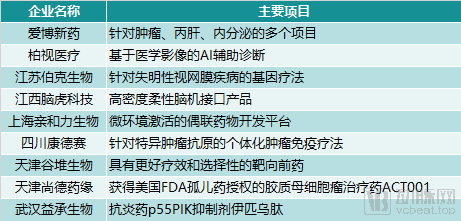
At the venture capital special session, in addition to an introduction to investment logic, there were also roadshows for selected high-quality innovative drug and medical device projects. Nine highly promising companies presented cutting-edge R&D projects in the pharmaceutical and healthcare industries. (Figure 1)
Figure 1. Projects in the Special Venture Capital Roadshow for Pharmaceutical and Healthcare Initiatives
In addition to the keynote speeches delivered by numerous entrepreneurs and industry experts, the Capital Summit features the “Industry-Investment Face-to-Face” session, a dedicated forum established since its inaugural edition that facilitates one-on-one discussions between project proponents and investors. Nearly 40 listed companies participated in this session, covering virtually all subsectors of the pharmaceutical industry.
V
Conclusion
The 2020 CPHI Health Industry Capital Summit is a critical and integral component of the CPHI Conference, benchmarked against the J.P. Morgan Healthcare Conference. At the Capital Summit, you will not only gain a comprehensive overview of the nuances and implications of industry policies, insights into the current landscape and trends of industry development, a deeper appreciation of corporate strategy, and an understanding of capital market considerations and directions, but also seize valuable opportunities for in-depth engagement with business leaders, investors, and industry experts.
Stay tuned for in-depth coverage of the conference.