

Daxiang Biotech Files IPO Prospectus: Pioneering China's First Commercial Organ-on-a-Chip Platforms to Transform Drug Discovery
Daxiang
Developer and Producer of Human Organ Chips and Organoid Chips
“A miniature model of a human organ, no larger than a memory card, enables researchers to examine biological mechanisms and behaviors, testing processes, and control processes in unprecedented ways, bringing about a radical transformation in medicine and drug manufacturing.” At the 2016 World Economic Forum in Davos, organ-on-a-chip was named one of the top ten emerging technologies, ranking alongside other innovative technologies such as blockchain, nanosensors, and graphene.
In the field of biomedicine, organ-on-a-chip technology is highly likely to emerge as another disruptive frontier technology, offering solutions to the challenges faced in biomedical research and development.
According to research and analysis by MEMS Consulting, organ-on-a-chip technology has the potential to provide better predictive outcomes for physiologically relevant in vitro drug testing. It can save hundreds of millions of dollars in development costs annually, shorten drug development timelines, and avoid failures caused by the lack of predictability in alternative models such as 2D cell cultures and animal experiments.
The integration of tissue engineering and microfluidics enables the construction of key elements of the organ “microenvironment”—such as living cells, tissue interfaces, biofluids, and mechanical forces—within the compact footprint of an organ-on-a-chip device, thereby recapitulating the structural and functional characteristics of human organs in vitro.
Based on this chip, the breathing “lungs,” beating “heart,” and flowing “blood vessels”... begin to be separated from animal bodies that are taxonomically distinct from humans, existing independently outside the human body.Organ-on-a-chip technology will significantly enhance experimental precision and accelerate the research and development process.
In fact, when the concept of organ-on-a-chip was first introduced to China in 2010, the core team at Daxiang began researching and studying this field. With over a decade of research experience, its key personnel possess specialized expertise in both microfluidic chip technology and cell tissue engineering. Notably, Xiao Rongrong, CTO of Daxiang, conducts research spanning multiple disciplines, including biotechnology, microfluidics, tissue engineering, and molecular biology.
The R&D capability for core technologies has been a major reason why Daxiang has emerged as a leader in the still-nascent organ-on-a-chip market.
Currently, Daxiang has developed three organ-on-a-chip platforms and, building on this foundation, established various organ-on-a-chip models—including tumor, liver, blood-brain barrier, liver-tumor, and blood-brain barrier-tumor models—thereby achieving a transition from 2D to 3D cell culture systems.
In 2004, the world’s first research article on organ-on-a-chip technology was published, introducing this concept. In 2010, when research on organ-on-a-chip in China and the United States was still largely at the same starting point, the U.S. government began to provide organized and systematic support for organ-on-a-chip research and subsequent industrialization, investing substantial resources into its development.
Although Chinese research institutions also began to devote more efforts to the study of organ-on-a-chip technology around 2010, the Ministry of Science and Technology launched a major special project on organ-on-a-chip in 2013.However, the organ-on-a-chip industry in China still lacks sufficient funding and systematic governmental support, remaining largely at the research stage with predominantly academic publications and minimal industrial application, resulting in relatively lagging industry development.
Compared to the predominance of animal models in preclinical new drug trials in China, Western pharmaceutical companies have continued to increase their investment in organ-on-a-chip research and application, driven by their pursuit of greater experimental precision and higher R&D returns.Organ-on-a-chip has gradually become an important tool for reducing animal testing and advancing new drug development.
In the past, domestic pharmaceutical companies primarily focused on developing generic drugs and had low requirements for preclinical trial data, resulting in a lack of application scenarios for organ-on-a-chip technology in China.Since 2017, China has intensified its policy support for the innovative drug industry. The issuance of multiple policies has ushered domestic innovative drug R&D into a golden era, making autonomous and controllable biomedical research and development a national strategic priority.
Years of accumulated experience in the industry have enabled Daxiang to keenly identify this market pain point, leading it to make in-depth strategic investments in the organ-on-a-chip sector.By assembling a team of specialists proficient in general microfluidics, medical tissue engineering, cell biology, pharmacology, pathology, and other disciplines, we have leveraged core R&D capabilities to achieve the seemingly impossible, launching China’s first commercial organ-on-a-chip platforms—IBAC S1, IBAC M1, and IBAC M2—as well as other organ-chip models.to reduce the cost of new drug development, shorten the development cycle, and lower the risk of failure.
For research users, Daxiang has specially developed the IBAC S series organ-on-a-chip. ThisOne category of chips is the 3D single-organ-on-a-chip. Compared with low-adhesion U-bottom culture plates on the market, the nested design of large and small wells in this type of chip reduces the gel volume required for each small well to just 1–10 μL. The anti-evaporation design effectively addresses the edge effect in experiments, thereby reducing the consumption of new drug candidates during R&D. Its 96-well format enables high-throughput drug screening.
Meanwhile, this organ-on-a-chip device exhibits strong biomimetic capabilities for the cellular microenvironment, making it suitable for 3D cell culture based on various hydrogels. It is compatible with high-content screening instruments, enabling precise positioning for imaging assays. The ultra-thin, optically transparent glass bottom provides a foundation for higher-quality imaging. Regarding materials, Daxiang uses black material to address the issue of fluorescence signal crosstalk.
Currently, Daxiang has utilized IBAC S1/SR1 to construct 3D tumor models and 3D PHH hepatotoxicity models, and has completed experiments including organoid culture and angiogenesis.
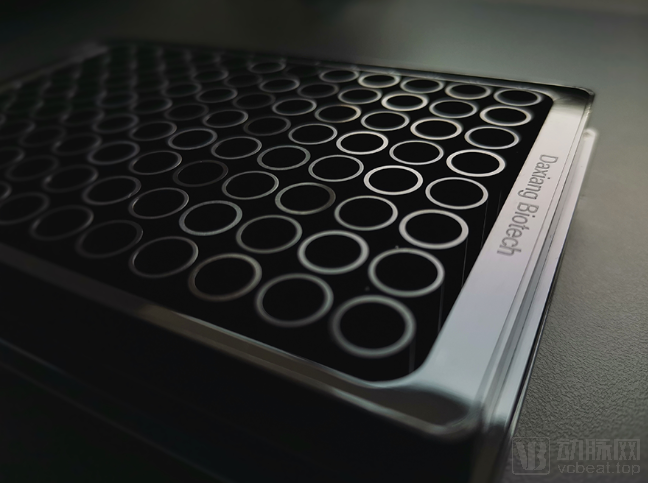
IBAC S1
The IBAC M series specializes in multi-organ-on-a-chip systems. The IBAC M1, a barrier organoid-on-a-chip platform, utilizes gravity-driven fluid flow to achieve high-throughput, pump-free, continuous and constant perfusion. This organ chip not only incorporates the functionalities of the IBAC S series but is also compatible with commercial transepithelial/transendothelial electrical resistance (TEER) measurement instruments, enabling rapid, real-time monitoring of barrier integrity. Based on the IBAC M1, various single-organ models with barrier functions can be established, such as blood-brain barrier, intestinal, renal, and pulmonary models. Additionally, it supports the construction of multi-organ co-culture models with barrier functions, including BBB-tumor models and gut-brain axis models.
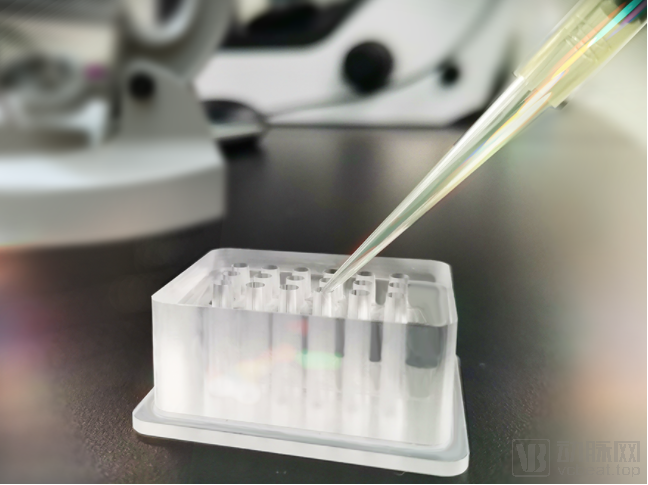
IBAC M1
IBAC M2 is a coupled multi-organ chip developed and manufactured by Daxiang. Its vertically coupled chip design enables flexible assembly and disassembly. The cross-shaped design of the upper chip allows for minimal, efficient fixation of 3D organoids. The channel design of the lower chip permits medium exchange and drug administration without dismantling the chip, making it more convenient and user-friendly. Based on the IBAC M2, non-barrier multi-organ co-culture models can be constructed, such as liver-tumor models.
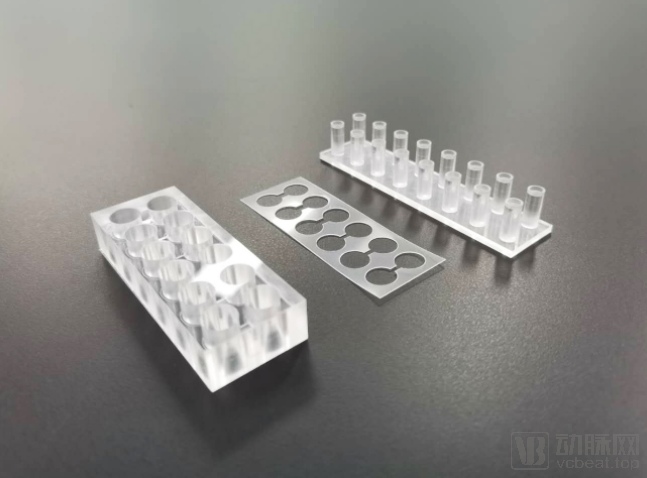
IBAC M2
The launch of Daxiang’s three products meets the multidimensional requirements of drug development, fills the domestic market gap for commercial organ-on-a-chip solutions, mitigates the potential risk of technological containment by foreign companies, and provides Chinese pharmaceutical companies with more competitive innovative technologies and platforms for new drug R&D.The emergence of domestically produced organ-on-a-chip technology is of great significance for advancing the new drug development process in China’s biopharmaceutical industry.
As is well known, the R&D cycle for innovative drugs, from conceptual design to market launch, can even be a marathon lasting more than 10 years. However, throughout this prolonged endeavor, the return on investment (ROI) in new drug development remains a critical concern for biopharmaceutical companies. According to a Deloitte research report, the ROI for large biopharmaceutical companies reached a nine-year low in 2019, standing at merely 1.9%. For pharmaceutical companies, high-intensity R&D investment does not necessarily yield commensurate returns.
“We aim to build a healthier world through organ-on-a-chip technology, empowering new drug development and personalized precision medicine. By reducing the time, cost, and failure rate of drug R&D, we ultimately benefit patients,” Zhou Yu, founder of Daxiang, told VCBeat. It is this original aspiration that has emboldened Daxiang to venture into this emerging field, providing more solutions for new drug development.
“Organ-on-a-chip” and “organoid-on-a-chip” are the two core technologies currently held by Daxiang, which is conducting ongoing research into a “one-stop microfluidic culture system.”
“Biomimicry does indeed enhance experimental precision, but an unrelenting pursuit of it only increases the operational complexity of organ-on-a-chip systems and reduces throughput, rendering them flashy yet impractical. We need to address this issue and find a balance,” said Zhou Yu.Unlike overseas organ-on-a-chip technologies, Daxiang’s organ chips do not blindly pursue biomimicry; instead, they continuously seek the optimal balance between biomimetic fidelity and throughput to maximize utility.Daxiang provides highly biomimetic, microvolume, high-throughput, and efficient organ-on-a-chip products tailored to the R&D needs of pharmaceutical companies.
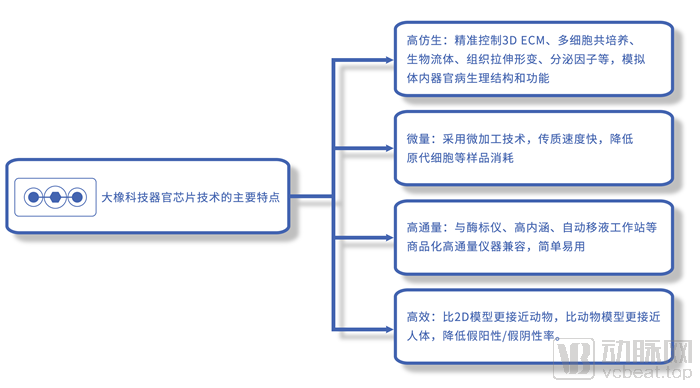
Key Features of Daxiang's Organ-on-a-Chip Technology
Meanwhile,Daxiang leverages the technological advantages of organoids and organ-on-a-chip systems to establish an organoid-on-a-chip platform, achieving complementary strengths between organoid and organ-on-a-chip technologies by enhancing biomimicry at the cellular source level within the organ-on-a-chip core.Among these, the organ-on-a-chip platform offers the following advantages:
1. Fluidic channel design to address nutrient and metabolic limitations in traditional static culture systems and simulate mechanobiological signals, thereby improving the success rate of organoid culture.
2. Chip miniaturization reduces the cost of organoids and consumables.
3. Secreted factors in micro-culture systems accumulate more readily to higher concentrations, enabling culture of small sample volumes, shortening the culture period, and improving experimental efficiency.
4. The chip utilizes non-PDMS materials to reduce nonspecific adsorption of small-molecule drugs.
5. Stability and reproducibility, reducing variations in size, structure, function, and gene expression.
6. User-friendly chip design to reduce operational complexity and result variability caused by manual handling.
7. An all-in-one chip solution enabling the workflow from organoid culture to high-throughput drug sensitivity testing.
Currently, Daxiang focuses on the research and development of organ-on-a-chip technologies for oncology, liver, and barrier applications.
Meanwhile, Daxiang will build upon its three organ-on-a-chip platforms to further expand pathology and physiology models related to the intestine, kidney, lung, and non-alcoholic steatohepatitis (NASH), as well as innovative organoid-on-a-chip models. To date, it has established various pathophysiological models, including those for tumors, liver, blood-brain barrier, liver-tumor, and blood-brain barrier-tumor interactions.
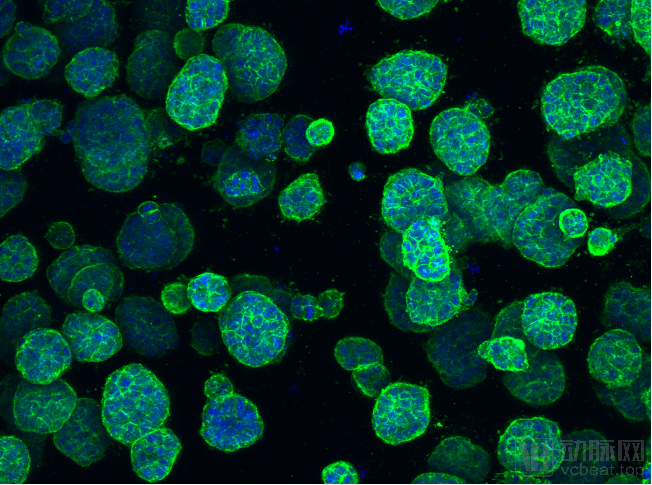
Tumor Model - IBAC Tumor
Daxiang’s organ-on-a-chip technology focuses on the progression of human diseases, conducting research on in vitro models required for medical conditions that remain unresolved or challenging to treat. The newly launched products provide additional data and experience for the company’s subsequent R&D efforts, enabling Daxiang to develop organ-on-a-chip models that balance biomimicry with high-throughput capabilities to meet drug development needs. This positions the company to offer standardized technical tools and platforms for “Phase 0” clinical trials.
Although many challenges remain to be addressed in the future development of organ-on-a-chip technology—such as how to better construct pathological models based on biomimetic physiological models, how to truly achieve multi-organ connectivity and interaction to approximate the functions of human systems biology, and issues related to product standardization, ease of use, and reproducibility—Daxiang has clearly opened the door to domestically produced organ-on-a-chip technology.
In the future, Daxiang will continue to explore the broader possibilities of organ-on-a-chip technology, leveraging digital means to replicate life and disease processes. This approach aims to enhance the efficiency and success rate of new drug development while reducing costs, thereby advancing the realization of precision medicine.