

Borcheng Launches World's First Gene Methylation-Based Blood Test for Early Gastric Cancer Detection, Pioneering a New Era in Cancer Screening
“Reducing cancer mortality cannot rely on various novel drug therapies for mid- to late-stage cancers, but rather on early detection, early diagnosis, and early treatment.” This is the insight and practical wisdom gained by Dr. Han Xiaoliang, Chief Technology Officer of Biochain, after years of researching cancer treatment.
Han Xiaoliang holds an M.D. from Peking Union Medical College and completed his postdoctoral training at the University of California School of Medicine. He has over 20 years of experience in the biopharmaceutical field. During his studies in the United States, Dr. Han pioneered a gene therapy approach using retroviral vectors for the targeted treatment of breast cancer. Although this technique demonstrates significant therapeutic efficacy, the issue of disease recurrence remains.“Cancer is insidious; if even a single cancer cell remains uneliminated, it can rapidly recur. Early detection and early treatment are key to improving therapeutic outcomes and reducing mortality.”
Consequently, Dr. Han became committed to the field of early cancer screening and diagnosis. In 1994, he co-founded BioChain Institute in the United States with his partners. The company has developed more than 5,000 products, providing technologies and solutions that enable leading diagnostic companies and pharmaceutical enterprises worldwide to identify biomarkers for early cancer detection and discover drug targets. It supplied core materials and technical services for the development of the world’s first liquid biopsy product based on EGFR gene mutations, with its products distributed globally.
Having spent many years establishing a business in the United States, the BioChain Institute team has accumulated extensive expertise, proprietary technologies, products, and rich experience in the discovery of targets for early cancer detection and diagnosis. In 2006, the core team returned to China to found Boercheng, focusing on the development and industrialization of products for the early detection and diagnosis of cancer and other major diseases.
Upon returning to China, Dr. Han led the Biochain team in participating in several national key R&D projects: in 2014, they joined the multicenter screening project for lung cancer and colorectal cancer jointly conducted by the National Cancer Centers of China and the United States; in 2016, their products for colorectal cancer, gastric cancer, and esophageal cancer were selected for the National “13th Five-Year” Key R&D Program; in 2017, their lung cancer product was selected for the National “13th Five-Year” Key R&D Program; and in 2018, their lung cancer product was again selected for the National “13th Five-Year” Key R&D Program.
Meanwhile, Biochain has received numerous honors during its development: In 2018, it was awarded the “Technology Entrepreneurship Contribution Award” by the China Technology Entrepreneurship Association; in 2019, its RNF180 gastric cancer detection product won the Second Prize at the China Medical Device Innovation and Entrepreneurship Competition; in 2019, it secured industrialization funding exceeding RMB 10 million from Zhongguancun for the project “Translation and Industrialization of Early Gastric Cancer Warning and Screening System Achievements”; in 2019, it received several million yuan in technological innovation funding from the Beijing Municipal Science & Technology Commission for the clinical study titled “Clinical Research on an Automated Nucleic Acid Processing–Methylation Analysis System for Early Diagnosis of Esophageal Cancer”; and in 2020, it obtained hundreds of thousands of yuan in funding from the Beijing Economic-Technological Development Area for the project “Feasibility Study on Screening and Prevention of Asymptomatic Potential Infections with Novel Coronavirus.”
After more than 10 years of development,Biochain has becomeThe pioneer and leader in China in achieving full-chain industrialization of early cancer detection, diagnosis, and intervention.The company holds dozens of products with National Medical Products Administration (NMPA) approval numbers and has established a technological and industrialization platform for early cancer detection based on liquid biopsy and gene methylation principles. It obtained the registration approval for its colorectal cancer detection product based on Septin9 gene methylation in 2015, the registration approval for its gastric cancer detection product based on RNF180 gene methylation in 2020, and the registration approval for its automated gene methylation processing instrument in 2020, among others. The Septin9 colorectal cancer detection product was granted eligibility for the national “Green Channel” for special review of innovative medical products in 2015, and the RNF180 gastric cancer detection product was recognized as a national innovative medical product in 2017.
Its subsidiary product, SiboDing®, is the first product approved by China’s National Medical Products Administration (NMPA) for the early detection of colorectal cancer.Received high acclaim from the National Medical Products Administration in 2015.“First of its kind in China, with significant clinical application value”, this product is also the world’s first registered liquid biopsy and gene methylation product for the early detection of colorectal cancer, and has been adopted by the majority of Grade A tertiary hospitals across China. Meanwhile, Siboding® is alsoThe only colorectal cancer blood screening product to have received certification from all three major regulatory bodies: CE, FDA, and NMPA.Included in the screening guidelines of both China and the United States.
For many years, Biochain has been actively developing the market for early cancer screening and diagnosis, boasting a rich product pipeline. On April 29, 2020, the National Medical Products Administration (NMPA) approved the registration of Sibowei® (RNF180/Septin9 Gene Methylation Detection Kit), the company’s product for the early detection of gastric cancer. Sibowei® enables convenient and rapid detection of early-stage gastric cancer. Clinical trials have demonstrated that the product has a sensitivity of 61.76% and a specificity of 85.07% for detecting gastric cancer, with an early-stage detection rate 5–10 times higher than that of traditional tumor markers.
SiboWei®, Biochain’s independently developed product for the early detection of gastric cancer, has been granted multiple national patents and is currently seeking global patent protection in various countries. Centered on its series of early cancer screening and diagnostic products and technological platforms, Biochain has obtained and applied for nearly 100 patents, ensuring that its technology remains at the forefront both domestically and internationally while fully protecting its independent intellectual property rights.
In 2019, the National Cancer Center released the latest national cancer statistics report. The report showed that in 2015, the incidence rate of gastric cancer in China was 10.26 per 100,000, ranking second among all cancer types. A research study published in The Lancet indicated that China is a country with a high burden of gastric cancer, with the number of cases in 2017 accounting for approximately half of the total in East Asia.
In the face of the severe situation in gastric cancer prevention and control, China has made significant efforts in gastric cancer screening. In 2017, the National Clinical Research Center for Digestive Diseases (Shanghai) led the development of the "Expert Consensus on the Screening Process for Early Gastric Cancer in China (2017, Shanghai)," proposing a novel gastric cancer screening scoring system. Meanwhile, the government has launched initiatives such as the Urban Cancer Early Diagnosis and Treatment Project and the Rural Cancer Early Diagnosis and Treatment Project, conducting screenings for various cancers, including gastric cancer, among the general population.
However, at present, the penetration rate of gastric cancer screening in China remains unsatisfactory, with the detection rate of early-stage gastric cancer being less than 10%. Studies show that the five-year survival rate for patients with early-stage gastric cancer can exceed 95%, whereas it is typically below 10% for those with stage IV disease. Early screening and diagnosis are key to improving survival rates for gastric cancer.
Dr. Han stated that the crux of China’s low gastric cancer screening rate lies in the immaturity of current screening technologies. Traditional gastric cancer screening methods include serological tests, imaging examinations, and gastroscopy, all of which have certain limitations. Among these, gastroscopy is currently the most important method for gastric cancer screening, with significantly higher accuracy in detecting early-stage gastric cancer compared to serological and imaging tests. However, as an invasive procedure, gastroscopy demands high operational proficiency from physicians and causes considerable discomfort to patients, resulting in low patient compliance.
“Cancer screening is akin to finding a needle in a haystack; it requires sifting through every single strand of hay, making it an extremely challenging task.”Dr. Han described it this way, whileGene methylation is the powerful tool for finding that needle.。
In recent years, gene methylation detection has garnered attention from the medical community as a novel approach for screening early-stage gastric cancer. Gene methylation is a form of chemical modification that alters genetic expression without changing the underlying DNA sequence. It can induce changes in chromatin structure, DNA conformation, DNA stability, and the manner in which DNA interacts with proteins, thereby regulating gene expression.
Gene methylation occurs prior to the onset of cancer and is a critical mechanism in carcinogenesis. In other words, the early detection of methylation abnormalities or expression profiles associated with gastric cancer can facilitate its early diagnosis.
SiboWei®, a gastric cancer screening product approved for Boercheng on April 29, 2020, is a methylation detection kit that non-invasively detects methylated RNF180 and Septin9 genes in human plasma via quantitative fluorescent PCR to identify early-stage gastric cancer.
This product features three major innovations:Innovative screening and optimized combination of composite loci enhance detection sensitivity; innovative liquid biopsy technology detects trace amounts of tumor-derived cell-free DNA in blood; innovative gene methylation detection technology enriches and detects causal indicators representing early-stage cancer, precancerous lesions, and the entire spectrum of cancer development.
It is understood that this kit detects gastric cancerThe sensitivity was 61.76%, and the specificity was 85.07%.Facilitates the convenient detection of early-stage gastric cancer.
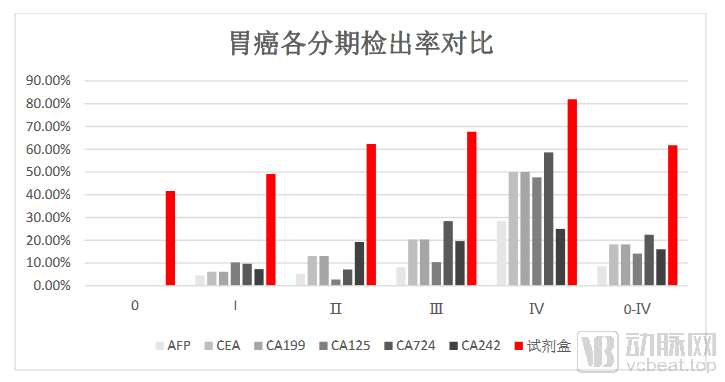
Statistical analysis of the positive rates of various tumor markers across different stages of samples, and comparison with the positive rates of the test kits
Dr. Han noted that the most significant highlight of SiboWei® lies in its ability to detect ultra-early-stage gastric cancer.The positive rate of Sibowei® for detecting stage 0 gastric cancer (high-grade intraepithelial neoplasia) is 40%,This is unattainable by other screening methods.”
On May 8, 2020, the National Medical Products Administration (NMPA) publicly released the technical review report for the registration of the “RNF180/Septin9 Gene Methylation Detection Kit (PCR-Fluorescent Probe Method) (CSZ1900136).” The report highlighted an innovative clinical trial design that distinguishes this product from other cancer detection assays. Specifically, a prospective clinical trial was designed to evaluate the product’s use in gastric cancer screening or opportunistic screening, fully simulating real-world application scenarios. Meanwhile, a retrospective clinical trial was conducted as a control comparison to assess the product’s performance in the auxiliary diagnosis of gastric cancer.
The prospective clinical trial results in the report are consistent with the retrospective clinical trial results, which highlights two key points: 1)DescriptionGastric cancer detection products can be used for screening or opportunistic screening of populations with unknown gastric cancer status., as the gastric cancer detection product yields identical test results in individuals with unknown gastric cancer status and those with confirmed gastric cancer; 2)Instructions"Clinical trial results demonstrate high reproducibility in both populations with unknown gastric cancer status and those with confirmed gastric cancer.", confirming the reliability of the clinical trial results.
Prospective clinical trials have further confirmedThis product is 5–10 times more sensitive than traditional tumor markers in detecting early-stage gastric cancer.Supports the use of gastric cancer detection products for screening or opportunistic screening in populations with unknown gastric cancer status.The National Medical Products Administration’s recent approval of a new gastric cancer product also confirms that plasma ctDNA methylation-based testing is feasible in the field of early tumor screening, holding significant application prospects.
Therefore, another major highlight of SporeGuard® isFills the gap in gastric cancer screening both internationally and domestically, providing technical and product support for the Party and state’s call for “opportunistic screening for gastric cancer.” The approval of SiboWei® can significantly promote the widespread adoption of gastric cancer screening.
Dr. Han stated that, moving forward, Biochain will collaborate with numerous domestic experts in the prevention and treatment of gastrointestinal cancers, as well as major health examination centers, hospitals, and medical laboratories, to accelerate the market entry of SiboWei®.
It is worth noting that gene methylation testing involves complex procedures and places high demands on physicians. To address this challenge, Biochain has developed automated detection equipment that simplifies operational steps and reduces manual labor, thereby facilitating the broader deployment of SiboWei® to primary healthcare settings and helping to improve the currently low prevalence of gastric cancer screening in China.
Meanwhile, Biochain is also planning to provide services such as intervention medications and lifestyle guidance for patients with gastric cancer who test positive, aiming to reduce the incidence and mortality rates of gastric cancer in China.
With over two decades of in-depth engagement in the field of early cancer screening and diagnosis, Dr. Han has observed that this sector has garnered significant attention in recent years. An increasing number of companies are entering the space, with many securing substantial financing. However, overall, the early cancer screening industry remains in its nascent stages and continues to face several major challenges.
The market is not yet mature in terms of education.Currently, a systematic awareness of health management has not yet been established among the public. The recognition and acceptance of new concepts inevitably require time. With the joint efforts of policymakers, enterprises, and other stakeholders, it is believed that people will gradually come to recognize the necessity of cancer screening.
High technical difficulty.The high difficulty of R&D has raised the entry barrier in this field. It requires companies to have many years of technological accumulation and the capability for early-stage development of tumor markers to successfully develop an effective cancer early screening product.
Regulatory Issues.Dr. Han noted that some companies in the current market prioritize promotion over quality, and he called on relevant authorities to strengthen regulatory oversight “to prevent low-quality products from disrupting the market and eroding consumer confidence in the industry.”
Next, Biochain will continue to expand its presence in the cancer screening market. Its lung cancer gene methylation product is currently undergoing clinical trials, while the esophageal cancer gene methylation detection kit is being prepared for entry into clinical trials. Products for the early detection of liver cancer and pan-cancer are also under accelerated development.
Biochain has been strategically positioned for many years on the technical platform of high-throughput sequencing for gene methylation and has currently developedA High-Throughput Sequencing-Based Pan-Cancer Early Detection Product Utilizing Gene Methylation for the Simultaneous Early Identification of Over a Dozen Cancer Types. The product’s greatest advantage is its ability to detect multiple types of cancer simultaneously, while its drawbacks include high costs, reliance on expensive equipment, and limited scalability and accessibility in broader markets. Biochain is addressing this critical barrier that hinders the use of high-throughput sequencing products for cancer screening.
Due to the current common limitation of high costs associated with high-throughput sequencing, Biochain has pioneered a series of cancer early screening and diagnosis products based on real-time PCR to lead and position itself in the market. The prominent advantage of the real-time PCR product series is its high cost-effectiveness, which can effectively improve compliance with cancer early screening and diagnosis. Even if the cost of pan-cancer early diagnosis products using high-throughput sequencing for gene methylation decreases in the future, the advantages of high cost-effectiveness and ease of widespread adoption will still allow the real-time PCR product series to occupy a significant market share.
Furthermore, Dr. Han also stated that the potential of gene methylation testing is not limited to cancer screening; it can also be used for screening chronic diseases and age-related conditions. “The market potential for gene methylation testing is substantial. In the future, Biochain will focus on cardiovascular and cerebrovascular diseases, diabetes, and other conditions, aiming to achieve early prevention and detection of various major diseases in line with residents’ health management needs.”