

Mission Bio Secures $70 Million Series C Funding to Advance Its Tapestri Single-Cell Genomics Platform in Precision Oncology
Mission Bio
Single-Cell Genomics Solution Provider
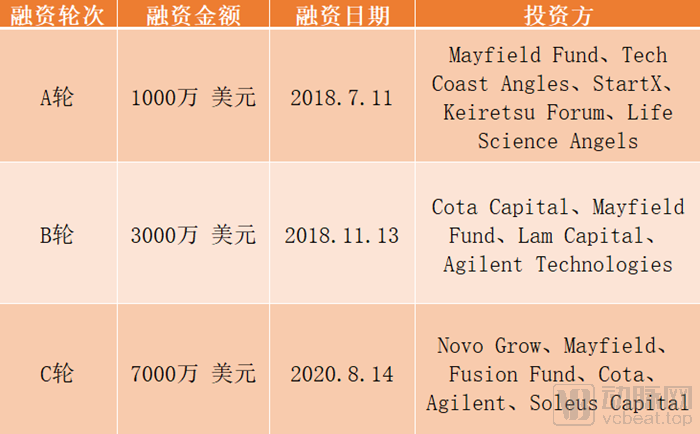
On August 14, VCBeat learned that Mission Bio, a leader in genetic diagnostics, announced the completion of a $70 million Series C financing round. The round was led by Novo Growth, with participation from Mayfield, Fusion Fund, Cota, Agilent, and Soleus Capital. The proceeds will be used to expand the application of its Tapestri platform in clinical trials for novel cancer therapies, enabling better analysis and characterization of the efficacy and features of cell and gene therapies.
Source: VCBeat Database
Since its founding in 2012, Mission Bio has completed three rounds of financing, raising a total of over $100 million, with each round oversubscribed by 200%. Amidst the impact of the pandemic on global private equity, Novo Growth, Mayfield, Fusion Fund, Cota Capital, Agilent Technologies, and Soleus Capital still chose to invest in Mission Bio. This not only underscores their recognition of the single-cell DNA analysis sector but also affirms Mission Bio’s robust technological capabilities.
“Driving the industry’s digital transformation with new technologies is of paramount importance.” As Mission Bio’s earliest investor and a participant in all subsequent funding rounds, Zhang Lu shared her investment rationale for Mission Bio in this round.
Zhang Lu stated that Mission Bio was chosen because it aligns with two major trends and directions in the future of cancer diagnosis:
First, the application of microfluidics technology in single-cell sequencing. Microfluidics technology can bring cancer diagnosis to a smaller and more precise dimension.
The second area is bioinformatics related to single-cell sequencing. As early as 2015, Mission Bio combined informational biological data with technologies such as microfluidics for sequencing, and by integrating the results of data analysis, it provides personalized diagnostic outcomes to better assist in medical diagnosis and monitoring. This is highly valuable in the current context, where the healthcare industry is undergoing a comprehensive digital transformation.
Multiple product lines have completed FDA approval
In recent years, with the advancement of technologies such as targeted therapy and precision medicine, cancer diagnosis and treatment have gradually become a key focus for both academia and industry. Mission Bio, operating in this sector, has garnered favor from major venture capital funds thanks to its advantages in technology, team, and business model.
In the field of medical treatment, Mission Bio is a pioneer in single-cell DNA analysis and precision genomics, as well as one of the earliest teams globally to apply microfluidics technology for screening individual cancer cells, giving it a first-mover advantage. Its unique single-cell multi-omics integration technology stands out. In clinical trials, this technology enables more intuitive observation of how different treatment regimens affect the genotype and phenotype of individual cells.
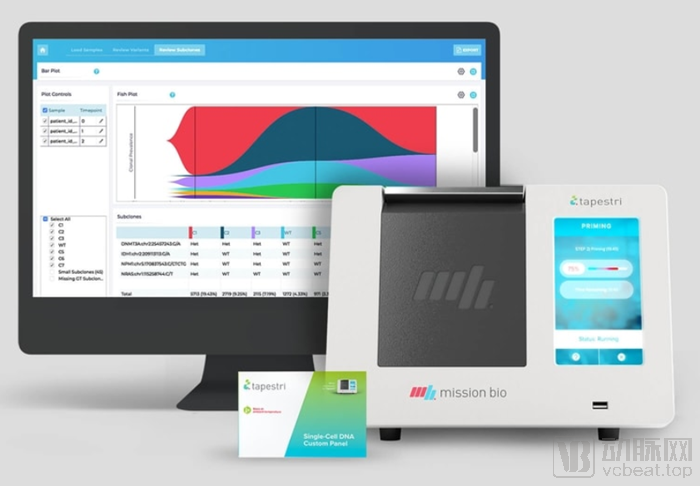
Leveraging this technology, Mission Bio developed Tapestri, the industry’s first targeted single-cell DNA sequencing platform. This platform is primarily used for the precise detection of heterogeneity in disease progression and treatment response, with applications including hematologic malignancies, solid tumors, and genome editing monitoring.
Tapestri Platform
Meanwhile, Tapestri enables researchers and clinicians to eliminate the influence of uncontrolled variables by detecting changes in DNA and proteins within individual cells during large-scale analyses across different cell categories. This not only makes the evaluation of targeted therapy efficacy more precise and convenient but also enhances analytical efficiency, allowing for the parallel analysis of tens of thousands of single cells. Tapestri empowers researchers and clinicians to use a single technological platform to support the detection of various small-cell carcinomas, thereby increasing product diversity and expanding the scale of its application.
Specifically, this breakthrough technology offers a sensitivity 50 times higher than that of conventional NGS technologies, and its single-base resolution is several orders of magnitude greater than that of other single-cell DNA analysis methods.
But Mission Bio’s advantages extend far beyond these. As early as 2015, when the industry had yet to recognize the potential of data analytics, artificial intelligence, and microfluidics in early cancer diagnosis, Mission Bio had already integrated these technologies into healthcare, leveraging them to address a key challenge in early cancer detection: the diagnosis of small cell carcinoma. Soon thereafter, Mission Bio’s technology gained market validation through its collaboration with Johnson & Johnson.
Notably, in addition to helping optimize clinical trials for therapeutic regimens targeting hematologic malignancies and solid tumors, Mission Bio’s technology can also be used to validate gene editing. In recent years, the clinical application of CRISPR-based gene-editing technology has garnered significant attention, demonstrating the substantial growth potential of the future gene-editing market.
Furthermore, Mission Bio has not limited its business model to medical devices; instead, it leverages its platform-based bioinformatics technology to detect various types of cancer. While most medical device companies currently exit the market through mergers and acquisitions, Mission Bio does not focus solely on a specific disease but rather targets the characteristics of all small-cell carcinomas. This broader approach significantly reduces the likelihood of an early exit compared to typical medical device companies.
Since securing its Series A financing, Mission Bio has not only achieved market validation but also commenced commercial operations, gradually emerging as an industry leader. In fact, by the time Mission Bio completed its Series B financing, multiple product lines had already received FDA approval, further expanding the scope of their commercial applications.
Team Originating from UCSF
The team is the driving force behind Mission Bio’s numerous technological breakthroughs.
Mission Bio was founded in 2012, with its technological framework derived from research conducted by its founding team at the University of California, San Francisco (UCSF). This technology is currently employed by numerous major pharmaceutical companies and cancer treatment institutions, including Aigios, LabCorp, Onconova Therapeutics, as well as UCSF, Stanford University, and Memorial Sloan Kettering Cancer Center.
Mission Bio’s team possesses a strong academic background, enabling the rapid market introduction of new technologies and facilitating their commercialization. As the leader of the team, Charlie, CEO and Co-Founder of Mission Bio, is dedicated to addressing complex medical challenges through precision engineering, innovative biochemistry, and bioinformatics.

Charlie, CEO and Co-Founder of Mission Bio
Charlie’s years of experience in startups within the healthcare and semiconductor industries have equipped him with a deep understanding of how to commercialize next-generation hardware technologies and scientific instruments. Prior to joining Mission Bio, he led product R&D at Novelx and worked in R&D and marketing at Agilent Technologies. Charlie holds a joint MBA from the University of California, Berkeley, and Columbia University, an M.S. in Physics from the University of Wisconsin–Madison, and a B.A. in Physics from Columbia University.
Adam, co-founder of Mission Bio, serves as Senior Director of Technology and Systems, overseeing cartridge and instrument development. After earning his Ph.D. in Applied Physics from Stanford University, he joined Abate’s laboratory at UCSF and began working in the field of microfluidics. This exposure to the technology provided additional insights for applying Mission Bio’s microfluidic platform to single-cell sequencing.

Adam, Co-founder of Mission Bio
As a postdoctoral fellow at UCSF, he leveraged the fabrication and engineering skill set acquired from condensed matter physics and applied it to droplet manipulation, ultimately co-developing the technology that became the core of Mission Bio.
Investors Say
With the rapid growth of Mission Bio’s commercial applications and the influx of high-quality capital, Mission Bio has begun to expand rapidly.
Before founding Fusion Fund, Zhang Lu also successfully founded a medical device company that was acquired by a U.S.-listed enterprise. Zhang Lu outlined the breakthroughs Mission Bio has achieved since its last round of financing:
First, Mission Bio has had more products complete FDA audits.
Secondly, Mission Bio has begun to rapidly expand its commercial applications. Previously, Mission Bio’s earliest partners were mainly in the California region, such as the Stanford Hospital system, UC Berkeley, and the overall healthcare system of UCSF. However, Mission Bio is now expanding nationwide, broadening the reach of its commercial applications and increasing revenue accordingly. Since Series B funding, the revenue growth for each of Mission Bio's single-line products has increased by 2-3 times or more.
Meanwhile, regarding the rationale for choosing the track of early cancer diagnosis, Zhang Lu stated that the future prospects for early diagnosis of cancer, cardiovascular and cerebrovascular diseases, and brain disorders are highly promising. Although some therapeutic devices currently command higher potential market launch prices, the overall trend in healthcare development is shifting toward diagnostics.
While conquering cancer may remain elusive in the foreseeable future, we can continuously expand the boundaries of early cancer diagnosis. Therefore, we need to implement very early, personalized diagnosis and monitoring of cancer to increase cure rates, rather than wasting more resources, funding, and technological capabilities on advanced-stage disease diagnosis and treatment.
Only high-quality, cutting-edge personalized diagnostic technologies can ensure that our bodies receive restorative treatment in the early stages of cancer, thereby minimizing disease-related damage.
Currently, Fusion Fund manages over $100 million in capital, focusing on investments in early-stage technology startups in the U.S. market. Zhang Lu has garnered significant attention for her forward-looking investment strategy. In 2017, she was named to the Forbes Under 30 list and featured as a key figure in the investment industry. In 2018, she was selected as a “Young Global Leader” by the World Economic Forum (Davos) and recognized as an influential woman in Silicon Valley.