

Me6TREN Emerges as a Promising Candidate for Treating Acute Gastrointestinal Radiation Syndrome via Intestinal Stem Cell Regeneration
Studies Show Novel Small-Molecule CompoundsMe6TRENIt holds promise as a candidate drug for the treatment of acute intestinal radiation sickness.
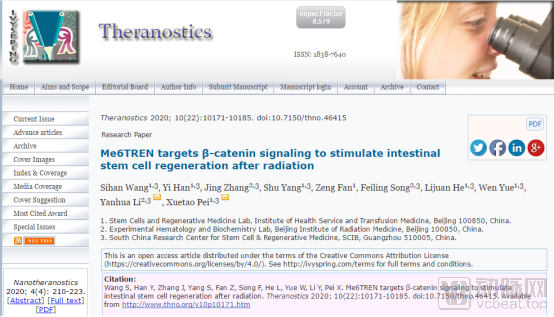
On August 13, 2020, the international academic journal *Theranostics* published online the latest research findings from the Academy of Military Medical Sciences of the Academy of Military Sciences and the South China Stem Cell and Regenerative Medicine Research Center, titled “Me6TREN targets β-catenin signaling to stimulate intestinal stem cell regeneration after radiation.” Professor Pei Xuetao and Professor Li Yanhua served as co-corresponding authors, with Dr. Wang Sihan as the first author. The study revealed that the novel small-molecule compound Me6TREN (Me6) promotes the repair of radiation-induced damage in intestinal epithelial cells. This compound regulates intestinal stem cell regeneration by activating the ERK/AKT-β-catenin signaling pathway, thereby significantly improving survival in mouse models of intestinal radiation syndrome.
Promoting the regenerative repair of injured tissues using stem cell technology is one of the key research focuses of this team. Previously, researchers from the team screened and identified a novel small-molecule compound, Me6, based on their stem cell technology platform. They found that Me6 can mobilize hematopoietic stem/progenitor cells and endothelial progenitor cells from the bone marrow and promote angiogenesis in ischemic lower limbs (related findings were published in the international academic journals *Blood*, 2014; and *Scientific Reports*, 2014). Therefore, they hypothesized that this compound might facilitate the regenerative repair of radiation-injured tissues.
In this study, researchers found that the small-molecule compound Me6 significantly reduced ionizing radiation-induced damage to intestinal epithelial cells, promoted their repair, and markedly improved survival in mice exposed to high-dose whole-body or abdominal irradiation. Compound Me6 activated the regenerative capacity of intestinal stem cells in damaged intestinal tissues and promoted the formation of new crypts within the intestinal epithelium. Further investigations using a mouse small intestinal organoid model revealed that Me6 enhanced the growth of small intestinal organoids under standard culture conditions and increased the proportion of Lgr5+ intestinal stem cells, suggesting that this compound could serve as a novel supplement for the in vitro expansion of intestinal organoids. Furthermore, compound Me6 demonstrated the ability to promote the regeneration of intestinal organoids following radiation-induced injury.
Further studies revealed that Me6 regulates the regenerative function of intestinal stem cells by activating the ERK/AKT-β-catenin signaling pathway. Notably, researchers found that compound Me6 did not significantly promote the growth of tumor tissues formed by HCT116 cells in vivo, suggesting its potential for clinical translation. It holds promise for the prevention or treatment of radiation-induced enteritis caused by tumor radiotherapy, or acute intestinal radiation syndrome resulting from sudden nuclear accidents.
In summary, researchers have confirmed, using intestinal organoid models and abdominal/whole-body irradiation models, that the small-molecule compound Me6 promotes the repair of intestinal epithelial cells by activating the regenerative capacity of intestinal stem cells, thereby improving survival in irradiated mouse models. These findings will lay the foundation for the future development of novel therapeutics for acute intestinal radiation syndrome.
Original Source:
1. Wang S, et al. Me6TREN targets β-catenin signaling to stimulate intestinal stem cell regeneration after radiation. Theranostics, 2020; 10(22): 10171-10185. doi:10.7150/thno.46415. Available from http://www.thno.org/v10p10171.htm
2. Zhang J, et al. Small molecule Me6TREN mobilizes hematopoietic stem/progenitor cells by activating MMP-9 expression and disrupting SDF-1/CXCR4 axis. Blood. 2014; 123(3): 428-441. doi:10.1182/blood-2013-04-498535
3. Chen H, et al. A novel molecule Me6TREN promotes angiogenesis via enhancing endothelial progenitor cell mobilization and recruitment. Sci Rep. 2014; 4: 6222. doi: 10.1038/srep06222.