

2020 China Hospital Information Network Conference (CHINC) to Unveil Next-Generation Smart Electronic Medical Record System
From August 21 to 23, 2020, the 2020 China Hospital Information Network Conference (2020 CHINC), hosted by the Hospital Management Institute of the National Health Commission and organized by the Editorial Office of "China Digital Medicine," will be grandly held at the Nanjing International Exhibition Center. At that time, elites from the digital healthcare industry across China will gather together, with the theme of “New Landscape · New Technologies · New Developments” as the theme, to jointly explore innovative technologies, practical experiences, and latest achievements in the research and application of medical informatization and intelligence.
As a key pivot for the intelligent upgrade of healthcare informatization, electronic medical records (EMRs) have undergone more than a decade of development. In 2003, influenced by the SARS outbreak, patient volumes surged dramatically, and hospitals were divided into isolation and non-isolation zones. To improve efficiency and address issues such as medical record exchange, EMRs emerged and gained traction. Subsequently, driven by technological advancements and new healthcare reform policies promoting healthcare informatization, EMRs experienced rapid growth. With the issuance of regulations and standards related to EMR construction, such as the Basic Specifications for Electronic Medical Records (2010) and the Notice on Pilot Programs for Electronic Medical Record Work (2011), China established its first set of norms for the construction and use of EMRs, further promoting their standardized development. Since 2018, the state has increasingly prioritized hospital informatization. As one of the focal points of healthcare informatization, EMRs have received significant attention from national and local governments, garnering substantial support in terms of policy, funding, and other areas. EMRs have evolved into the core of informatization construction in medical institutions, the foundation for the application and development of healthcare big data, and a critical support for refined hospital management.
Currently, the electronic medical record (EMR) market is experiencing significant momentum. In 2019, more than 7,000 hospitals across China applied for EMR system grading. The Chinese Government Procurement Network recorded 227 procurement entries related to EMRs and interoperability, with publicly disclosed amounts totaling RMB 721 million. The market, valued in the hundreds of billions, continues to show year-on-year growth, indicating several more years of expansion potential. At this stage, EMR systems will undergo continuous transformation and upgrading. Key considerations for future informatization development in the healthcare industry include how next-generation EMRs can facilitate hospitals’ digital transformation and deepen clinical application, as well as help healthcare institutions upgrade their service models and implement intelligent prevention and control measures in the post-pandemic era.
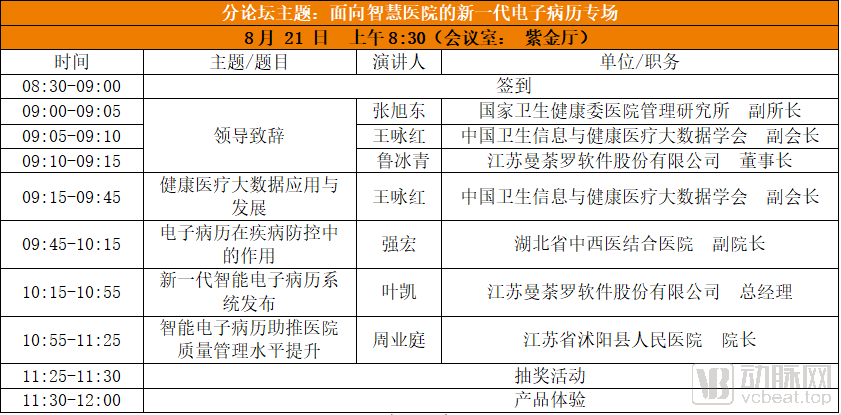
8:30 a.m., August 21, Jiangsu Mandala Software Co., Ltd. will be inZijin Hall, 3rd Floor, Nanjing International Exhibition CenterHost "Special Session on Next-Generation Electronic Medical Records for Smart HospitalsThe conference was honored to invite distinguished guests, including Vice President Wang Yonghong of the Chinese Society for Health Information and Big Data, Vice President Qiang Hong of Hubei Provincial Hospital of Integrated Traditional Chinese and Western Medicine, and President Zhou Yeting of Shuyang County People's Hospital, to deliver insightful presentations.
Distinguished guests will explore several key topics, including the application and development of health and medical big data in China, the role of electronic medical records (EMRs) in disease prevention and control, and how intelligent EMR systems are driving improvements in hospital quality management. Furthermore, Mandala Company has meticulously developedNext-Generation Intelligent Electronic Medical Record SystemIt will also be officially released at this conference. It is reported that the new-generation electronic medical record (EMR) system, empowered by healthcare big data, applies new technologies to meet emerging needs and create new scenarios, thereby promoting intelligent management, intelligent clinical practice, and intelligent services. The system aims to enhance medical safety, reduce medical risks, and optimize patient care processes through the implementation of this next-generation EMR platform.
2020 China Hospital Information Network Conference (2020 CHINC) — "Special Session on Next-Generation Electronic Medical Records for Smart Hospitals" invites you to jointly explore the development of intelligent electronic medical records and share in the feast of this conference.
Li Haixia 15052209516
Cai Yan15052225098