

Soundny Bio's Drug-Loaded Tumor Microparticle Immunotherapy Gains Pricing Approval in Seven Provinces, Leading China's Novel Tumor Immunotherapy Race
Recently, VCBeat (WeChat ID: vcbeat) learned that the Hubei Provincial Healthcare Security Administration and the Health Commission issued the "Notice on Issues Concerning the Addition and Revision of Certain Medical Service Price Items," approving a batch of newly added medical service items. Among them,Drug-Loaded Vesicle Technology for Tumor Treatment Officially Approved for Multiple Cancer Indications, enabling clinical application in a broader range of indications.
Hubei Soundny Bio-tech Co., Ltd. (hereinafter referred to as “Soundny”), established in 2009, is an innovative biotechnology enterprise dedicated to the research and development, application, and promotion of China’s pioneering “drug-loaded vesicle technology for tumor treatment.” The company was officially listed on the National Equities Exchange and Quotations (NEEQ) in February 2017, with stock code: 870592.
Soundny focuses on the field of oncology therapeutics, having established a drug-loaded extracellular vesicle-based anti-tumor technology and R&D pipeline that covers solid tumors and their complications, including malignant pleural effusion, malignant ascites, cholangiocarcinoma, and lung cancer.

Meng Fanfan, General Manager of Hubei Soundny Bio-tech Co., Ltd., comes from an investment background. In 2009, amid a major shift in the economic landscape, she led her team to invest in the biopharmaceutical sector and in Soundny. This decision forged an enduring bond between her and drug-loaded vesicles.
In the early stages of investment, Meng Fanfan and her team conducted in-depth due diligence on and invested in multiple early-stage research projects in the biopharmaceutical and environmental protection sectors. As the incidence of cancer continued to rise, investor interest in oncology therapeutics gradually intensified. Data from China Galaxy Securities’ 2018 pharmaceutical industry research report indicated that the annual number of new malignant tumor cases in China had exceeded 4 million, with an incremental market size of over RMB 140 billion and an existing market size exceeding RMB 250 billion.
Ultimately, she remained steadfast in her commitment to commercializing drug-loaded vesicle therapy for tumors. “The therapeutic efficacy observed in the first patient enrolled in our clinical trial gave us tremendous confidence and encouragement. Since making the initial investment decision, we have continuously optimized both the manufacturing processes and clinical protocols for drug-loaded vesicles. Seeing a growing number of patients benefit from this project today is what drives us to persevere,” said Meng Fanfan.
Professor Huang Bo, the inventor of drug-loaded vesicle technology for cancer treatment, is dedicated to cutting-edge medical research in tumor immunology and tumor biotherapy. As the corresponding author, he has published more than 70 papers in internationally renowned academic journals, with over 4,000 total citations.
As early as 2009, Huang Bo led his team to pioneer research on drug-loaded vesicles in tumor therapy. By encapsulating chemotherapeutic agents within vesicles released by tumor cells, they demonstrated that these drug-loaded vesicles could efficiently kill tumor cells. This work was published in Nature Communications in 2012.
After more than a decade of research, Professor Huang Bo’s team has elucidated that vesicles can be effectively combined with chemotherapeutic agents, oncolytic viruses, and biological macromolecules. The team continues to investigate the molecular mechanisms underlying the cytotoxic effects and actions of this technology on tumor cells, thereby facilitating clinical experts in continuously optimizing therapeutic regimens.
Soundny’s clinical translation team has accelerated the deployment of this technology across various indications. To date, the technology has been involved in diverse clinical trials targeting different cancer types in collaboration with 65 leading Grade-A tertiary hospitals in China, verifying its safety and efficacy while establishing a stable and sustainable product development pipeline.

Tumor immunotherapy is referred to as the fourth pillar of cancer treatment, following surgery, radiotherapy, and chemotherapy.
Tumor immunotherapy is a treatment approach that achieves targeted killing of cancer cells by reactivating the body's own specific immune cells. Common tumor immunotherapies include immune checkpoint inhibitor therapies, represented by PD-1 and PD-L1 inhibitors, and cellular immunotherapies, represented by CAR-T technology.
In 2013, the Nobel Prize in Physiology or Medicine was awarded to three scientists for their discovery of the regulatory mechanisms governing vesicle transport within cells, propelling global vesicology research into a new phase and further advancing studies on vesicle-based immunotherapy.
Distinct from other immunotherapies, drug-loaded vesicle therapy for tumors combines the dual advantages of biochemotherapy and immunotherapy. Leveraging the role of vesicles in intercellular communication and operating through biophysical mechanisms, this approach more effectively targets and eliminates cancer stem cells responsible for tumor recurrence and metastasis. Furthermore, these vesicles can activate immune responses and remodel the tumor immune microenvironment, offering high efficacy with low toxicity.
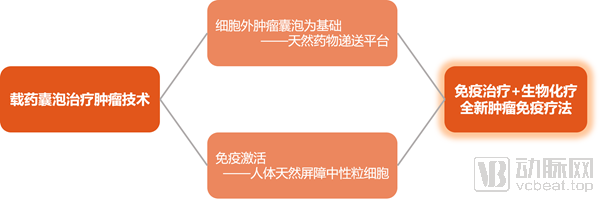
Drug-loaded vesicles are 100–1,000 nm extracellular vesicles secreted by tumor cells that serve as drug delivery platforms and can encapsulate various small-molecule chemotherapeutic agents. These drug-loaded vesicles not only enable targeted delivery of small-molecule chemotherapeutics into target tumor cells but also synergistically kill tumor cells by activating immune responses.
This is a novel cancer immunotherapy that combines the characteristics of both immunotherapy and biochemotherapy.
Compared with normal cells, tumor cells exhibit higher uptake efficiency of drug-loaded vesicles, thereby ensuring high biosafety. Meanwhile, these vesicles can be loaded with various chemotherapeutic agents, enabling targeted antitumor effects across multiple cancer types. Currently, this technology has taken the lead globally in completing clinical translation. This technology has already taken the lead inMalignant Pleural Effusion, malignant ascites, and solid tumors such as cholangiocarcinoma and lung cancer.
Many solid tumors, including lung cancer, breast cancer, and ovarian cancer, can metastasize to the pleural cavity, leading to malignant pleural effusion. Taking lung cancer as an example, up to 60% of patients with advanced-stage disease develop malignant pleural effusion, which severely impacts their survival and quality of life; however, effective clinical treatment options remain limited.
Malignant pleural effusion is the first indication for which drug-loaded vesicle tumor therapy has been approved for clinical use. The relevant clinical research teams include Professor Jin Yang’s team from Wuhan Union Hospital. Clinical trial results conducted by Professor Jin Yang’s team showed that, among the 11 patients treated, the objective response rate (ORR) for drug-loaded vesicle therapy in malignant pleural effusion was 90.91%, with a median overall survival of 240 days. These findings demonstrate favorable safety and efficacy in the treatment of refractory recurrent malignant pleural effusion.
Furthermore, a large-scale post-marketing clinical study on malignant pleural effusion, conducted by the Cancer Hospital of the Chinese Academy of Medical Sciences in collaboration with 50 hospitals across China, is currently underway in multiple provinces and municipalities, including Beijing, Hebei, Shandong, Henan, Hubei, Hunan, Anhui, Sichuan, and Guangdong.
To date, Hubei Soundny Bio-tech Co., Ltd. has established clinical collaborations with more than 60 leading Grade A tertiary hospitals across China. Its marketed indications include malignant pleural effusion and cholangiocarcinoma, while its R&D pipeline also covers indications such as lung cancer, gastric cancer, liver cancer, esophageal cancer, and malignant ascites.

Soundny undertook the 2018 National Major Science and Technology Special Project for New Drug Innovation, successfully secured inclusion in the National Key New Product Program, and was awarded key provincial-level projects in Hubei Province, Hunan Province, Tianjin Municipality, and other regions.
The company is also collaborating with dozens of clinical experts in markets such as Guangdong, Hunan, Hubei, Anhui, Sichuan, Hebei, Tianjin, Shandong, and Beijing to carry out various project applications. It has established a monopoly and leading position in niche technologies on a global scale, building a moat with high technical barriers.
Furthermore, Hubei Soundny Bio-tech Co., Ltd. aligns with national policy directives to accelerate the research and translation of key technologies in oncology treatment.
From the 2015 “Notice of the National Development and Reform Commission on Issues Concerning the Acceleration of Acceptance and Review of New Medical Service Price Items,” which encouraged innovation and expedited the clinical adoption of new medical technologies, to the 2017 “Notice on Comprehensively Promoting the Comprehensive Reform of Public Hospitals,” which abolished drug markups, strictly capped the proportions of drug and consumable costs, and encouraged improvements in the quality of hospital medical services.
In 2019, the National Development and Reform Commission (NDRC), in conjunction with multiple departments, issued the “Action Outline for Promoting High-Quality Development of the Health Industry (2019–2022)” (hereinafter referred to as the “Outline”). Aimed at fostering high-quality development of the health industry, the Outline launched ten major initiatives. It explicitly called for accelerating the research and translation of key technologies, such as tumor bioimmunotherapy, and overcoming bottlenecks in critical (“chokepoint”) technologies in China’s oncology treatment sector by encouraging innovation and practical implementation.
Hubei Soundny Bio-tech Co., Ltd. has introduced its drug-loaded exosome therapy for tumor treatment into the market as a new medical technology, thereby completing the “last mile” of clinical translation and accelerating its clinical application. This technology is an outcome of China’s current “government-industry-academia-research-application” innovation system. Under the new medical technology model, enterprises sign medical technology service contracts with hospitals, which then carry out clinical applications. This approach aligns with the direction and trends of China’s ongoing and future deepening of healthcare system reforms.
As of now, the technology has been approved for market launch in seven provinces and municipalities: Anhui, Hubei, Hunan, Hebei, Tianjin, Shandong, and Shenzhen.