

Tongkang Therapeutics Files IPO Prospectus: Advancing First-in-Class Drug TDM-105795 to Address Global Hair Loss Affecting Over 700 Million
Are you experiencing hair loss?
This issue is not limited to the elderly and middle-aged men; it also affects young men, young women, and middle-aged women. Male readers of this article may wonder: Do women also suffer from hair loss?
Yes. “Big waves” and “small waves” not only exude feminine charm but also create the visual illusion of thicker hair. Life is tough for young urbanites…
“Live for the moment, drink today and get drunk today” and “Why sleep? Get up and party” are mindsets that continue to gain traction among young people today. Staying up late, maintaining irregular sleep schedules, and following unbalanced diets have become seemingly normalized lifestyle habits. In short, everything is driven by the pursuit of sensory pleasure.
Of course, the neon-lit nightlife is not always a revelry for the young. It also harbors their passionate dreams, the pressures of daily life, and the ongoing urban drama of “Struggle” played out under the neon lights...
However, regardless of the reasons, “what goes around comes around.”
According to statistics, individuals born in the 1990s account for more than 50% of clinical visits and consultations related to hair loss.Hair loss no longer appears to be merely a symbol of “wisdom” in middle-aged men, but is showing a trend toward affecting younger individuals... The World Health Organization states that currently 1 in every 6 people exhibits symptoms of hair loss, with the incidence rate increasing by at least 15% annually.
Among this vast patient population,Over 90% of patients with hair loss suffer from seborrheic alopecia (also known as androgenetic alopecia, AGA).According to statistics,The global number of patients with seborrheic alopecia exceeds 700 million.
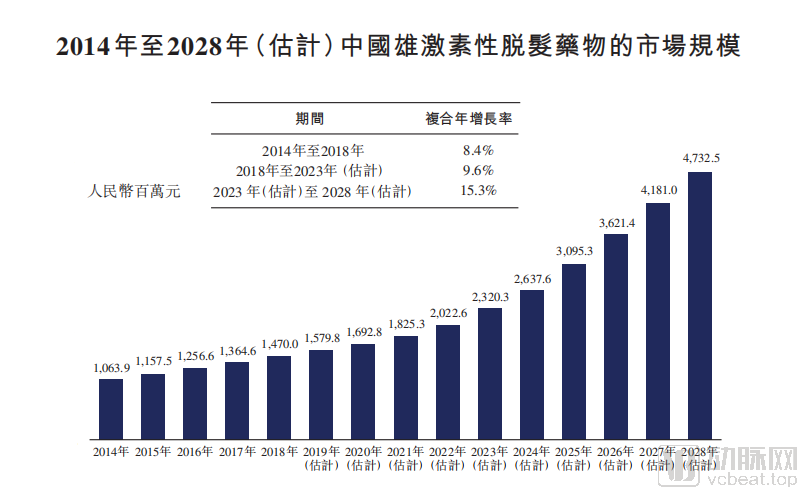
Market Size of Drugs for Seborrheic Alopecia in China, 2014–2018
Image source: Public information
The market potential is enormous, yet there are currently no highly effective drugs specifically targeting seborrheic alopecia.
Currently, there is limited research and development of small-molecule drugs for seborrheic alopecia.The only drugs approved by the U.S. FDA for the treatment of hair loss are minoxidil (Minoxidil) and finasteride (Finasteride)., both drugs have moderate efficacy and significant side effects.
According to Dr. Wang Zengquan, founder of Technoderma Medicines, even the development of next-generation minoxidil or small-molecule drugs targeting novel androgen inhibition mechanisms may still face challenges such as suboptimal efficacy and significant side effects. In light of this, the R&D team at Technoderma Medicines, led by Dr. Wang, intends to target the underlying mechanisms of hair growth to launch a new generation of hair-regrowth therapies with superior efficacy and safety profiles, thereby addressing patients’ hair loss concerns from the “root.”
Technoderma Biologics, fully known as Jiaxing Technoderma Biotechnology Co., Ltd., was established in March 2014 in the Xiuzhou National High-Tech Zone of Jiaxing City, Zhejiang Province. Technoderma Biologics is dedicated to the research and development of first-in-class global novel drugs for skin-related diseases, having built a specialized R&D platform focused on first-in-class global novel drugs for such conditions.
Currently,Technoderma’s flagship hair regrowth project has successfully developed a drug molecule with significant efficacy in promoting hair growth and possessing global independent intellectual property rights.The drug molecule has successively obtained patents in China, PCT patents, and patents in the United States and Japan, while the European patent application is currently under examination. The project has completed studies on efficacy and pharmacokinetics, CMC formulation research, and preclinical toxicology and safety assessments. Currently, the team is preparing clinical trial application materials and plans to submit an Investigational New Drug (IND) application in the United States in the second half of this year as a global first-in-class novel drug, thereby initiating Phase I clinical trials.
In addition to its hair growth projects, Technoderma Medicines has also expanded its dermatology research portfolio, launching initiatives includingDermatitis and Eczema, Psoriasis, Alopecia Areata, Nail Disorders, and Scarsnew drug development projects in the field of dermatology, and have made good progress.
Technological research and development is a protracted and arduous endeavor. For enterprises, safeguarding their R&D achievements from infringement is of paramount importance. Technoderma Medicines, Inc. fully recognizes this imperative and spares no effort in protecting its intellectual property rights.
In June this year, Technoderma Medicines filed its fifth series of patent applications for small-molecule compound inventions and is currently drafting the sixth and seventh patents.Technoderma Medicines, Inc. estimates that there will be 8–10 patents in this field within the year. The R&D efficiency of Technoderma Medicines is remarkable.
Dr. Wang Zengquan, founder of Technoderma Medicines, stated that the company aims to build a sustainable competitive advantage in intellectual property (IP) by strengthening protection for its drug development technologies. He added that with robust IP holdings in the fields of immune-mediated diseases and inflammatory skin disorders, Technoderma can strategically pursue parallel drug development across multiple indications.
To date,Technoderma Medicines hasCompleted tens of millions in angel and Pre-A financing rounds, and currently raising RMB 60 million in Series A financing.This round of funding will be primarily used to advance preclinical research for drug candidates targeting dermatitis, eczema, and psoriasis, and to propel these projects into Phase I clinical trials. The remaining funds will be allocated to preparing for Phase II clinical trials of the hair growth project and expanding the R&D team.
Technoderma’s core new drug R&D team comprises Dr. Wang Zengquan, Dr. Li Guanqun, and Dr. Fang Wenkui. All three hold degrees from prestigious universities, have pursued advanced studies abroad for many years, and possess extensive experience at internationally renowned pharmaceutical companies. Each is a leading expert in the field of dermatological research and has been recognized as a “Leading Talent” by Jiaxing City, Zhejiang Province.

Founders of Technoderma Medicines (from left to right: Dr. Fang Wenkui, Dr. Wang Zengquan, and Dr. Li Guanqun)
Dr. Wang ZengquanHe is the Founder, General Manager, and Chairman of Technoderma Medicines, Inc., as well as an internationally renowned expert in dermatological drug development. He earned his Ph.D. at Washington State University and completed his postdoctoral fellowship in the Department of Dermatology at the University of Michigan Medical School, where he also served as a research fellow for several years.
After leaving academia, Dr. Wang Zengquan held key positions at prominent pharmaceutical companies, including OSI Pharmaceuticals, Pfizer, AstraZeneca, and Viva Biotech. With over two decades of experience in drug development for dermatological diseases, he has published more than 20 papers in prestigious international journals such as Nature, Nature Medicine, and The New England Journal of Medicine, and holds multiple patents for small-molecule drugs.
Dr. Guanqun LiHe serves as the Vice President of Biological Drug Research and Development at the company. He completed his undergraduate through doctoral studies at Beijing Medical University (now Peking University Health Science Center). He previously served as an attending physician and lecturer in the Department of Dermatology at the First Hospital of Beijing Medical University. He later conducted postdoctoral research at the Laboratory of Skin Biology of the U.S. National Institutes of Health and the Laboratory of Skin Biology at Baylor College of Medicine. Dr. Li Guanqun formerly served as an Assistant Professor of Dermatology at Oregon Health & Science University in the United States.
After entering the industry, Dr. Li Guanqun held key positions at Pfizer’s Dermatological Topical Drug R&D Center in the United States, the Novartis Institutes for Genomic Research in the United States, and PhaseRx, Inc. He has published dozens of articles in international journals and was awarded the Career Development Award by the American Skin Foundation. From academia to industry, Dr. Li has accumulated nearly 30 years of R&D experience in the field of dermatology.
Dr. Wenkui FangHe serves as the Vice President of Medicinal Chemistry for New Drug R&D at the company. He completed his undergraduate and master’s studies at Nankai University, then earned his Ph.D. in Organic Chemistry from the University of Michigan, followed by postdoctoral research at the University of Pennsylvania.
Dr. Fang spent 15 years engaged in new drug development at Allergan, a renowned international pharmaceutical company specializing in dermatological therapeutics, with disease areas spanning cutaneous immune disorders, central nervous system (CNS) diseases, and other indications. He subsequently served as Vice President at several pharmaceutical companies, including Baonuo, Xuanzhu, and Nivien, where he oversaw the comprehensive R&D of innovative drugs. To date, Dr. Fang has published dozens of academic papers in prestigious international journals and holds or has contributed to more than 50 invention patents for small-molecule drugs during his tenure in the pharmaceutical industry.
Within the company’s comprehensive talent framework, Technoderma Medicines has assembled outstanding human resources from both China and abroad.The Company not only has a strong global scientific advisory team deeply involved in the R&D of its products and project execution, but also most of its shareholders are founders, CEOs, and other senior executives of pharmaceutical companies.This has endowed Technoderma with extensive experience and resources in the research, development, and industrialization of innovative drugs.
TDM-105795As the inaugural hair regrowth product of Technoderma Medicines, Inc., this asset currently represents its most rapidly advancing pipeline. TDM-105795 is indicated for androgenetic alopecia (seborrheic alopecia). Its primary mechanism of action involves activating hair follicle stem cells, inducing dormant hair follicles to enter the anagen phase, prolonging the anagen phase, and shortening the catagen and telogen phases, thereby achieving therapeutic efficacy in hair loss treatment.
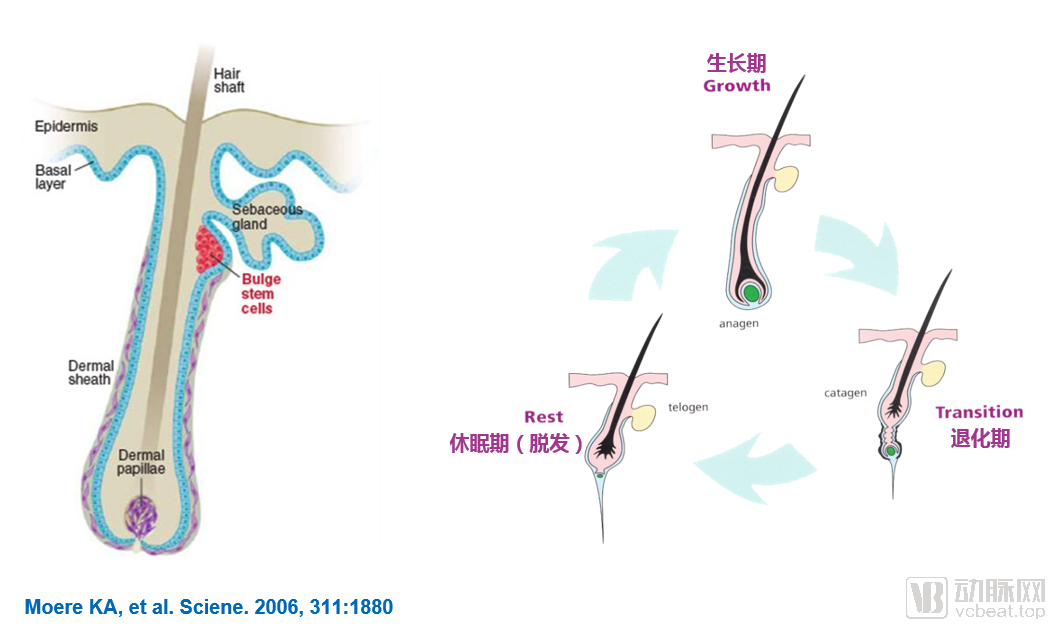
Compared with similar competing products, TDM-105795 demonstrates potentially superior efficacy and a better safety profile.
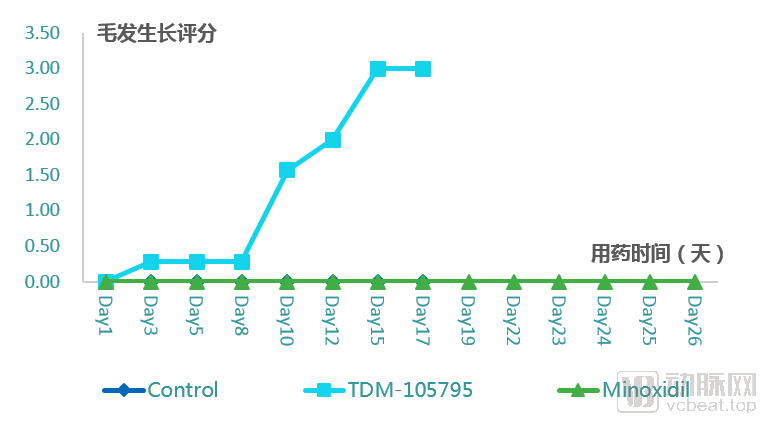
The results of the animal experiments in this project indicate that:TDM-105795 exhibits a rapid onset of action, with significant hair growth observed within 3–5 days of administration. The entire hair growth cycle is completed within 15–18 days, and its efficacy in promoting hair growth in mice is substantially superior to that of minoxidil.Meanwhile, TDM-105795 is effective at a low dose, with a minimum effective dose (MED) of 0.001%, demonstrating significant hair growth effects.
Currently, the project has completed pharmacodynamics/pharmacokinetics studies, CMC formulation research, and preclinical toxicology and safety assessments. Preparation of clinical trial application materials is now underway, with plans to submit an Investigational New Drug (IND) application in the United States as a global first-in-class novel drug and initiate Phase I clinical trials in the second half of this year.According to market research reports, the market for drugs treating seborrheic alopecia is expected to reach $11.8 billion in 2022, with an annual growth rate of 7%.
Initiating projects that address critical clinical unmet needs and entering the market with significant differentiation are Technoderma Medicines’ key strategies for securing its competitive advantage. Technoderma Medicines possesses an independent R&D platform for inflammatory dermatological drugs. Leveraging this foundation, the company has established an in-depth strategic presence in other dermatological fields, including atopic dermatitis/eczema and psoriasis.
Dermatitis and EczemaIt is a broad category of chronic, recurrent, pruritic, and inflammatory skin diseases associated with allergic reactions, with atopic dermatitis (AD) being the representative condition.
The incidence of atopic dermatitis (AD) in children is as high as 15%–20%, with a continuously rising trend; in China alone, there are more than 20 million pediatric patients with AD.The incidence of AD in adults is lower, at approximately 1%–3%. Overall, more than 90% of patients have mild-to-moderate disease.
The primary treatment for mild-to-moderate dermatitis and eczema involves topical agents such as corticosteroids, calcineurin inhibitors, and PDE4 inhibitors, which are associated with significant side effects and limited efficacy.
Consequently, Technoderma Medicines initiated early-stage drug development projects for psoriasis and dermatitis/eczema in 2018. To date, the company has successfully identified multiple lead compounds and filed a batch of patent applications. Preclinical efficacy studies of the selected drug candidate demonstrated that Technoderma’s candidate for this indication is equivalent in efficacy to hydrocortisone. The project has entered the CMC (Chemistry, Manufacturing, and Controls) phase, with an IND submission to the U.S. FDA and initiation of Phase I clinical trials expected in Q3 2021.Technoderma estimates that the global market size for dermatitis and eczema medications may exceed $4 billion.
PsoriasisIt is a common chronic, relapsing inflammatory dermatosis characterized by erythematous or brownish maculopapules or plaques covered with silvery-white scales. It predominantly affects the scalp and the extensor surfaces of the limbs. A minority of patients present with pustular lesions or arthritic symptoms, while others may develop erythroderma, manifested by generalized erythema and desquamation.
According to statistics, there are over 125 million psoriasis patients worldwide.The incidence rate in Europe and North America is approximately 2%-3%, while that in Asian populations is about 0.2%. The number of patients in China exceeds 6 million.
Currently, the most commonly used topical agents for psoriasis are glucocorticoids, vitamin D derivatives, and retinoid preparations, which offer moderate efficacy but have significant side effects. The clinical and market performance of benvimod cream, a newly approved treatment for psoriasis in China, remains to be observed.
According to GlobalData, sales of psoriasis medications in eight major markets, including the United Kingdom, the United States, France, Germany, Italy, Spain, Japan, and India, reached $6.6 billion in 2014 and are projected to grow to $13.1 billion by 2024.Technoderma stated that the global psoriasis market in 2024 may significantly exceed the $21 billion estimate.
Thus, it is evident that the market for dermatological drugs holds immense potential.
While Technoderma focuses on deepening its technological expertise, it also actively pursues external collaborations.
In China, Technoderma Medicines has primarily established partnerships with CRO companies, including WuXi AppTec, Viva Biotech, ChemPartner, Suzhou Shengsu, and the Chengdu Haiqi National Safety Evaluation Center. In 2019, Technoderma Medicines collaborated with Chesson Labs in the United States, introducing two marketed products for onychomycosis and nail disorders—LiquiCure (You Rui Jia) and NuvaNail (You Rui Jia)—and became its sales partner in mainland China.
As Technoderma Medicines focuses its drug R&D efforts on dermatology, its therapeutics primarily exert their effects through topical administration. The team’s core technical competency lies in selecting small-molecule drug candidates that are optimal for local skin absorption and efficacy. Determining the optimal formulation processes to maximize therapeutic effectiveness is also a key consideration for Technoderma Medicines’ subsequent drug commercialization, presenting opportunities for extensive collaboration.
Dr. Wang Zengquan stated that although Technoderma Medicines is currently focused on early-stage drug development and clinical research, it will inevitably progress to the stages of industrialization and commercialization. The company welcomes collaboration and strategic positioning in these areas and has already begun initiating project partnerships.
When asked about the company’s plans for the past two years, Dr. Wang Zengquan stated that the company’s primary focus is to solidify its projects.EstimatedThree drug candidates will be advanced into clinical trials between 2021 and 2022.
Regarding the current wave of IPOs among biopharmaceutical companies, Dr. Wang Zengquan told VCBeat: “The company currently expects to go public in 2022–2023. The listing venue may be on the NASDAQ or the Hong Kong Stock Exchange, with the possibility of listing on China’s STAR Market not ruled out. Technoderma Medicines will select the optimal timing and the most suitable listing venue for the company’s long-term development, based on the specific clinical progress of its projects.”