

Behind ZhenFund's 60+ Healthcare Investments: A Panoramic View of an Early-Stage Angel Investor’s Medical Strategy
By mid-2020, the panic induced by the COVID-19 pandemic was gradually subsiding, yet its impact on the Chinese market continued to unfold.
In primary market healthcare investment, a clear trend is that capital is increasingly flowing toward leading enterprises. According to data from VCBeat’s Orange Data, the total global financing amount in the first half of 2020 increased by 13% year-on-year. In China, the total financing amount declined slightly, while the number of financing deals dropped significantly by 36% year-on-year to 282. This indicates a rise in capital concentration and greater difficulty for early-stage startups in securing financing.
Choosing to focus on early-stage healthcare investment means facing greater uncertainty and assuming higher risks.
ZhenFund is one of the few institutions that truly remain committed to early-stage healthcare investment. In the high-risk, high-barrier field of life sciences, ZhenFund has frequently made exclusive seed-round investments.
There is a stereotype surrounding well-known TMT funds: those with expertise in TMT investments tend to focus primarily on healthcare services and health technology when investing in the medical sector. Outsiders may assume that ZhenFund is no exception.
Indeed, ZhenFund has invested in leading companies in niche sectors such as Yitu Healthcare, Jicheng Dental, Mingyi Zhudao, Youfu Clinic, and Lianyi Technology. However, its healthcare investments have gone further than one might imagine.
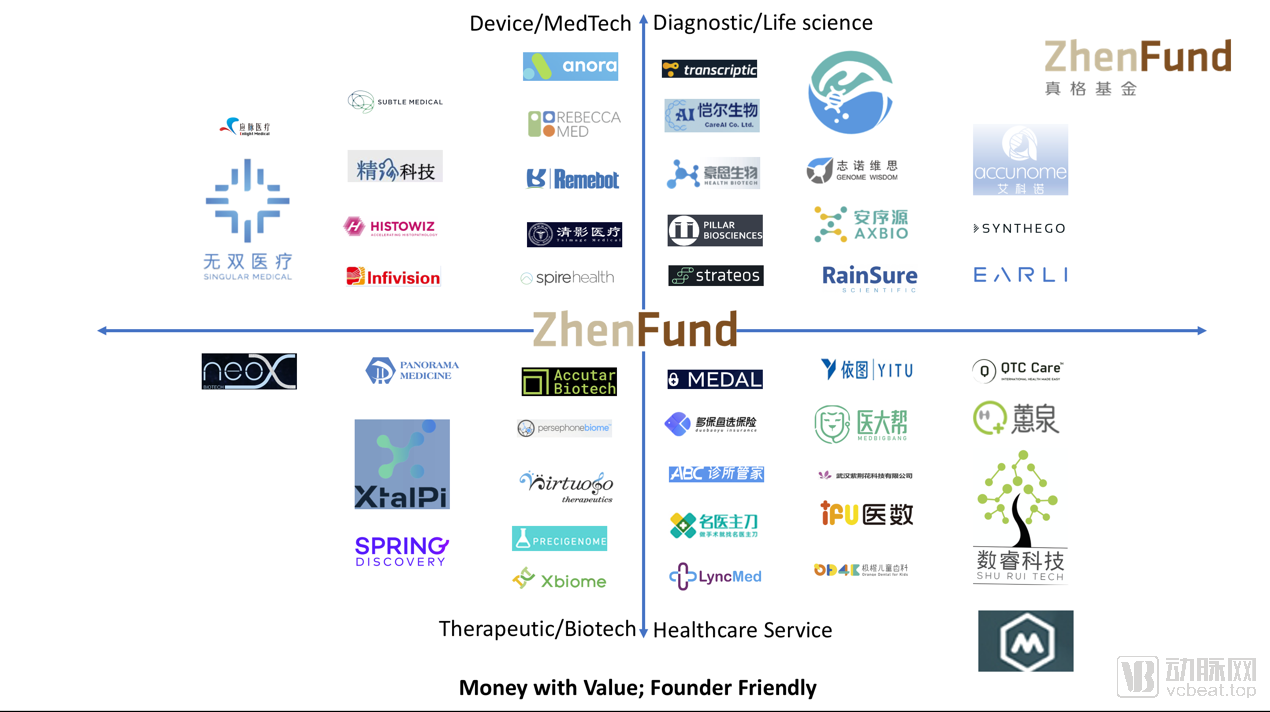
VCBeat compiled statistics on the distribution of healthcare projects invested in by ZhenFund, covering sectors such as biopharmaceuticals, medical devices, diagnostics, healthcare services, and healthtech. In terms of project scope, ZhenFund has invested in Synthego, a genetic engineering company co-founded by CRISPR pioneer Jennifer Doudna, as well as in Xiaoying Technology, a company providing blood cell analysis solutions for primary care hospitals in China.
Countless stories have been told about ZhenFund’s willingness to invest in dreams. This time, we aim to delve deeper into ZhenFund’s professional insights into current trends in healthcare investment. How do its professional expertise and “people-first” philosophy intertwine to drive ZhenFund’s success as a standout player in early-stage healthcare investing? VCBeat interviewed Chen Gaopeng, Vice President of ZhenFund.
Chen Gaopeng is the Vice President of Investment at ZhenFund, focusing on investments in the biopharmaceutical sector. Prior to joining ZhenFund, he worked at Eli Lilly and Company, where he was engaged in clinical drug development and participated in the registration and launch of multiple pharmaceutical products. Mr. Chen holds a bachelor’s degree from Sichuan University and a Ph.D. in myocardial regeneration from the Li Ka Shing Faculty of Medicine at the University of Hong Kong. He also conducted scientific research at the Icahn School of Medicine at Mount Sinai in the United States.
As an early-stage investment firm, we must always be willing to take risks by betting on great companies that lead technological innovation and change the world. In healthcare investing, ZhenFund (hereinafter referred to as “Zhen”) follows the same approach, embracing early-stage risks to support innovations with genuine clinical value.
“Especially in the dynamic and high-risk field of biopharmaceuticals, Chen Gaopeng believes that the development of innovative drugs in China has evolved from early-stage mere introduction and follow-on imitation to a phase of independent innovation. ZhenFund aims to identify the true leading forces in the second half of this game.”
Chen Gaopeng stated, “The analytical framework for traditional small- and large-molecule drugs is highly typical and straightforward: first, assess unmet medical needs by considering disease incidence, severity, and clinical guidelines; second, evaluate commercial prospects based on the degree of target validation, development progress, competitive landscape, and data differentiation. While the first aspect represents enduring value in the healthcare sector, opportunities for fast-follow strategies are becoming increasingly scarce.”
Looking back on the development of innovative drugs in China, after 2000, there were new pharmaceutical companies that quickly followed up, and this led to the success of companies like Beida, MicroCore, and others. After 2010, the PD-1 single target largely contributed to the success of the second wave of enterprises such as BeiGene, Innovent, and Junshi."
However, he pointed out that these successes were built upon the gaps between the Chinese and U.S. markets and technologies. As drug registration processes have opened up and reforms in pharmaceutical end-points have been implemented, these advantages are gradually disappearing. Only by truly achieving international first/best-in-class status can success be possible. "Changes in the domestic environment dictate that only highly experienced industry professionals, combined with differentiated technology platforms and strong support from professional venture capital firms, will have a higher probability of success. A bispecific antibody company that ZhenFund participated in during its initial funding round in early 2019 meets all three of these criteria."
In the field of new drug development, Chen Gaopeng believes that the traditional industrial environment and technological evolution curves are rapidly declining; existing logic can no longer explain emerging phenomena, while a new paradigm is swiftly taking shape. Throughout this process, ZhenFund has consistently focused on early-stage companies, strategically positioning itself at the source of innovation. By using clinical value as the key evaluation criterion, ZhenFund supports corporate growth through post-investment management and value-added services.
“In the field of biomedicine, ZhenFund is willing to support novel biological mechanisms, therapeutic approaches, or new technological platforms. Although many of these technologies are often the latest research outcomes from academic institutions, typically lacking proof of concept and carrying high technical risk, and although the founding teams at the angel stage are often incomplete, these technologies hold significant potential and require relatively small individual investments, making them well-suited for early-stage investors like ZhenFund.”
“We believe that emerging biotech companies often begin by providing services to pharmaceutical firms, then co-develop products with them, and ultimately evolve into fully integrated pharmaceutical enterprises with their own commercialization capabilities.”
Taking ZhenFund’s strategic layout in the AI-driven drug discovery sector as an example, it has invested in startups such as XtalPi and Accutar Biotechnology, as well as NeoX, which recently secured funding from Yuanjing Capital and Sequoia China. When AI-driven drug discovery was still in its early stages of development, ZhenFund had already made significant early-stage investments in numerous companies.
“We firmly believe that drug discovery and development will be increasingly driven and guided by data. This is the trend we observe; what remains is a matter of selecting the right competitors within this track. At the current stage, one should not harbor illusions that AI can provide a one-time, permanent solution or replace experiments and scientists. Instead, AI should be positioned as a new tool for pharmaceutical development, working alongside traditional tools to address industry challenges. We view AI in its current form as a tool, and thus our primary focus is on the specific problems it solves.”
Another example is Panorama, an RNA therapeutics company invested in by ZhenFund. Over 7,000 human diseases are associated with aberrant RNA splicing, yet 95% of these conditions lack effective treatments. ZhenFund’s strategic entry at this juncture reflects its belief that the widespread adoption of next-generation sequencing (NGS) and the accumulation of bioinformatics capabilities in recent years now meet the sequencing demands for analyzing alternative RNA splicing, marking a critical technological inflection point.
Panorama’s founding team includes world-renowned authorities in RNA splicing experiments and bioinformatics analysis. At the time of ZhenFund’s investment, the company lacked experience in traditional pharmaceutical development. Although not perfect, ZhenFund remained optimistic about the power of technological innovation. Recently, Panorama has onboarded a key team member with 25 years of pharmaceutical industry experience, formerly Vice President of R&D at Boehringer Ingelheim.
In ZhenFund’s investment philosophy, the market and research serve as a map, but it is people who ultimately blaze the trail to the finish line. Rather than focusing on sector selection, ZhenFund’s overall investment style leans toward betting on founders.
The Chinese market differs from the U.S. market in that Chinese startups are founder-led. Unlike in the United States, where venture capital firms can revive a company by bringing in new management personnel if they have chosen the right sector but the wrong team, such an approach is less feasible in China.
ZhenFund prioritizes evaluating the founders, rather than imposing stringent criteria on the founding team. On the contrary, when ZhenFund decides to invest, the founding team is often far from perfect.
At the time of investing in Wushuang Medical, its team was relatively young. ZhenFund believed that although the team lacked experience in cardiac devices, it possessed strong learning agility and execution capabilities, enabling it to maximize the use of industry resources facilitated by investors.
ZhenFund’s investment in NeoX at the angel round followed the same logic: the two founders, who earned their PhDs from MIT and Caltech respectively, are exceptional young talents with outstanding learning abilities. Although they lacked extensive industry experience, they were able to rapidly integrate into and adapt to the industrial chain, identifying specific application scenarios for their technology.
“ZhenFund has a highly systematic framework for evaluating founders. Founder assessment remains paramount; we believe that exceptional entrepreneurs are generally capable of creating substantial value and delivering strong returns to investors. As the saying goes, ‘success hinges on human effort.’ Without the racer, the track is lifeless; a skilled racer can carve out new paths and stand out even in crowded lanes.”
Returning to clinical value, this investment philosophy is even more critical in medical device investments. ZhenFund divides the medical device sector into two major categories: Medical Devices (Device/MedTech) and Diagnostics/Life Sciences (Diagnostic/Life Science).
“Broadly defined, medical devices include in vitro diagnostics (IVD) and AI-enhanced imaging diagnostic products. While new drugs offer a higher growth ceiling, they require substantial investment, involve significant equity dilution, demand intensive post-investment support, and carry high risks. In contrast, the medical device sector is more favorable for early-stage institutions like ZhenFund: it requires smaller individual investments and enables faster execution. Although traditionally perceived as having a lower growth ceiling, with challenges in going public but greater ease of being acquired, the sector still presents numerous opportunities by leveraging China’s vast market. Therefore, ZhenFund has made extensive investments in this field.”
In the medical device sector, which is currently enjoying a dual development opportunity driven by domestic substitution and technological iteration, ZhenFund is bullish on two types of opportunities.
First, the opportunity for domestic substitution.
“Domestic substitution has been the dominant theme over the past two to three decades. While many categories have achieved a high level of localization, the medical device sector remains highly fragmented, leaving substantial room for further growth.”
In the logic of domestic substitution, there are two true criteria: the market is large enough; the barriers are high enough and the target is a leading enterprise.
Under the logic of domestic substitution, ZhenFund has chosen to enter the market by addressing urgent clinical needs, leveraging the vast unmet clinical demand as its entry point for strategic layout. For instance, in the field of cardiovascular disease, which has the highest mortality rate among Chinese residents, leading companies such as MicroPort Medical, Venus Medtech, and Peijia Medical have emerged through domestic substitution efforts. ZhenFund has invested in two companies specializing in high-value cardiac consumables, one of which is Wushuang Medical. The investment in Wushuang Medical was driven not only by the aforementioned emphasis on founding teams but also by ZhenFund’s optimism about the domestic substitution potential of implantable cardioverter-defibrillators (ICDs) and Wushuang Medical’s strategic positioning in the cardiac rhythm management (CRM) device market, which represents one of the largest single segments within the cardiovascular market.
“ICD penetration in China is more than an order of magnitude lower than in the United States, with no domestic production whatsoever and extremely high technical barriers. Wushuang Medical has entered the market through ICDs, with a long-term aim at the broader cardiac rhythm management (CRM) market.”
Another track is the mitral valve sector. In the cardiac valve market, which has seen significant hype in the primary market this year, mitral regurgitation has the highest incidence rate and the greatest clinical demand among all valvular diseases.
“Abbott’s MitraClip has released highly encouraging follow-up data at TCT for two consecutive years. ZhenGe invested in a startup specializing in the mitral valve field well before the primary market saw a surge in interest, enabling the company to advance to animal trials within a short period.”
Within ZhenFund’s investment logic for medical devices, alongside the theme of domestic substitution, lies the thesis of Chinese innovation. In this regard, ZhenFund has also invested in globally innovative, high-risk medical device ventures.
Electrical Impedance Tomography (EIT) has yet to achieve a true breakthrough in medical applications. Currently, only the ventilator giant Dräger is exploring its use for ventilator support, specifically by employing EIT to monitor the degree of alveolar recruitment, thereby ensuring that the lungs are adequately inflated and protected from injury during mechanical ventilation.
“In the ‘post-ventilator era’ following the pandemic, high-end ventilators equipped with Electrical Impedance Tomography (EIT) and standalone EIT modules will become a key focus for ventilator manufacturers. ZhenFund’s portfolio companies have already signed cooperation agreements with multiple ventilator manufacturers to supply EIT technology for their next-generation flagship models.”
He added, “The greater future potential of EIT lies in monitoring pulmonary perfusion and pulmonary embolism. The incidence of pulmonary embolism is second only to coronary syndromes and stroke, while its mortality rate is second only to cancer and acute myocardial infarction. The overall incidence among all hospitalized patients is approximately 1%. Acute onset of pulmonary embolism is highly life-threatening. The gold standard for diagnosis is CT pulmonary angiography (CTPA), yet most patients do not have the opportunity to be transported to the CT suite, and blind thrombolysis carries significant risks. The current state-of-the-art in international EIT research involves injecting hypertonic saline into the pulmonary arteries of experimental animals to visualize perfusion information, an approach that is virtually infeasible in clinical practice. However, a portfolio company of ZhenFund has already obtained proof-of-concept data from healthy individuals, as well as from patients with embolism and after thrombolysis, using non-invasive monitoring techniques.”
Based on ZhenFund’s investment portfolio in the medical device sector, it is evident that what appeals to ZhenFund often extends beyond breakthroughs in individual products. ZhenFund also values a company’s long-term growth potential and its ability to secure a foothold in sectors where domestic alternatives are virtually nonexistent. This may also explain why companies backed by ZhenFund at the seed stage frequently attract follow-on investments from specialized healthcare funds such as Qiming Venture Partners, Legend Capital, and YuanSheng Venture Partners in later stages.
In the field of molecular diagnostics, ZhenFund has invested in multiple companies, including Genetron Health, whose founding team comprises senior veterans from Bio-Rad, a leading digital PCR company, and which previously secured the FDA’s third Emergency Use Authorization (EUA) for a digital PCR diagnostic kit; and Aikenuo, which has developed a fully automated sample processing and PCR detection platform featuring “sample-in, result-out” capability. The founder of Aikenuo holds a Ph.D. from the California Institute of Technology, has 20 years of deep expertise in molecular diagnostics, and served as the Asia-Pacific Vice President at bioMérieux, a leader in automated PCR platforms, prior to launching his venture.
Wang Qiang, co-founder of ZhenFund, once stated that ZhenFund does not aspire to be just one among thousands of venture capital firms, but rather aims to become the world’s “largest” “small” fund.
“Big” is reflected in a broad mindset that embraces failure, a global perspective, and ample patience. ZhenFund not only possesses the curiosity to pursue innovation but also the patience to provide long-term companionship regardless of the industry’s fluctuations. “Small” refers to ZhenFund’s unwavering commitment to the angel investment stage, supporting startups from their inception.
“We boast rapid and agile decision-making that rivals anyone in the industry, tolerating entrepreneurs’ setbacks and failures, and daring to take risks by providing the initial round of funding. Our investment terms are highly founder-friendly, as we believe that if a venture underperforms, no contractual terms can safeguard investors; whereas if it succeeds, investors will profit regardless of the specific terms.”
Taking the AI + medical imaging sector as an example, ZhenFund is one of the earliest and most active investors in this field. In the realm of AI + medical imaging, due to the challenges associated with clinical implementation, the development of AI + healthcare has not met expectations, and external enthusiasm for AI + healthcare is waning.
“ZhenFund is arguably the institution that has invested earliest and most extensively in the AI sector, with portfolio companies including Yitu Healthcare, Senyi Intelligence, Qingying Medical, and Jingzhen Technology, among others. Throughout the ups and downs of this sector, ZhenFund has also formed certain judgments on AI+Healthcare.”
First, in terms of application scenarios, AI should remain sufficiently humble. Reliable use cases should focus on helping physicians save time and improve efficiency, with machine accuracy that can be immediately recognized and validated by clinicians.
Secondly, robustness must be sufficiently high. While it is common to see products in various tests demonstrating sensitivity and specificity that far surpass those of human physicians, the real world presents a different challenge. Variations in data acquisition, analysis, and interpretation across different hospitals make it difficult for a single model to perform exceptionally well in multiple scenarios, necessitating further refinement.
Next is the importance of integrating software and hardware. After long-term development, it has become difficult to establish competitive barriers in this field by relying on software alone. While software is the core of AI-enabled clinical applications, hardware must also possess distinct advantages or differentiation.
Finally, cultivate a service-oriented mindset toward physicians and clinical practice.
Although the sector experiences fluctuations, ZhenFund remains convinced that the integration of AI and healthcare is a long-term trend with significant room for growth. ZhenFund has not lost faith in the AI-plus-healthcare landscape and continues to make strategic investments in this area.
Recently, ZhenFund completed an investment in an AI-powered microscopic morphology analysis product.
Microscopic morphology serves as the gold standard in many clinical tests, such as blood cell analysis. According to guidelines, routine blood tests should have a 20% re-examination rate. However, due to limitations in the capabilities and capacity of clinical laboratories, there is significant room for improvement in actual clinical practice, particularly in primary care hospitals. On the other hand, clinicians still engage in laborious and repetitive tasks in many scenarios. For instance, reticulocyte counting requires manually determining the proportion of reticulocytes among 1,000 red blood cells under a high-power microscope, a process that is time-consuming, labor-intensive, and prone to errors. Such scenarios are common in both clinical laboratory and hematology departments. A portfolio company of ZhenFund has developed the industry’s fastest hardware scanning platform, supported by a dataset of nearly one million annotated cells from top-tier tertiary hospitals, with each cell labeled by two associate chief physicians.
“During our pre-investment due diligence, we collected over a dozen blood smear slides, observed their scanning, interpretation, and report generation processes, and then cross-validated the results with our own physicians. In registered clinical trials conducted across China’s top-tier tertiary hospitals, regional tertiary hospitals, and county-level hospitals, the system has demonstrated exceptional robustness and is poised to obtain the first Class III medical device certification in its field. Combining high-speed scanning hardware with precise clinical annotations, this platform can be applied to multiple areas, including urine sediment analysis and semen analysis.”
In healthcare investment, ZhenFund’s strength is multifaceted. On one hand, it possesses the vitality and adventurous spirit of a TMT fund, daring to explore the frontiers of medical innovation. On the other hand, it maintains the professionalism essential for healthcare investment funds, centering its investment decisions on clinical value and rapidly sensing cutting-edge innovations in biotechnology and the medical field. Admittedly, these two aspects do not fully capture all of ZhenFund’s distinctive characteristics, but one thing is certain: ZhenFund holds a long-term bullish outlook on investments in the healthcare sector.
As an early-stage investor, ZhenFund has also devoted significant effort to post-investment services.
“We maintain a highly open stance toward collaboration with other investors. With our extensive coverage of universities and emerging technologies, we aim to help specialized healthcare funds nurture new innovations and mitigate risks. We believe that in the healthcare and venture capital industries, where challenges are multiplying, collaboration is the path to mutual success, and unity provides strength.”
“Meanwhile, ZhenFund boasts extensive resources in late-stage venture capital within the TMT sector and is well-versed in the investment mindset of these firms. We aim to serve as a bridge between healthcare startups and TMT-focused venture capitalists who are actively exploring opportunities in the healthcare space. With our deep understanding of medical professionalism and access to a broad network spanning the industry, hospitals, physicians, and specialized funds, we are well-positioned to provide comprehensive post-investment services and grow alongside entrepreneurs. These capabilities constitute the core strengths of our post-investment support.”
This year, a surge of capital from the primary market has flooded into the healthcare sector, driving up project valuations and intensifying competition for top-tier deals. For investment firms, making precise judgments has become increasingly difficult in this overheated market.
Chen Gaopeng told VCBeat that valuation bubbles and the scramble for projects within the industry are quite evident, but this is not necessarily all bad for funds that remain bullish on healthcare in the long term.
“Capital is smart. Healthcare represents humanity’s most core and inelastic demand. From the perspectives of both rational analysis and market economics, the influx of capital into healthcare is justified. Moreover, a certain degree of bubble can actually stimulate industry growth. For investors, it is precisely in such circumstances that greater composure is required, to clearly define what kind of founders and enterprises they truly intend to invest in.”